










Quick summary
Bitcoin’s recovery to prior all-time highs is accelerating each cycle, especially by 2024
Peak-to-peak cycles still average about four years, but rebound speed has notably increased
2024 marked the first time a previous cycle high was broken before the halving
Earlier investor accumulation may be driving faster recoveries, but this pattern is not guaranteed
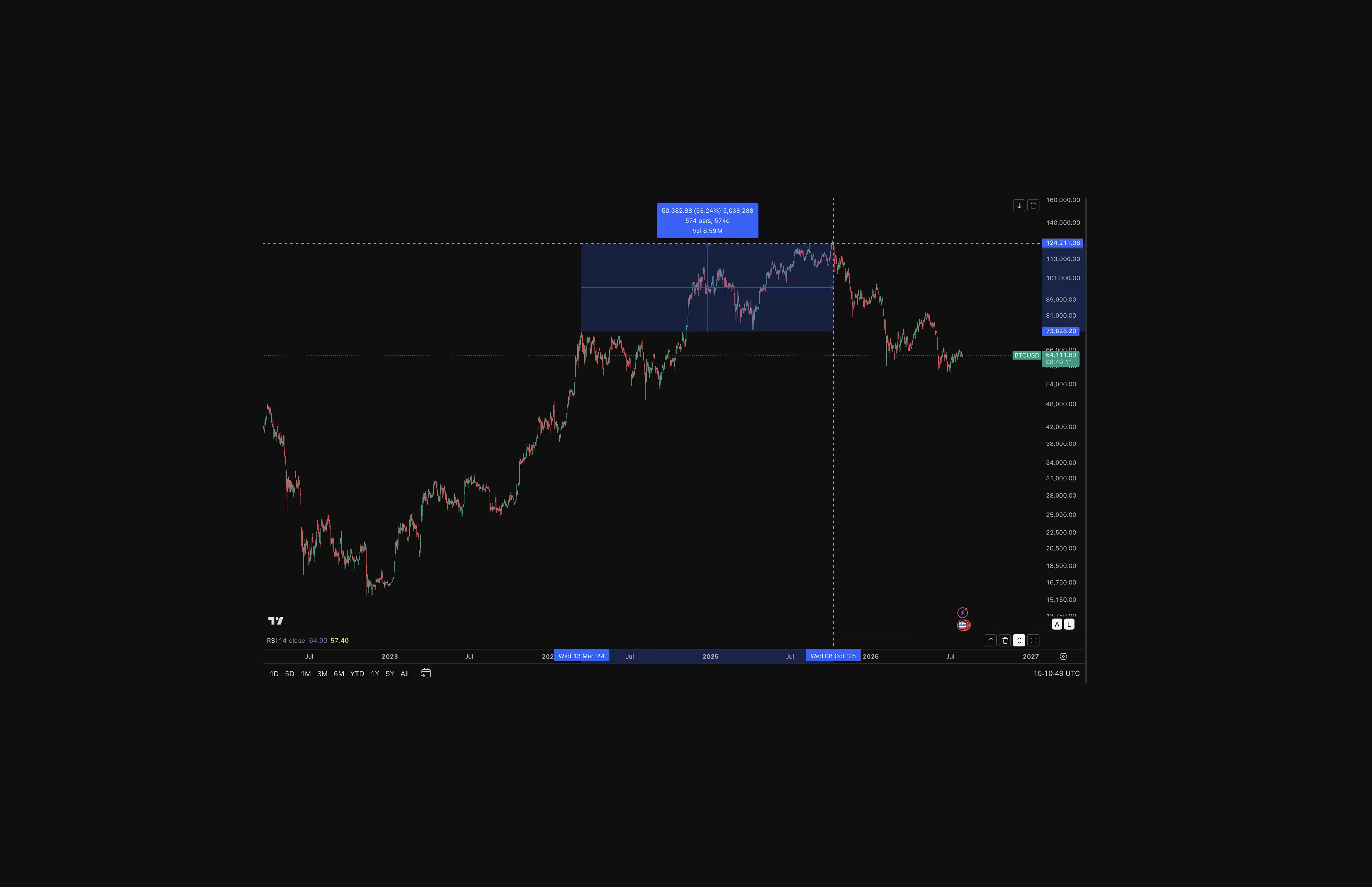
Bitcoin did something in 2024 it had never done before: it broke its previous cycle's all-time high before the halving arrived. Bitcoin's three most recent ATH recoveries have become progressively faster: 1,181 days starting from the 2013 high, then 1,097 days, then 851 days.
The March 9, 2024 breakout was the first ATH to occur before a halving rather than after one. What follows separates the confirmed data from the open question it raises: could Bitcoin reach a new record before the next halving, expected around 2028?
Bitcoin Is Recovering Faster
Here's the rule behind every recovery date in this piece: Bitcoin only counts as having reclaimed an old record once its price closes above it for three days in a row. Filtering out one-day spikes stops a quick fakeout from counting as a real recovery.
It's a judgment call made for this analysis, not an official industry standard. A looser rule, one that counts the very first day price pokes above the old high, would shift each number by a few days. So the exact figures matter less than the overall trend they show.
Elapsed days between each previous cycle high and its confirmed reclaim:
30 November 2013 → 23 February 2017: 1,181 days.
16 December 2017 → 17 December 2020: 1,097 days.
9 November 2021 → 9 March 2024: 851 days.
The sequence: 1,181 → 1,097 → 851 days.
2017's recovery (1,097 days) was 84 days faster than 2013's (1,181 days).
2024's recovery (851 days) was 246 days faster than 2017's (1,097 days).
2024's recovery (851 days) was 330 days faster than 2013's (1,181 days).
Methodology note: Bitcoin has no single official global price. Exact dates can shift by a day depending on the exchange, time zone, and whether the dataset uses intraday highs or daily closing prices. The December 2017 peak, for example, is dated December 16 on closing-price data and December 17 on intraday data. The direction of the trend holds regardless of which convention is used.
The Full Picture: Every Cycle, Two Ways to Measure Recovery
That's just one way to judge when Bitcoin has really recovered. A tougher test, one that only counts a recovery once the old high is never touched again until the next peak, tells a flatter story. Both versions are worth understanding.
Cycle peaks
Cycle top | Date | Price |
2013 high | 30 Nov 2013 | $1,127.45 |
2017 high | 16 Dec 2017 | $19,665.39 |
2021 high | 9 Nov 2021 | $67,491.52 |
2025 high (current ATH) | 6-7 Oct 2025 | $124,745.86 |
This table below looks at the same three recoveries three different ways. The first column asks the question used throughout this piece: how many days until Bitcoin's price closed above the old record for three days in a row.
The second column asks a stricter question: how many days until Bitcoin's price stopped dipping below the old record altogether, staying above it all the way to the next peak. The third column asks something different: once Bitcoin did get back to its old record, how many more days did it take to reach that cycle's actual top.
Cycle | Confirmed reclaim (3-day close) | Permanent reclaim (no dip back) | Reclaim → next peak |
2013 → 2017 | 1,181 days | 1,220 days | 296 days |
2017 → 2020/21 | 1,097 days | 1,097 days | 327 days |
2021 → 2024 | 851 days | 1,084 days | 577 days |
The two columns tell different stories once lined up:
Confirmed reclaim shrinks cleanly: 1,181 → 1,097 → 851 days, a clear speed-up across all three cycles.
Permanent reclaim barely moves: 1,220 → 1,097 → 1,084 days. Bitcoin kept dipping back below $67,491 for roughly 181 of the 255 days between March and November 2024 before finally holding above it for good.
2013 to 2017 only stumbled once, right at the finish: Bitcoin first closed above its old $1,127 record in February 2017, dipped back below it briefly, then climbed back above and stayed there for good about five weeks later.
2017 to 2021 never stumbled at all: once Bitcoin closed above its old $19,665 record in December 2020, it never fell back below that level again before hitting its next peak.
That gap matters for how much weight the shrinking-recovery pattern can bear. The confirmed-reclaim story is real and internally consistent, but it is a choice of definition, not the only valid one. A reader who prefers the stricter test sees a market that regains its confidence quickly but takes longer to fully hold it.
Bitcoin Cycle Length Hasn't Changed: Bitcoin Bounce-Back Speed Has
As of July 29, 2026, two different questions here, two different answers. If you're asking "is the whole boom-and-bust cycle getting shorter," the answer is no. Peak to peak, one all-time high to the next, Bitcoin has held to almost exactly four years for the last two cycles in a row. If you're asking "is Bitcoin bouncing back from crashes faster than it used to," the answer is yes. Bitcoin took over three years to climb back to even after the first two crashes, and under two and a half years after the most recent one.
Full cycle (peak to peak), not slowing, not speeding up. Holding steady at roughly four years across the last two cycles, 1,424 days then 1,428 days.
Recovery time (crash low back to old record), speeding up. Shrinking each cycle: 1,181 → 1,097 → 851 days.
Bottom line: Bitcoin isn't cycling faster overall. It's recovering from crashes faster within the same roughly four-year rhythm.
Whichever recovery definition is used, the peak-to-peak cycle length has stayed close to four years. The compression shows up in how fast Bitcoin gets back to its old high, not in how long the full cycle runs.
Where things stand now: Bitcoin's current record, $124,745.86, was set on 7 October 2025. As of this writing, 295 days have passed without a new all-time high.
The 2024 Bitcoin Breakout Was Different
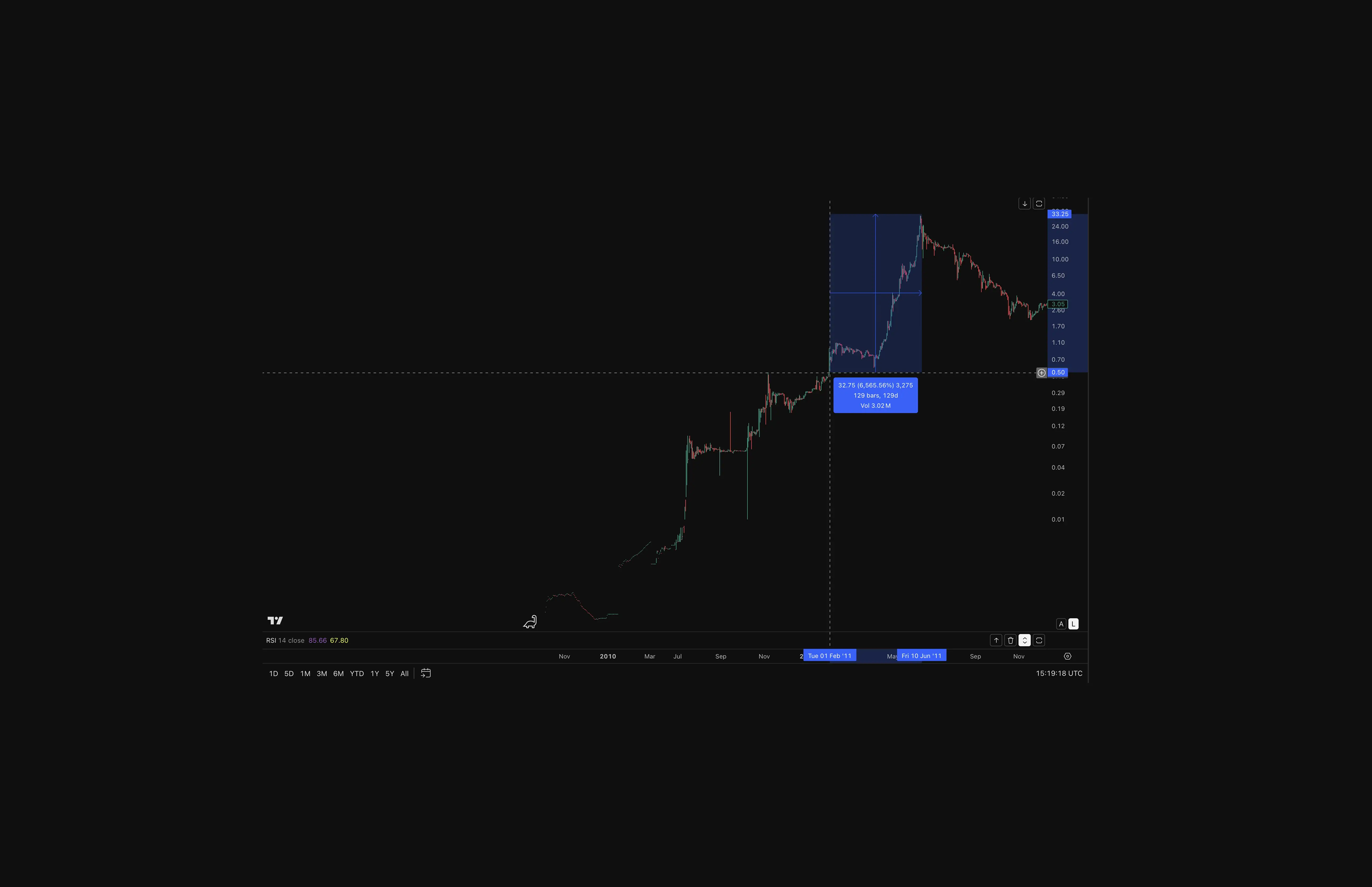
Measured against halving dates instead of previous peaks, the confirmed-reclaim data reveals something sharper.
After the November 2012 halving: historical records indicate that Bitcoin needed roughly three months to reclaim its 2011 high. This figure, like all Bitcoin price data before April 2013, falls outside the verified price series used elsewhere in this piece and comes from third-party historical charting rather than confirmed data. The earliest tracked price in that series, $135.30 on 28 April 2013, is at least consistent with a recovery having already occurred by March 2013, though it does not independently confirm the exact date. Chart data also points to a sharp, short-lived mini-peak near $266 around 10 April 2013, just weeks after that reclaim, before Bitcoin crashed roughly 80% and spent months rebuilding toward its final 2013 top.
After the July 2016 halving: Bitcoin took roughly seven and a half months to reclaim its 2013 high.
After the May 2020 halving: Bitcoin took approximately seven months to reclaim its 2017 high.
Before the April 2024 halving: Bitcoin's confirmed reclaim of its 2021 high, on 9 March 2024, landed 42 days ahead of the halving on 20 April 2024.
In every prior cycle, the old record fell only after the block reward had already been cut. In 2024, Bitcoin broke its previous cycle's all-time high before the halving, the first time that sequence has happened.
Are Buyers Getting Ahead?
One explanation: investors are learning the cycle.
After watching Bitcoin survive several deep bear markets and recover, some buyers may be less willing to wait for a rally to become obvious. Waiting has its own cost. Continued monetary expansion and persistent currency debasement give some investors a reason to treat Bitcoin's fixed supply as a store of value worth holding through a downturn rather than timing around it.
Investors who see it this way may accumulate during the drawdown, anticipating both renewed demand as the next halving approaches and the ongoing erosion of the cash they would otherwise be holding instead.
Bitcoin recoveries may produce a reflexive pattern:
Investors expect Bitcoin eventually to recover.
Investors and traders begin buying before the recovery is obvious.
Earlier demand absorbs available selling.
Bitcoin reclaims its previous record sooner, like in 2024, before the halving itself.
The faster recovery reinforces confidence in buying the next downturn.
The dates do not prove this is happening. They are consistent with investors attempting to front-run the anticipated rally, an interpretation, not a settled conclusion.
Readers building a framework for accumulating through drawdowns without leverage can find one in the Coinjuice ebook, Bitcoin Trading Without Leverage.
What Bitcoin's Recovery Data Proves, and What It Doesn't
The figures establish one narrow, meaningful fact: Bitcoin's three most recent ATH-recovery periods became progressively shorter, and the 2024 recovery was the first to occur before a halving rather than after one.
The figures do not establish:
That the next recovery must be faster: Three data points describe a recent trend, not a law.
That a new all-time high is guaranteed to arrive by a specific date: A trend across three cycles doesn't work like a calendar. It describes how the last recovery compared to the ones before it, not when the next one will land.
That total demand is permanently increasing: A faster recovery can reflect stronger buying, thinner selling, tighter liquid supply, or some combination, the price data alone cannot separate the three.
One possible reason the four-year rhythm persists: Bitcoin has no earnings, no dividend, and no conventional yardstick for pricing it. A genuinely scarce, hard-capped asset with nothing to discount may need repeated boom-and-bust cycles to find its price at all, at least until adoption becomes broad enough, wallets, payments, everyday commerce, that the market has a steadier reference point to work from. That would be a reason for the cycle to eventually fade. It isn't evidence that it already has.
Could Bitcoin All Time High Happen Before 2028?
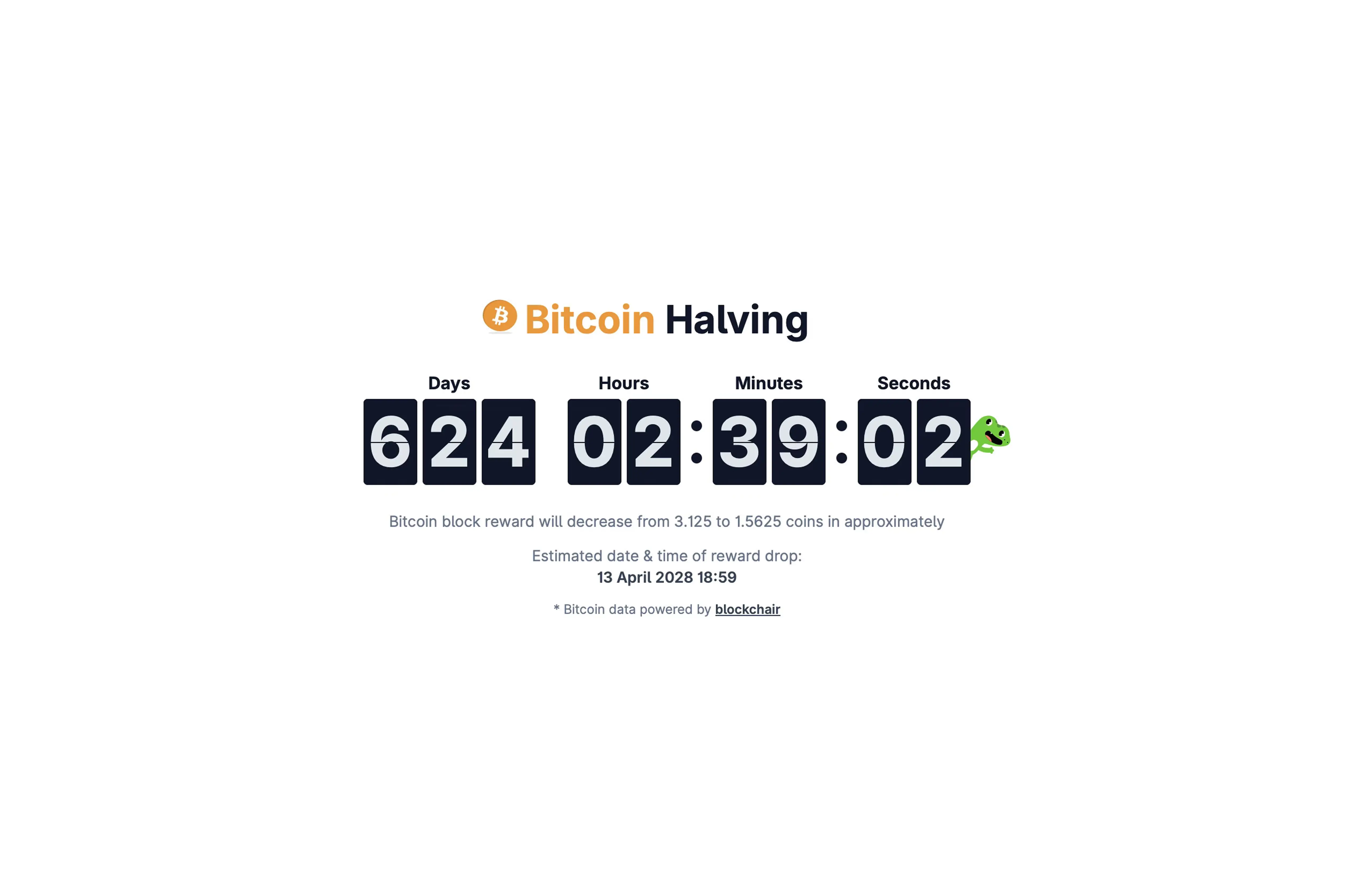
Bitcoin's next halving occurs at block 1,050,000, currently estimated for around spring 2028. The exact date shifts as the network's average block time changes.
To produce another pre-halving ATH, Bitcoin would need to exceed its current record before that date arrives.
That is not a forecast. It is a question worth tracking as the run-up to 2028 unfolds.
What to Watch
The indicators most likely to show whether buyers are genuinely arriving earlier:
Spot Bitcoin ETF flows: sustained inflows during a drawdown would support the front-running case.
Long-term-holder supply: rising holder balances during weak price action indicate accumulation rather than distribution.
Exchange balances: falling balances suggest coins are moving into storage rather than toward sale.
Corporate treasury purchases: scheduled buying is less reactive to headlines than retail flows.
Realized capitalization: growth here reflects capital entering at current prices, not just paper gains.
Supply in profit vs. loss: shows how much of the market is holding through a drawdown rather than exiting it.
If those measures show sustained accumulation through the next downturn, the front-running argument moves from plausible to supported. Coinjuice tracks these indicators in ongoing research, available through Coinjuice membership.
Outro
Bitcoin’s next all-time high is not owed to investors on any historical timetable. But 2024 showed that Bitcoin can reclaim its previous cycle high before the halving arrives.
If investors are increasingly front-running Bitcoin’s recovery, today’s discount does not tell us where the bottom lies. It raises a more interesting question: are deeply discounted Bitcoin prices becoming harder to sustain because buyers are returning earlier?
FAQ
How has Bitcoin’s all-time-high recovery time changed across recent cycles?
Bitcoin’s ATH recovery times have shortened across the last three cycles: 1,181 days from the 2013 high, 1,097 days from the 2017 high, and 851 days from the 2021 high, using the rule that a recovery is confirmed once price closes above the old record for three days in a row.
Did Bitcoin reclaim its previous cycle high before or after the 2024 halving?
Bitcoin reclaimed its 2021 all-time high on 9 March 2024, 42 days before the halving on 20 April 2024, marking the first time a prior-cycle record was broken before rather than after a halving.
Has Bitcoin’s overall four-year cycle length changed?
No. Measured peak to peak, Bitcoin’s last two full cycles have remained close to four years, at 1,424 days and 1,428 days, indicating the overall cycle length has held steady even as recovery times have sped up.
Does past recovery data guarantee that Bitcoin will set a new all-time high before the 2028 halving?
No. The data shows that recovery times have shortened and that 2024 saw a pre-halving reclaim, but it does not prove that the next recovery must be faster or that a new all-time high is guaranteed by any specific date, including before the 2028 halving.
Disclaimer
The information provided in this article is for informational purposes only. It is not intended to be, nor should it be construed as, financial advice. We do not make any warranties regarding the completeness, reliability, or accuracy of this information. All investments involve risk, and past performance does not guarantee future results. We recommend consulting a financial advisor before making any investment decisions.
More like this


Written by

Andrew Kamsky
Andrew Kamsky is a Bitcoin analyst. He spent a decade in traditional finance across a Big Four firm and a listed fintech bank before going deep on Bitcoin full-time.