









Quick summary
High leverage in crypto amplifies volatility, causing losses even when directionally correct
Profitable traders size positions by fixed risk and asset volatility, not max leverage
Variance fatigue and structural costs like funding and liquidations push winners away from leverage
Durable edge comes from process, spot or light leverage, and surviving multiple crypto cycles
Crypto markets sell leverage as the shortcut. Twenty-five times on Bitcoin, fifty times on Ethereum, a hundred times on smaller altcoins. The pitch is that borrowed capital turns small accounts into large ones overnight.
The performance data across multiple cycles tells a quieter story. Traders who remain profitable through bull runs, drawdowns, and chop tend to reduce leverage as experience compounds, and many eliminate it entirely. The reason is mathematics, behavioural calibration, and an honest read of how Bitcoin and altcoins actually move.
The article explains why high performers walk away from leverage and what the pattern reveals for readers building a durable approach.
Why Leverage Fails Under Crypto Volatility
Leverage is marketed as a return amplifier. In practice, leverage amplifies volatility more than outcomes. A trader can be directionally correct on Bitcoin or Ethereum and still lose the position before the thesis plays out.
Crypto compounds this problem because BTC and altcoins routinely produce the kind of sharp, non-linear moves leverage punishes hardest.
Core mechanics:
Drawdown asymmetry: A 50% loss requires a 100% gain to recover. Bitcoin has produced 30% drawdowns inside a single week multiple times across cycles. Leverage shortens the distance to a hole the trader will find harder to climb out of. A structured response to drawdowns involves reducing size and waiting for price to return to base levels, not increasing exposure
Altcoin volatility compounding: Ethereum and large-cap altcoins routinely move 10–20% plus inside a single trading day. Leveraged positions compound losses faster than gains across volatile sequences, draining capital even when the directional call is correct
Forced liquidation risk: Crypto perpetual futures liquidate aggressively. A wick of a few percent against a 25x position closes the trade, even if the underlying thesis plays out hours later.
In crypto, leverage does not just raise the cost of being wrong. It raises the cost of being right too early.
How Profitable Traders Actually Size Positions
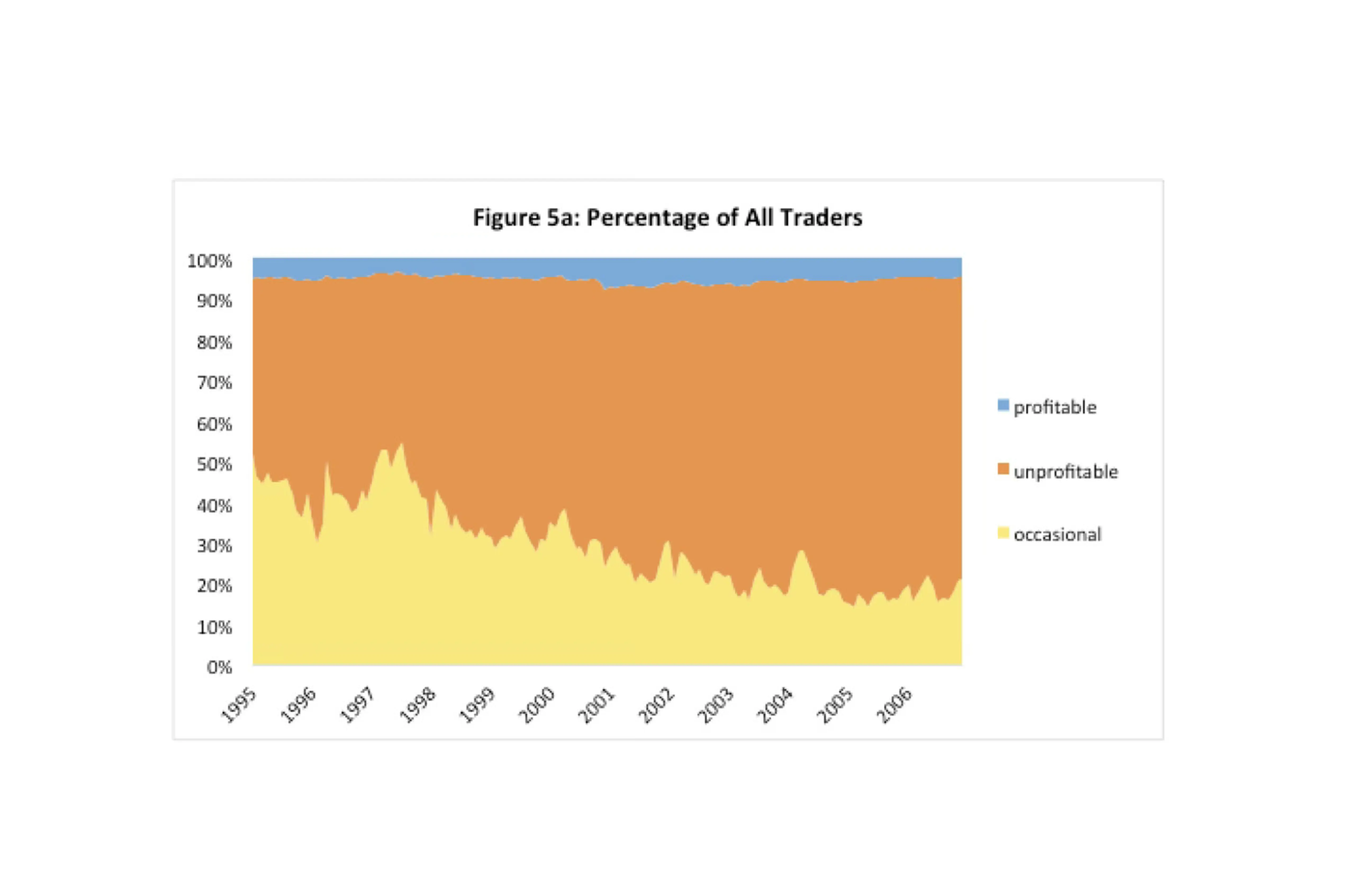
The largest empirical study on retail trader behaviour, conducted by Barber, Lee, Liu, Odean and Zhang at Berkeley using fifteen years of complete Taiwan Stock Exchange data, tracked hundreds of thousands of traders from 1992 to 2006. Two findings hold particular weight for crypto traders today.
First, more than 75% of all day traders quit within two years. Second, only a small fraction of experienced traders, less than 3% on a given day, were predictably profitable. Among that profitable minority, position sizing stopped being anchored to maximum available leverage. It started being anchored to historical drawdown behaviour of the asset.
A leverage-free framework typically starts with fixed risk per trade and volatility-adjusted sizing.
Observed patterns:
Fixed risk budgets: High performers risk a small fixed percentage of capital per trade, often 0.5% to 2%, regardless of conviction. A Bitcoin setup and an Ethereum setup are sized the same way
Volatility-adjusted sizing: Altcoin positions are sized smaller than BTC positions because realised volatility is higher. Leverage is replaced by intelligent allocation on smart bets of the future
Lower trade frequency: Profitable traders trade less, waiting for setups with defined asymmetry rather than forcing entries to keep margin productive. Patient entries at base levels, layered rather than maximised, produce stronger long-term performance than aggressive sizing on conviction trades.
The above implies that small wins that repeat beat big bets that blow up. The trader keeps the account intact, keeps a clear head, and is still around to trade the next cycle.
What Replaces Leverage in a Profitable Trader's Process
A survival analysis published in the European Journal of Operational Research (2022) tracked 5,164 retail spread traders across the 2006–2012 window, including the 2008 financial crisis. The study identified a V-shaped relationship between a trader's Sharpe ratio and the likelihood of quitting.
The least profitable traders exited through losses. The most profitable traders also exited earlier than average, but for a different reason. The variance of leveraged trading wears down even those who win.
The study also documented something specific to crisis periods. During the 2008–09 drawdown, the disposition effect (closing winners too quickly while holding losers) intensified, and the proportion of noise traders in the market grew. Crypto cycles produce a similar pattern in compressed form.
Key dynamics
Variance fatigue: Watching a 20x Ethereum position oscillate between profit and liquidation across a single funding interval produces cognitive load that erodes decision quality over months
Career migration: Top performers frequently move into research, portfolio management, or systematic strategies where compensation is steadier and decision-making is structural rather than reactive
Predictability preference: Interview studies report a shift from speculative excitement toward the slower reward of model validation and back-testing.
Spot trading or light leverage removes the variance that drives even profitable traders out. The reward is simple: still being in the market when the next cycle arrives.
The Hidden Costs Leveraged Traders Pay Daily
Crypto leverage carries structural costs the spot trader avoids entirely.
Perpetual futures funding rates compound against crowded positioning, and liquidation cascades create reflexive moves that punish leveraged participants regardless of directional accuracy.
Structural drag
Funding drag: Long-biased perpetual futures positions (perps) on Bitcoin and Ethereum routinely pay funding during uptrends, eroding returns the spot holder keeps in full
Cascade vulnerability: When volatility spikes, exchanges close out leveraged positions in waves, often at prices far worse than the trader expected when entering.
The pattern is the same across every dataset, every cycle, every market. The traders who last do not predict harder. They build a process that does not need leverage to win.
Conclusion
The migration away from leverage among top crypto traders eventually becomes a story of math, structural awareness, and the understanding that Bitcoin and altcoin volatility already provides enough opportunity without amplification.
Readers should watch for the same arc in their own development. As analytical capability strengthens, the dependence on borrowed capital weakens.
These ideas are explored in more detail in How to Trade Without Leverage.
In crypto, edge compounds through understanding, not amplification.
FAQ
Why do the most profitable crypto traders eventually reduce or abandon leverage?
Because over time they recognize that crypto volatility makes leverage amplify variance and drawdowns more than outcomes, increases the risk of forced liquidation, and adds structural and psychological costs that are not needed to profit from Bitcoin and altcoin moves.
How does leverage fail under typical Bitcoin and altcoin volatility?
Large, sharp moves in BTC and altcoins mean that even correct directional trades can be stopped out or liquidated before the thesis plays out. Drawdown asymmetry, frequent 10–20% daily moves in altcoins, and aggressive liquidation on perps make leveraged positions compound losses faster than gains.
How do consistently profitable traders size positions without relying on leverage?
They use a leverage-free framework with fixed risk per trade and volatility-adjusted sizing: risking a small, fixed percentage of capital per trade (often 0.5%–2%), sizing altcoin positions smaller than BTC due to higher realised volatility, and trading less often while waiting for setups with clear asymmetry and patient entries at base levels.
What structural and behavioural costs make leveraged crypto trading hard to sustain?
Leveraged traders face funding drag on long-biased perps during uptrends, vulnerability to liquidation cascades during volatility spikes, variance fatigue from large leveraged swings, and intensified behavioural biases such as closing winners too quickly and holding losers during crisis-like drawdowns.
Disclaimer
The information provided in this article is for informational purposes only. It is not intended to be, nor should it be construed as, financial advice. We do not make any warranties regarding the completeness, reliability, or accuracy of this information. All investments involve risk, and past performance does not guarantee future results. We recommend consulting a financial advisor before making any investment decisions.
More like this


Written by

Andrew Kamsky
Andrew Kamsky is a Bitcoin analyst. He spent a decade in traditional finance across a Big Four firm and a listed fintech bank before going deep on Bitcoin full-time.