








Quick summary
Bitcoin Runes lets people create ordinary, interchangeable tokens directly on Bitcoin, with no separate blockchain needed
Runesreplaces an older method that depended on outside services to track ownership
Making a Rune involves setting the rules, letting people mint it, then sending it like regular Bitcoin
If a transaction is built incorrectly, those tokens are burned
Bitcoin Runes is a protocol for creating fungible tokens directly on the Bitcoin blockchain. Runes lets people create their own tokens (a custom currency or collectible coin) that live directly on Bitcoin rather than on a separate blockchain or application.
Once someone creates a Rune (called etching one), it moves using the same transaction system already moving Bitcoin itself. No extra network is required, and it inherits the same proof-of-work security Bitcoin runs on, rather than depending on a single company's server staying online.
History of Bitcoin Runes
Casey Rodarmor introduced the Runes protocol on September 25, 2023, roughly a year after creating Ordinals.
Runes launched at Bitcoin block 840,000 on April 20, 2024, timed to coincide with Bitcoin's fourth halving. The launch produced an immediate fee spike: average transaction fees jumped to roughly $128, several times the prior day's average, as thousands of Runes were etched within the first 48 hours.
Daily Runes transactions peaked above 750,000 on April 23, 2024, a record at the time and part of the reason Runes activity briefly consumed the majority of Bitcoin's network fees in its opening days.
The Runes protocol's design goal from the outset was to replace BRC-20's off-chain indexing and JSON-based inscriptions with a fungible-token method built directly into Bitcoin's own transaction structure.
Why Was the Runes Protocol Created?
Before Runes launched in April 2024, fungible tokens on Bitcoin depended almost entirely on BRC-20, a standard introduced in 2023, writing JSON-formatted data into Ordinal inscriptions. The approach worked, but it introduced friction:
BRC-20 carried three recurring issues:
UTXO bloat: Each action created new, often tiny, unspent transaction outputs, cluttering the network with data unrelated to standard payments.
Off-chain balance tracking: BRC-20 tokens need outside tools to figure out who owns what, and those tools don't always agree with each other. As happened when two different tracking tools showed Binance holding different amounts of the same token, nearly 5 million tokens apart on November 27, 2023. Runes fixes this by building the rules directly into Bitcoin's own transaction data, so there's much less room for different tools to land on different answers.
Higher fees: BRC-20's text-based format takes up more space in every transaction than it needs to and on Bitcoin, more space means a bigger fee. So every time someone minted or sent a BRC-20 token, they paid more than they had to, just because of how bulky the format was.
What Are Bitcoin Runes?
Every unit of a Rune is exactly the same as any other unit of that same Rune, just like how any one-dollar bill is worth exactly the same as any other one-dollar bill.
This is actually the opposite of Ordinals, the other Bitcoin project by the same creator. Ordinals put unique, one-of-a-kind data onto individual bitcoin, more like digital collectibles or trading cards, where each one is different. Runes do the reverse: every unit is identical on purpose, because that's what makes something usable as a currency or token.
The easiest way to remember the difference: a Rune works like money or a token a person or company would use and spend. An Ordinal works like a collectible, something you'd want to own precisely because it's one of a kind.
Spotting a pattern before the crowd catches on isn't just a token thing. Charts play the exact same game, and panic-driven dips tend to leave the same fingerprints behind. The Coinjuice ebook walks through reading a chart the same way, one repeatable shape at a time.
How Does Bitcoin Runes Work
Every Rune transaction carries its instructions in Bitcoin's OP_RETURN field, decoded into what the protocol calls a Runestone. Three actions make up the full lifecycle:
Etching: Creating a brand-new Rune
Minting: Anyone can create new units of an already-etched Rune
Transferring: Sending Runes from one Bitcoin transaction to another, using the same system Bitcoin already uses to move regular bitcoin around because no separate app or network is needed.
What Is Etching
Etching is how someone creates a brand-new Rune. It's like filling out a form that locks in the rules forever:
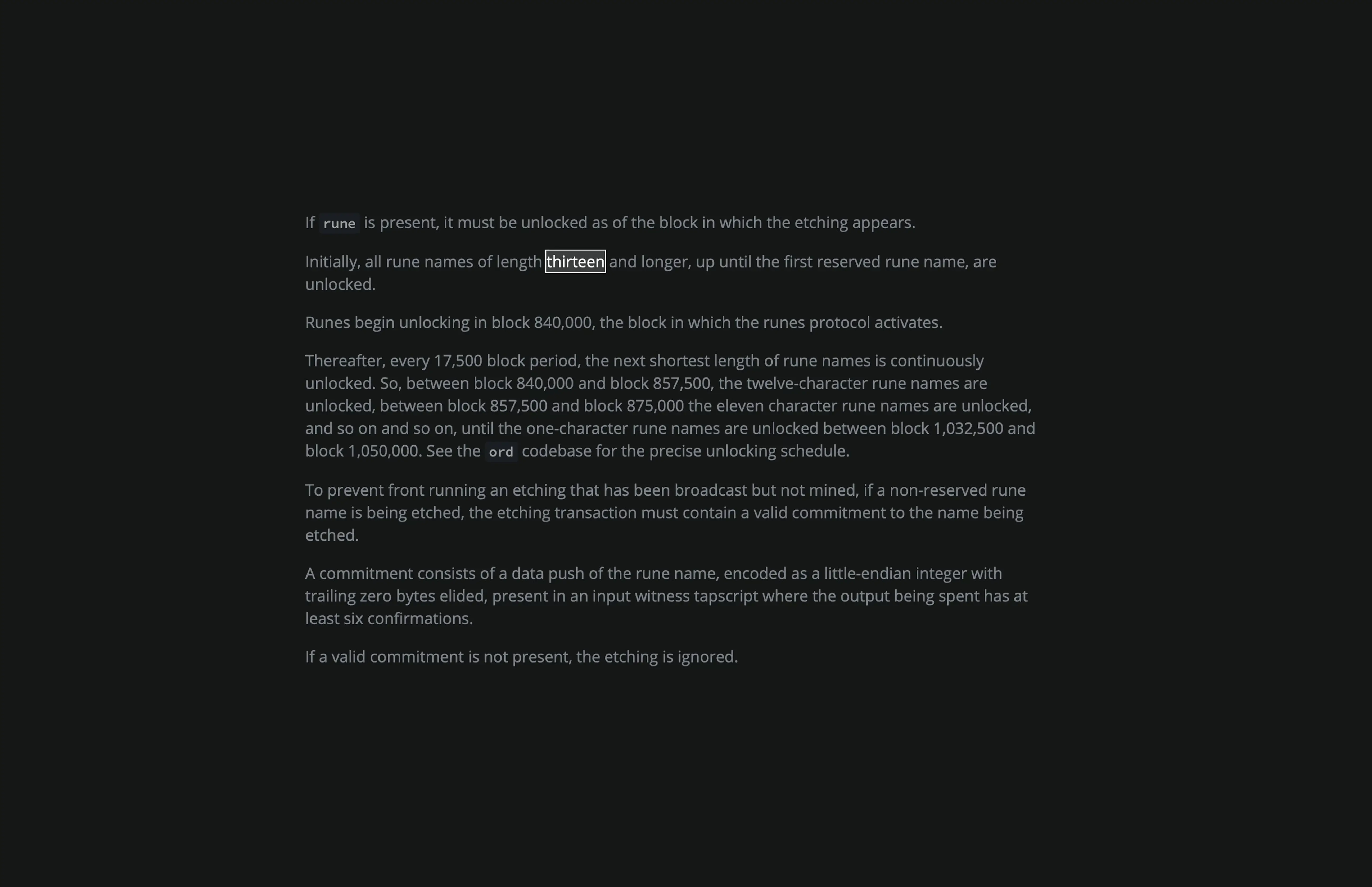
Choosing a name: Every Rune needs a unique name in capital letters like a ticker. Short, catchy names were locked out at launch and short names only unlock gradually over time, so insiders couldn't grab the best ones early, which is why so many early Runes have long, odd names like DOG•GO•TO•THE•MOON instead of something short.
Setting how splittable it is: This decides whether people can hold tiny fractions of one unit, or only whole numbers similar to how a dollar splits into cents.
Picking a symbol: A single character shown next to the amount, just like "$" shows up next to a dollar figure.
Reserving some for the creator (optional): The creator can set aside a chunk for themselves before anyone else is allowed to get any.
Once these rules are set at creation, they can't be changed which means anyone can check exactly how many of that Rune will ever exist, without having to trust the creator's word for it.
How Does Minting Work? (A Simple Guide)
Once a Rune is created, anyone can start minting it but only under rules that were locked in from day one and can't be changed. Here's what that actually means:
Supply cap: There's a maximum number of that Rune that will ever exist, once minting hits the cap, it's over for good.
Amount per mint: Each individual mint gives you a fixed, set amount, not a random or negotiable number.
Opening and closing window: Minting only works between a specific start point and end point, try outside that window and it simply won't count.
No favorites: Anyone can mint while the window's open, on the same terms as everyone else, there is no pre-sale, no insider allocation, no one able to bend the rules after the fact.
The result: anyone can check exactly how many of a Rune exist and how they were created, directly from Bitcoin itself, without having to trust a company's word for it. What that verification can't guarantee, though, is a fair spread: a creator can still take a reserved premine and then mint aggressively during the open window themselves, ending up holding far more than any other individual holder perfectly within the rules, but far from evenly distributed.
Quick note: minting ≠ buying.
Runes Minting Explained
“Minting” means creating new tokens straight from the token's own built-in supply like being one of the first people to pull a fresh coin out of a mint.
A person does not pay someone else for a coin they already own; a person who wants a token can claim a brand-new one directly from the source, usually for close to nothing beyond Bitcoin's regular transaction fee.
Buying, on the other hand, means paying someone else — on a marketplace — for a token they already got from minting or a previous trade. Minting only works while the mint window is open and unclaimed supply remains; buying can happen anytime, from anyone willing to sell.
How Sending Runes Works
Sending a Rune from one person to another isn't a separate step bolted onto Bitcoin. Sending happens as part of a normal Bitcoin transaction. The instructions for where the tokens should go are tucked directly into the same transaction that's already moving bitcoin around.
This means wallets don't need to build and maintain a whole separate system just to track Rune balances because they can use the same tools they already use for regular bitcoin, with a little extra token info riding along.
Runes tokens like DOG are built in a way that makes payment use technically possible without a ton of extra engineering, that's the real innovation.
But "technically possible" and "actually adopted as a payment method" are two different things, and DOG right now sits much closer to "speculative collectible/memecoin traded on exchanges" than "something you can spend like money," that gap is more about which wallets and businesses choose to support it than a technical limitation of the protocol itself.
What's a Cenotaph?
If someone builds a broken or invalid Rune transaction, the protocol has a strict, built-in rule: any tokens involved just get destroyed.
A cenotaph is Bitcoin Runes' built-in safeguard for broken transactions: any tokens involved get destroyed outright, whether that's coins lost in a bad transfer or a brand-new token name locked forever at zero supply.
This protects everyone else on the network: by destroying the mistake instead of letting it linger, no one else ever ends up confused about who really owns what.
Bitcoin Runes vs. Ordinals vs. BRC-20
Feature | Ordinals | BRC-20 | Runes |
Token type | Non-fungible | Fungible | Fungible |
Data location | Inscription (witness) | Inscription (JSON) | OP_RETURN field |
Balance tracking | N/A | Off-chain indexer | Native, on-chain |
Network efficiency | N/A | Lower | Higher |
Error handling | N/A | Often ignored | Burned (cenotaph) |
Creator | Casey Rodarmor | Domo | Casey Rodarmor |
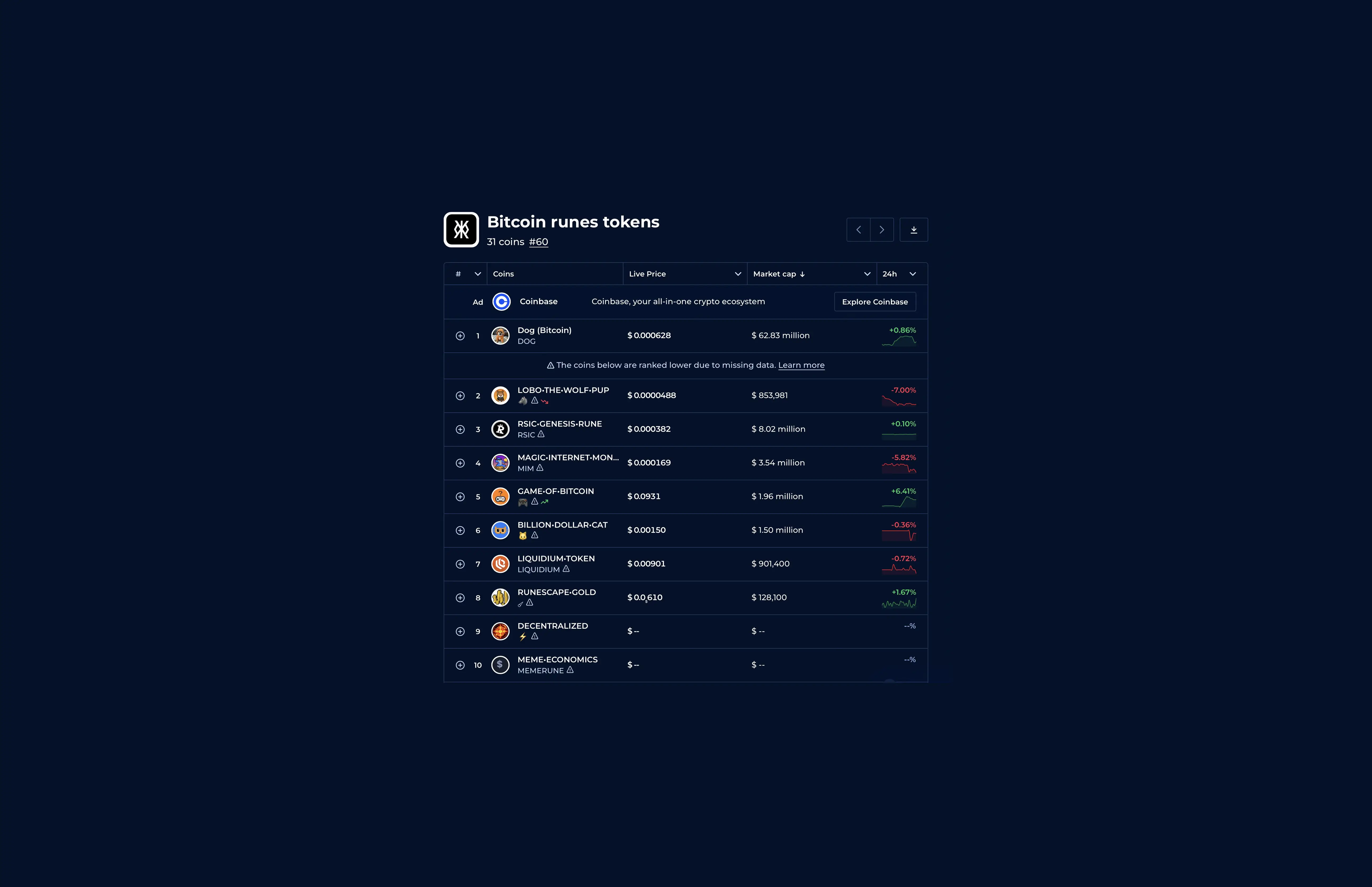
Popular Bitcoin Runes Tokens
Market-cap figures for the Runes sector vary meaningfully depending on tracker and inclusion criteria, and a handful of data points are worth holding onto:
Sector total: Spark Research puts the total near $130 million as of mid-2026.
DOG's dominance: DOG•GO•TO•THE•MOON stands out as the one consistent data point across every tracker, becoming the flagship Rune in much the same way Dogecoin became synonymous with proof-of-work memecoins.
Peak to present: A decline of more than 90% to a current range of $56 to $77 million across live trackers by mid-2026.
Not a straight decline: Sector activity has been volatile rather than one-directional. Bitcoin transactions hit a two-year high in late June 2026, with Runestone transactions surpassing 600,000 per day and Rune-related activity accounting for roughly 25% of network fees.
Fluid rankings: Beyond DOG, no fixed second-through-fourth ranking holds across platforms.
Most function as memecoin-style assets: community-driven, speculative, without a formal business or revenue model underneath.
Spark is a Bitcoin Layer 2 that uses statechains to let users transact off-chain while keeping funds recoverable on Bitcoin's base layer.

How to Get Started With Bitcoin Runes
Participation in Runes follows a short sequence:
Wallet selection: A Runes-compatible wallet (Xverse and UniSat are common examples) handles Runestone data properly.
BTC funding: Standard Bitcoin transaction fees apply to every etch, mint, and transfer.
Research phase: A Runes explorer displays active tokens alongside mint terms still open.
Mint or acquire: Open mint windows allow direct participation; closed windows require a marketplace purchase instead.
Risks
A handful of risk factors deserve attention before capital moves toward Runes:
Thin liquidity: Limited market history produces sharp price swings across most Runes tokens.
No underlying backing: The overwhelming majority function as memecoins without revenue or asset support.
Copycat naming: Open etching access allows similar-looking names designed to impersonate established tokens.
Permanent transactions: Bitcoin transactions cannot reverse; mint or transfer mistakes stay final.
Block space debate: Some within the Bitcoin community argue Runes activity raises fees for standard payments, echoing the debate sparked during the original Ordinals inscription period.
Closing Take
Bitcoin Runes is best understood as Bitcoin's native fungible token standard rather than a memecoin ecosystem. Whether Runes becomes a lasting part of Bitcoin's infrastructure or remains primarily a speculative market depends on adoption by wallets, exchanges, developers, and users.
Worth tracking: mint volume, holder distribution, and continued wallet support in the months ahead.
Runes represents Bitcoin's first widely adopted attempt at issuing fungible assets in a way aligning with Bitcoin's own transaction and security durability model instead of building around it.
If you made it this far, a discount waits for you here.
FAQ
What is Bitcoin Runes and how does it differ from Ordinals?
Bitcoin Runes is a protocol for creating fungible tokens directly on the Bitcoin blockchain, where every unit of a given Rune is identical, like dollars. Ordinals, by contrast, attach unique, one-of-a-kind data to individual bitcoin, making them more like digital collectibles where each item is different.
Why was Bitcoin Runes created instead of using BRC-20?
Bitcoin Runes was created to replace BRC-20’s JSON-based inscriptions and off-chain indexing with a fungible-token method built directly into Bitcoin transactions. BRC-20 caused UTXO bloat, relied on external tools that could disagree on balances, and used a bulky text format that increased transaction fees.
What are the main steps in the lifecycle of a Rune?
The lifecycle of a Rune has three actions: etching, which creates a brand-new Rune and locks in its rules; minting, where anyone can create new units under those fixed rules; and transferring, which sends Runes between Bitcoin transactions using the same system that already moves bitcoin.
What is a cenotaph in the context of Bitcoin Runes?
A cenotaph is the result of a broken or invalid Rune transaction where the protocol destroys any tokens involved. In such cases, tokens are permanently burned rather than returned or left in limbo, and a misconfigured new token can become permanently unmintable under its chosen name.
Disclaimer
The information provided in this article is for informational purposes only. It is not intended to be, nor should it be construed as, financial advice. We do not make any warranties regarding the completeness, reliability, or accuracy of this information. All investments involve risk, and past performance does not guarantee future results. We recommend consulting a financial advisor before making any investment decisions.
More like this

Written by

Andrew Kamsky
Andrew Kamsky is a Bitcoin analyst. He spent a decade in traditional finance across a Big Four firm and a listed fintech bank before going deep on Bitcoin full-time.