










Quick summary
Between 2015 and 2026, 1M satoshis rose from $2.79 to $657, a 235x increase
Retail-sized addresses holding 1M–10M satoshis grew from 850,678 to 8.3 million addresses
This cohort’s holdings increased from 27,800 BTC to 279,861 BTC, from 0.19% to 1.40% supply
Despite higher entry costs and institutional arrival, retail continued accumulating Bitcoin over eleven years
In July 2015, one million satoshis cost $2.79. By June 2026, the same satoshis cost $657 a 235-fold increase in eleven years. Yet over the same period, the cohort holding between 10 million and 1 million satoshis expanded from 850,678 addresses to 8.3 million. No government and no whale lives in this range making the 10 million and 1 million satoshi range the cleanest on-chain measure of retail Bitcoin ownership available. That is what this article tracks.
Bitcoin's Retail Entry Cost Rose 235×
By 2017, following Bitcoin's first major retail cycle, 1 million satoshi allocation cost $24. By 2021 it cost $367. At the October 2025 peak it cost $1,247. Today 1 million satoshi costs $657.
Each cycle retail is paying more for the same number of satoshis.
Year | BTC Price | Cost: 1M sats | Cost: 10M sats |
Jul 2015 | $279 | $2.79 | $27.90 |
Jun 2017 | $2,411 | $24 | $241 |
Jun 2021 | $36,660 | $367 | $3,666 |
Oct 2025 ATH | $124,773 | $1,247 | $12,477 |
Jun 2026 ★ | $65,700 | $657 | $6,570 |
The logical expectation is that a cohort facing a 235x cost increase would shrink. The data shows the opposite occurred.
11 Years of Bitcoin Retail Ownership Data (2015–2026)
Every figure below is read directly from archived BitInfoCharts snapshots via the Wayback Machine and the live BitInfoCharts distribution page.
Date | BTC Price | 10M–1M Sat Addresses | BTC Held | % Supply | Cost 10M sats | Cost 1M sats | $57 buys |
$279 | 850,678 | 27,800 | 0.19% | $27.90 | $2.79 | 20,430,000 sats | |
Jun 2016 | $568 | 1,486,223 | — | — | $56.80 | $5.68 | 10,035,000 sats |
$2,411 | 2,749,333 | 85,260 | 0.52% | $241 | $24 | 2,365,000 sats | |
$6,433 | 3,869,405 | 123,687 | 0.73% | $643 | $64 | 886,000 sats | |
$8,558 | 4,455,015 | 144,575 | 0.82% | $856 | $86 | 666,000 sats | |
$9,716 | 5,350,620 | 173,539 | 0.94% | $972 | $97 | 587,000 sats | |
$36,660 | 5,791,497 | 187,378 | 1.00% | $3,666 | $367 | 156,000 sats | |
$47,000 | 7,110,016 | 238,615 | 1.24% | $4,700 | $470 | 121,000 sats | |
$21,299 | 6,575,761 | 213,865 | 1.12% | $2,130 | $213 | 268,000 sats | |
$30,062 | 7,687,558 | 258,609 | 1.33% | $3,006 | $301 | 190,000 sats | |
$67,916 | 8,080,545 | 274,634 | 1.39% | $6,792 | $679 | 84,000 sats | |
$104,738 | 7,895,754 | 267,475 | 1.35% | $10,474 | $1,047 | 54,000 sats | |
Jun 2026 ★ | $65,700 | 8,324,184 | 279,861 | 1.40% | $6,570 | $657 | 87,000 sats |
At $500k | $500,000 | — | — | — | $50,000 | $5,000 | 11,400 sats |
At $1M | $1,000,000 | — | — | — | $100,000 | $10,000 | 5,700 sats |
Source: BitInfoCharts via Wayback Machine (2015–2024) and live snapshot (Jun 2026). ★ = live figure. Jun 2016 BTC held unavailable in archived snapshot. Dec 2021 price uses known market price (~$47k). Last two rows = arithmetic projection, not forecast.
Retail Increased Its Share of Bitcoin Supply From 0.19% to 1.40%
Every address in this band holds between 1 million and 10 million satoshis, nothing more, nothing less. Together they form a measurable claim on Bitcoin's fixed 21 million coin supply.
That claim went from 0.19% in 2015 to 1.40% in June 2026, across 8.3 million addresses, accumulating 252,061 BTC over eleven years.
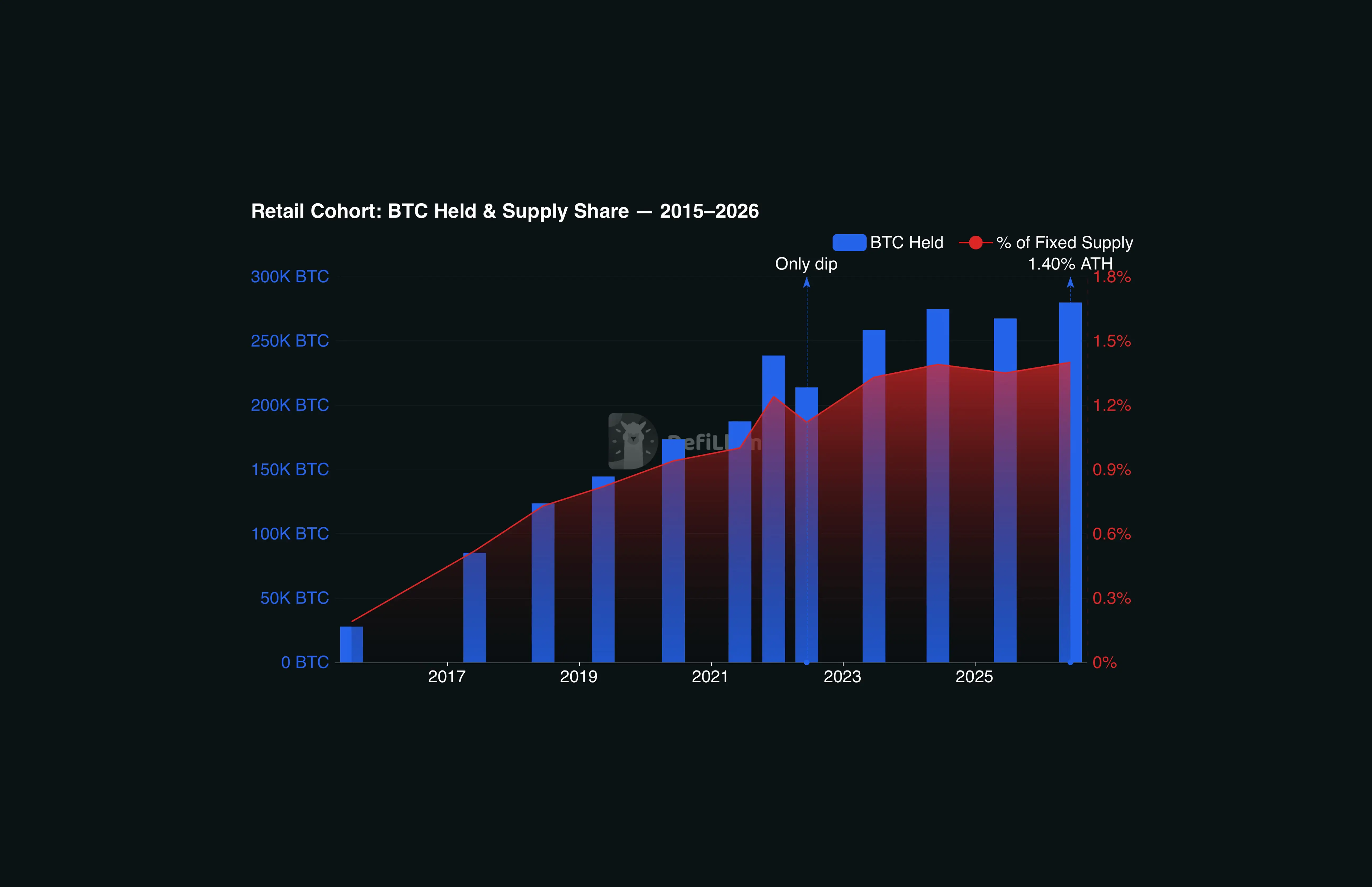
In absolute terms:
2015: 27,800 BTC attributed to this cohort
2026: 279,861 BTC attributed to this cohort
Net accumulation: approximately 252,000 BTC across eleven years
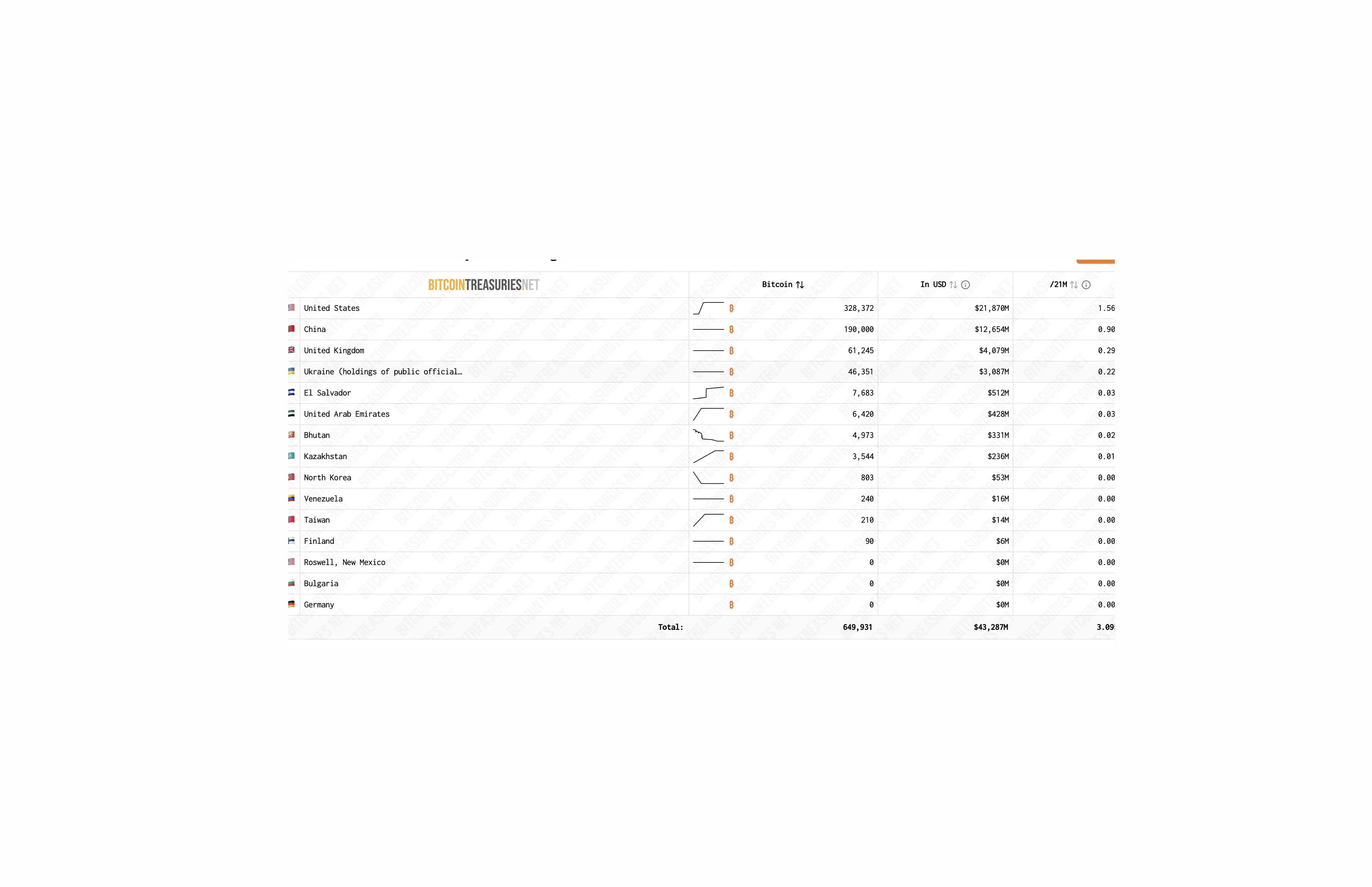
For context, if this cohort were ranked alongside sovereign Bitcoin holders, its 279,861 BTC would place it second, behind the United States at 328,372 BTC and ahead of China at 190,000 BTC, the United Kingdom at 61,245 BTC, and every other nation on the BitcoinTreasuries list. China's figure per BitcoinTreasuries tracker is disputed by some analysts.
All 15 governments combined hold 649,931 BTC. This cohort holds 279,861 BTC. It got there one small purchase at a time.
How Bitcoin Holders Move From One Ownership Band to Another
The retail ceiling of this article rounds that to 10 million satoshis for consistency across the full dataset.
The band functions as a conveyor belt with three simultaneous flows:
Entry from below: Addresses crossing 1 million satoshis upward from the 100K–999K sat band
Graduation upward: Addresses accumulating past 10 million satoshis and entering the BTC gold floor band. These addresses elevate into the next cohort
Exit downward: Addresses selling below 1 million satoshis. These represent genuine distribution events.
If that movement is structural rather than cyclical, a portion of retail is not simply entering and exiting Bitcoin. A portion is progressing through it.
What Happens at Bitcoin $500,000 or $1,000,000?
The following is arithmetic, not prediction.
BTC Price | Cost: 1M sats | Cost: 10M sats | $57 buys |
Today $65,700 | $657 | $6,570 | 87,000 sats |
$500,000 | $5,000 | $50,000 | 11,400 sats |
$1,000,000 | $10,000 | $100,000 | 5,700 sats |
At $1,000,000 per Bitcoin, 1 million satoshis costs $10,000.
The retail ceiling of 10 million satoshis costs $100,000. The historical pattern offers one data point. Whether that continues at the next order of magnitude is not something on-chain data can determine.
Can Bitcoin Addresses Measure Retail Ownership?
Four caveats apply to this dataset.
Addresses are not people: One person can hold multiple addresses. One address can represent thousands of exchange customers
Exchange custody: Some addresses in this band may be exchange sub-wallets rather than self-custody holders
ETF custody: From January 2024 onward, retail Bitcoin exposure held through spot ETFs does not appear on-chain. Address counts from 2024 onward understate total retail exposure
Address movement: Wallet software sometimes merges or splits addresses. Count changes do not always represent buying or selling events.
None of these invalidate the dataset. No institutional treasury, exchange cold wallet, or mining pool operates in the $657 to $6,570 range this band occupies. Which is why this cohort of buyers remains one of the least contaminated proxy for retail Bitcoin ownership available on-chain.
Conclusion
The cohort held its ground anyway. From 850,678 addresses to 8.3 million. From 27,800 BTC to 279,861 BTC. From 0.19% to 1.40% of a supply that will never increase.
Across eleven years, three bear markets, and the arrival of institutional capital at scale — entry became more expensive with every cycle and the cohort grew regardless. That Bitcoin now sits in addresses that were not there in 2015, accumulated in amounts that rarely exceeded the cost of a weekend away.
The data does not prove retail is winning. The data proves retail keeps showing up and keeps accumulating.
That is a different and more interesting observation.
FAQ
How did retail Bitcoin entry costs change between 2015 and June 2026?
In July 2015, 1 million satoshis cost $2.79, and by June 2026 they cost $657, a 235-fold increase. Over this period, the cost per 1 million sats was $24 in 2017, $367 in 2021, and peaked at $1,247 in October 2025 before falling to $657 in June 2026.
What share of Bitcoin’s supply is held by addresses with 1–10 million satoshis, and how has it changed?
Addresses holding between 1 million and 10 million satoshis increased their share of supply from 0.19% in 2015 to 1.40% in June 2026, accumulating approximately 252,000 BTC over eleven years, from 27,800 BTC to 279,861 BTC.
Why are 1–10 million satoshi addresses used as a proxy for retail Bitcoin ownership?
This band is used because no government or whale operates in it, and no institutional treasury, exchange cold wallet, or mining pool holds balances in the $657 to $6,570 value range it represents at current prices, making it one of the least contaminated on-chain proxies for retail ownership.
What limitations affect using Bitcoin addresses to measure retail ownership?
Addresses are not people, some may be exchange sub-wallets, spot ETF holdings from January 2024 onward do not appear on-chain, and wallet software can merge or split addresses, so changes in address counts do not always correspond to actual buying or selling.
Disclaimer
The information provided in this article is for informational purposes only. It is not intended to be, nor should it be construed as, financial advice. We do not make any warranties regarding the completeness, reliability, or accuracy of this information. All investments involve risk, and past performance does not guarantee future results. We recommend consulting a financial advisor before making any investment decisions.
More like this

Written by

Andrew Kamsky
Andrew Kamsky is a Bitcoin analyst. He spent a decade in traditional finance across a Big Four firm and a listed fintech bank before going deep on Bitcoin full-time.