










Quick summary
BIP-110 proposes a one-year soft fork reimposing strict limits on transaction data, including constraints on OP_RETURN, output sizes, witness elements, and Taproot functionality
Even temporary consensus changes irreversibly reshape infrastructure, incentives, and economic assumptions, markets are path-dependent and do not have undo buttons
BIP-110 would shift Bitcoin from neutral structural validation toward policy-driven, content-based filtering, a first in the protocol's history
Both the success and failure of BIP-110 risk long-term governance fractures, dangerous precedents, and unresolved community tensions
A protocol, by definition, is a shared set of rules. In a decentralized monetary network, those rules govern ownership, validation, and trust at global scale. Once changed and adopted, the protocol rules become embedded in infrastructure, capital allocation, and user expectations.
Software developers live with a comforting assumption: if a feature causes problems, roll it back. Push an update, observe the fallout, revert. Most centralized SaaS systems are designed to absorb disruption and move on.
Bitcoin is different. It is a trillion-dollar monetary protocol governed by decentralized consensus, where changes, once activated, become part of the chain’s historical record.
This article examines what a temporary consensus change means in theory and whether a ‘temporary’ change can truly function as a reversible cooling-off period or whether BIP-110’s long-term consequences extend beyond the code.

What BIP-110 Actually Proposes
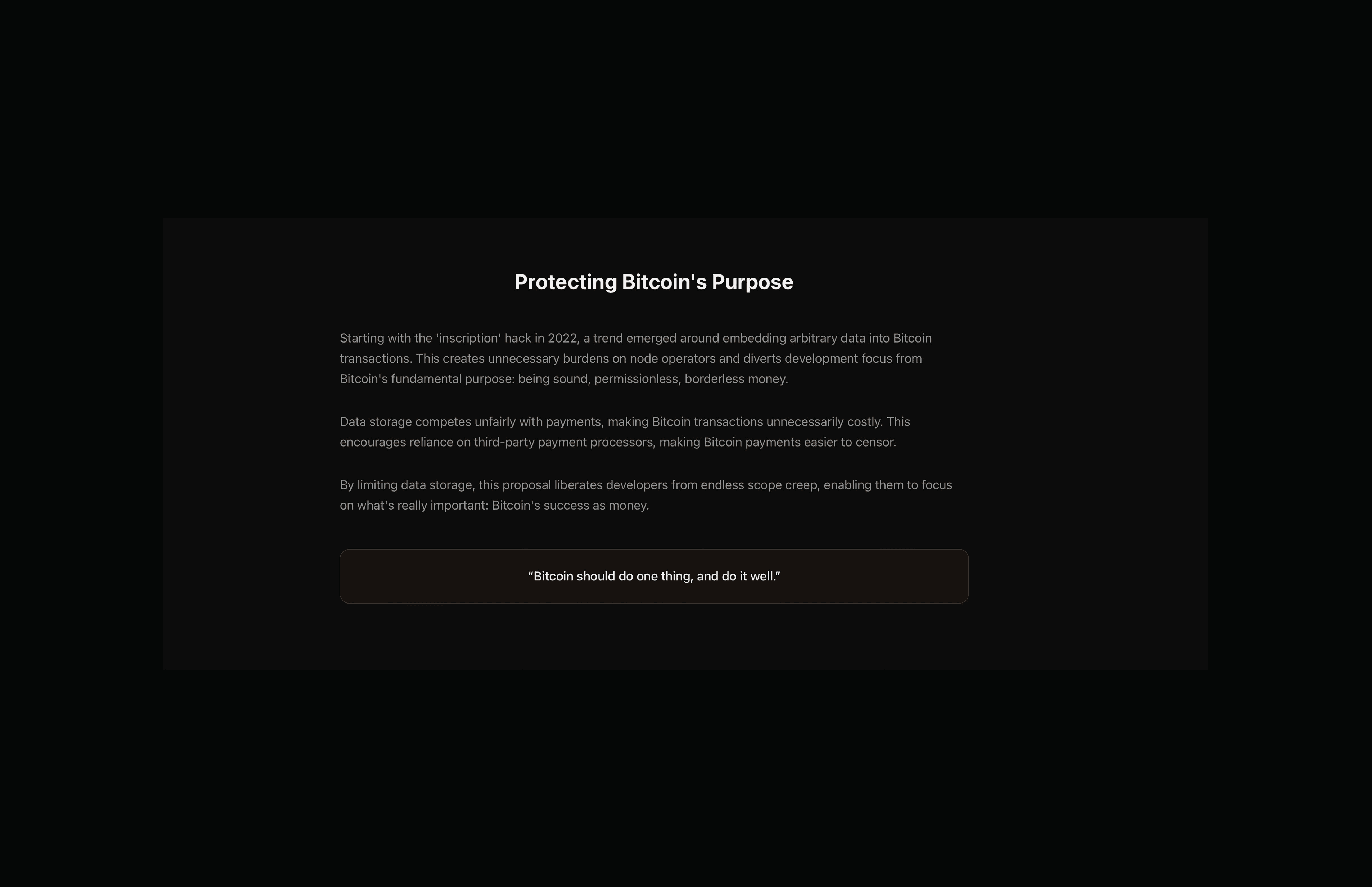
Beginning in 2022, Bitcoin's scripting and witness structure enabled large volumes of arbitrary data, images, text, token metadata, entire application layers, to be embedded directly into transactions through protocols like Ordinals and BRC-20.
Core v30 change: On October 11, 2025, Bitcoin Core v30 removed the long-standing 83-byte OP_RETURN relay limit, allowing OP_RETURN outputs up to approximately 100KB and intensifying the debate over block space policy.
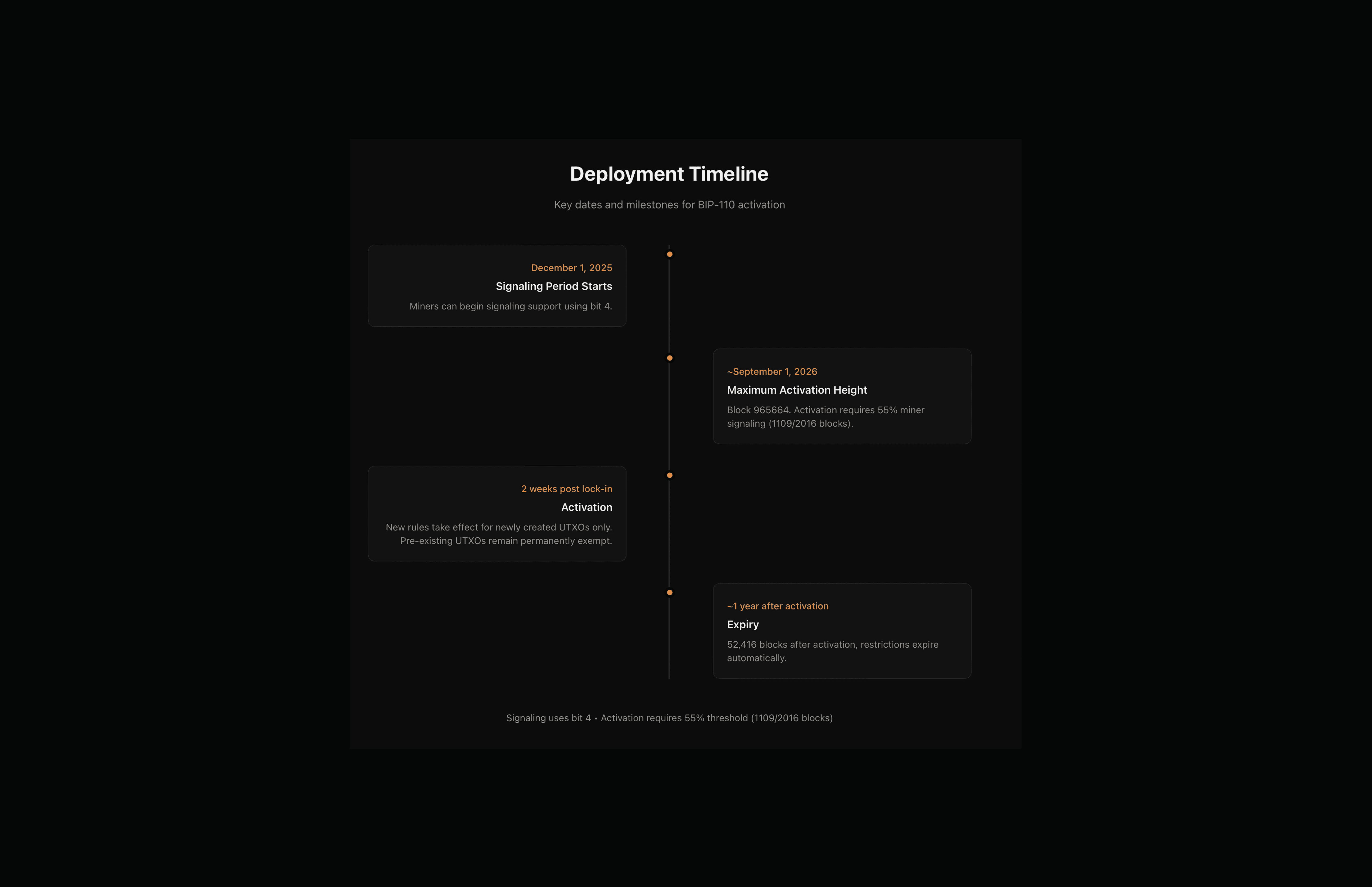
BIP-110 proposal: Advanced primarily through Bitcoin Knots by Luke Dashjr, BIP-110 proposes a time-limited soft fork lasting approximately 52,416 blocks (roughly one year), imposing tighter consensus limits — OP_RETURN capped at 83 bytes, transaction outputs restricted to 34 bytes, witness elements limited to 256 bytes, Taproot annexes invalidated, control blocks capped at 257 bytes (limiting script trees to 128 leaves), and OP_SUCCESS and certain OP_IF/OP_NOTIF tapscripts disabled, after which nodes automatically revert to pre-activation rules without manual intervention.
The stated goal is to slow blockchain growth, reduce node operator costs, and buy time for a permanent solution. As its proponents describe it: "a one-year deployment that can be refined or extended based on community feedback."
As of early 2026, roughly 2–3% of reachable nodes run the BIP-110 implementation, almost entirely through Bitcoin Knots this figure has increased to 6-7% in February 2026. No mining pools have signaled support at the consensus level.

Why Bitcoin Protocol Changes Only Move in One Direction
Can Bitcoin alter its consensus rules temporarily and then simply return to where it was before?
In practice, once a rule change activates, the ecosystem adapts. Infrastructure forms around it. Economic assumptions incorporate it. Consensus changes reshape incentives immediately and even if designed to expire after one year, their removal would not restore the prior equilibrium; it would initiate a second wave of adaptation.
SegWit illustrates the principle.
Upgraded miners enforce stricter validation rules while non-upgraded nodes continue under the original rules. Compatibility is preserved because the new rules narrow what is valid. But once stricter rules are relied upon, they become part of the system's security assumptions. Removing them does not restore neutrality it withdraws guarantees that infrastructure and capital may depend on.
The Economic Risk of a One-Year Consensus Change
In code, BIP-110 is reversible. Economically, it may not be neutral. If active for a year, the effects would begin immediately:
Application adaptation: Data-heavy protocols would compress, migrate, redesign, or shut down.
Fee dynamics: Block composition and congestion patterns could shift.
Miner revenue mix: Income sources might rebalance as transaction demand changes.
Development direction: Builders could avoid designs dependent on broader data capacity.
Market narrative: Investors may reassess what Bitcoin is optimized for, monetary settlement alone or broader functionality, whilst questioning whether "temporary" content limits signal a new approach to censorship resistance.
When the limits expire, the code may revert. The ecosystem may not. Adoption, capital allocation, and fee markets are path-dependent, they evolve in response to the environment experienced, not the environment that existed before.
There is also a human dimension. Humans have inscribed symbols, portraits, and messages onto money for thousands of years. BIP-110 would significantly constrain the scale and method by which expressive data can be embedded into Bitcoin's base layer. Whether that preserves monetary integrity or suppresses a longstanding pattern of expression depends on how one defines Bitcoin's purpose.
The Problem with "Temporary"
Supporters of BIP-110 correctly note a distinction: a temporary data cap is not the same as introducing a new consensus feature that directly secures funds. If an OP_RETURN limit expires, no coins become vulnerable. Comparisons to SegWit are not exact.
Even temporary rule changes alter incentives while active. When the limits expire, consensus rules may revert, but economic positioning, infrastructure decisions, and capital flows would not necessarily unwind in parallel.
The deeper risk is the precedent itself. Bitcoin has never deployed a time-boxed consensus rule designed to expire automatically. Every soft fork in its history has been permanent. In 2010, Satoshi disabled OP_CAT; fifteen years later, proposals to reactivate it remain contentious. Protocol decisions, once made, tend to persist. That durability is part of what makes Bitcoin's rule set a foundation of trust.
Introducing temporary consensus rules would signal that protocol constraints can be experimental rather than enduring. Bitcoin's value proposition is not just code, it is predictability: fixed supply, stable validation rules, long-term spendability, conservative governance. Altering those expectations with temporary adjustments, even with good intentions, may gradually reshape how the base layer is perceived.
The Spam Question: Who Decides?
Beneath BIP-110 is a foundational question the proposal never fully answers: what counts as spam on a permissionless blockchain?
At the consensus level, Bitcoin does not distinguish between a payment and a piece of data. A transaction either meets validation rules or it does not. No field declares "payment" or "inscription." The protocol does not evaluate why a transaction exists, only whether it is valid. Any definition of spam must therefore be imposed from outside the protocol, by humans judging which uses of block space are legitimate. In a decentralized system, no authority should render that judgement.

Who Gets to Define Spam on a Permissionless Blockchain?
The debate over what constitutes spam on Bitcoin remains unresolved, with both sides anchored in fundamentally different views of the protocol's purpose:
The case for restriction: Kratter of Bitcoin University argues that without intervention, "spam takes over, systems degrade, entropy takes over" non-monetary data embedded on-chain threatens the network's long-term viability.
The case against: Casa CTO Jameson Lopp contends that "limiting OP_RETURN does not solve spam problems" data simply migrates to witness fields, bare multisig outputs, and other structures where it may be harder to identify and potentially more harmful. The fee market, not a content filter, is the only mechanism that scales.
The precedent: The boundary between monetary and non-monetary use has never been clean, Colored Coins, Mastercoin, Counterparty, timestamp proofs, memorial messages, and even Lightning channel opens all go beyond simple payments, yet have been widely treated as legitimate.
Block space is scarce and additional data increases node costs, that much is objective. The disagreement is over how Bitcoin's purpose should be defined. When consensus rules restrict transaction structures based on how they are used, the change reflects a choice about protocol direction not purely technical, but one of governance and scope.
A First in Bitcoin: Filtering by Content, Not Validity
Bitcoin's consensus layer has historically focused on structural validity rather than transaction intent, verifying signatures, confirming unspent inputs, enforcing the supply schedule, and ensuring size limits, without evaluating the purpose of the data contained within:
The shift: Under BIP-110, a transaction could be perfectly signed, fully funded, and paying market fees, yet still be rejected at the consensus level if it exceeded the newly imposed structural limits.
The precedent: No soft fork in Bitcoin's history has operated on this basis. SegWit added stricter signature validation. Taproot expanded scripting capability. Both evaluated whether transactions met structural conditions, neither attempted to distinguish transactions based on how block space was being used.
The consequence: BIP-110, while implemented through structural limits, is explicitly motivated by restricting certain patterns of usage. The moment consensus rules start deciding how Bitcoin should be used, they stop being purely technical and start becoming policy.
Bitcoin's strength has been minimizing policy at the base layer.
The Censorship Gradient
When consensus rules are adjusted to restrict certain types of transactions, the underlying mechanism does not inherently limit itself to a single use case:
Use-case filtering: If transactions can be rejected because of how block space is being used, future changes could apply similar logic to other categories of activity.
Privacy constraints: Mechanisms introduced to limit inscriptions in 2026 could, in principle, be extended to restrict privacy-enhancing transaction patterns tomorrow.
Sanctions pressure: The same structural tools could be invoked to justify filtering transactions associated with sanctioned entities or jurisdictions.
Factional Disputes: Competing visions within the community could seek to encode their preferences about acceptable protocol usage directly into consensus rules.
Bitcoin’s censorship resistance depends on the protocol treating all structurally valid transactions equally.
Introducing consensus-level filtering, even with protective intent, creates a mechanism that could later be extended beyond its original purpose. The risk is not immediate abuse, but the gradual normalization of discretionary control at a layer designed to remain neutral.
The Honest Case for BIP-110
None of this means BIP-110's concerns are trivial:
Node costs are real: If blockchain growth meaningfully increases hardware requirements, validation could concentrate among well-resourced actors, weakening decentralization. The concern about inscription-driven data bloat is genuine and shared by part of the technical community.
Governance frustration runs deeper: Some developers and users are uneasy with Bitcoin Core's recent direction, including the OP_RETURN relay policy change in v30 and perceptions about governance transparency. For many supporters, BIP-110 represents the only mechanism available in a decentralized system running alternative software.
The proponents are not fringe: The proposal is framed as a temporary, cautious intervention rather than a permanent rewrite of policy.
The issue, however, is not intent but structure. A temporary soft fork is still a soft fork and once consensus rules change, even briefly, the network adapts in ways that cannot simply be undone.
What Happens If BIP-110 Fails
Most of the debate has focused on the risks of BIP-110 succeeding.
Failure carries its own consequences, and some of those consequences matter just as much for Bitcoin’s long-term health.
Vindication of the status quo: If BIP-110 collapses without meaningful mining support, Core v30’s removal of the longstanding 83-byte OP_RETURN relay limit effectively allows OP_RETURN outputs up to the standard transaction size limit (roughly 100KB) to be relayed and mined by default. Any future attempt to address data growth at the protocol level, even a well-designed permanent proposal, will carry the stigma of BIP-110’s failure. The window for addressing legitimate concerns about blockchain bloat may close for years.
Core’s governance concerns remain unresolved: BIP-110 is a response to growing frustration with Bitcoin Core’s direction. If it fails and Core does not address the concerns that gave rise to it (including worries about a small group of maintainers, opaque decision-making, and a shrinking contributor base) the tension will not disappear. It will pause, then resurface when the next controversy arrives.
The intolerant minority model is tested and found wanting: If a user-activated soft fork cannot secure even 10% mining support, it sends a clear signal that node signalling alone is insufficient to change consensus. For some, that is reassuring, it reinforces the idea that changes require broad alignment. For others, it suggests that miners retain significant veto power over the protocol’s evolution, complicating the narrative that Bitcoin is governed primarily by its users. Miners are among the most economically committed participants in the network, given their continuous capital and energy expenditures.
The BIP-110 movement regroups: History suggests failed fork attempts do not end the movement behind them. Bitcoin XT failed. Bitcoin Classic failed. Bitcoin Unlimited failed. Each time, the big-block movement regrouped, refined its arguments, and tried again, producing Bitcoin Cash. A failed BIP-110 in September 2026 is unlikely to be the last attempt at a data-restriction soft fork. The next version may be better designed, better funded, and harder to dismiss.
Community fracture without resolution: If BIP-110 neither succeeds nor produces clear learnings, the Bitcoin community remains split along the same fault lines. Developers who feel Core has drifted remain frustrated. Inscription critics remain unsatisfied. And the next controversy, whether it involves OP_CAT, a ZK verifier, or something not yet proposed, inherits all of the unresolved anger from the current one.
Failure is not the same as resolution. If a proposal collapses without producing clarity about the underlying concerns, the tensions that gave rise to it remain unresolved.
Why 2017 Is Not a Useful Comparison
Both sides of the BIP-110 debate invoke 2017. Supporters compare it to BIP-148 and SegWit activation. Opponents compare it to the big-block movement that led to Bitcoin Cash. Neither analogy cleanly applies:
Alignment gap: In 2017, SegWit already had broad developer support, significant node adoption, major exchange backing, and visible economic signaling activation stalled mainly at the mining layer. BIP-110 has none of that alignment.
Different dispute: SegWit addressed a widely acknowledged technical limitation. BIP-110 centers on block space policy, a question that blends technical tradeoffs with competing visions of Bitcoin's purpose.
No economic signal: No miners are signaling support and no major exchanges have backed it.
The lesson of 2017 is not that user-activated soft forks always succeed or fail. It is that outcomes depend on alignment and the alignment that made BIP-148 viable is not present for BIP-110.
Conclusion
If Bitcoin truly faces an existential spam problem, the solution should be permanent and defended on those grounds. If the problem does not rise to that level, a temporary consensus change introduces more instability than it resolves. Bitcoin's base layer was never designed for provisional rule-making.
A one-year experiment sounds pragmatic. But temporary changes will alter incentives, expectations, and behavior the moment they activate. Once the network adapts, it does not snap back because a timer expires because markets do not have undo buttons.
Bitcoin's strength has never been speed or flexibility. It has been reliability, the accumulated proof of work, the deliberate pace of upgrades, the culture of resistance to change, all serving one purpose: ensuring that the rules do not shift unexpectedly.
And there is something deeper at stake. Humans have inscribed meaning onto money for as long as money has existed, symbols, portraits, prayers, protests, proof that someone was here. Bitcoin did not break that tradition. It extended it into a new medium. What some call spam, others call expression on the most durable ledger ever created. Narrowing what Bitcoin is allowed to carry means narrowing what Bitcoin is allowed to be.
BIP-110 asks the network to treat consensus as something that can be tried and later undone. In a system people trust precisely because the rules don't change, that is not a small ask.
Some doors, once opened, do not close the same way again.
FAQ
What does BIP-110 propose to change in Bitcoin’s rules?
BIP-110 proposes a time-limited soft fork of about 52,416 blocks (roughly one year) that tightens consensus limits: OP_RETURN outputs are capped at 83 bytes, transaction outputs are restricted to 34 bytes, and witness elements are limited to 256 bytes. After this period, nodes automatically revert to the pre-activation rules without manual intervention.
Why is a temporary consensus change considered risky for Bitcoin?
Once a rule change activates, the ecosystem adapts: infrastructure, economic assumptions, incentives, and user behavior shift in response. Even if the code later reverts, adoption, capital allocation, and fee markets do not simply snap back, so a time-limited change effectively triggers two adaptation phases rather than a reversible “cooling-off” period.
How does BIP-110 relate to the debate over spam and acceptable use of block space?
At the consensus level, Bitcoin does not distinguish payments from other data and has no intrinsic notion of spam. BIP-110 is motivated by concerns that non-monetary data threatens long-term viability, while critics argue that limiting OP_RETURN will not solve spam and that the fee market should allocate block space. The proposal exposes a deeper disagreement about Bitcoin’s purpose and who, if anyone, should define legitimate uses of block space.
What are some potential consequences if BIP-110 fails to gain sufficient support?
If BIP-110 fails, the status quo is reinforced: Core v30’s effective expansion of OP_RETURN relay to roughly 100KB stands, and future protocol-level attempts to curb data growth may be stigmatized. Governance concerns about Bitcoin Core remain unresolved, evidence accumulates that node signaling alone cannot change consensus without miner alignment, the BIP-110 movement is likely to regroup with new attempts, and community fractures over inscriptions and protocol direction persist without clear resolution.
Disclaimer
The information provided in this article is for informational purposes only. It is not intended to be, nor should it be construed as, financial advice. We do not make any warranties regarding the completeness, reliability, or accuracy of this information. All investments involve risk, and past performance does not guarantee future results. We recommend consulting a financial advisor before making any investment decisions.
More like this


Written by

Andrew Kamsky
Andrew Kamsky is a Bitcoin analyst. He spent a decade in traditional finance across a Big Four firm and a listed fintech bank before going deep on Bitcoin full-time.