












Quick summary
Article categorizes bitcoin and altcoin analytics into block explorers, on-chain data providers, research platforms, and market data
Lists key tools per category for Bitcoin behavior, DeFi fundamentals, custom queries, wallets, and forensics
Highlights persistent gaps in full-node access, fragmented tooling, entity resolution and cross-chain attribution
Stresses matching each research question to the right platform and understanding underlying methodologies
The tools available for analyzing Bitcoin and altcoin markets have matured considerably. What was once fragmented across block explorers and price trackers now spans forensic-grade on-chain platforms, machine learning pipelines, and multi-chain SQL editors.
This guide is published by Coinjuice, which is included in the research platforms section below. It breaks down the main categories, names the platforms worth knowing, and explains what each one actually does.
Task | Type | Tools |
Bitcoin holder behavior | Research | LookIntoBitcoin, Glassnode |
DeFi protocol revenue | Research | Token Terminal, DefiLlama |
Exchange flows and reserves | Research | CryptoQuant |
Custom on-chain queries | On-chain | Dune Analytics, Flipside Crypto |
Wallet entity tracking | On-chain | Nansen, Arkham Intelligence |
Transaction forensics | Research | Chainalysis, GraphSense |
Fund and ETF flows | Market | CryptoQuant |
Derivatives positioning (funding rates and open interest) | Market | CryptoQuant |
Price and market data | Market | CoinGecko, TradingView |
DEX and new token tracking | Market | DEX Screener, BirdEye |
Block verification | Explorer | Etherscan, Blockchain.com, Blockchair |
How Crypto Research Platforms Are Categorized
Recent academic reviews tend to group platforms into four functional categories. Understanding them first prevents the article from feeling like a random list of brand names.
Block explorers: Transaction and block-level transparency. Useful for verification, not deep analysis
On-chain data providers: Structured querying of blockchain datasets, typically via APIs or SQL interfaces
Research platforms: In-depth network analysis, token economics, and trend tracking. Often incorporate machine learning
Market data providers: Price aggregation, volume tracking, sentiment indicators, fund and ETF flows, and derivatives positioning. These datasets complement on-chain analysis with information from exchanges and fund reporting
Block Explorers
Block explorers remain the baseline and the major industry platforms include:
Etherscan: Ethereum's default block explorer for transaction queries and address lookups
Blockchain.com: Bitcoin-native explorer covering transactions, blocks, and mempool data
Blockchair: Multi-chain explorer spanning Bitcoin, Ethereum, and a dozen other networks.
BscScan: BNB Chain's primary explorer, mirroring Etherscan's interface for BSC transactions.
Solscan: Solana's leading explorer for SPL token transfers and program interactions.
Block explorers show what happened. Everything below explains where the interpretation layer begins.
On-Chain Data Providers
This category has the most practical range for active researchers:
Indexers: The Graph, Bitquery, and Covalent allow programmatic access to on-chain data without running a full node. The Graph has become a default infrastructure layer for DeFi protocol data
SQL editors: Dune Analytics and Flipside Crypto let analysts write custom queries directly against indexed blockchain data. Dune has a large library of community-built dashboards, which shortens research time on common queries
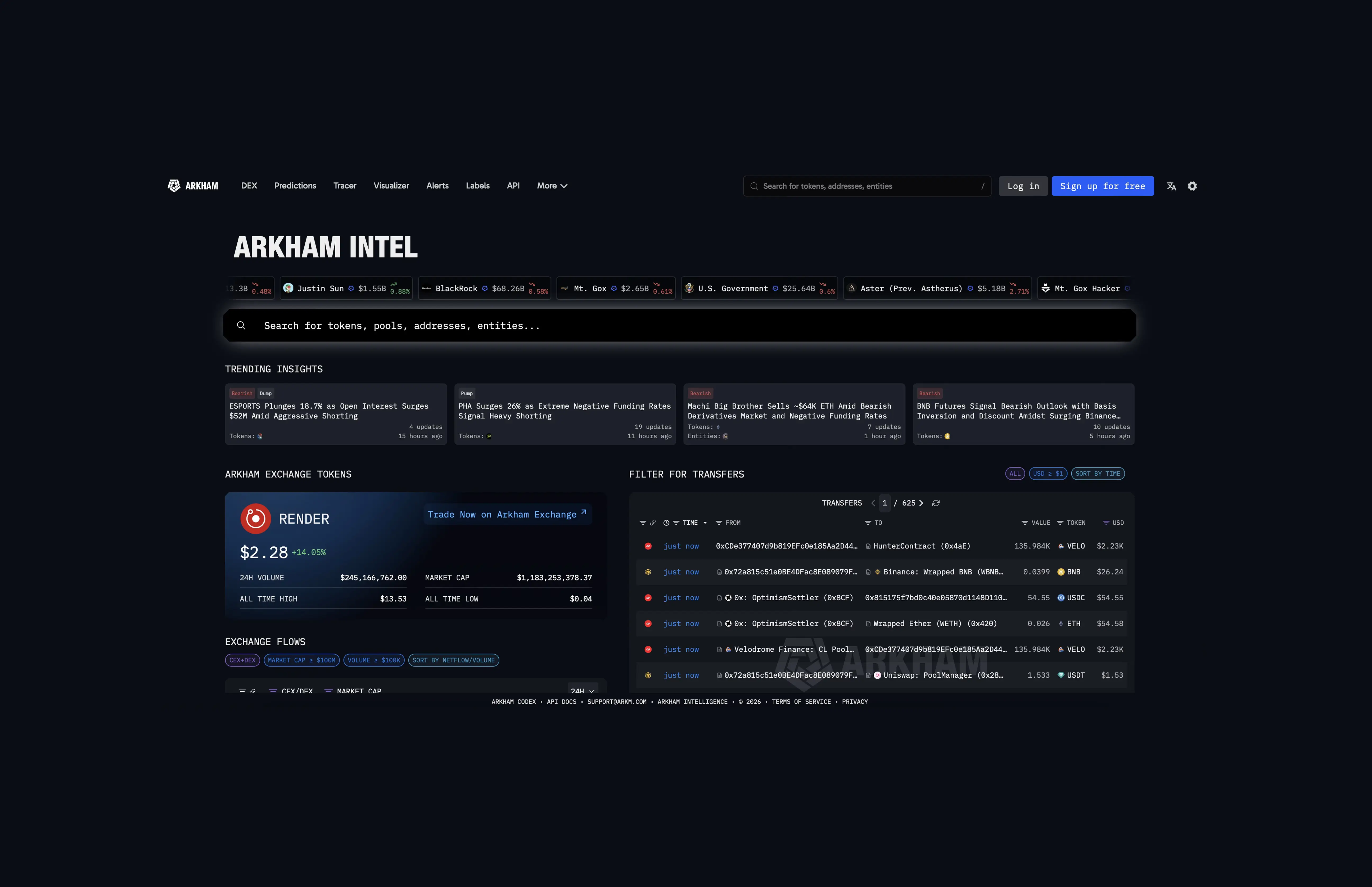
No-code visualization tools: Arkham Intelligence, Footprint Analytics, and Dapplooker serve analysts who want structured data without writing queries. Arkham adds entity attribution, labeling known wallets and exchange addresses.
The difference between raw blockchain access and actionable intelligence is now the core competitive layer in this space. Indexers and SQL editors give access; what analysts do with it determines the quality of the output.
Research Platforms
Research platforms turn blockchain and market data into tools for analyzing holder behavior, capital flows, protocol fundamentals, and transaction activity. Their strengths vary: some focus on Bitcoin cycle analysis, others on wallet attribution, exchange activity, or forensic tracing.
The platforms below serve different parts of that research process.
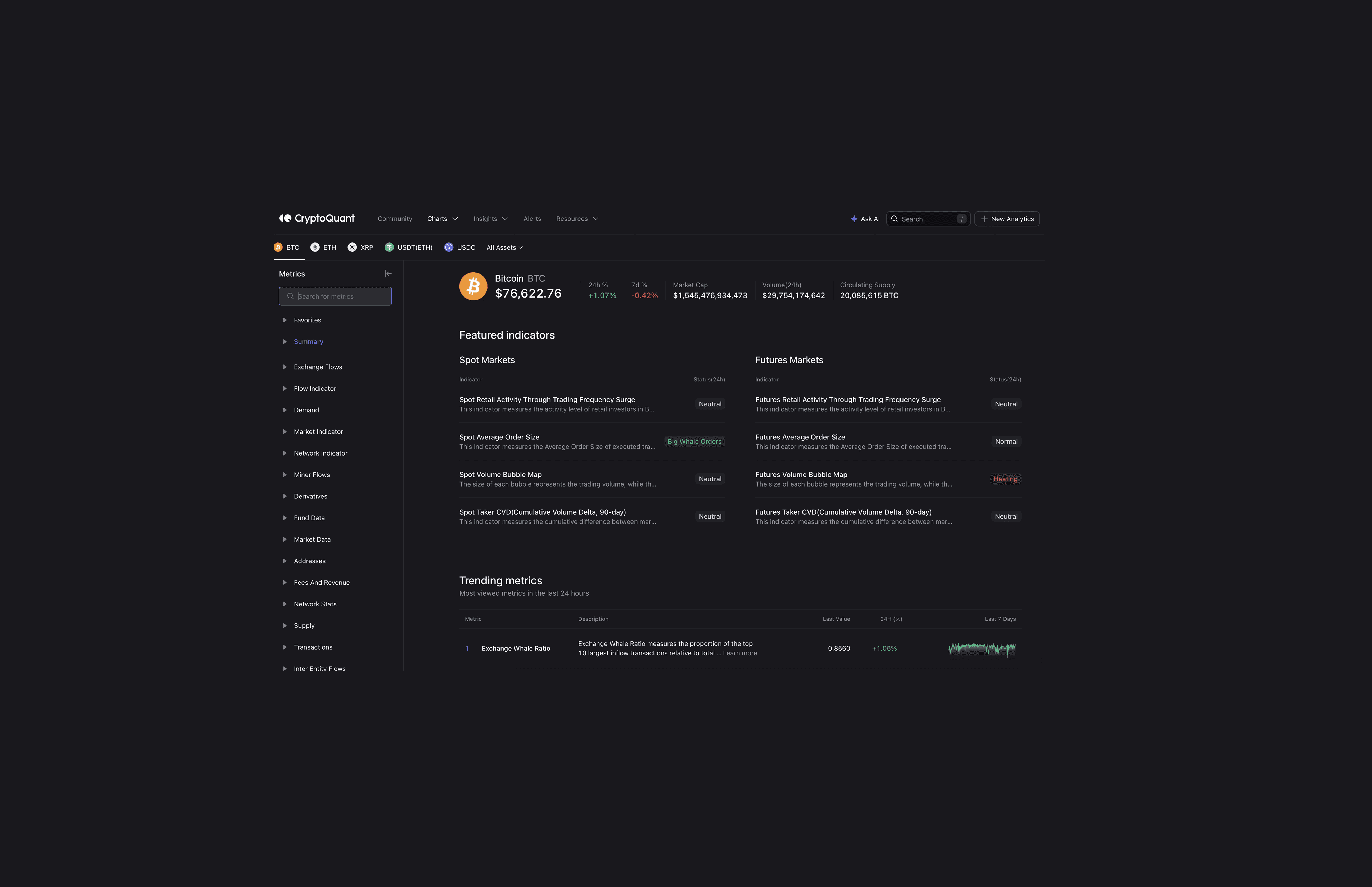
CryptoQuant: On-chain and market data platform covering exchange flows and reserves, miner activity, fund and ETF data, and derivatives indicators such as funding rates and open interest. Useful for analyzing capital flows and market positioning alongside Bitcoin holder behavior.
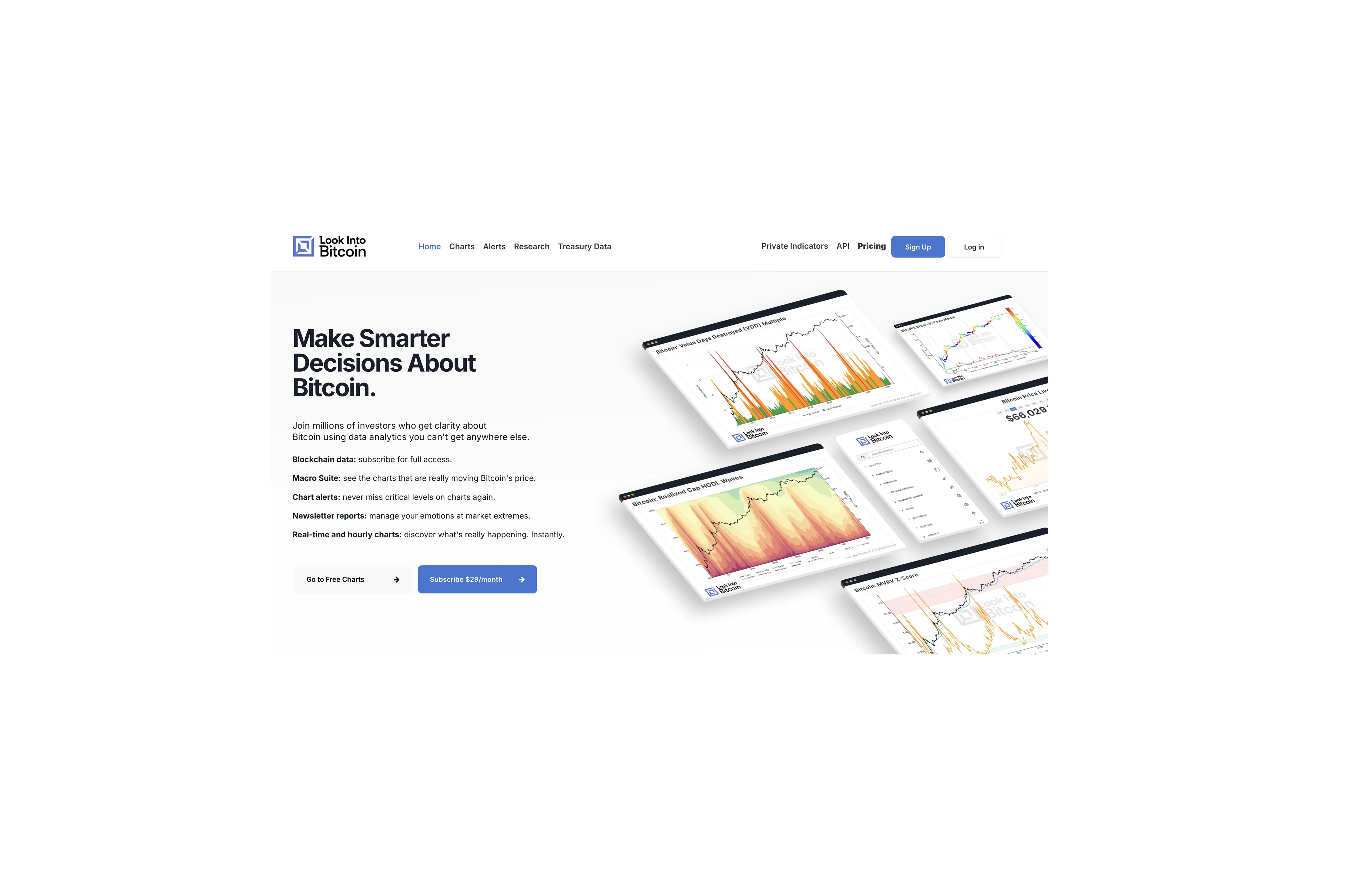
LookIntoBitcoin: Charting and on-chain data platform. Covers HODL waves, miner behavior, and cycle analysis with a Bitcoin-only data stack
Glassnode: On-chain metrics and Bitcoin holder behavior data. The reference platform for supply distribution, HODL waves, and realized price analysis
Nansen: Wallet labeling and on-chain flow tracking across Ethereum and EVM chains. Strong for DeFi and token movement
Chainalysis: Forensic-grade transaction tracing used by law enforcement and compliance teams. Also publishes public research on illicit activity flows
Messari: Protocol research, token metrics, and governance tracking across a broader asset set than most on-chain-native platforms
IntoTheBlock: Retail-facing on-chain indicators covering Bitcoin and major altcoins.
Token Terminal: Financial metrics for protocols: revenue, fees, P/S ratios. Useful for comparing DeFi fundamentals across the sector
GraphSense: Open-source analytics framework built on a knowledge graph. Used in academic and law enforcement contexts for tracing monetary flows across Bitcoin and other chains
Coinjuice: Bitcoin-first research publication covering on-chain data, address cohort analysis, HODL wave frameworks, DeFi protocol fundamentals, trading strategy, and market structure. Publishes original research, interviews, and technical analysis across Bitcoin and altcoins.
Maketo: Bitcoin market intelligence platform launched publicly in 2026, distilling on-chain data, valuation models, cycle indicators, and news into plain-English reads. Maketo wallets by size page offers address cohort analysis, tracking Bitcoin addresses by balance range, including address counts, BTC held per group, share of supply, and how those figures shift over time.
Market Data Providers
Market data providers handle price aggregation, volume tracking, and sentiment at the asset and protocol level, the surface layer most analysts check first.
CoinGecko and CoinMarketCap: Standard market cap, volume, and price data across thousands of assets
TradingView: Charting and technical analysis with broad asset coverage and community-built indicators
DefiLlama: DeFi-specific TVL tracking, protocol revenue, and chain-level breakdowns. Free and frequently updated
DEX Screener and BirdEye: Real-time DEX pair data for tracking new token launches and liquidity movements on-chain.
Why Tool Selection Matters
The wrong platform produces the wrong interpretation. Different methodologies index the same chain data differently, meaning two analysts using different tools can reach different conclusions from identical on-chain events.
On-chain data without methodological context produces false narratives as often as useful ones. Knowing which tool answers which question and understanding its limitations is as important as knowing the data itself.
What 2026 Research Flags as Persistent Gaps
The analytics infrastructure has matured but the interpretation layer has not. Five structural problems persist across the industry in 2026.
Full-node synchronization: Running a local node remains resource-intensive, pushing most analysts toward third-party indexers and the centralization risks that come with them
Fragmented tooling: Each platform indexes the same underlying chain data differently, meaning query results vary across tools and cross-platform comparison requires manual reconciliation
Entity resolution: Accurately labeling who owns which address across networks remains unsolved at scale and most platforms label exchange wallets reliably but struggle with everything else
Cross-chain attribution: Arkham's AI-powered entity engine is the closest the industry has to a working solution, but coverage thins considerably outside Ethereum and Bitcoin.
Machine learning integration: Platforms like IntoTheBlock now blend on-chain conditions, market structure, and sentiment into forward-looking models, though the output quality still depends entirely on the cleanliness of the underlying data pipelines feeding them.
The gap is now in interpretation: who owns what, what the activity means, and whether the platform's methodology is transparent enough to trust.
Conclusion
Understanding which platforms serve which analytical function cuts research time and reduces reliance on secondary summaries. For Bitcoin-specific analysis, Glassnode and LookIntoBitcoin provide holder data and cycle indicators. CryptoQuant covers exchange flows and reserves, fund and ETF data, and derivatives indicators such as funding rates and open interest.
For altcoin protocol fundamentals, Token Terminal and DefiLlama are practical starting points before going deeper with Dune or Nansen. For forensics, Chainalysis supports compliance-focused transaction tracing, while GraphSense offers an open-source framework for investigating monetary flows.
For Bitcoin narrative research and cycle analysis, Coinjuice publishes research combining on-chain data, market structure, and broader market context.
FAQ
What are the main categories of crypto research platforms described for 2026?
Platforms are grouped into four functional categories: block explorers, on-chain data providers, research platforms, and market data providers.
What is the difference between block explorers and on-chain data providers?
Block explorers give transaction and block-level transparency useful for verification, while on-chain data providers offer structured querying of blockchain datasets, typically via APIs or SQL interfaces, enabling deeper analysis.
Which tools are recommended for analyzing Bitcoin holder behavior and DeFi protocol fundamentals?
For Bitcoin holder behavior, Bitcoin Magazine Pro and Glassnode are listed, and Glassnode is noted as covering on-chain holder data at the depth most analysts need. For DeFi protocol fundamentals, Token Terminal and DefiLlama are highlighted as practical starting points.
What persistent gaps in on-chain analytics are identified for 2026?
Five structural problems are flagged: full-node synchronization being resource-intensive, fragmented tooling leading to differing query results, unresolved entity resolution across networks, limited cross-chain attribution, and machine learning models whose quality depends on underlying data cleanliness.
Disclaimer
The information provided in this article is for informational purposes only. It is not intended to be, nor should it be construed as, financial advice. We do not make any warranties regarding the completeness, reliability, or accuracy of this information. All investments involve risk, and past performance does not guarantee future results. We recommend consulting a financial advisor before making any investment decisions.
More like this
Written by

Andrew Kamsky
Andrew Kamsky is a Bitcoin analyst. He spent a decade in traditional finance across a Big Four firm and a listed fintech bank before going deep on Bitcoin full-time.