








Quick summary
Avoiding leverage and forced liquidations matters more than perfectly timing crypto market tops
Portfolio survival relies on owning assets outright, conservative position sizing, and stablecoin reserves
Use cautious yield strategies and avoid protocols where total loss would change outcomes
Self-custody, limited exchange exposure, and long-term focus enable multi-cycle compounding
The investors who compound wealth across crypto cycles are not the ones who picked the top in 2017, 2021, or 2025. They are the ones who were still holding capital when the next cycle began.
Most losses in the asset class come from forced exits, not bad asset selection, meaning leveraged positions close during drawdowns, with the recovery later watched from the sidelines. Portfolio survival outranks cycle-timing, and the structural decisions that make multi-cycle compounding possible are knowable in advance and discussed in this article.
The Real Cost of Liquidation
A drawdown on the spot is reversible. A liquidation is not.
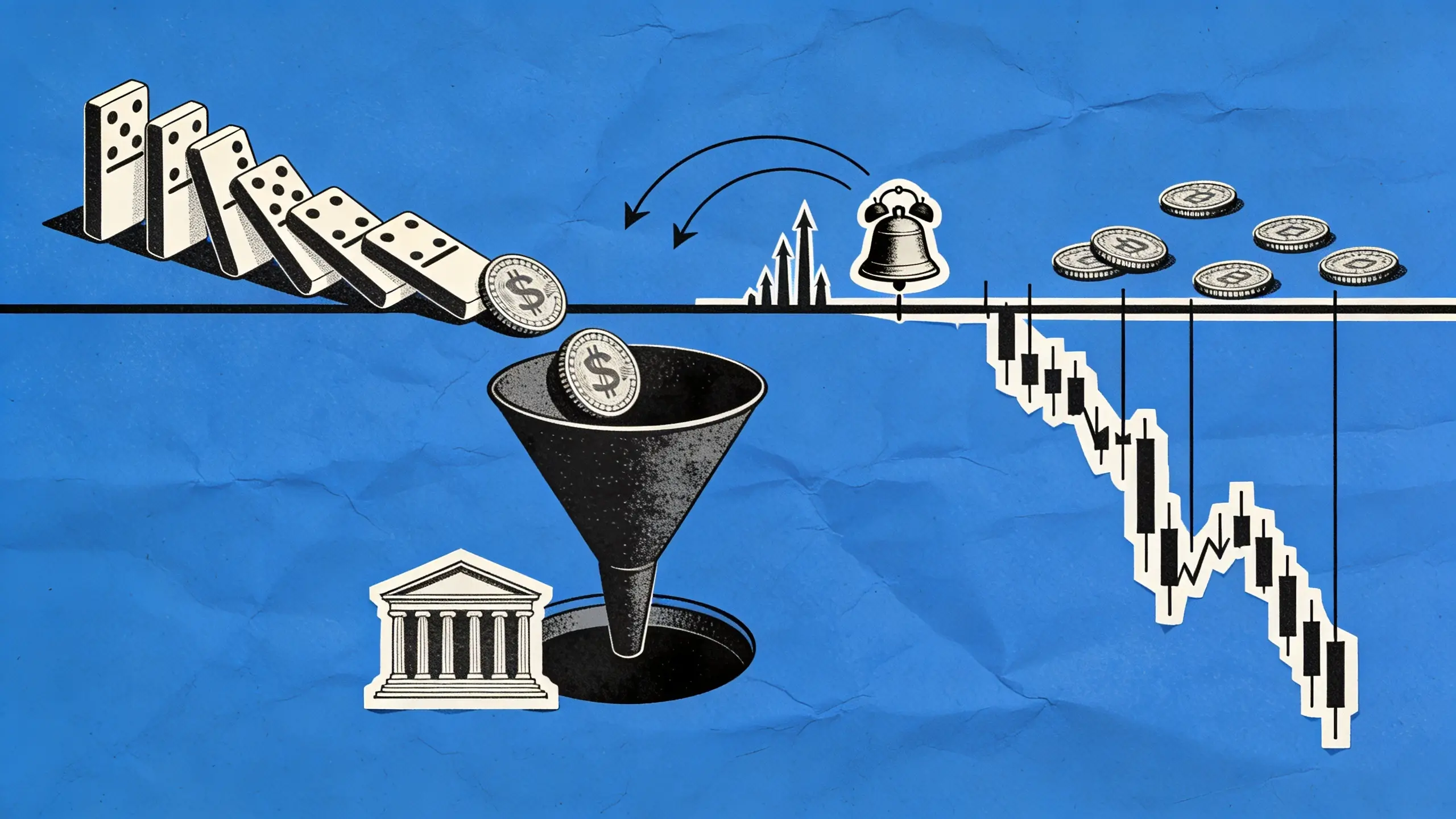
When a leveraged position closes against the holder, the capital does not return when the asset does. The position is gone. The recovery happens for someone else.
Mechanics of permanent removal:
Margin call dynamics: Once collateral falls below the maintenance threshold, the position closes automatically. The decision to hold is taken out of the holder's hands
Recovery participation lost: Re-entry requires fresh capital and the capital that would have funded re-entry was just destroyed in the exit
Cascade vulnerability: Forced selling clusters during sharp moves, deepening the drawdown and triggering further liquidations underneath.
The 2022 cycle made the cost visible. Aggregate liquidations across centralized and decentralized venues exceeded tens of billions of dollars in a matter of weeks.
In 2022, holders who weathered Bitcoin from roughly $69,000 down to $17,000 and back were not operating on a superior thesis to those who got liquidated at $42,000 on the descent. They simply held assets outright while the other group held positions dependent on margin. One group rode the cycle. The other group paid for it.
The most important number in a crypto portfolio is the price at which exposure terminates by force. For unleveraged holders, the number is zero. For leveraged accounts, the number is whatever a wick, a funding spike, or a counterparty failure decides on any given day.
How to Build a Crypto Portfolio Without Leverage
Multi-cycle portfolios are built on assets owned outright. Borrowed exposure is the exception, never the foundation.
How much you buy matters more than what you buy.
A 5% position in a token that goes to zero is a small loss. A 50% position in the same token wipes out the portfolio. Size is the decision that controls everything else.
Allocation principles:
Bitcoin as the base layer: The longest cycle survivorship record in the asset class. A meaningful core anchors the portfolio against single-asset failure
Conviction positions sized for failure: Additional allocations only at sizes where a 70% drawdown does not change the holder's financial outcome
Stablecoin reserves (10–20%): Optionality first, yield second. Dry powder during capitulation is where multi-cycle returns are actually generated.
Coinjuice readers seeking deeper allocation frameworks can reference the methodology in the Coinjuice ebook.
Earning Yield Without Portfolio Blowups
Yield is a legitimate enhancement for portfolios that use it carefully. It is also the most common way crypto investors lose principal outside of leverage. The distinction between the two outcomes is the entire game.
Case Study Yield
The filter that matters: if the total loss of a yield position would meaningfully change the portfolio outcome, either the size is wrong, the protocol is wrong, or both. Anchor Protocol offered roughly 20% on UST deposits and held over $17 billion at peak in May 2022.
When the UST peg broke on May 7–8, Anchor's TVL collapsed from $17.15 billion to under $30 million within weeks. The yield, the protocol, and the underlying asset failed simultaneously
Tiered risk by yield source:
Native staking: Close to free return on assets already held. Ethereum staking has paid 3–5% since the Merge with no major validator-level failures
Lending blue-chip assets through audited venues: Steady return with quantifiable smart contract exposure. Aave and Compound have processed billions in loans across multiple cycles without protocol insolvency.
Yield farming on novel protocols: Triple-digit APRs reflect protocol risk, not generosity. Anchor (20% on UST), Iron Finance (TITAN bank run, 2021), and the long list of cross-chain bridge exploits each looked safe until the morning they did not.
Self-Custody as Structural Defense
Counterparty failure has been the most reliable wealth destroyer of recent cycles.
FTX, Celsius, BlockFi, and Voyager each delivered the same lesson under different names with assets held by a counterparty are claims against that counterparty's solvency, and the claim only gets tested when the solvency is already gone.
Custody hierarchy:
Long-term holdings: Cold storage removes counterparty risk from positions intended to compound
Larger allocations: Multi-signature distributes key control against single-point compromise
Active trading capital: Funds left on venues should match what a holder would accept losing if the platform went dark overnight.
The case for self-custody is not technical. It is portfolio-structural and the choice cannot be made retroactively.
The Mindset Behind Multi-Cycle Compounding
The discipline reduces to a single instruction: operate on a longer clock than the market.
Drawdowns inside an unleveraged portfolio are uncomfortable but non-terminal. Leverage during euphoria is the most expensive mistake in the asset class. Both pressures peak precisely when acting on them produces the worst outcomes.
The compounding math reframes what counts as performance.
An investor who participates in three bull markets without liquidation beats a trader who maximizes one cycle and exits the next on a margin call. Missed returns are recoverable. Liquidated capital is not. The asymmetry is why unleveraged portfolios win over time.
Conclusion
Crypto does not reward the best traders. It rewards the ones still trading.
Multi-cycle wealth accrues to portfolios built on unleveraged ownership, conservative sizing, defensive yield, and self-custody choices that look unremarkable during bull markets and decisive during bear markets. The next major drawdown will once again separate structurally sound portfolios from leverage-dependent ones, and the separation will be permanent for the second group.
The objective is not winning the current cycle. The objective is being present for the next one — and the one after that.
FAQ
Why is avoiding liquidation more important than timing the top in crypto cycles?
Because most losses come from forced exits, not bad asset selection. When a leveraged position is liquidated, the capital does not return with the asset’s recovery, so the holder misses future cycles. Investors who remain unliquidated and still have capital when the next cycle begins are the ones who compound wealth over multiple cycles.
What portfolio structure supports multi-cycle compounding in crypto?
Multi-cycle portfolios are built on unleveraged ownership, conservative position sizing, stablecoin reserves, defensive yield, and self-custody. Bitcoin serves as a base layer, conviction positions are sized so a 70% drawdown does not change the holder’s financial outcome, and 10–20% in stablecoins provides dry powder for capitulation.
How can investors earn yield without risking portfolio blowups?
Yield should be used only when a total loss of the position would not meaningfully change the portfolio outcome. Safer tiers include native staking on assets already held and lending blue-chip assets through audited venues like Aave and Compound. Triple-digit APRs on novel protocols typically signal protocol risk, not generosity, as shown by failures like Anchor and Iron Finance.
Why is self-custody described as structural defense for a crypto portfolio?
Because assets held with counterparties are merely claims on their solvency, and this claim is tested only when solvency is already gone. Counterparty failures such as FTX, Celsius, BlockFi, and Voyager have been major wealth destroyers. Long-term holdings belong in cold storage, larger allocations use multi-signature, and only an amount one can accept losing should be left on trading venues.
Disclaimer
The information provided in this article is for informational purposes only. It is not intended to be, nor should it be construed as, financial advice. We do not make any warranties regarding the completeness, reliability, or accuracy of this information. All investments involve risk, and past performance does not guarantee future results. We recommend consulting a financial advisor before making any investment decisions.
More like this

Written by

Andrew Kamsky
Andrew Kamsky is a Bitcoin analyst. He spent a decade in traditional finance across a Big Four firm and a listed fintech bank before going deep on Bitcoin full-time.