










Quick summary
Aave reinvests 13.2 percent of fees, while Compound distributes 96.9 percent to depositors
From 2024 to 2026 Aave’s lending share grew to 46 percent, Compound fell to 2.8
Aave diversifies revenue via GHO, flash loans, liquidations, and swaps; Compound relies solely on lending
Winning DeFi protocols reinvest revenue, diversify income streams, and continuously expand products and chains
Imagine you build a lending protocol. Users deposit money. Borrowers take loans and pay interest. You're generating revenue.
Now comes the hard choice: Do you give that revenue back to depositors (cheap way to stay competitive on rates), or do you keep some and reinvest it?
Compound chose option one. Aave chose option two.
That decision explains the 17x gap between them today, leaving Aave the better hold for a few years.
How Aave Captured Market Share
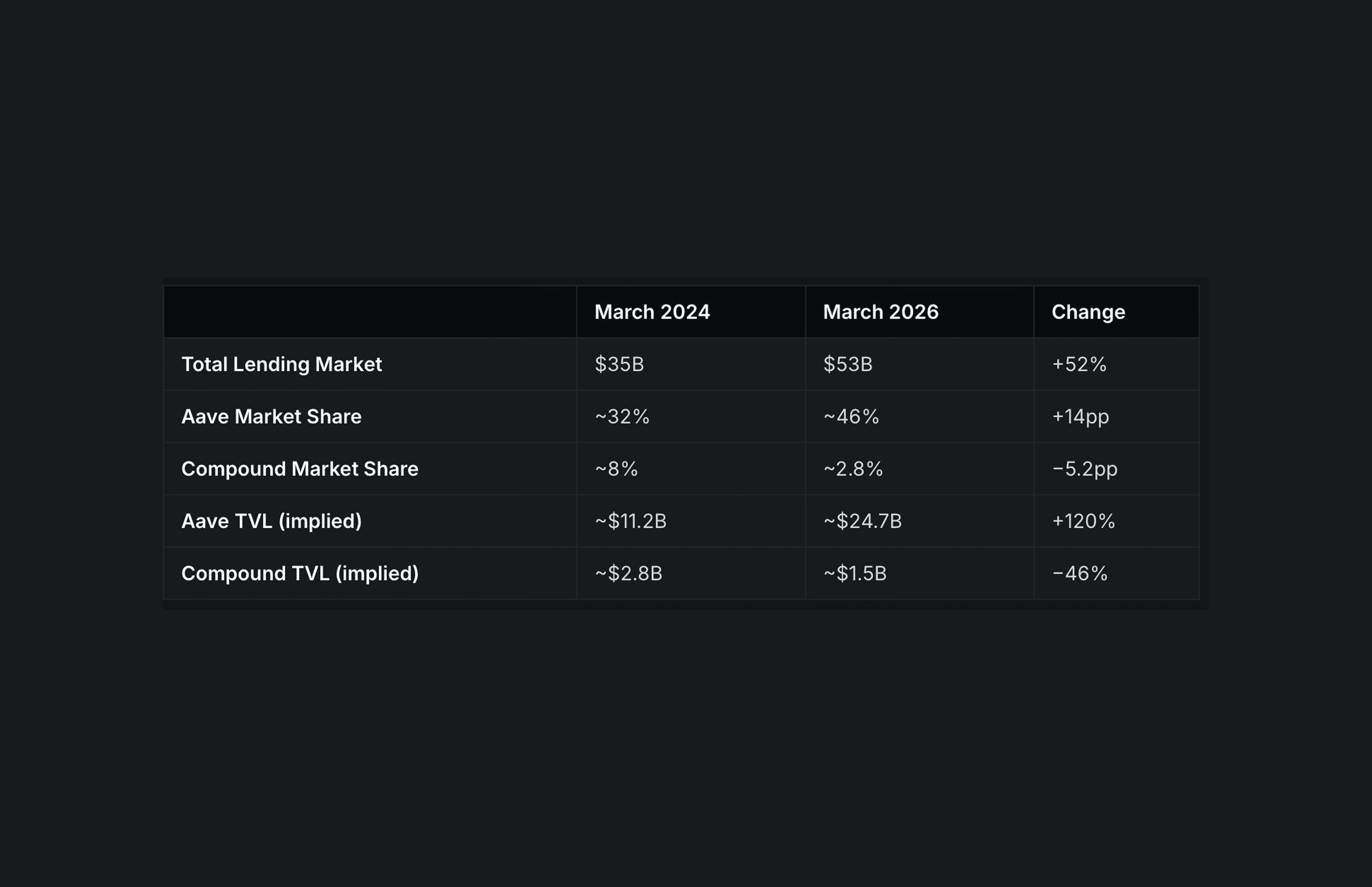
In March 2024, the gap was smaller. Aave held ~32% of the lending market and Compound ~8%.
By March 2026, Aave owned ~46% but Compound dropped to ~2.8%.
The market grew ~52% over those two years. From $35B to $53B in total lending. This wasn't a collapse. It was selective growth.
Aave captured the expansion. Compound didn't.
How Aave Reinvests Protocol Revenue
When Aave earns $47.8M in monthly fees, it doesn't just distribute them all to depositors. Aave takes 13.5% and keeps it. With that money, it does four things:
First: Aave funds for development. The team building new features, fixing bugs, improving security.
Second: Aave launches new products. GHO (a stablecoin). Flash loans (instant borrowing). Embedded swaps. Each new product generates its own fees.
Third: it expands to new blockchains. Ethereum, Polygon, Optimism, Arbitrum. More chains mean more users, more volume, more fees.
Fourth: it buys back AAVE tokens (~$42-46M per year). This rewards people who own the token.
Each of these reinforces the others. More products mean more reasons to use Aave. More chains mean more users to reach. More buybacks mean token holders benefit from protocol success.
Compound took a different path. It gave 96.9% of its fees to depositors and kept 3.1%. That's barely enough to cover short term expenses. No buybacks. No new products. No aggressive expansion.
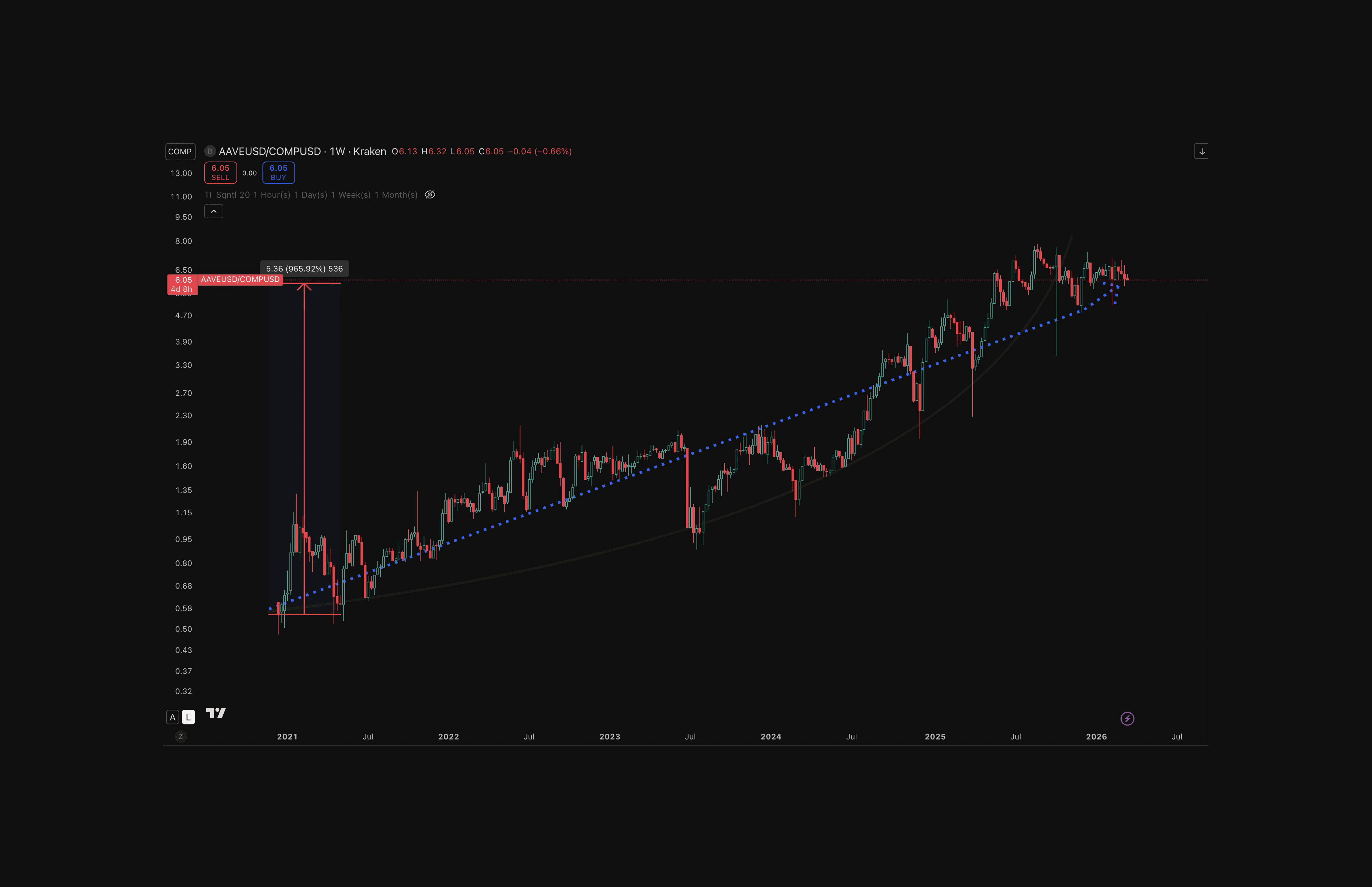
The AAVE/COMP ratio has been in an unbroken uptrend since 2022. Every dip has held the trendline, and at 6.05 today, AAVE buys you 10x more COMP than it did at the bottom. The market has been voting on this for four years and hasn't changed its mind.
Why Compound Struggles to Compete
When the market gets competitive, Aave has flexibility. It can lower lending rates to attract borrowers while still funding development because it has other sources of revenue streams (flash loans, GHO, swaps).
Compound can't do this. Lowering rates means cutting into a smaller revenue pool. Raising rates means losing users to Aave.
Compound appears to be caught in the middle.
How Aave Diversifies Revenue vs Compound
Aave makes money from five different sources:
Lending interest: Users pay to borrow
Liquidations: Risky positions that close generate fees
GHO interest: Borrowers pay interest on Aave's stablecoin
Flash loans: Instant borrowing for traders (fee-based)
Partner swaps: Embedded DEX generates fees
Today lending interest still dominates at 91% but the rails are built. GHO, flash loans, and swaps exist as levers Compound simply doesn't have.
Compound makes money from one:
Lending interest and that's it. When you have one revenue lever, you're at the mercy of that market.
When you have five, you can optimize across multiple variables. Aave doesn't win on lending rates alone. It wins because it can stay competitive on rates while funding growth. (DefiLlama data: Compound captures 3.1% of fees, passes 96.9% to depositors, zero alternative revenue streams.)
What Makes DeFi Protocols Win
The pattern is clear: Protocols that capture some revenue and reinvest it grow. Protocols that give away all revenue stagnate.
This applies beyond lending. It's a principle.
Protocols that are evolving are integrating and building product ecosystems. They fund development from operational revenue. They expand aggressively. They align token holders with protocol success through buybacks and distributions.
Protocols that optimize a single feature struggle to sustain dominance when markets diversify.
Compound is often cited as an example of a protocol that executed well on its core lending product but struggled to expand its ecosystem relative to competitors that reinvested more aggressively in development.
How to Evaluate a DeFi Protocol
If you're using a lending protocol or thinking about investing in one, ask three questions:
Does it capture meaningful revenue to reinvest? (If it gives away 97% to users, there's nothing left for growth)
Does it have multiple income streams? (One lever is fragile. Five levers is resilient)
Is it expanding or consolidating? (New chains, new products, or just maintenance?)
The protocols that thrive in DeFi share three traits: diversified revenue streams, reinvestment strategy, and continuous product expansion. This isn't about Aave vs. Compound. It's about what the market rewards right now. If you're evaluating any lending protocol, whether it's established or new, ask those three questions. The answer tells you if it's built for growth or built to maintain.
DeFi Protocols: Risks to consider
Reinvestment doesn't guarantee success: A protocol can retain revenue and allocate it poorly, bad product bets, failed chain expansions, or bloated development costs can erode the same advantage this piece describes
Concentration risk cuts both ways: Aave's dominance means it is now the systemic risk. A major exploit, liquidity crisis, or regulatory action hits harder when one protocol owns 46% of the market
The framework has a recency bias: Revenue reinvestment has been rewarded in the current market cycle. That correlation may not hold through a prolonged bear market, where user trust and liquidity depth often matter more than product breadth
Governance is a hidden variable: Both protocols are DAO-governed. A single contentious governance vote can reverse a reinvestment strategy overnight, something no on-chain metric will warn you about in advance
Conclusion
The lending market didn't punish Compound for building a bad product. It punished it for building only one.
Aave's advantage isn't technical superiority, it's structural. A protocol that retains revenue can absorb competitive pressure, fund new products, and expand into new markets. A protocol that distributes everything cannot. Over time, that asymmetry compounds.
The protocols that endure aren't necessarily the ones that execute a single feature best. They're the ones that treat protocol revenue as fuel rather than output — and build accordingly. Ask the three questions. The answer tells you if a protocol is built for growth or built to maintain.

FAQ
How did Aave’s and Compound’s market shares change between March 2024 and March 2026?
Aave’s share of the lending market grew from about 32% to about 46%, while Compound’s share fell from about 8% to about 2.8%, during a period when total lending grew from $35B to $53B.
What does Aave do with the 13.5% of fees it keeps?
Aave uses the 13.5% it keeps from fees to fund development, launch new products like GHO, flash loans, and embedded swaps, expand to new blockchains such as Ethereum, Polygon, Optimism, and Arbitrum, and buy back AAVE tokens.
How do Aave’s and Compound’s revenue models differ?
Aave keeps 13.2% of its fees and uses them for development, new products, chain expansion, and token buybacks, while Compound gives 96.9% of its fees to depositors, keeps 3.1% mainly for short-term expenses, and has no buybacks, new products, or aggressive expansion.
What key traits indicate that a DeFi lending protocol is built for growth?
Key traits are capturing meaningful revenue to reinvest rather than giving almost all of it away, having multiple income streams instead of just one, and actively expanding with new chains and products rather than only maintaining the existing system.
Disclaimer
The information provided in this article is for informational purposes only. It is not intended to be, nor should it be construed as, financial advice. We do not make any warranties regarding the completeness, reliability, or accuracy of this information. All investments involve risk, and past performance does not guarantee future results. We recommend consulting a financial advisor before making any investment decisions.
More like this



Written by

Andrew Kamsky
Andrew Kamsky is a Bitcoin analyst. He spent a decade in traditional finance across a Big Four firm and a listed fintech bank before going deep on Bitcoin full-time.