













Quick summary
Bitcoin is built from bits, bytes, and hexadecimal, which structure raw blockchain data into readable form
A private key is a randomly generated 256-bit number (32 bytes) drawn from an astronomically large keyspace
Hexadecimal represents bytes compactly; every two hex characters correspond to one byte of data
Bitcoin security depends on proper key generation, offline storage, limited signing use, and strict confidentiality
Every Bitcoin wallet, transaction, and private key is built from the same fundamental building blocks:
Bits
Bytes
Hexadecimal
Once these three concepts are understood, raw blockchain data can begin to make more sense. In this article, the focus will be on understanding what bits are, how bytes are structured, and how hexadecimal makes raw Bitcoin data readable.
What Is a Bit?
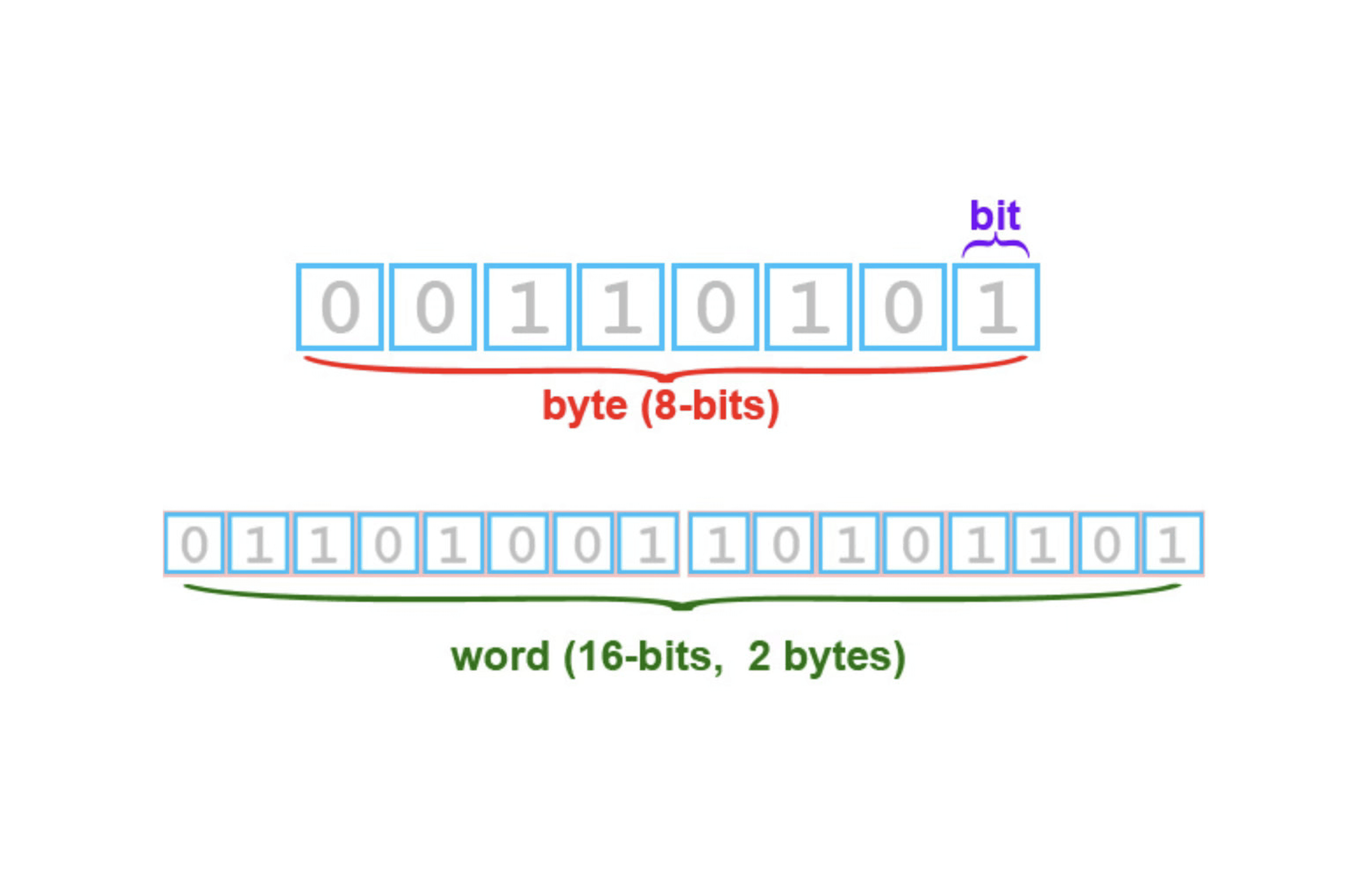
A bit is the smallest unit of digital information. A bit holds one of two possible values: 0 (off) or 1 (on). Everything on a computer, including every Bitcoin transaction ever made is ultimately built from combinations of these two states.
What Is a Byte?
A byte is a group of 8 bits. Rather than working with individual bits, computers group them into bytes because it's more practical at scale.
This means: 1 byte = 8 bits.
Most Bitcoin data is measured in bytes. Where a Bitcoin private key is 32 bytes, which is 32 × 8 = 256 bits.
That's where the term "256-bit security" comes from.
Where Does a Bitcoin Private Key Fit In?
A Bitcoin private key is simply a randomly generated 256-bit number.
That means it is 32 bytes of raw data, nothing more, nothing less. It has no special structure, no username, no registration process. Anyone who can generate a sufficiently random 256-bit number has a valid Bitcoin private key.
The range of possible private keys is so vast that it stretches beyond intuitive understanding. A 256-bit number does not simply represent “a lot” of possibilities but represents over 115 quattuorvigintillion distinct values (an extremely large number defined as 1 followed by 77 zeros).
That scale is so extreme that the odds of two people independently generating the same private key by chance are, for all practical purposes, zero.
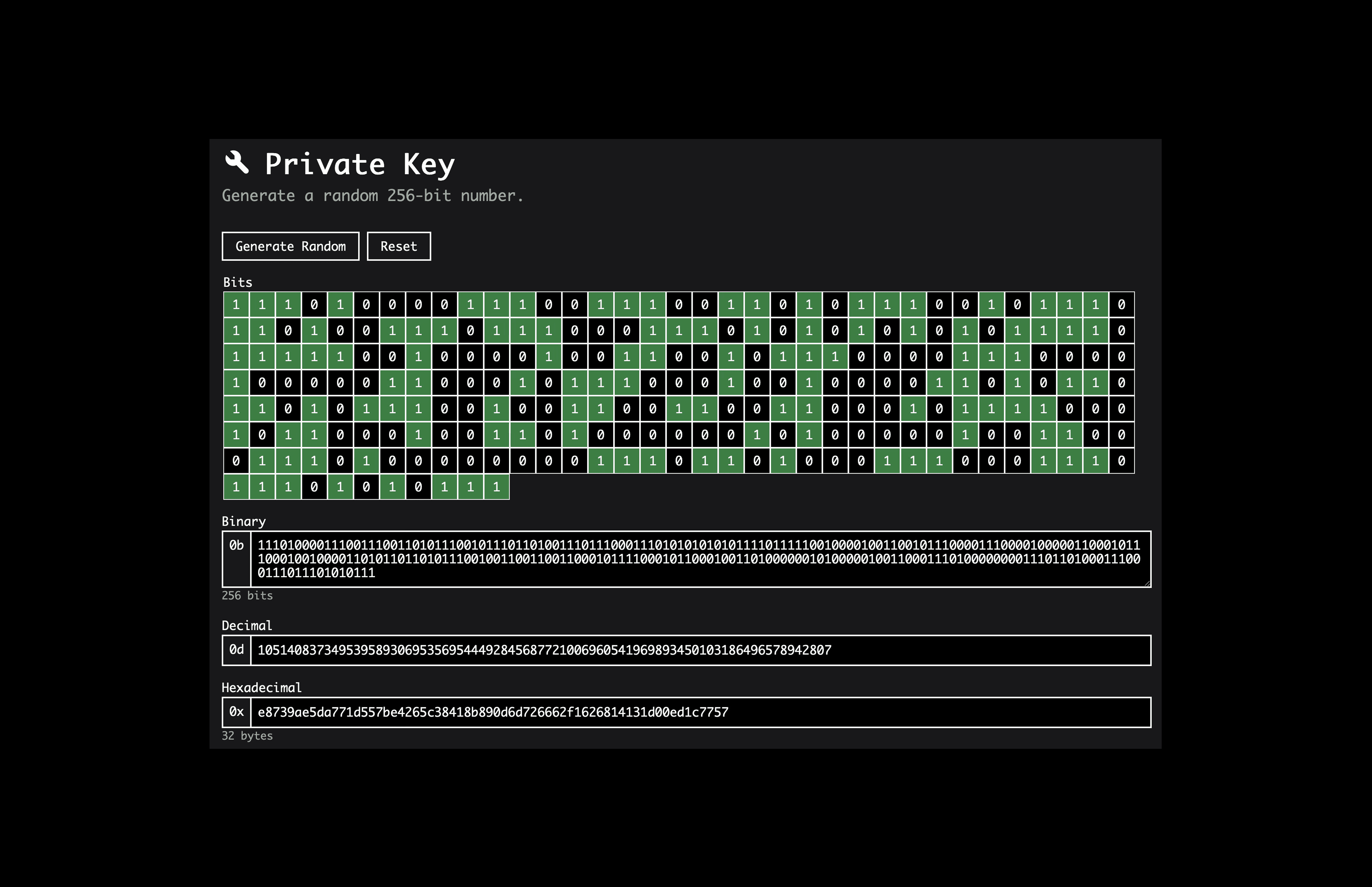
When a private key is generated using proper randomness, it is chosen from a space so astronomically large that brute-force guessing becomes functionally impossible. The limiting factor is never the size of the keyspace itself, it is only the quality of the randomness used to select from it.
This immense numerical scale is also what makes Bitcoin fundamentally permissionless. No institution issues accounts. No authority assigns ownership. The “account” is simply the key, created locally, independently, and controlled entirely by whoever possesses it.
Ownership is not granted by a third party; it exists by virtue of holding the key.
In other words, the security and sovereignty of a properly generated 256-bit private key do not rely on trust. An individual private key rests on a scale so vast that it places practical attack beyond reach and removes the need for permission altogether.
Hexadecimal: A Cleaner Way to Read Bytes
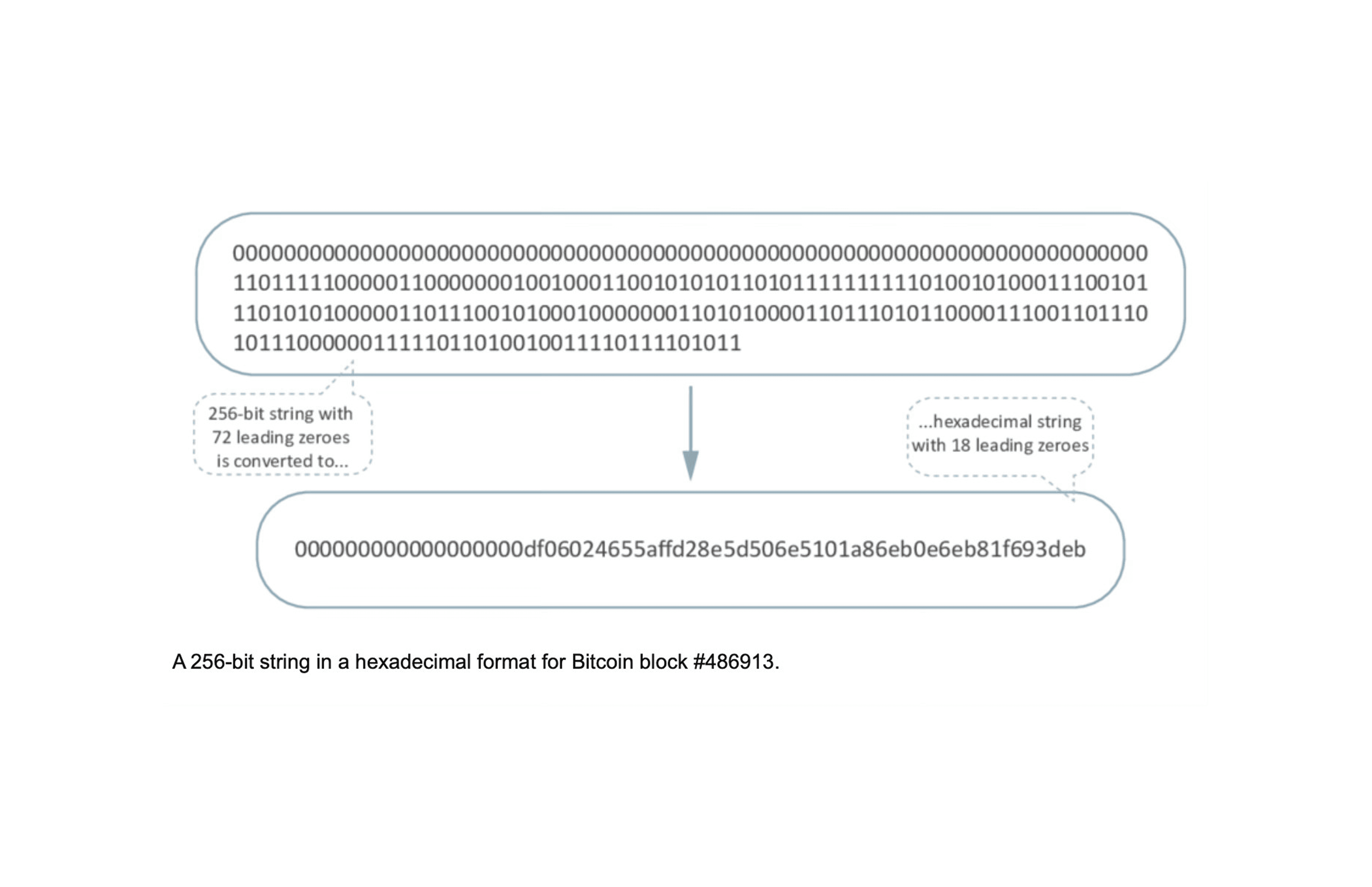
Writing out 8 ones and zeros for every single byte gets unwieldy fast. Hexadecimal (hex) solves this by using a base-16 number system:
0 1 2 3 4 5 6 7 8 9 A B C D E F
Each hex character represents exactly 4 bits, so two hex characters represent one full byte.
Here's how that looks in practice:
"0110" = 6
"1011" = B
"01101011" = 6B
Same data just far cleaner to read and work with.
Hexadecimal is case-insensitive. Whether written as 6B or 6b, the value is identical. Both are valid and Bitcoin software accepts either form, meaning it is purely a display preference.
What a Bitcoin Private Key Actually Looks Like
A raw private key looks something like this:
61 dc 9f f8 b1 54 50 21 29 70 c6 fa 99 73 38 bb
20 5d d4 8f fa ca 3a 05 6b 09 a3 b4 4a 24 4d 76
Note: the spaces shown above are for readability only. A private key in use is a continuous 64 character hexadecimal string with no spaces.
Each pair of characters is one byte. There are 32 pairs. Bitcoin software reads it as a raw byte array, not as characters, which is why encoding matters and why handling it incorrectly breaks everything downstream.
Why Bitcoin Private Keys Must Be Handled as Bytes, Not Text
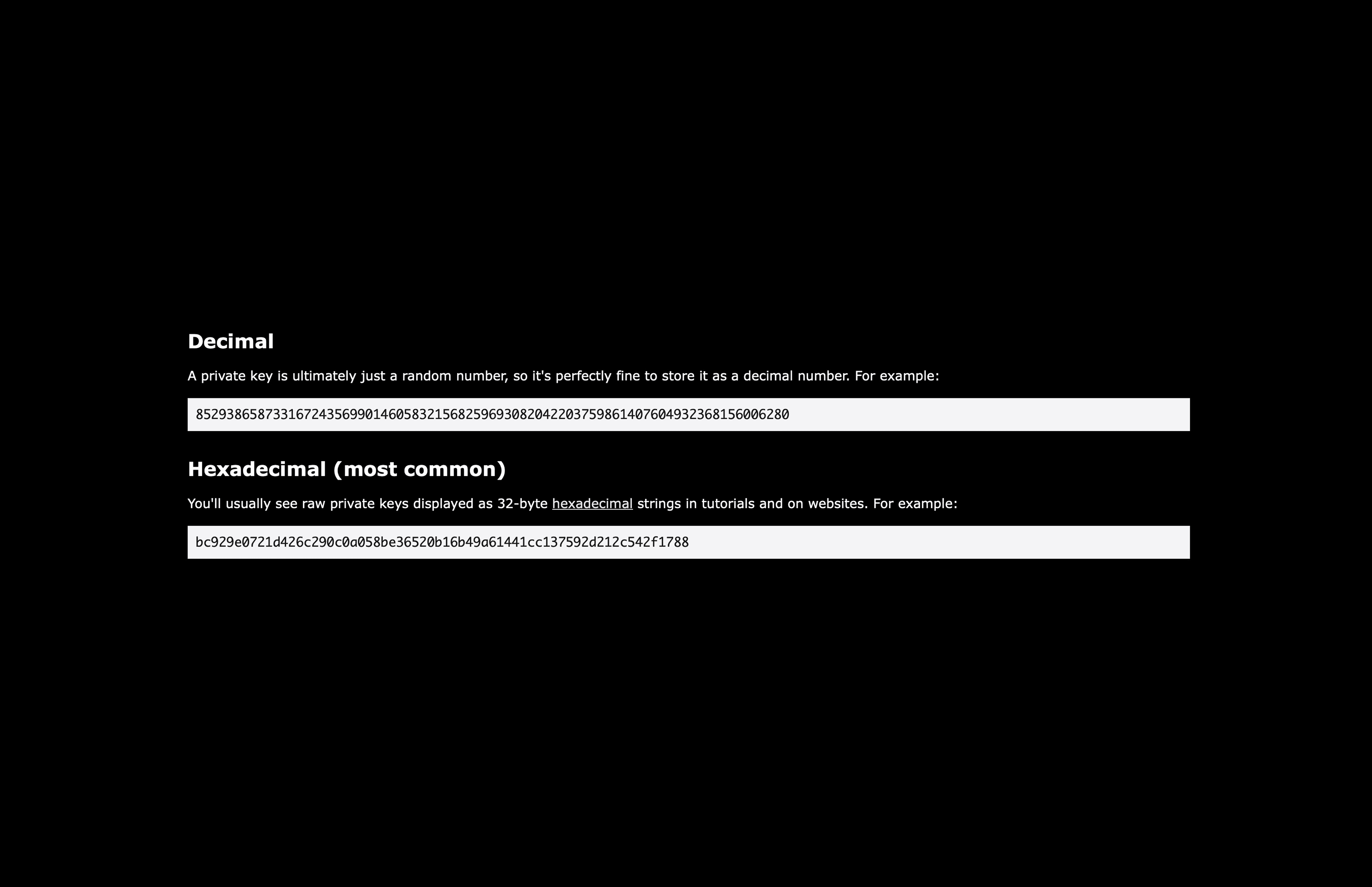
A private key displayed on screen looks like readable text, a string of letters and numbers that could be mistaken for a password. However, that string is only a representation.
The actual data underneath is raw bytes, and every cryptographic operation in Bitcoin works strictly at that level. Treating hex as text instead of converting it properly into bytes first will produce incorrect results, often without any obvious error.
Could Two Bitcoin Wallets Ever Share the Same Private Key?
In theory, if two people generated the same private key, both would control the same bitcoin wallet. Yet the scale of the 256-bit keyspace makes this so astronomically unlikely that it falls outside practical reality.
The number of possible private keys is so enormous that even if one million machines were each generating one million keys every second, it would still take far longer than the age of the universe to exhaust the full keyspace.
If someone were attempting to target a specific private key, they would, on average, need to search through half of all possible combinations before finding the correct one. At this scale, both accidental duplication and deliberate brute-force guessing are effectively impossible with any conceivable computing power.
Mathematics does not ask to trust it. The scale speaks for itself.
Private Key Security: What You Must and Must Never Do
A private key’s security depends entirely on how it is managed.
Creating the private key properly is only the first step, safeguarding the private key afterward is what truly protects a user's bitcoin. The guidelines below outline the difference between maintaining control and putting it at risk.
Must use a cryptographically secure random number generator: Most programming languages have a basic random function built in but basic is not good enough for Bitcoin. Use one specifically described as cryptographically secure, which pulls randomness from your operating system rather than a predictable pattern.
Must store the private key offline: Keep the private key in a location only the owner of the private key has access to. A key on an internet-connected device carries risk, and once it touches a network, the potential attack surface increases.
Must limit the key’s use to transaction signing: Signing transactions is its sole purpose. A well-designed Bitcoin wallet handles this internally, so the key does not need to be manually exposed during normal use.
Never enter the private key into any website: A site that requests a private key can log, store, or misuse it. There are no legitimate exceptions.
Never display the private key publicly: Not for support, not for verification, not for troubleshooting. Control of the key is control of the bitcoin.
Never speak your private key: Not for support, not out loud to anyone. Control of the key is control of the bitcoin.
Never use keys generated by online tools: If a website created the key, it may have retained a copy.
The mathematics behind Bitcoin make brute-force guessing infeasible. Human mistakes are usually the real vulnerability. Protect the key accordingly.
Conclusion
At its core, Bitcoin is simply structured digital data that follows strict rules. Once you understand bits, bytes, and hexadecimal encoding, much of the confusion disappears. Transaction parsing, private key handling, and reading raw blockchain data should start making more practical sense. You're no longer looking at random strings but at organized data with a defined structure.
This foundation is what everything else in Bitcoin builds on.
With it, you can begin examining raw transaction data and understand how private keys are represented and stored.
FAQ
What is a Bitcoin private key in terms of bits and bytes?
A Bitcoin private key is a randomly generated 256-bit number, which is exactly 32 bytes of raw data.
Why is hexadecimal used to represent Bitcoin private keys?
Hexadecimal provides a cleaner way to read bytes because each hex character represents 4 bits, so two hex characters represent one full byte, making raw data more readable and manageable.
Could two Bitcoin wallets ever share the same private key?
In theory it is possible, but the 256-bit keyspace is so astronomically large that accidental duplication or successful brute-force guessing is effectively impossible in practice.
Why must Bitcoin private keys be handled as bytes rather than text?
The displayed string is only a representation; the real private key is raw bytes, and all cryptographic operations work at the byte level, so hex must always be decoded into bytes before being used.
Disclaimer
The information provided in this article is for informational purposes only. It is not intended to be, nor should it be construed as, financial advice. We do not make any warranties regarding the completeness, reliability, or accuracy of this information. All investments involve risk, and past performance does not guarantee future results. We recommend consulting a financial advisor before making any investment decisions.
More like this
Written by

Andrew Kamsky
Andrew Kamsky is a Bitcoin analyst. He spent a decade in traditional finance across a Big Four firm and a listed fintech bank before going deep on Bitcoin full-time.