










Quick summary
Pendle splits yield-bearing assets into principal and yield tokens, enabling fixed and variable yield trading
Strategy's STRC preferred stock is brought on-chain via Saturn and Apyx as high-yield stablecoins
Pendle lists sUSDat and apyUSD pools at 16–18% yields, attracting growing STRC-linked TVL
Key drivers: STRC pool inflows, new STRC wrappers, dividend level, and PENDLE's multi-year price base
Pendle is a DeFi protocol that lets users trade future yield separately from the underlying asset generating it. One trader can lock in a fixed return. Another can speculate on whether future yields rise or fall. Until recently, Pendle was mostly used for crypto staking yields.That changed at Consensus 2026 when Michael Saylor, founder and executive chairman of Strategy, referenced Pendle as part of the growing ecosystem around STRC, Strategy’s yield-paying preferred stock tied indirectly to its Bitcoin treasury strategy.
In May 2026, two Pendle pools, Saturn's sUSDat and Apyx's apyUSD, both wrapping yield from Strategy's STRC instrument were paying 16%–18% annualised yield, verified live on DefiLlama. Most stablecoin pools were sitting around 5%. The article below explains how the yield is generated, why Saylor put Pendle on the Consensus 2026 stage, and what the on-chain data shows.
How Pendle Separates Yield From The Underlying Asset
Pendle takes a yield-bearing asset, such as staked Ethereum, an interest-bearing stablecoin, or a tokenized Treasury product and splits it into two tokens:
Principal token (PT): Represents the original deposited asset redeemable at maturity. PT buyers effectively lock in a fixed return if held until maturity
Yield token (YT): Represents the future interest, dividends, or yield generated by the asset until maturity. YT buyers profit if future yields rise and lose if yields fall.
The closest traditional finance comparison is stripped Treasury bonds, where the principal and interest payments trade separately. Pendle applies the same structure to crypto and tokenized real-world assets.
Why splitting matters:
Fixed-rate buyers get certainty: Instead of accepting a floating yield that drifts with market conditions, a PT buyer locks in the exact annualised return at the moment of purchase, the discount between what they pay and the token's face value at maturity is their yield, fixed from day one
Yield speculators get capital efficiency: A YT buyer receives all the floating yield generated by the underlying asset without committing the principal. If yields rise, YT becomes more valuable. The upside is amplified; the principal stays with the PT side
Liquidity providers earn swap fees: Pendle's AMM prices PT against the underlying asset, YT's value is implied from that spread. Liquidity Provider LPs earn fees from traders moving in and out of PT positions on both sides of the market. Pendle takes a separate protocol fee on each transaction on top.
PENDLE, the governance token, is locked into vePENDLE for voting rights and a share of protocol fees. The fee retention is unusually high, DefiLlama data shows Pendle routes 98.3% of fees to the protocol treasury rather than leaking to liquidity providers, which is one of the cleanest revenue capture rates in DeFi. Readers comparing this against other DeFi business models can find a breakdown in The Top 3 DeFi Protocols: Which One Actually Returns Money to Token Holders?
What Is STRC? Strategy’s Bitcoin-Backed Yield Instrument Explained
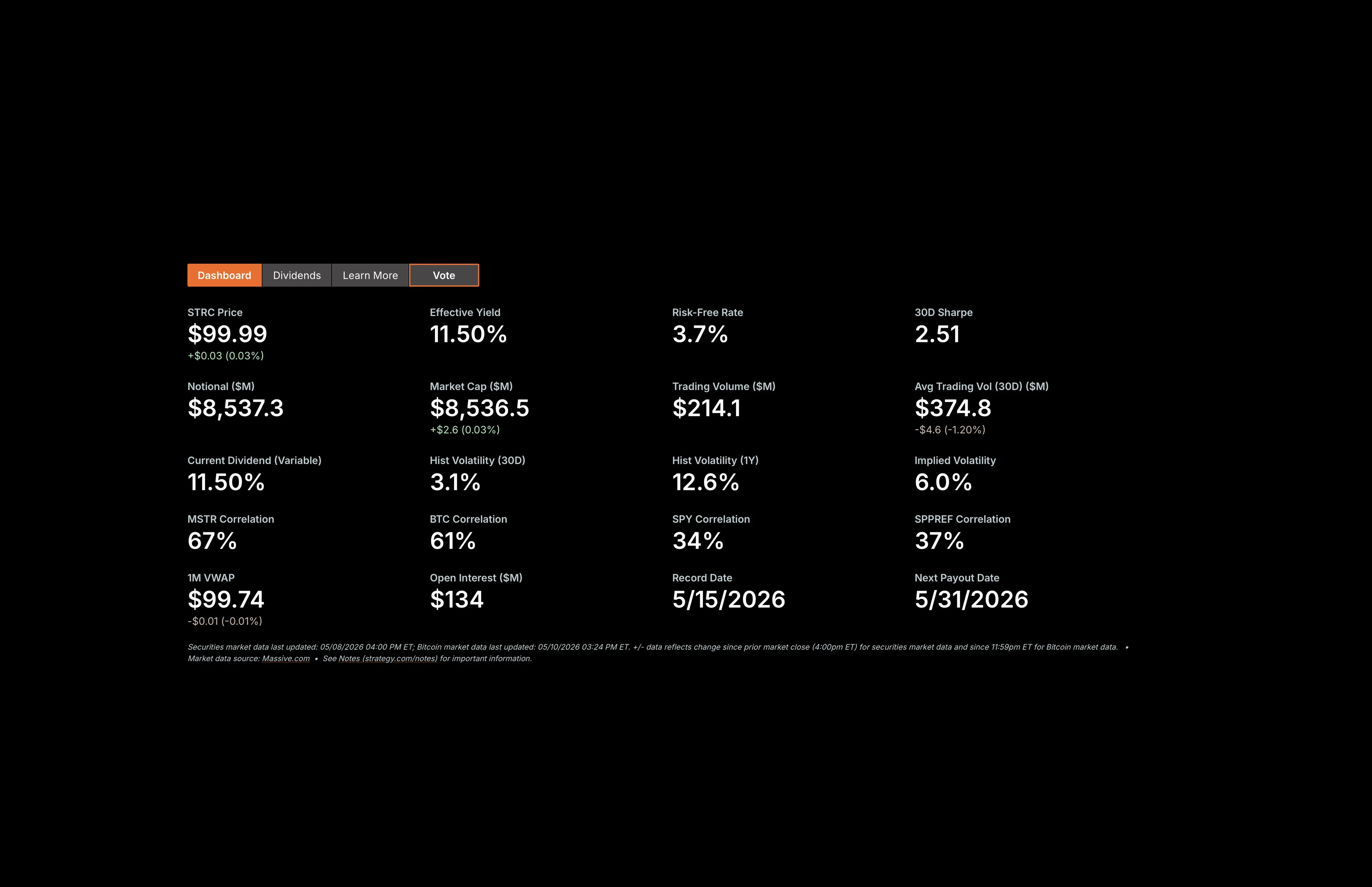
STRC is Strategy's perpetual preferred stock, listed on Nasdaq, paying a variable dividend currently set at 11.5% per year, distributed in monthly cash payments.
Strategy adjusts the rate to keep STRC trading near its $100 par value, dampening the volatility that defines its common stock MSTR. Proceeds from STRC issuance fund Strategy's ongoing Bitcoin accumulation.
For Bitcoiners unfamiliar with Saylor's capital structure beyond MSTR, the Coinjuice MSTR explainer covers how digital credit fits into the broader Strategy thesis.
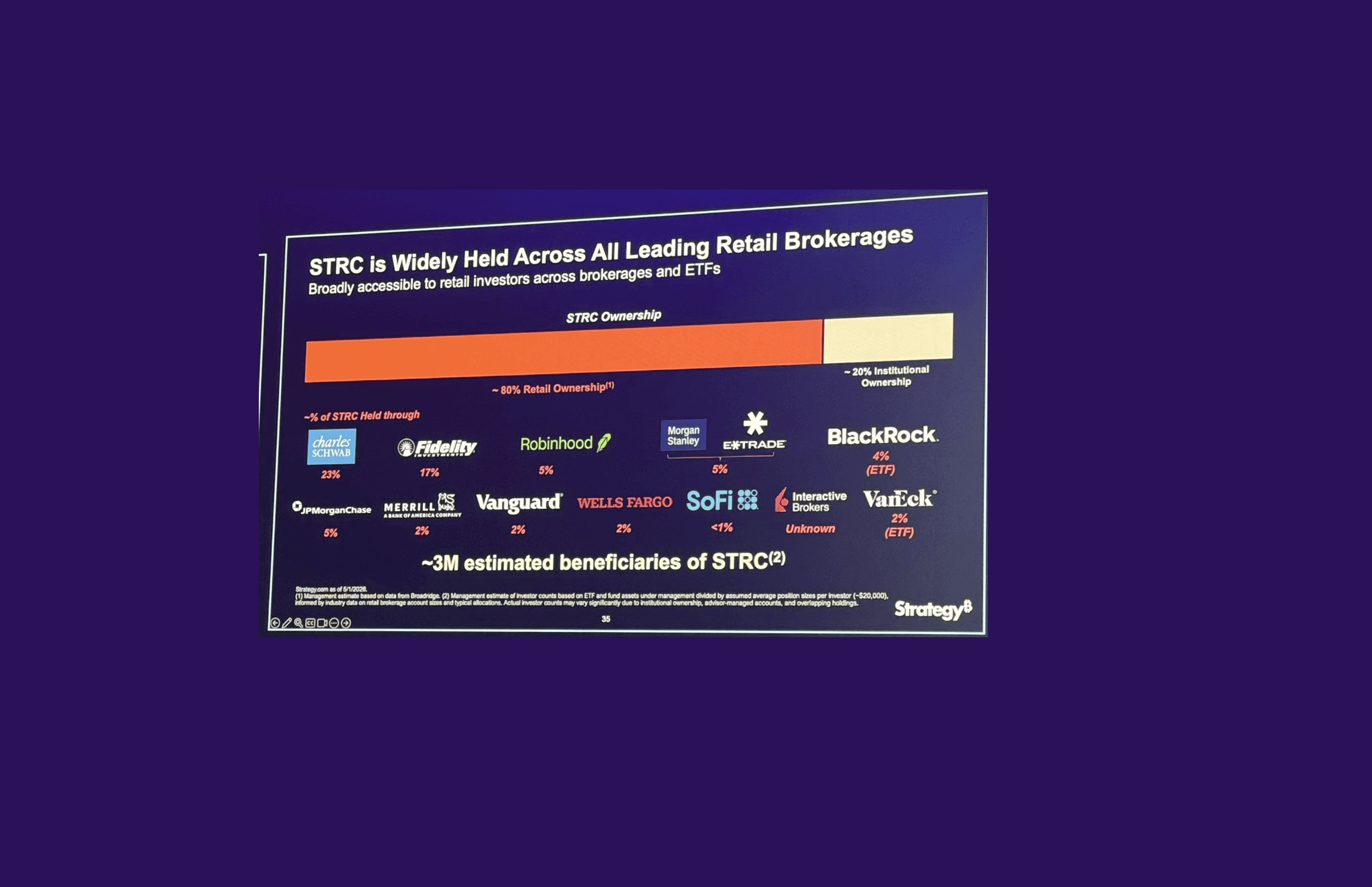
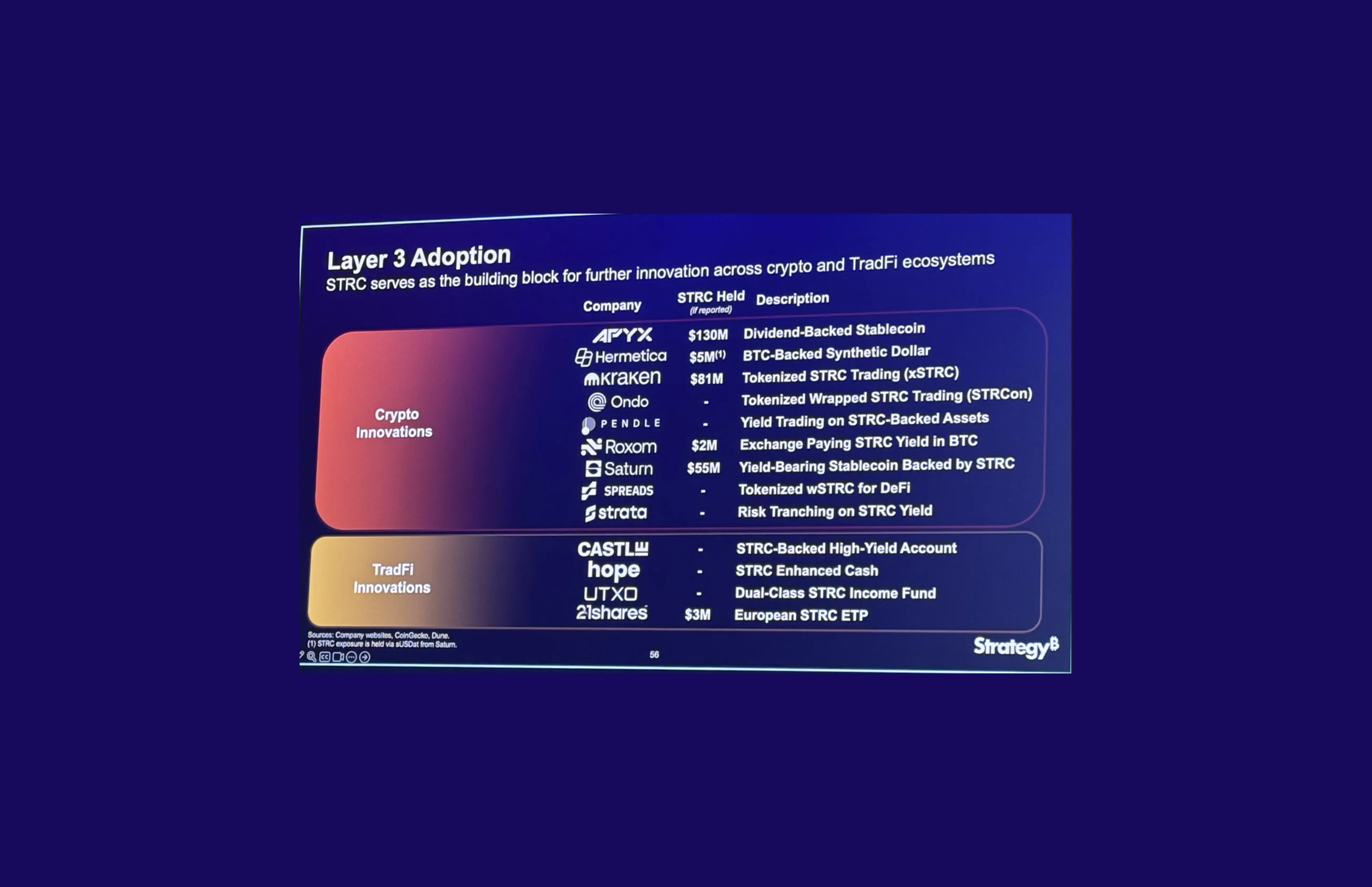
The benefit STRC offers a holder is straightforward: high monthly cash yield with limited price drift, backed by a company whose entire purpose is converting fiat into Bitcoin reserves. Roughly 80% of STRC holders are retail. According to Saylor's Consensus 2026 keynote, around $266 million of STRC has now been tokenized for on-chain use Apyx holds $130M, Saturn holds $55M, and Kraken's xSTRC product holds $81M. With most of the Apyx and Saturn flow reaching Pendle markets via two intermediary protocols.
How Saturn And Apyx Bring STRC Yield On-Chain
STRC itself is a Nasdaq-listed equity. It cannot live on Ethereum directly. Two protocols solved the wrapping problem.
Saturn issues sUSDat: A yield-bearing stablecoin backed by STRC dividend flows held off-chain. Holders earn the STRC dividend translated into stablecoin yield
Apyx issues apyUSD: An over-collateralised, dividend-backed stablecoin that accrues yield from STRC and similar publicly-listed preferred equity instruments. Because apyUSD is backed by more collateral than the stablecoins issued against it, the dividend yield concentrates, pushing the headline rate above the base STRC dividend.
Essentially, Apyx holds more STRC than the number of apyUSD tokens it creates. So all that extra dividend income gets shared among fewer tokens, making each token earn more yield than STRC actually pays out on its own.
Think of it like a pizza. STRC pays one pizza per person. But Apyx only gives out 8 slices instead of 10, so each person gets a bigger slice.
The benefit: A holder of apyUSD gets exposure to Strategy's Bitcoin-linked dividend yield, without owning a Nasdaq stock, opening a brokerage account, or touching a share certificate. Just a wallet and a stablecoin. And because Apyx issues fewer tokens than the collateral it holds, apyUSD was paying 18.12% in May 2026, above the 11.5% STRC dividend itself.
Both wrappers list on Pendle, where Pendle strips the principal from the yield. PT-sUSDat converts STRC's variable dividend stream into a fixed return until maturity. YT-sUSDat captures the variable rate exposure.
What this stack delivers to a yield buyer:
Variable becomes fixed: Strategy can adjust STRC's dividend month to month. PT tokens convert that variable cash flow into a known number, the difference between something a treasury can underwrite and something it cannot.
Off-chain becomes composable: Once tokenised, STRC yield can be combined with on-chain leverage, hedging, and lending positions. Apyx's headline 18% APY is the base STRC dividend concentrated through over-collateralisation, more collateral held than tokens issued, so each token earns a larger share of the same dividend pool.
Retail gets institutional access: Buying STRC directly requires a brokerage. Buying PT-apyUSD on Pendle requires a wallet.
In simpler terms: STRC pays a dividend that Strategy can adjust over time. Pendle freezes whatever that rate is into a fixed return so you know exactly what you'll earn. Apyx makes it bigger by spreading more collateral across fewer tokens. And instead of calling your broker, you just connect your wallet.
Why Apyx Returns Excess Yield Instead of Keeping It
Because if it did, apyUSD would yield the same as buying STRC through a broker and arguably nobody would use it. The over-collateralisation yield premium is the entire value proposition of the wrapper.
Apyx earns on protocol fees instead with small charges each time apyUSD is minted or redeemed. It is a steady, predictable income stream that grows as more users enter the protocol, without touching the yield at all. The more attractive the yield, the more holders.
The more holders, the more fee revenue. Passing the full yield through is not generosity but it is the business model.
How Saturn Passes STRC Yield Directly to sUSDat Holders
Saturn takes the simpler route with no amplification, just the base STRC dividend passed cleanly through sUSDat.
Where Apyx targets yield maximisers, Saturn targets holders who want direct, transparent exposure to the STRC dividend without the engineering layer. Less yield with more simplicity attracting a different buyer, not a worse product.
How Pendle Fits Into the STRC Yield Stack
Pendle is entirely separate from Saturn and Apyx. Saturn and Apyx are the issuers, they hold STRC off-chain, wrap the dividend into a stablecoin, and bring it on-chain.
Pendle is the marketplace that sits on top.
Pendle takes whatever yield-bearing token one gives it — sUSDat, apyUSD, or anything else — and splits it into a fixed leg and a variable leg. Pendle does not care where the yield comes from. Saturn and Apyx could disappear tomorrow and Pendle would still function with every other yield-bearing asset it lists. Three separate protocols, one connected stack.
Pendle’s STRC Markets By The Numbers
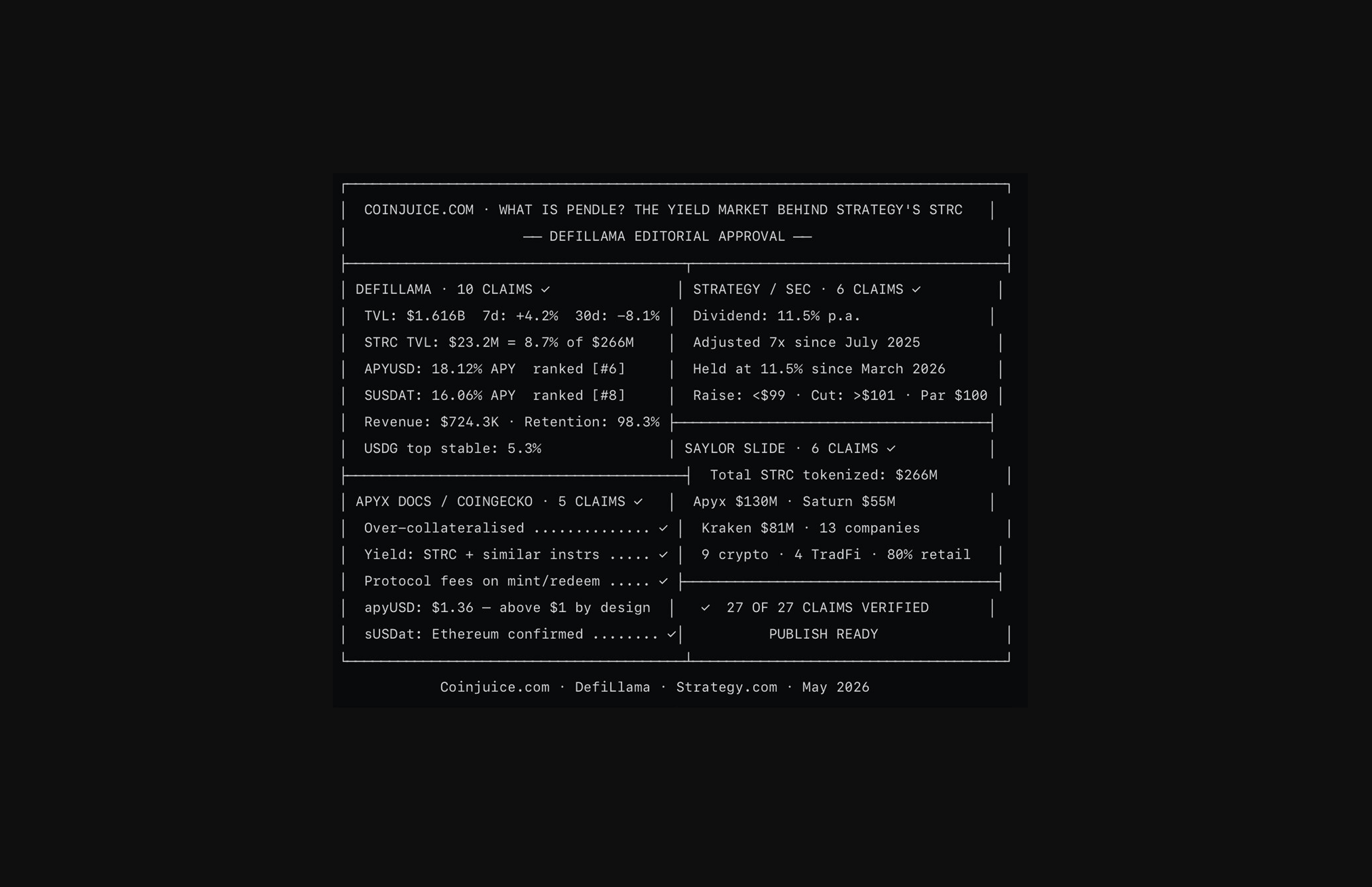
Data sourced from DefiLlama, May 10, 2026:
Pendle total TVL: $1.616B (recovering +4.2% over the past week after a 30-day pull-back of -8.1%)
Combined STRC-linked TVL on Pendle: ~$23.2M across the apyUSD and sUSDat main markets
Pendle share of all tokenized STRC: ~8.7% of the $266M cited on Saylor's slide
APYUSD market base APY: 18.12%
SUSDAT market base APY: 16.06% (18.47% including rewards)
30-day Pendle protocol revenue: $724.3K, with 98.3% fee retention
The chart below shows where STRC-linked pools rank against the rest of Pendle's top markets:
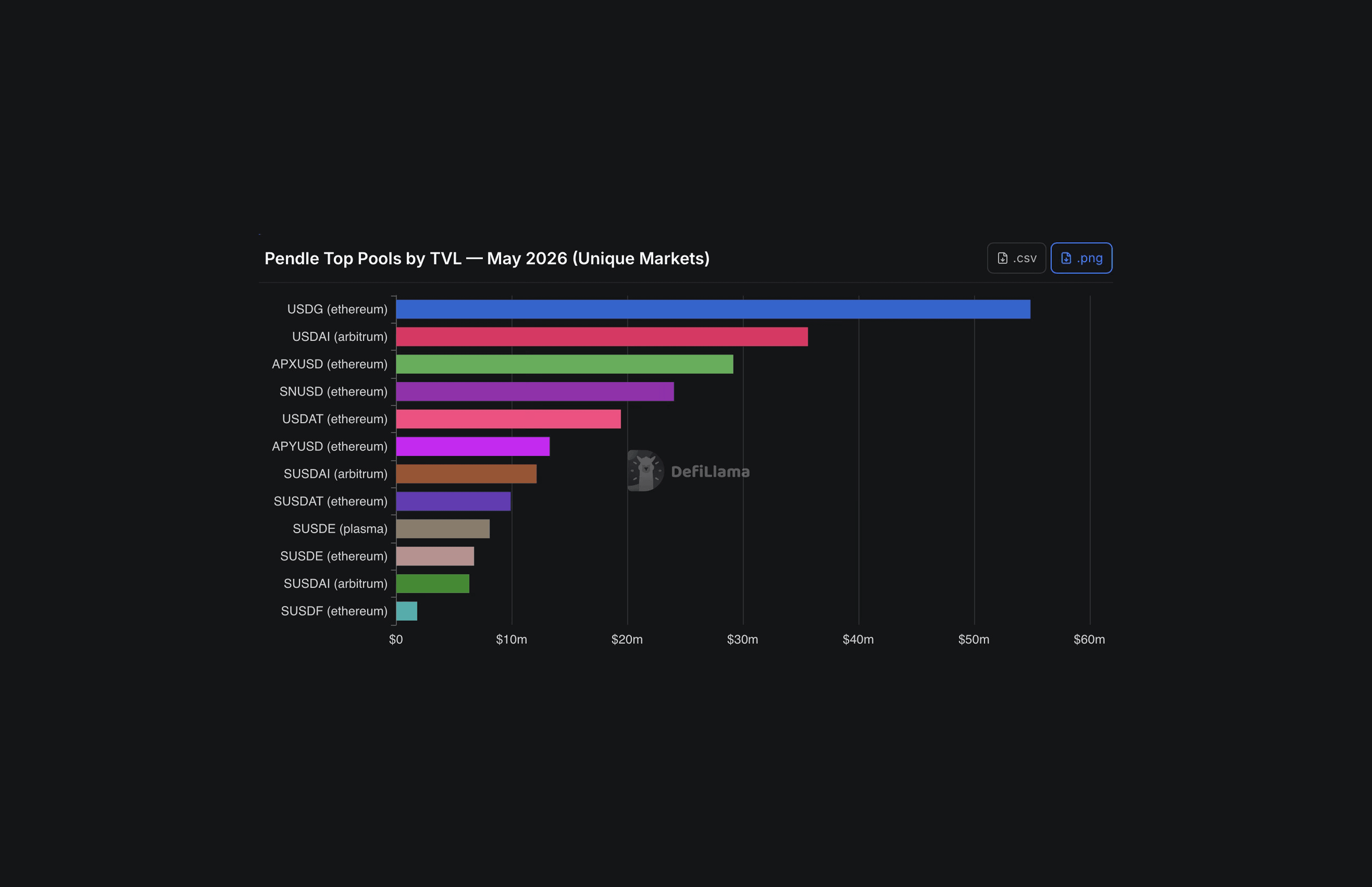
What the data shows: APYUSD and SUSDAT both rank inside Pendle's top 10, paying base yields nearly triple the leading stablecoin market USDG (5.3%). Keeping in mind that apyUSD trades above $1 by design because yield accrues into the token price rather than being distributed separately, so the price rising is the yield working as intended.
The benefit for readers tracking PENDLE: That growth happened while Pendle's overall deposits were shrinking. Money is rotating into the STRC pools even as money rotates out of older yield products. The story underneath the chart is a rotation, not a retreat.
Why the high yields matter:
Buyers want certainty: A 16–18% rate is rare. Anyone earning it wants to lock it in before it drops
Locking it in means buying a PT token: That is the only way to fix the rate to maturity
More PT buyers means more trading on Pendle: More trading means more fees for the protocol.
The chain is simple: High yields attract buyers, buyers use Pendle to lock the rate, Pendle's markets grow, and PENDLE captures the fees.
Why Michael Saylor Named Pendle At Consensus 2026
Saylor's Consensus 2026, keynote placed Pendle inside what he called the Yieldcoin ecosystem, a three-layer stack where Bitcoin sits at the base as Digital Capital, STRC in the middle as Digital Credit, and Pendle at the top as Digital Money and Yield, alongside Apyx, Saturn, Kraken, Ondo, and others.
The takeaway: Pendle has been recast as financial infrastructure for Bitcoin's monetisation layer. The venue where dividend streams from Strategy's Bitcoin treasury get priced and locked in on-chain.
Catalysts Supporting Further Upside in Pendle (PENDLE)
Three things to watch that would tell readers whether this is just a Saylor moment or the start of something bigger:
More money flowing into Pendle's STRC pools: Right now, only $23M of the $266M tokenized STRC sits on Pendle. If that climbs past $100M, Pendle stops being a niche staking venue and becomes the main venue for trading Bitcoin-linked yield. More money on Pendle means more fees, which means more value flowing to PENDLE holders.
More companies wrapping STRC for on-chain use: Saylor's slide named 13 companies building on STRC. Only two, Apyx and Saturn, are live on Pendle so far. Every new wrapper that launches is a new yield product Pendle can list. The more products, the more fees Pendle earns.
Whether Strategy keeps the STRC dividend high: STRC pays 11.5% per year right now. If Strategy raises it, Pendle yields go up and more buyers pile in. If it drops, Pendle yields shrink and the appeal fades. Watching STRC's monthly dividend is the simplest way to track whether the trade still works.
The STRC dividend moves on a simple rule: Strategy raises it when STRC trades below $99 to attract buyers back toward par, and lowers it when STRC climbs above $101 because demand is strong enough without the extra incentive. The target is always $100 and the dividend is the dial Strategy turns to keep it there.
Risks To Watch Before Trading PENDLE Or STRC Wrappers
Stacking yield means stacking risk. Every protocol added between the reader and STRC's dividend is another point of failure. Five risks deserve attention before sizing any position:
STRC's dividend is not guaranteed: If Bitcoin drops hard and Strategy's balance sheet tightens, the board can pause payments. No dividend means no yield for sUSDat or apyUSD, and Pendle's STRC pools fall with it. Every other risk below assumes the dividend keeps flowing
More layers, more bugs: Buying STRC through a broker carries one risk being Strategy itself. Buying PT-apyUSD on Pendle carries three: Strategy, Apyx, and Pendle. Holding PT-sUSDat adds Saturn as a fourth. Each layer is fresh code that has not been stress-tested through a full crypto cycle
Off-chain custody can break: Saturn and Apyx hold STRC at brokerages and issue tokens against it. If the custodian freezes or fails, the on-chain tokens lose their backing
Leverage loops can cascade: Some traders use PT-apyUSD as collateral on Morpho to borrow USDC, then redeploy into more PT positions. If STRC drops on an ex-dividend day, those loops can unwind fast and drag the whole pool with them
PT only fixes the rate if held to maturity: Selling early means accepting whatever the secondary market offers, which during stress can be well below the rate originally locked in.
Anyone treating these markets as fixed income should read How to Audit Crypto Infrastructure in 2026 before sizing positions.
Pendle (PENDLE) Price Analysis And Key Levels Snapshot 2026
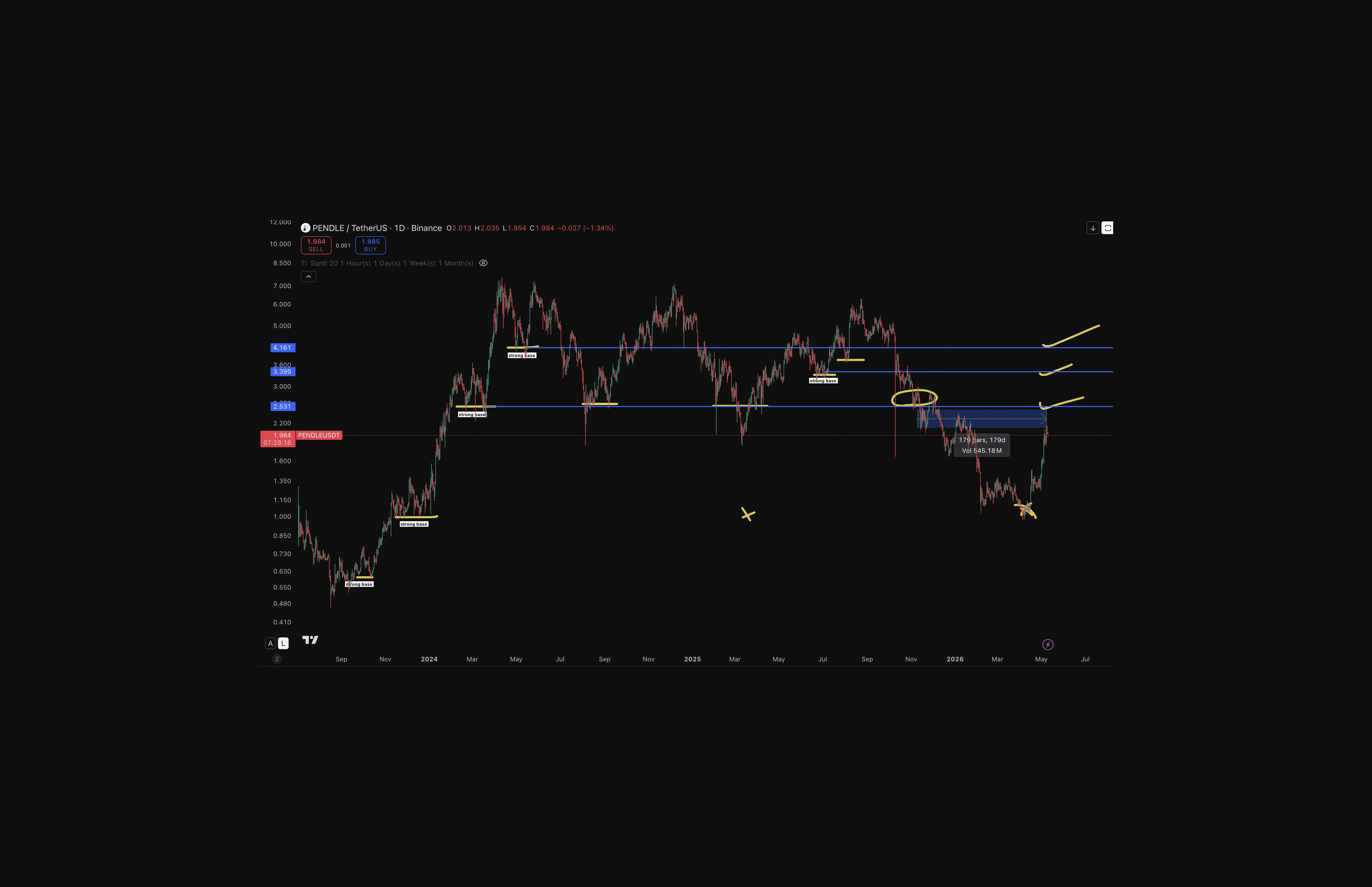
PENDLE has built three stacked bases over the past three years:
$2.53: Held as support through 2024 and most of 2025
$3.40: Formed mid-2025 as TVL grew
$4.16: The upper rejection zone since May 2024
PENDLE spent 179 days below the $2.53 base before reclaiming it on the recent move. As of May 2026, it trades at $1.98, just below that level on retest. In QFL terms, the previous support is now the floor for the next leg up.
The two bases above it are the targets: $3.40 and $4.16.
For readers who want to learn how to spot these setups themselves, the Coinjuice ebook breaks the framework down chart by chart. The framework behind this read is covered in QFL Strategy: How to Trade Panic Selling in Crypto Without Leverage.
Conclusion
Saylor's Consensus slide listed Pendle inside Strategy's STRC ecosystem, opening up a far larger addressable market than the liquid staking yield Pendle has historically served.
The data already shows the integration working: STRC-linked pools are top-10 within months, paying yields three times the leading stablecoin market, with $23M of capital that did not exist on Pendle a year ago. The chart shows PENDLE reclaiming a multi-year base as the fundamentals strengthen.
Four things to watch over the next two quarters: how much money flows into Pendle's STRC pools, how many new companies wrap STRC for on-chain use, whether Strategy keeps the dividend at 11.5%, and whether PENDLE holds the $2.53 level on retest. Those numbers will tell the story better as me move forward.
FAQ
How does Pendle separate yield from the underlying asset?
Pendle takes a yield-bearing asset and splits it into two tokens: a Principal Token (PT), which represents the original deposited asset redeemable at maturity, and a Yield Token (YT), which represents the future interest, dividends, or yield generated by the asset until maturity.
What is STRC and how is its dividend managed?
STRC is Strategy's perpetual preferred stock listed on Nasdaq, paying a variable dividend currently set at 11.5% per year in monthly cash payments. Strategy adjusts this rate to keep STRC trading near its $100 par value, raising it when STRC trades below $99 and lowering it when STRC trades above $101.
How do Apyx and Saturn bring STRC yield on-chain?
Saturn issues sUSDat, a yield-bearing stablecoin backed by off-chain STRC dividend flows, passing through the base STRC dividend. Apyx issues apyUSD, an over-collateralised, dividend-backed stablecoin holding more STRC than the tokens it issues, so dividend income is concentrated and apyUSD can yield more than STRC itself.
Why are Pendle’s STRC-linked pools attracting attention?
In May 2026, Pendle’s STRC-linked pools using apyUSD and sUSDat were paying around 16%–18% annualised yield, nearly triple the leading stablecoin market on Pendle, and had grown to about $23.2M TVL, ranking inside Pendle’s top 10 markets while overall protocol deposits had recently pulled back.
Disclaimer
The information provided in this article is for informational purposes only. It is not intended to be, nor should it be construed as, financial advice. We do not make any warranties regarding the completeness, reliability, or accuracy of this information. All investments involve risk, and past performance does not guarantee future results. We recommend consulting a financial advisor before making any investment decisions.
More like this


Written by

Andrew Kamsky
Andrew Kamsky is a Bitcoin analyst. He spent a decade in traditional finance across a Big Four firm and a listed fintech bank before going deep on Bitcoin full-time.