













Quick summary
MSTR is Strategy’s stock, with valuation closely tied to its large Bitcoin treasury holdings
The stock trades more like a leveraged Bitcoin-sensitive instrument than a traditional software equity
Michael Saylor leads the Bitcoin treasury strategy and functions as a central narrative driver
Strategy issues multiple preferred securities to fund long-duration Bitcoin exposure and shape trading dynamics
MSTR is the publicly traded equity of Strategy, a company that originated as an enterprise analytics and business intelligence provider and later evolved into a large scale Bitcoin treasury operator. The stock trades on traditional equity markets while representing a balance sheet that is heavily concentrated in Bitcoin.
What is MSTR
What makes MSTR structurally different from most equities is that its market value reflects not only operating performance, but also the value, financing, and market perception of its Bitcoin holdings. As a result, the stock often behaves less like a conventional software company and more like a high sensitivity instrument tied to Bitcoin price, liquidity, and sentiment.
Over time, MSTR has become one of the most actively watched equities among traders who want exposure to Bitcoin related volatility within equity market infrastructure.
Who Is Michael Saylor
Michael Saylor is an American entrepreneur and billionaire business executive, and the co-founder and Executive Chairman of Strategy. He is the architect of the company’s Bitcoin treasury approach, with his influence most visible in capital allocation decisions and long-term balance sheet philosophy rather than in day-to-day software operations.
For traders, Saylor matters less as a traditional executive and more as a narrative anchor. His consistency, public presence, and framing of Strategy as a digital credit platform contribute to attention, participation, and liquidity. Traders are trading the company story, positioning, and flow.
What Is Strategy as Digital Credit
Strategy positions itself as a digital credit vehicle built on Bitcoin. Rather than acting like a passive holder, the company uses traditional financial instruments to transform demand for yield, volatility exposure, and equity participation into long duration Bitcoin ownership. On February 10, 2026, Strategy hold 714,644 BTC.
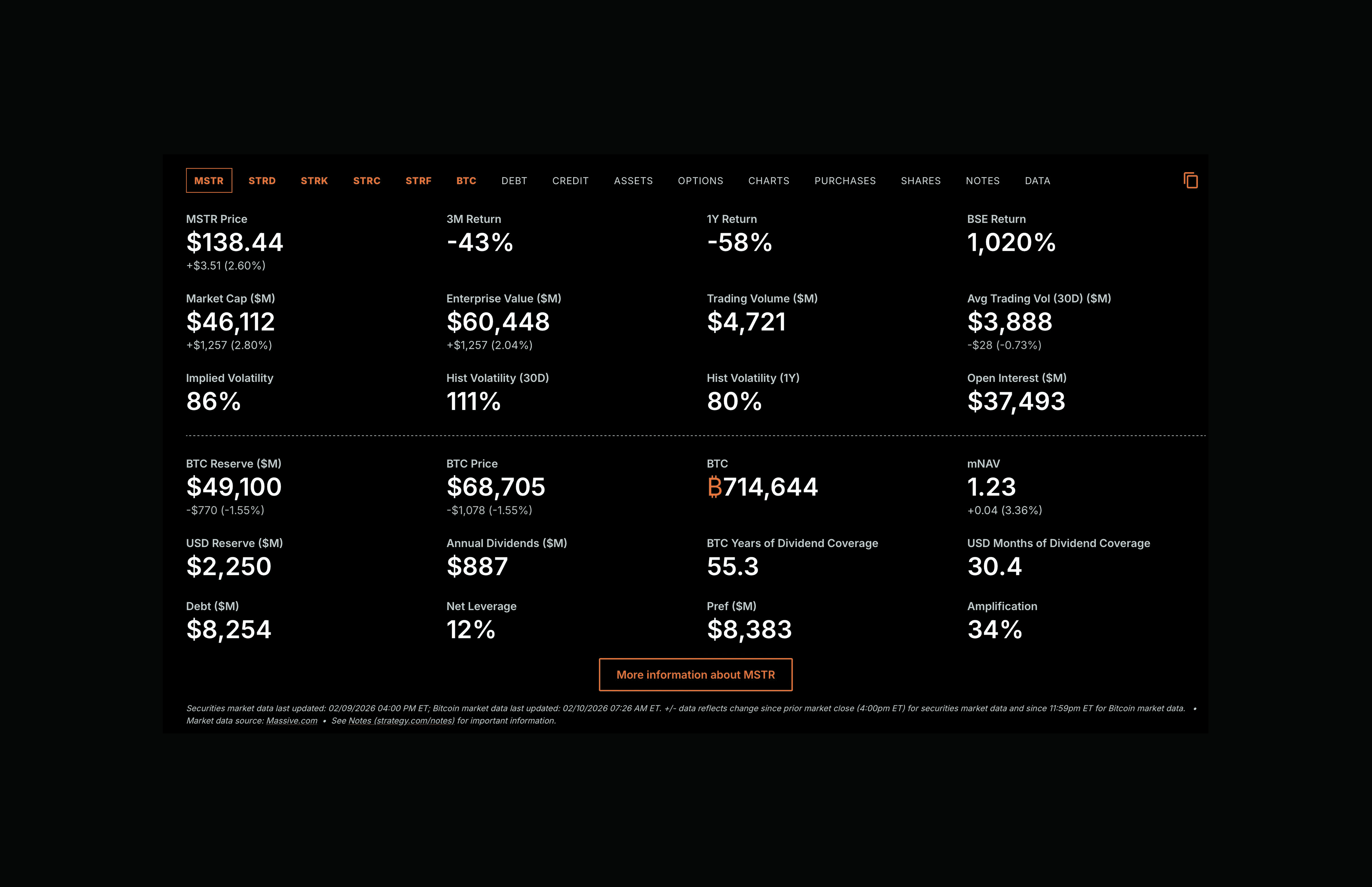
These instruments include:
STRK (Strike Preferred Stock): A Bitcoin backed hybrid preferred share that pays a fixed annual dividend and offers optional conversion into MSTR equity at defined quarterly windows, combining income with conditional equity upside.
STRF (Strife Preferred Stock): A senior fixed yield preferred share designed for income focused investors, offering a higher coupon with no equity conversion and enhanced dividend protection through an escalating coupon mechanism if payments are missed.
STRD (Stride Preferred Stock): A junior high yield non cumulative preferred share structured for risk tolerant investors, providing elevated income potential with flexible redemption features and lower priority in the capital stack.
STRC (Credit Preferred Stock): A Bitcoin backed preferred security positioned as part of Strategy’s digital credit framework, designed to extend the capital stack by converting overcollateralized Bitcoin reserves into yield bearing equity instruments while preserving full BTC ownership at the corporate level.
In practice, this means raising capital through equity, preferred style instruments, and convertible structures, then allocating a significant portion of that capital into Bitcoin while servicing obligations through cash flow, dividends, or structured payouts. The Bitcoin treasury functions as a long life reserve asset, while the capital structure around it behaves like a credit system layered on top.

The image above explains why Strategy increasingly resembles a financial platform rather than a pure operating company, and why its stock trades with characteristics that feel closer to derivatives, leverage, and credit sensitivity than to classic software peers.
Why MSTR Has Become a Trading Vehicle
Bitcoin is increasingly treated by many market participants as a strategic hold. MSTR, by contrast, has evolved into a repeatable trading instrument. The reason is structural more than speculative.
Why trade MSTR
MSTR has evolved into a favored trading vehicle because it concentrates Bitcoin sensitivity, equity market structure, and capital flow dynamics into a single, highly liquid stock.
Volatility: MSTR consistently exhibits larger percentage moves than Bitcoin during active market phases.
Catalyst density: Price action can be driven by Bitcoin moves, financing announcements, earnings, disclosures, and equity market flows.
Liquidity: The stock trades on major equity venues with deep participation during active sessions.
Structure: Capital raises, convertibles, and preferred instruments introduce recurring repricing events that create opportunity.
Narrative momentum: The digital credit framing attracts attention cycles that can reinforce trends.
Why MSTR is so volatile
MSTR’s volatility is structural, emerging from the interaction between a Bitcoin-heavy balance sheet, an active capital structure, and continuous repricing by equity and derivatives markets.
Balance sheet sensitivity: Large Bitcoin exposure directly links equity value to Bitcoin price expectations.
Capital structure dynamics: Financing instruments change supply, demand, and hedging behavior around the stock.
Premium repricing: The market frequently adjusts how much it is willing to pay above or below underlying asset value.
Flow amplification: Options activity and institutional positioning can accelerate moves in both directions.
Reporting impact: Updated accounting treatment under FASB fair value standards reduces earlier asymmetries, but earnings and disclosures still influence short term perception and price response.
Why Some Traders Choose MSTR Instead of Bitcoin to Trade
Bitcoin and MSTR increasingly serve different purposes within trading and portfolio construction.
Why trade MSTR instead of Bitcoin
Market access: MSTR trades through standard equity brokerage infrastructure.
Tooling: Shares and listed options allow structured expressions of risk.
Regulatory simplicity: Equity exposure fits more easily within many institutional and retail frameworks.
Event driven setups: MSTR responds to a broader set of triggers than Bitcoin alone.
Time horizon flexibility: Bitcoin is often treated as a long duration allocation to protect against money printing, while MSTR may be treated as a tactical instrument.
This distinction is why many participants hold Bitcoin while actively trading MSTR around it.
The Role of the Operating Business of Strategy
The analytics and software segment continues to operate in the background. It provides revenue, cash flow, infrastructure, and corporate continuity. While it is not the primary driver of short term price movement, the operating business of Strategy contributes to the company’s ability to function as a digital credit platform rather than a single asset shell.
In strong market phases, this layer is often ignored. In weaker phases, it becomes part of the company’s stability narrative.
Where to Trade MSTR
MSTR is listed on NASDAQ and is accessible through most platforms that support US equities.
Common platforms that provide access
Interactive Brokers: Broad international access to US equities and options.
Saxo: Multi asset platform with US equity access.
Swissquote: International brokerage with US equity availability.
DEGIRO: Access varies by region, commonly offers US equities.
Trading 212: Access varies by region.
eToro: Equity access varies by account type and region.
Revolut: Equity access available in many regions, features vary by plan.
Robinhood: Provides access to MSTR and Strategy preferred securities.
Availability of options, margin, and specific instruments depends on jurisdiction and account type. Disclaimer: Availability changes and readers should verify directly. If you are looking for a trading framework check out our Hot to Trade Without Levearge eBook.
Risks Associated with Trading MSTR
MSTR’s structural strengths as a trading vehicle also introduce distinct risks that traders should account for before taking positions.
Bitcoin price exposure: The stock is highly sensitive to Bitcoin. Sustained BTC declines directly compress equity value, with limited offset from operating performance.
Dilution risk: Ongoing capital raises through equity, convertibles, and preferred securities can dilute shareholders and alter per-share economics over time.
Premium compression: MSTR often trades above the implied value of its assets. That premium can contract rapidly during risk-off periods, independent of Bitcoin price moves.
Gap risk: Bitcoin trades continuously while MSTR trades during equity market hours, creating exposure to overnight and weekend price gaps.
Capital structure complexity: Multiple layers of equity and preferred instruments introduce cross-dependencies that can trigger unexpected repricing across the stack.
Regulatory and accounting sensitivity: Evolving regulatory, tax, and accounting frameworks can influence reported results and market perception despite improved fair-value treatment.
Narrative dependence: Price action is partly driven by market narratives around Bitcoin adoption, digital credit framing, and leadership positioning, which can reverse quickly.
Single-name concentration: Trading MSTR concentrates exposure in one company, adding management, financing, and execution risk on top of Bitcoin volatility.
Conclusion
MSTR occupies a unique position in public equity markets, part Bitcoin proxy, part capital structure experiment, part trading vehicle. For traders, its value lies not in any single characteristic but in the convergence of volatility, liquidity, catalyst density, and structural complexity.
Understanding what drives the stock requires looking beyond Bitcoin price alone and into the financing, flow, and narrative dynamics that surround Strategy. Whether used as a tactical instrument or studied as a case in digital credit design, MSTR rewards attention to structure.
FAQ
What is MSTR and how is it structurally different from most equities?
MSTR is the publicly traded equity of Strategy, whose balance sheet is heavily concentrated in Bitcoin. Its market value reflects both operating performance and the value, financing, and market perception of its Bitcoin holdings, so it behaves less like a conventional software stock and more like a high-sensitivity instrument tied to Bitcoin price, liquidity, and sentiment.
Who is Michael Saylor and why do traders care about him?
Michael Saylor is an American entrepreneur, billionaire business executive, and the co-founder and Executive Chairman of Strategy. He designed the company’s Bitcoin treasury approach, and for traders he serves as a narrative anchor whose consistency, public presence, and framing of Strategy as a digital credit platform help drive attention, participation, and liquidity in MSTR.
What does it mean that Strategy operates as a digital credit vehicle built on Bitcoin?
Strategy uses traditional financial instruments—such as Bitcoin-backed preferred stocks like STRK and STRC, income-focused preferreds like STRF, and high-yield junior preferreds like STRD—to raise capital and convert demand for yield, volatility exposure, and equity participation into long-duration Bitcoin ownership, with Bitcoin serving as a long-life reserve asset and the surrounding capital structure functioning like a credit system layered on top.
Why might traders choose MSTR instead of Bitcoin as a trading instrument?
Traders may choose MSTR because it trades through standard equity brokerage infrastructure, offers shares and listed options for structured risk, fits more easily into many regulatory frameworks, responds to a wider set of catalysts than Bitcoin alone, and is often treated as a tactical trading instrument while Bitcoin is treated as a long-duration allocation.
Disclaimer
The information provided in this article is for informational purposes only. It is not intended to be, nor should it be construed as, financial advice. We do not make any warranties regarding the completeness, reliability, or accuracy of this information. All investments involve risk, and past performance does not guarantee future results. We recommend consulting a financial advisor before making any investment decisions.
More like this
Written by

Andrew Kamsky
Andrew Kamsky is a Bitcoin analyst. He spent a decade in traditional finance across a Big Four firm and a listed fintech bank before going deep on Bitcoin full-time.