








Quick summary
GoMining launched GoBTC, a layer-one Bitcoin payment protocol for instant, low-fee point-of-sale payments
GoBTC uses a 2-of-3 multisig wallet, keeping user control while relying on GoMining co-signing
Merchants pay a 0.2% fee, split equally between GoMining pool miners and integrating wallets
Open APIs and tools target broad wallet and merchant adoption, with full toolkit by June 2026
GoMining argues that Bitcoin has never functioned as a practical payment method at the point of sale and that every attempt to fix this has introduced trade-offs that undermined the protocol's core principles. Its answer is GoBTC, a layer-one Bitcoin payment protocol launched at Consensus Miami on May 5, 2026.
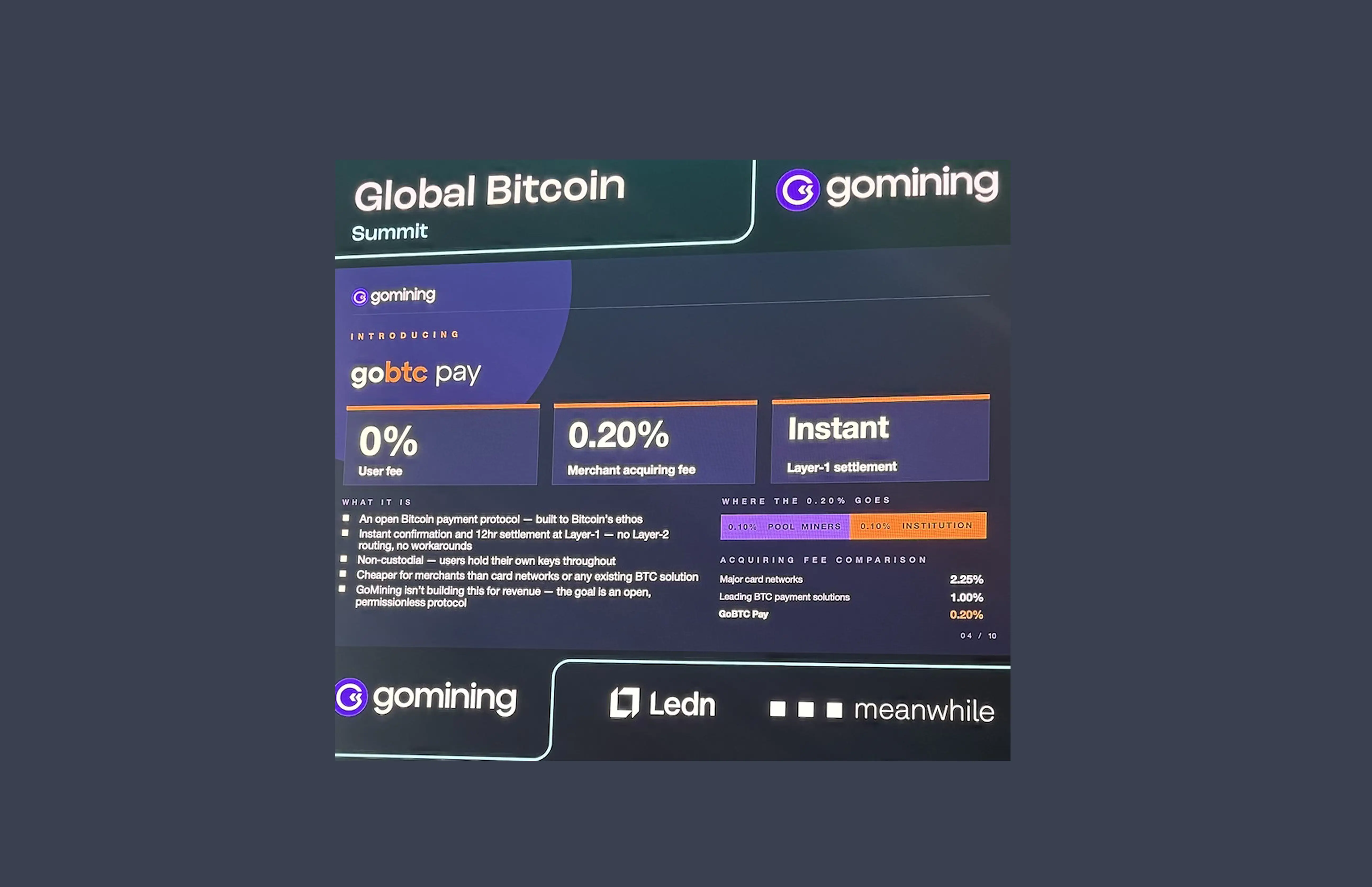
The protocol offers instant transaction authorisation, zero fees for users, and a 0.2% merchant acquiring fee, with no bridges, no layer-two routing, and no full custodial handover of user keys.
What GoBTC Is and How It Works
GoBTC allows consumers to pay merchants with Bitcoin at the point of sale. Payments are free for the user. Merchants pay a 0.2% acquiring fee below the 1.5% to 3.5% range traditional card processors charge in the US market.
GoBTC uses a 2-of-3 multi-signature wallet model that divides transaction control between three parties, each holding one key:
User key: Held by the user and required for all normal transactions.
GoMining key: Co-signs transactions during standard operation.
Recovery key: Held by a regulated third-party custodian. Active only if GoMining ceases operations. GoMining intends to place this key under regulatory supervision market by market, referencing the CFPB in the US and the FCA in the UK.
How GoBTC Enables Instant Bitcoin Payments for Merchants and Point-of-Sale Transactions
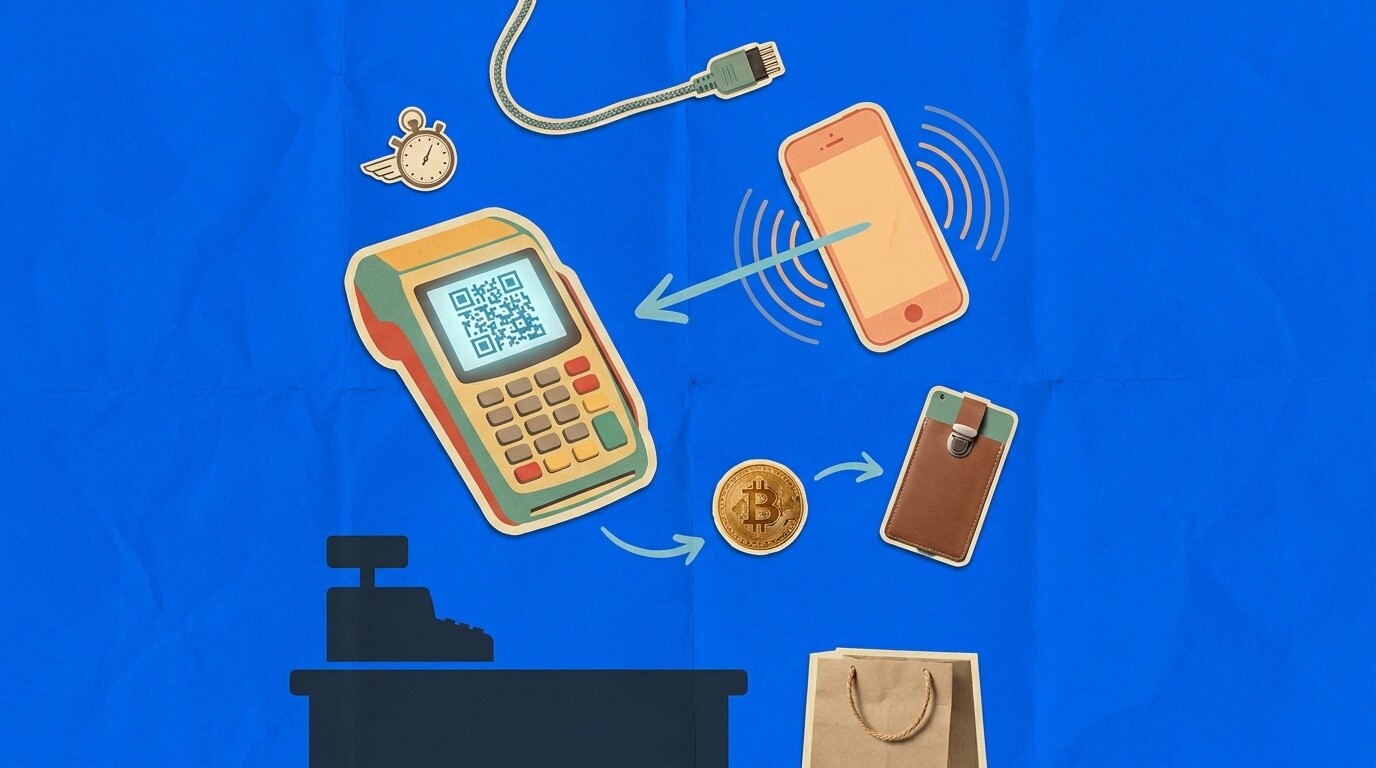
The system is designed to make Bitcoin payments feel as fast and simple as using a bank card, allowing merchants to receive immediate payment confirmation while the transaction settles on the blockchain afterward.
Key mechanics:
Instant authorisation: Transactions are confirmed immediately via the dual-signature process, then queued for the next block GoMining's pool mines
On-chain settlement: At current mining capacity, GoMining expects to mine approximately one block every nine hours by the end of 2026, targeting a 12-hour final on-chain settlement
Fee management: Because GoMining mines its own blocks, it controls the fee attached to each transaction, removing fee volatility from the user and merchant experience
Native Bitcoin only: No wrappers, no layer-two routing, no asset conversions. Transactions settle as native BTC on the Bitcoin blockchain
Security and Trust Model Behind GoBTC’s Bitcoin Payment System
Unlike fully custodial payment systems, GoBTC is designed so users still retain control over their own Bitcoin rather than handing complete ownership to a third party. The third-key recovery mechanism is designed so that no single party, including GoMining, can permanently block access to user funds.
The protocol still depends operationally on GoMining co-signing each transaction.
Users cannot transact unilaterally, both the user key and GoMining's key are required to move funds during normal operation. The third key only becomes relevant as a recovery option, not as a routine signing party. GoMining's position is that placing the recovery key with a regulated custodian — and eventually under direct government regulatory supervision — mitigates the counterparty risk introduced by the co-signing dependency.
Whether that structure satisfies users who hold self-custody as a non-negotiable principle is a question the protocol will face as it scales.
Bitcoin Point of Sale 2026: Where Things Stand
GoMining's case for GoBTC rests heavily on the argument that earlier Bitcoin payment attempts failed. The company points to two persistent problems: confirmation times and fee volatility.
On these points, the record broadly supports its position. The Lightning Network, introduced in 2018, was designed to solve instant Bitcoin payments. According to figures cited by GoMining, seven years later it reached $1 billion in monthly volume but its average transaction of $223 reflects exchange-to-exchange flows rather than retail purchases.
The company also cites approximately 22% of US adults owning Bitcoin, against only around 2,300 US businesses accepting it directly.
GoMining's diagnosis of prior failure modes:
Routing complexity: Layer-two solutions added technical overhead that made merchant and wallet adoption difficult
Custodial trade-offs: Most payment solutions require users to surrender key control at odds with Bitcoin's self-custody principle
No retail traction: Despite functional engineering, prior solutions did not reach meaningful point-of-sale adoption.
GoBTC Fees Explained: What Merchants and Miners Earn
GoMining distributes the 0.2% merchant acquiring fee entirely back into the ecosystem. The company retains nothing on transactions processed through third-party wallets, a deliberate choice to accelerate external wallet integration.
Fee split:
50% to miners: Half goes to the miner within GoMining's pool that finds the block and closes the transaction, an additional revenue stream on top of standard Bitcoin block rewards
50% to wallet providers: The initiating wallet receives half the fee, incentivising third-party wallets, Trust Wallet, MetaMask, hardware wallets, banking apps to integrate GoBTC and route transactions through the protocol.
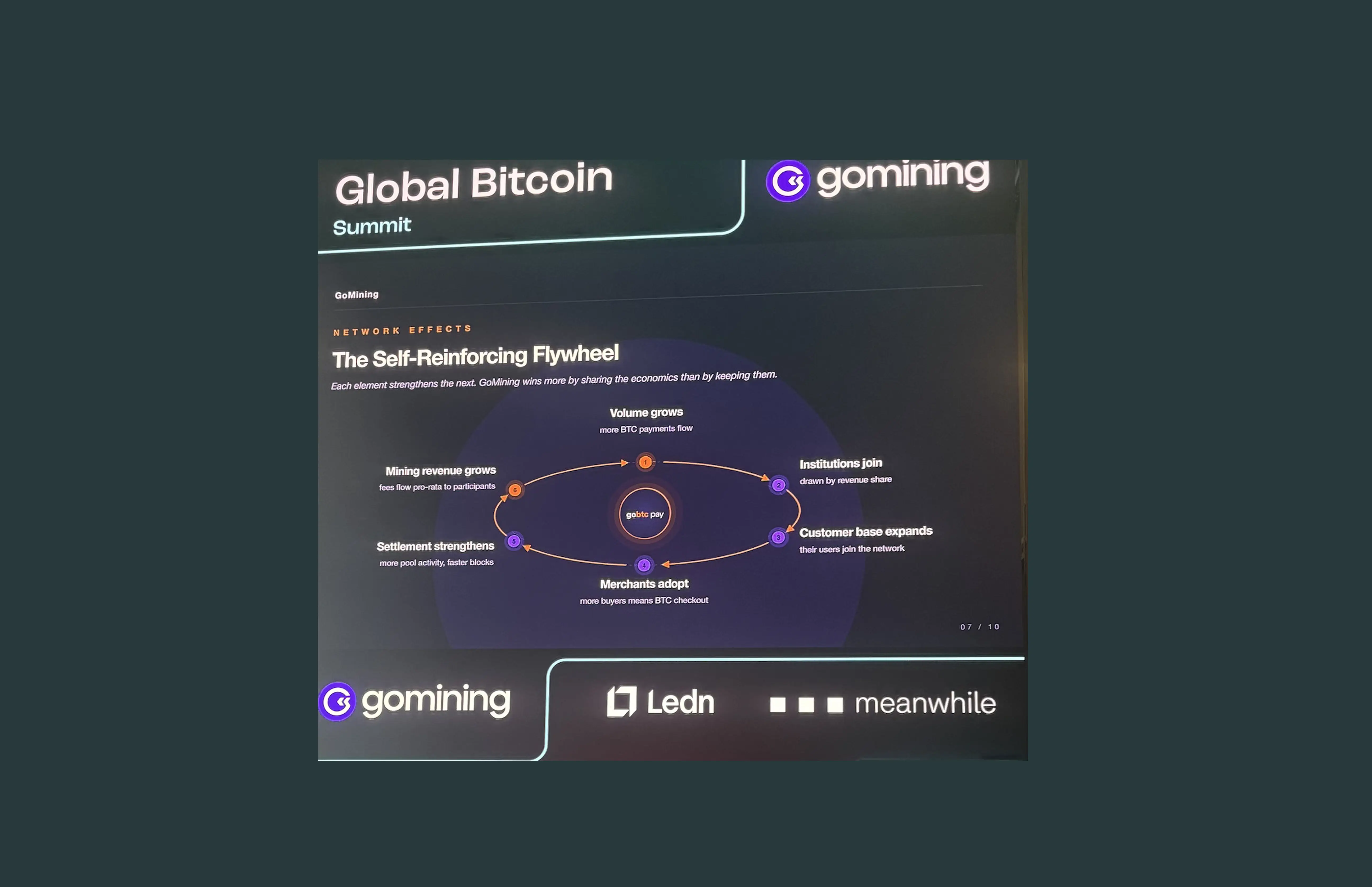
The structure attempts to align incentives at each layer of the stack: as volume grows, miners earn more from transaction fees and wallets earn more from the payments they process, which in turn draws more merchant adoption.
GoMining's position as a top-ten Bitcoin miner by hashrate — currently managing over 15 exahash, with a further 20% capacity increase expected within weeks of the launch — gives the company direct control over block production rather than dependence on third-party pools. That distinction matters: without mining infrastructure, the fee-management and settlement mechanics the protocol relies on would not be replicable in the same form.
How GoBTC Works as Open Bitcoin Infrastructure
GoMining has positioned GoBTC as open infrastructure. Any wallet can integrate via open APIs and an open SDK. GoMining operates the reference implementation and the mining pool, but the company says it does not intend to gatekeep access to the protocol.
Which means any wallet provider — custodial or non-custodial — can connect to GoBTC and offer instant Bitcoin payments to their users without GoMining's approval.
Speaking at Consensus 2026, CEO Mark Zalan framed the long-term goal as community ownership. By 2027, GoMining intends for GoBTC to be owned and maintained by the broader Bitcoin ecosystem — with the company as a participant rather than a controller. A single-link wallet integration is in development and expected within two to three months.
GoBTC for Merchants: Fees, Tools, and Launch Dates
For merchants, GoBTC functions as a Bitcoin-native acquiring network. On a $100 transaction, the merchant retains $99.80. Merchants can receive BTC directly to their own wallet, or use GoMining's custodial merchant product, which offers yield on BTC held during the settlement window and a fiat off-ramp.
Product rollout timeline:
May 5, 2026: QR-code payments live at a branded concession stand at Consensus Miami. New users receive 26,000 satoshis (approximately $20) toward their first transaction
Coming months: NFC functionality, Shopify and WooCommerce plugins, a dedicated point-of-sale terminal, web merchant dashboard, and developer SDK
Second half of June 2026: Full merchant toolkit including dashboards, APIs, and fiat on-ramps
Ongoing: P2P payments between users, and expansion of GoMining's US data center capacity toward a 1 GW compute target combining Bitcoin mining and AI workloads.
Conclusion
GoBTC is a direct attempt to fulfill the original Bitcoin whitepaper's description of a peer-to-peer electronic cash system. Whether it succeeds depends on adoption by wallets, by merchants, and by the mining community willing to treat payment fee revenue as a meaningful second income stream.
GoBTC is designed so that everyone involved — wallets, miners, and merchants — has a financial reason to participate. But the protocol still relies on GoMining to co-sign every transaction and mine the blocks that settle them. Whether that dependency eases as the network matures is the question worth watching.
Watch for: third-party wallet integrations in the next 90 days, the June merchant toolkit launch, and whether GoMining's pool scales to the sub-12-hour settlement window targeted by end of 2026.
FAQ
What is GoBTC and what problem is it trying to solve?
GoBTC is a layer-one Bitcoin payment protocol that enables consumers to pay merchants with Bitcoin at the point of sale. It aims to make Bitcoin practical for everyday payments by offering instant transaction authorisation, zero fees for users, and a low 0.2% merchant acquiring fee, without using bridges, layer-two routing, or full custodial control of user keys.
How does GoBTC’s 2-of-3 multi-signature wallet model work?
GoBTC uses a 2-of-3 multi-signature wallet where control is split between three keys: a user key held by the user and required for normal transactions, a GoMining key that co-signs transactions during standard operation, and a recovery key held by a regulated third-party custodian that becomes active only if GoMining ceases operations. During normal operation, both the user key and GoMining’s key are required to move funds.
How are fees structured for GoBTC transactions and who receives them?
Users pay no fees, while merchants pay a 0.2% acquiring fee, which is lower than typical card processor fees in the US. This 0.2% fee is distributed entirely back into the ecosystem: 50% goes to the miner within GoMining’s pool that finds the block and closes the transaction, and 50% goes to the initiating wallet provider.
How does GoBTC provide instant payments while settling on-chain as native Bitcoin?
GoBTC provides instant authorisation by confirming transactions immediately via a dual-signature process and then queuing them for the next block mined by GoMining’s pool. Transactions settle on the Bitcoin blockchain as native BTC, with GoMining targeting a roughly 12-hour final on-chain settlement window by the end of 2026. Because GoMining mines its own blocks, it controls the transaction fees attached, removing fee volatility for users and merchants.
Disclaimer
The information provided in this article is for informational purposes only. It is not intended to be, nor should it be construed as, financial advice. We do not make any warranties regarding the completeness, reliability, or accuracy of this information. All investments involve risk, and past performance does not guarantee future results. We recommend consulting a financial advisor before making any investment decisions.
More like this


Written by

Andrew Kamsky
Andrew Kamsky is a Bitcoin analyst. He spent a decade in traditional finance across a Big Four firm and a listed fintech bank before going deep on Bitcoin full-time.