









Quick summary
Midnight is Cardano’s privacy layer enabling selective disclosure instead of fully public blockchains
It combines a public ledger with an off-chain private execution layer using zero-knowledge proofs
Developers build privacy-preserving apps in TypeScript, hiding ZK complexity under the hood
Two-token system: NIGHT for governance and DUST for predictable, regenerating transaction resources
Every blockchain today has the same problem. Everything is public.
Who sent it. How much. When. All visible to anyone who cares to look. That works fine for moving Bitcoin around. It does not work for a hospital storing patient records, a fund hiding its trading strategy, or a business sharing contract terms with one partner, not the whole internet.
Midnight is Cardano's answer to that problem. For readers following Cardano's broader decentralization and governance buildout — covered in detail here — Midnight is the next layer of that infrastructure story.
What Midnight Actually Does
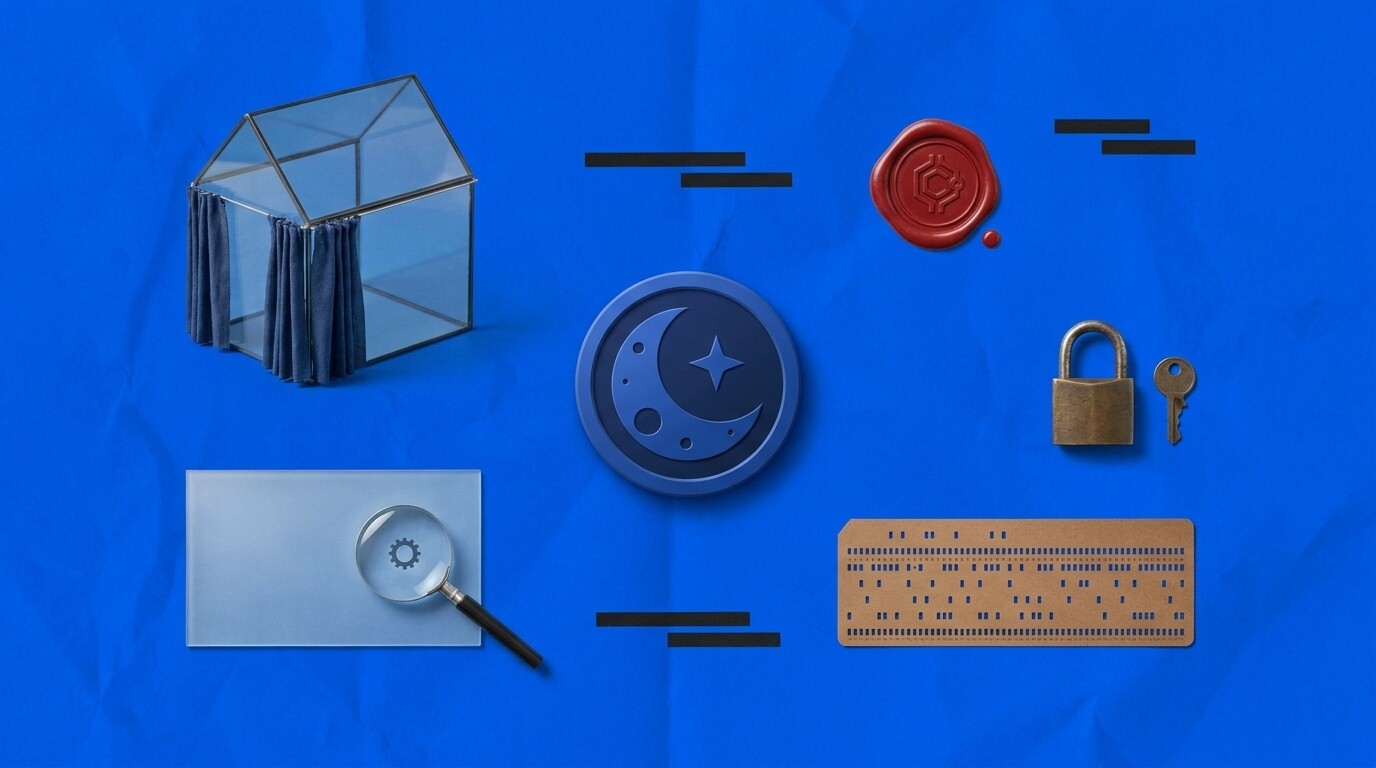
Most blockchains expose everything by default. Midnight introduces the option to restrict what is visible, to whom, and when. Most blockchains are glass houses. Midnight adds curtains but only where needed. Not everything is hidden. Not everything is public. Just enough of each.
The technical term is selective disclosure: show the right people the right information, and nothing more. This means:
Public ledger: A standard blockchain layer open, verifiable, unchanged
Private execution layer: Transactions are processed off-chain. Only a cryptographic proof of the result is submitted on-chain with no underlying data exposed.
The mechanism enabling this is zero-knowledge proofs (ZKPs): a method of proving something is true without revealing the data behind it:
Real-world example (banking): A lender can confirm a borrower meets income requirements without accessing a full salary history.
Real-world example (regulation): A regulator can audit a transaction without accessing every detail of the trade.
This is why Hoskinson calls it "rational privacy" not anonymous by default, but private where it matters.
Who Actually Builds on NIGHT
Institutions don't build directly but developers do.
Most privacy-focused chains require deep cryptography expertise just to get started. Midnight sidesteps this by using a TypeScript-based smart contract stack. TypeScript is one of the most widely used languages in web development. Developers already know it. The ZK complexity is handled under the hood, so builders can deploy privacy-preserving applications without needing a cryptography degree first.
That developer accessibility is arguably Midnight's strongest adoption lever.
The NIGHT and DUST Token System
Midnight runs on two tokens and understanding both matters:
NIGHT: The governance and consensus token. Fixed supply of 24 billion. Held for voting rights, block production rewards, and ecosystem access. Public and tradeable on major exchanges
DUST: The transaction resource. Not bought on an exchange generated passively by holding NIGHT. The more NIGHT held, the more DUST produced over time.
The practical benefit: transaction costs become predictable. Businesses building on Midnight don't face volatile fee markets. DUST regenerates like a refilling meter rather than a one-time spend, a meaningful design choice for enterprise budgeting.
How It Connects to Cardano
Midnight is not competing with Cardano. It is secured by it.
At launch, Midnight uses Cardano's existing Stake Pool Operators as validators, the same decentralized node network underpinning Cardano's governance architecture. NIGHT also launched natively on Cardano before migrating to the Midnight mainnet, with a bridge locking tokens on one chain when active on the other.
For ADA holders and SPOs, Midnight is an expanded utility for infrastructure already running.
Where Things Stand for Midnight in 2026
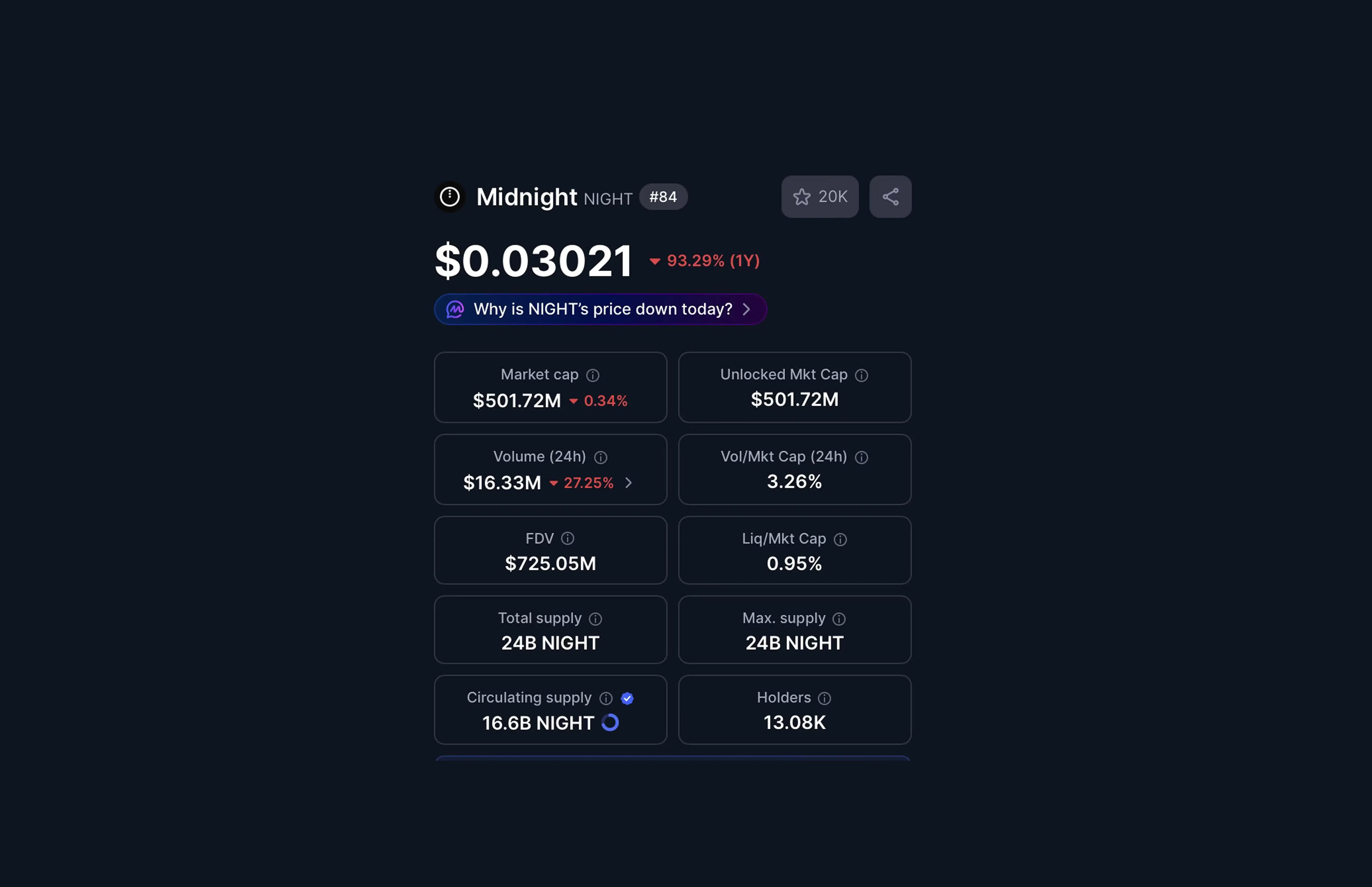
Mainnet went live March 31, 2026. Google and Vodafone came on as initial validators via enterprise infrastructure partnerships, institutional names that carry weight for a project pitching regulated use cases. So far, price has tracked distribution mechanics more than network usage. NIGHT hit an all-time high of $0.12 shortly after launch before fading to ~$0.031 today.
The primary headwind is structural: the Glacier Drop airdrop distributes tokens in quarterly installments through December 2026, creating steady sell pressure as tranches unlock. Watch developer activity and DUST usage as the leading indicators of whether the adoption thesis is real.
Hoskinson is expected to unveil four new R&D directions including a DeFi privacy kernel and a consensus upgrade called Minotaur.
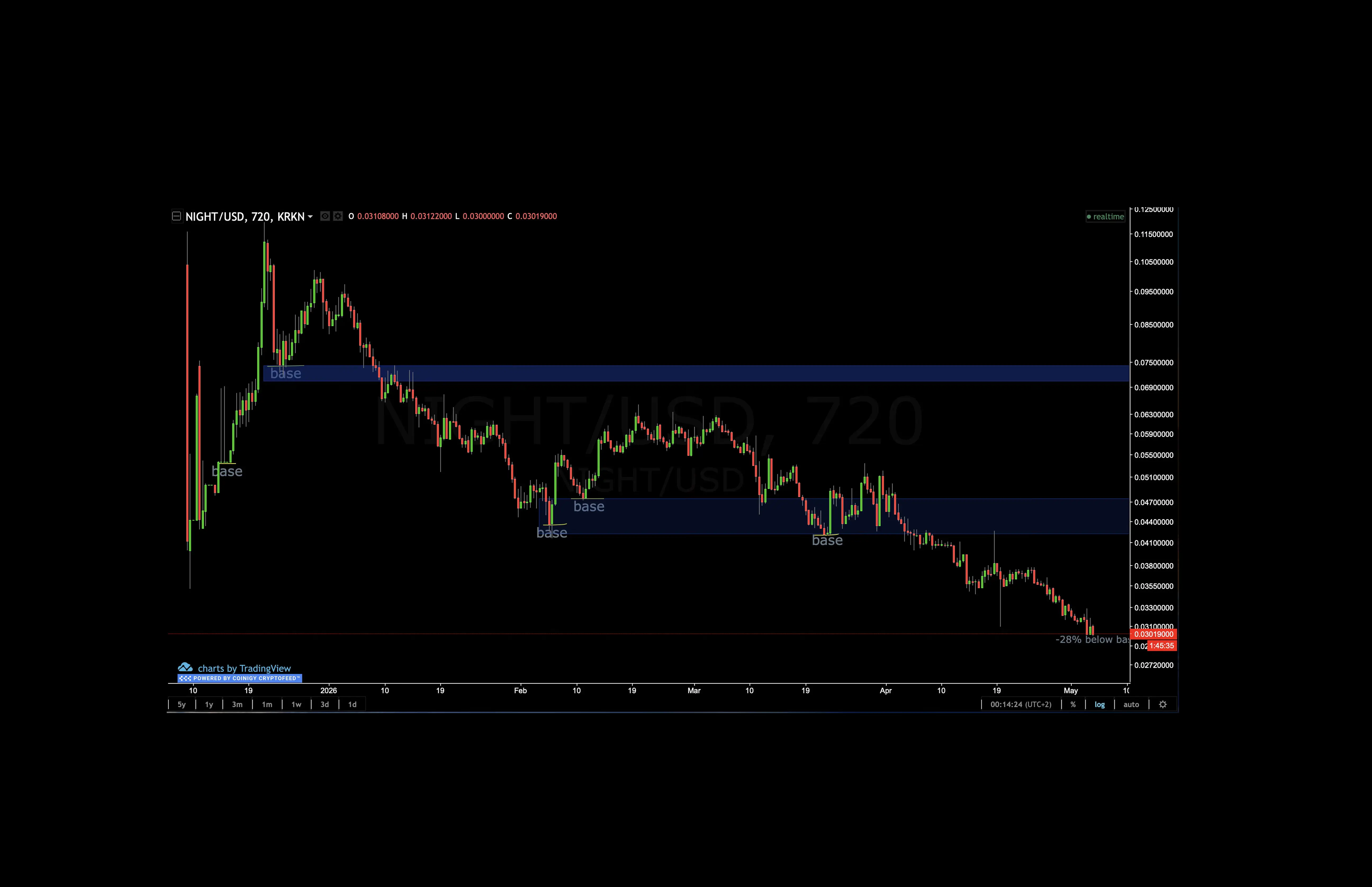
NIGHT price structure to target:
Base at $0.075: First base formed post-launch. Price failed to hold and broke down a sign early buyers were exiting into strength
Base at $0.044–0.047: Held briefly before breaking. Now acts as overhead resistance
Current Price $0.030: On May 5, 2026, price is 28% below the last base.
What this means: Each broken base leaves NIGHT at a lower entry point than the last. For readers familiar with the Coinjuice framework, buying into mechanical sell pressure ahead of a known resolution is exactly the kind of opportunity the ebook was written for.
Conclusion
Midnight is solving a problem most blockchains have ignored: full transparency is a feature for settlement, but a liability for commerce. The infrastructure is live, the validator base is credible, and the developer tooling lowers the barrier to build. The airdrop overhang is real and won't clear until late 2026. Beyond that, adoption decides whether this becomes infrastructure or just another experiment.
FAQ
What problem is Midnight designed to solve?
Midnight is designed to solve the problem that most blockchains make all transaction data public by default, which is unsuitable for use cases like storing patient records, hiding trading strategies, or sharing private contract terms.
How does Midnight provide privacy while still using a public blockchain?
Midnight uses selective disclosure with a public ledger and a private execution layer where transactions are processed off-chain. Only a cryptographic proof of the result, generated using zero-knowledge proofs, is submitted on-chain without exposing the underlying data.
What are the roles of the NIGHT and DUST tokens in the Midnight network?
NIGHT is the governance and consensus token with a fixed supply of 24 billion, used for voting rights, block production rewards, and ecosystem access, and is publicly tradeable. DUST is the transaction resource that is generated passively by holding NIGHT and is used to make transaction costs more predictable.
How is Midnight connected and secured in relation to Cardano?
Midnight is secured by Cardano and uses Cardano's existing Stake Pool Operators as validators. NIGHT launched natively on Cardano before migrating to the Midnight mainnet, with a bridge that locks tokens on one chain when they are active on the other.
Disclaimer
The information provided in this article is for informational purposes only. It is not intended to be, nor should it be construed as, financial advice. We do not make any warranties regarding the completeness, reliability, or accuracy of this information. All investments involve risk, and past performance does not guarantee future results. We recommend consulting a financial advisor before making any investment decisions.
More like this


Written by

Andrew Kamsky
Andrew Kamsky is a Bitcoin analyst. He spent a decade in traditional finance across a Big Four firm and a listed fintech bank before going deep on Bitcoin full-time.