









Quick summary
BTCS collected cash upfront by promising to buy Bitcoin at lower prices, not just holding it and hoping
The company runs Bitcoin validators on CoreDAO and ZIGChain, with Canton Network coming next
Poland still has no MiCA law, and Kaszycki says that's sending crypto business abroad
Mobilum lets Bitcoin holders borrow cash without ever selling their coins
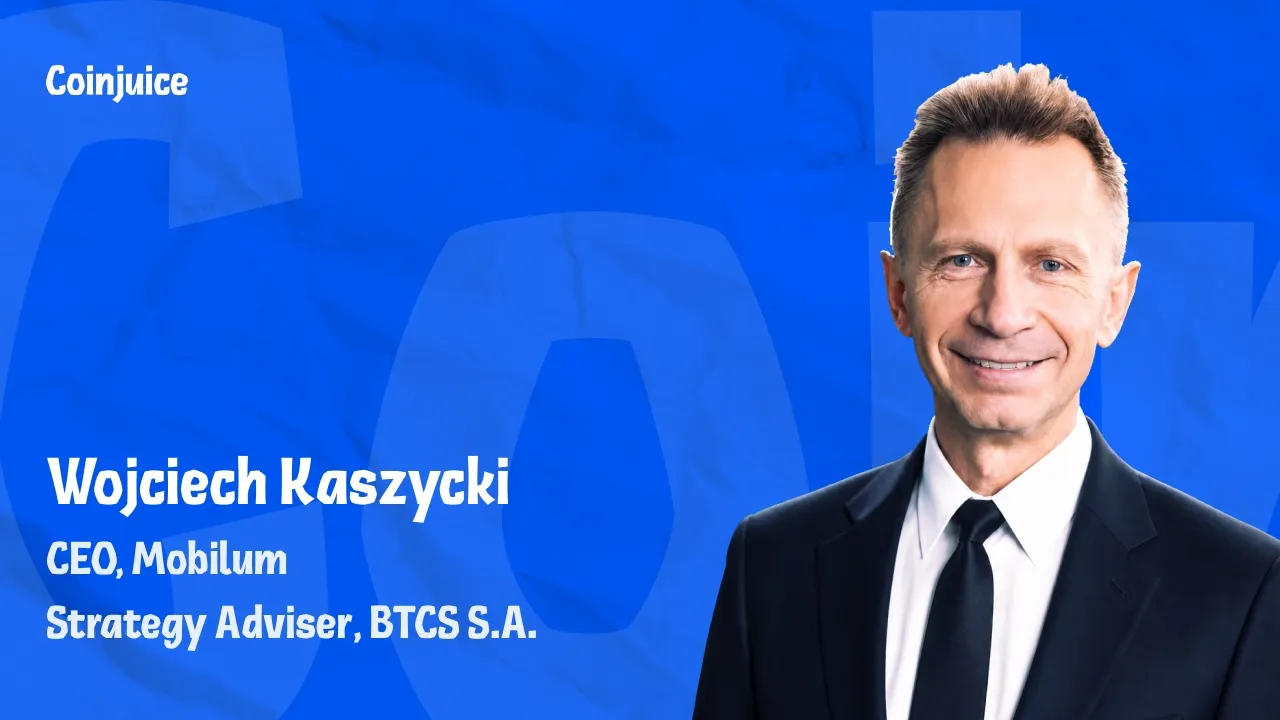
Wojciech Kaszycki has spent more than 30 years in payments and fintech. Since 2017, he has served as CEO and founder of Mobilum. Since August 2025, he has also been Strategy Advisor to BTCS S.A., formerly Vakomtek S.A., which rebranded in September 2025 into what the company describes as Europe's first dedicated digital asset treasury company.
Kaszycki was clear about the boundary between the two businesses before anything else.
"Mobilum Group, or Mobilum by itself in general, it's a group of license entities which provide on-ramp and off-ramp and issuance of the cards to the market. We are working in a B2B2C mode, which means that we serve our partners which have their retail investors."
BTCS, Kaszycki said, "has nothing to do with payments or the cards. It does help companies for example with tokenization... It helps with professional services like for the financial institutions to help them to tokenize the flows." Mobilum, by contrast, is "just on-ramp, off-ramp digital banking technology... a technology that helps to buy digital assets, to sell digital assets, or just to use them or exchange."
Buying Bitcoin Through Cash-Secured Puts
BTCS began accumulating Bitcoin in the middle of 2025. Kaszycki said the approach was shaped by watching other treasury companies operate on what he called fear of missing out.
Kaszycki said "I invested in a few digital asset treasury companies before, mostly on the US market, in order to check how that works. And basically I saw that most of them, I'm not talking about the biggest one, Strategy, because it's a different kind, most of them it was just fomo. So basically people were just getting money from the investors, buying treasury, and that's it."
Instead of buying directly, BTCS sold what Kaszycki called cash secured puts, generating premium income while taking on an obligation to purchase Bitcoin at a set price if the market fell to it.
"We were selling cash covered puts, because that's one of the strategies which is very well known on the market... you sell puts, so you are receiving a premium, and you promise to buy, like for example, a few percent under the current market value. And that way you can always get a premium. You can get like a yield, you can call it the yield."
How BTCS Uses Cash-Secured Puts to Accumulate Bitcoin Below Market Price
Asked to explain it plainly, Kaszycki offered a worked example. "Let's imagine you see Bitcoin at $64,000, right? But you are saying, okay, if it will drop to $60,000, we'll buy. And this, you sell an option, right? The promise that if someone buys from you the option, it's a promise that when at the date of the execution of the option the price is $60,000, then basically the transaction commences." The seller receives the premium whether or not the option is exercised, although losses on the resulting Bitcoin purchase can exceed that premium if the market continues falling.
When BTCS began raising capital, Kaszycki said Bitcoin was trading between $100,000 and $110,000. "Our final price of the buy was between $79,000 to $80,000."
Asked whether BTCS was still accumulating with Bitcoin trading below $70,000 at the time of the conversation, Kaszycki said he could not disclose the company's current activity. Kaszycki said "we are public entities, so I cannot tell you more than it's in a public reports, but I can tell you personally, in my opinion, those are like very good levels, and for sure each entity should start to accumulate."
He framed the position as a multi-year holding rather than a trade: "Digital asset treasury company, it's not a short play, it's not like a speculation. It's like a play for three to five years minimum... it's enough if you will buy like 20, 30 percent below the market. And that's what we've done."
Building BTCS’s Validator Infrastructure
Beyond holding Bitcoin, BTCS currently operates validators on CoreDAO and ZIGChain and has announced plans to operate a validator on Canton Network. Kaszycki described the buildout in his own words: "We currently run two validators and we are building the third one. So today we run a validator for CoreDAO, we run a validator for ZIGChain, and we are building a validator for Canton Network."
Kaszycki tied validator strength to the size of the balance sheet behind it. "When you run a validator in a network which is like proof of stake, not a proof of work like pure Bitcoin, then the quality or the power of your validator depends on the amount of the assets or the value of the assets... that back the validator,” Kaszycki said.
Inside BTCS’s Bitcoin Yield Strategy: Validators, Protocols and Partnerships
He added that the company’s balance sheet also matters when establishing credibility with counterparties: “It’s also very important what’s the value of the balance sheet that we hold. Kaszycki said counterparties assess that balance sheet directly: "the company which is our counterparty can see precisely what's the value of our balance sheet and can decide whether we are wealthy enough to hire us to render services for them." The interview did not specify which assets are delegated to each validator, or whether Bitcoin itself moves, is wrapped, or is bridged in that process.
Kaszycki described BTCS's yield generation as running across a few distinct channels rather than a single approach:
Validator rewards: Delegated assets earn network rewards that BTCS says it converts into stablecoins or additional Bitcoin.
Protocol backing: BTCS supplies assets or liquidity to selected protocols and emerging chains in exchange for yield.
Partner arrangements: The company has announced partnerships including Hemi and describes its approach as chain- and product-agnostic.
How BTCS Earns Bitcoin Yield Through CoreDAO Validators and Hemi DeFi
On validator rewards, Kaszycki explained: "Devoting digital assets which we hold to our validator in CoreDAO network. CoreDAO network, depending on the amount of assets which are delegated to the validator, pays yield. We convert this yield then to the stablecoins or more Bitcoins in order to increase value."
On protocol backing, separately: "We are also looking for the opportunistic deals where we can back different protocols. We can back liquidity pros, we can back lending protocols, we can back some new chains which come to the market providing our liquidity. And in advance those protocols pay us yield." He did not specify what proportion of yield, if any, comes from Bitcoin itself as opposed to other digital assets or validator tokens.
BTCS and Hemi: Putting Bitcoin to Work in DeFi
Hemi is a Bitcoin-focused network designed to combine Bitcoin's security with Ethereum-compatible programmability, creating infrastructure for Bitcoin-based DeFi applications. BTCS has announced Hemi as one of the partners supporting its broader yield strategy. "Hemi is one of the partners we announced. Not only Hemi, we are chain agnostic. We are product agnostic. We are just looking for the best ways to put our Bitcoins at work for the goods of our balance sheet and our investors."
The terms of that arrangement are on the public record. BTCS disclosed the six-month arrangement in February 2026, committing to provide between 50 and 100 BTC to Hemi's liquidity program. The agreement specified a guaranteed minimum annual yield of 10% for the first two months and 6% for the remaining four. In its first-month update, BTCS said an initial 50 BTC position had increased to 50.4167 hemiBTC, representing remuneration of approximately 0.4167 BTC.
MiCA and Poland's Regulatory Gap
Kaszycki said he has read the EU's Markets in Crypto-Assets regulation multiple times, and his assessment was mixed rather than dismissive.
Kaszycki said "it's good that any kind of law was introduced in the European Union. The question is whether it was introduced in the proper way... even if some of the MiCA parts are not the perfect one, it's good that MiCA was introduced in general, because before every country was having its own law and basically there was no harmonization within the European Union."
On whether the framework supports innovation specifically, he was more critical, and offered his own reading of the motivation behind it. Kaszycki said "in my opinion, it could be implemented or written much better to support innovation. Now it does not support innovation, that's all... I believe motivation was different. The motivation was how to stop the denomination of the US dollar in the crypto space in Europe. So they used the tools they knew how to use. It's not the best law for sure, but it's good that we have a law."
Poland’s MiCA Stalemate Leaves Its Crypto Market in Limbo
Poland, he said, is one of the last EU member states still without MiCA in force. "We are, I believe, one of the only countries left from the European Union which do not yet implement MiCA. Basically we don't have a body who controls the market, who supervises the market and so on, which is a really bad situation."
Kaszycki described three attempts by the government to pass domestic crypto legislation, each rejected by the president. "Three times they tried with exactly the same acts. Three times the president declined it, saying that the law they try to announce is not good for the local market... I kind of agree with some of those theories. I believe that the law can be much better."
The Price of Poland's MiCA Delay
In Kaszycki's view, the delay has a direct cost. "There are a lot of MiCA license entities in other parts of Europe, and those companies just enter the Polish market... we as Poles, haven't lost the possibility to buy crypto. But Poland as a country, our treasury, our taxes, we are real losers in terms of that part of the economy, because foreign companies are selling digital assets for Polish citizens. It means that they are supervised by foreign securities and exchange commissions, and they pay taxes somewhere else, not in our country."
That accounting of lost tax revenue is Kaszycki's own assessment rather than an independently confirmed figure. His recommendation: "We should implement MiCA as soon as possible. We should start issuing licenses, and we should have our own Polish companies being MiCA approved and accredited to offer crypto services to Polish people."
The record bears out the stalemate he described. President Karol Nawrocki vetoed Poland's Crypto-Asset Market Act on June 11, 2026. After MiCA's transitional period ended on July 1, Poland's tax administration warned that registration in the country's existing virtual-currency register no longer constituted authorization to provide regulated crypto-asset services. It also said the body maintaining that register was not empowered to issue MiCA licenses.
Using Bitcoin as Collateral Without Selling It
Asked whether Mobilum could serve as the rail for a merchant wanting to accept payment in satoshis, Kaszycki pointed first to how Bitcoin holders actually behave. "If you ask real Bitcoin holders, they will tell you they will never sell their satoshis to pay for anything."
Mobilum's answer leans on collateralized credit rather than direct spending of holdings. “The tendency is moving in this direction, and we as a company support it. We are following a path where you can use your bitcoin, or your satoshis as a collateral to obtain a fast, instant credit line or loan, however it is structured, and use it to pay at a restaurant or for anything else you want. That is what we issue through our licensed entities and partners.”
BTCS Strategy: A Five-Year Test
Kaszycki was direct that BTCS's strategy cannot be judged yet. "In five years, we will be in the position to look five years back and find out whether our strategy was good or not."
That same long-term perspective matters for individual investors: surviving Bitcoin’s cycles may depend less on predicting every move than on accumulating with discipline and avoiding forced liquidation.
Build your own framework: Read the Coinjuice ebook, Bitcoin Trading Without Leverage, or explore Coinjuice Pro for ongoing research and actionable market insights.
Disclaimer
The information provided in this article is for informational purposes only. It is not intended to be, nor should it be construed as, financial advice. Statements attributed to Wojciech Kaszycki reflect his own views and interpretations and are not independently verified facts unless otherwise noted. All investments involve risk, and past performance does not guarantee future results. We recommend consulting a financial advisor before making any investment decisions.
FAQ
What is BTCS S.A.?
BTCS S.A. is a publicly listed European digital-asset treasury company. Its strategy combines holding Bitcoin with active treasury operations intended to generate additional returns from its assets.
How does BTCS generate yield on its Bitcoin?
BTCS works with infrastructure and blockchain partners to deploy some of its Bitcoin in yield-generating arrangements. Its agreement with Hemi, for example, committed between 50 and 100 BTC to a liquidity program with a guaranteed minimum annual yield for the six-month term.
Does BTCS exchange its Bitcoin for other tokens?
Not necessarily. In the Hemi arrangement, BTC is represented within the network as hemiBTC, with each hemiBTC corresponding to Bitcoin held in custody. This enables the company to use Bitcoin within the network without treating it simply as an unrelated altcoin investment.
How does Poland’s regulatory situation affect BTCS?
Poland’s delayed implementation of its crypto-asset framework has created uncertainty for domestic service providers. However, BTCS is a listed treasury company rather than a retail crypto exchange, and Kaszycki said it works through licensed entities and partners where regulated services are required.
Disclaimer
The information provided in this article is for informational purposes only. It is not intended to be, nor should it be construed as, financial advice. We do not make any warranties regarding the completeness, reliability, or accuracy of this information. All investments involve risk, and past performance does not guarantee future results. We recommend consulting a financial advisor before making any investment decisions.
More like this


Written by

Andrew Kamsky
Andrew Kamsky is a Bitcoin analyst. He spent a decade in traditional finance across a Big Four firm and a listed fintech bank before going deep on Bitcoin full-time.