











Quick summary
Pendle splits yield-bearing wrapper tokens into Principal Tokens for fixed yield and Yield Tokens for variable yield
STRC is a Nasdaq preferred share whose dividend backs wrappers sUSDat and apyUSD, not tokenized directly
Deposited sUSDat or apyUSD mint PT and YT on Pendle, with returns ultimately dependent on STRC dividends
Key risks include dividend cuts, wrapper custody failures, depegs, YT decay, smart contract and liquidity risks
The search term "STRC Pendle" has been picking up traction among DeFi yield traders in 2026. If you've seen it surface on X or in yield-farming threads and aren't sure what it means, here's a clean breakdown of the mechanics including the one piece most quick explainers get wrong.
Pendle Finance Explained
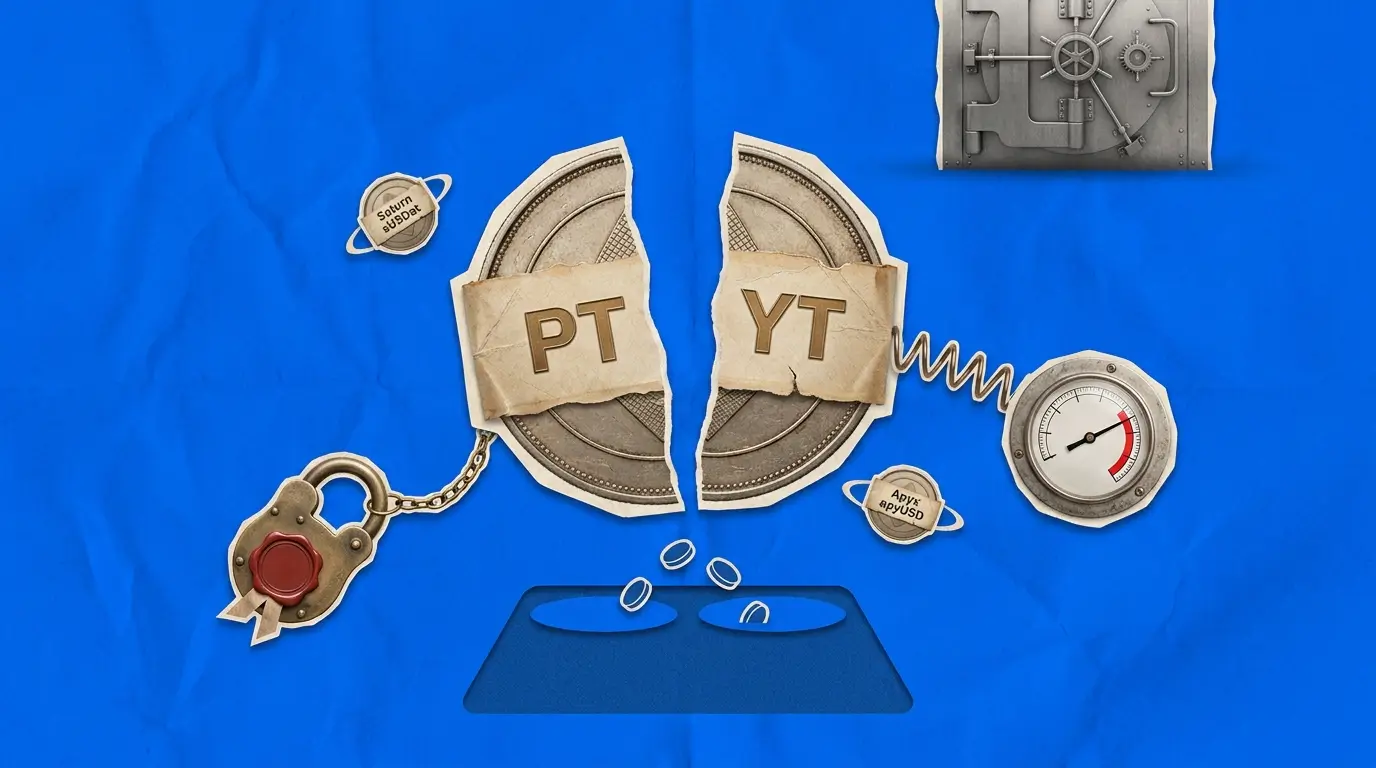
Pendle is a DeFi yield-trading protocol. It splits yield-bearing tokens into two separate components: a Principal Token (PT) and a Yield Token (YT).
The PT represents the underlying principal. The YT represents the future yield stream. Once split, each component trades independently on Pendle's automated market maker.
That structure opens two distinct strategies. Hold the PT to maturity and lock in a fixed yield. Hold or trade the YT and take a directional view on where yield rates are heading. In 2026, the protocol has attracted meaningful liquidity across a range of yield-bearing assets and, more recently, across assets whose yield originates entirely off-chain.
STRC and Its Dividend Yield
STRC isn't a DeFi token. It's Strategy's Nasdaq-listed perpetual preferred stock, nicknamed "Stretch," ticker STRC. It pays a variable cash dividend, currently set at 12% per year, which Strategy adjusts up or down to keep the stock trading near its $100 par value. Proceeds from STRC issuance fund Strategy's ongoing Bitcoin accumulation.
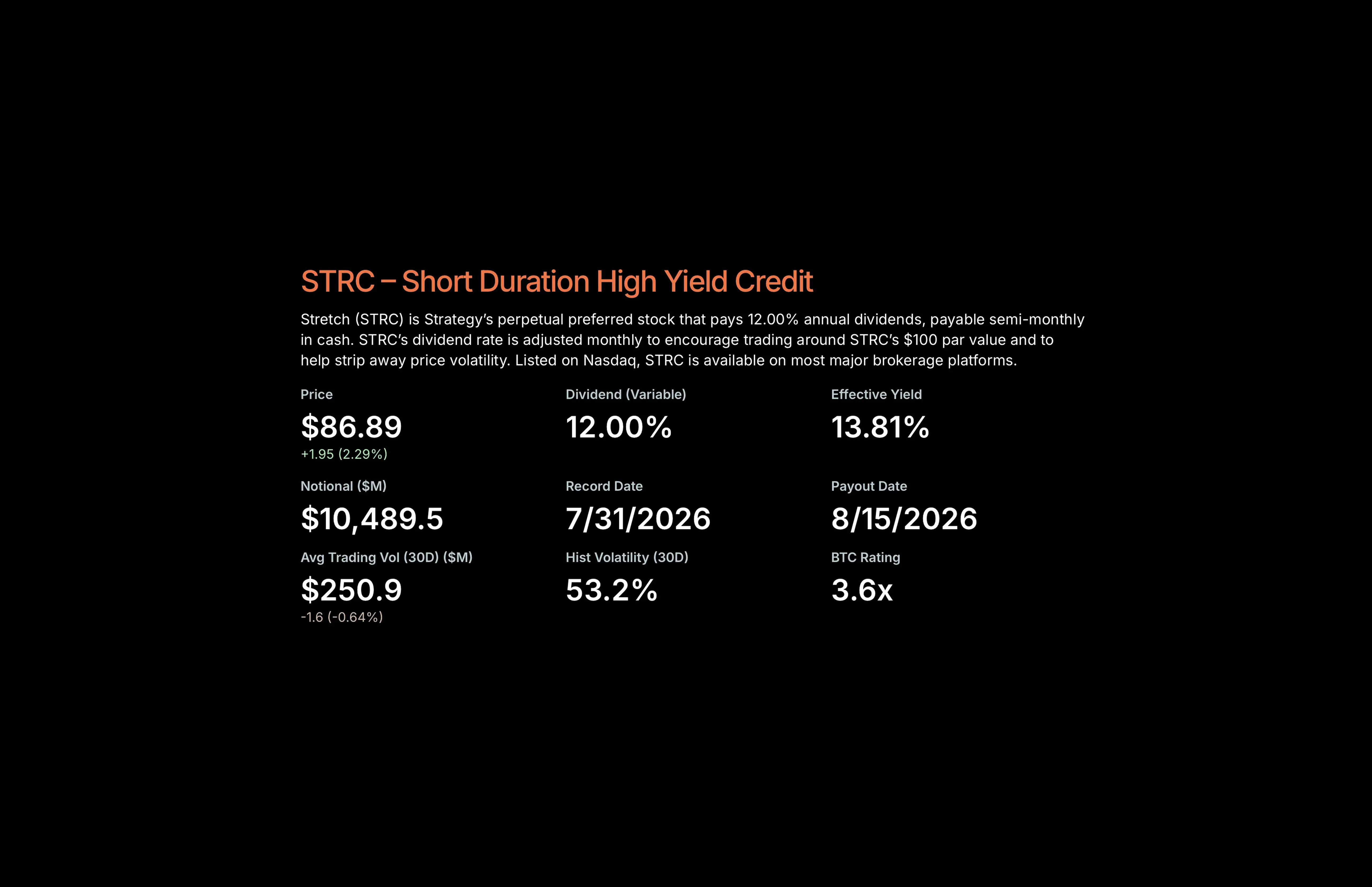
STRC does not mint directly into Pendle. It can't, it's a Nasdaq equity, not a token, and STRC lives in a brokerage account, not a wallet.
What connects STRC to Pendle is a middle layer: separate protocols that hold STRC off-chain and issue on-chain wrapper tokens against its dividend stream.
Two are live today:
Saturn: Issues sUSDat, a yield-bearing stablecoin that passes STRC's dividend through more or less directly.
Apyx: Issues apyUSD, an over-collateralized, dividend-backed stablecoin that holds more STRC than the tokens it issues, concentrating the same dividend pool across fewer tokens pushing apy USD's headline yield above STRC's raw 12%.
Those wrappers in sUSDat and apyUSD, not 'STRC' itself are what get deposited into Pendle and split into PT and YT. Combined STRC-linked exposure across these wrapper protocols runs well over $200M, though the share routed onto Pendle has pulled back sharply since a May peak as positions unwound.
For the full breakdown of how the wrapper layer works, see Coinjuice's earlier explainer, How Pendle Turns STRC Into Yield.
How the STRC Pendle Yield Strategy Works
When sUSDat or apyUSD is deposited into Pendle, the protocol mints two tokens for that specific wrapper:
PT (e.g., PT-sUSDat, PT-apyUSD): Redeemable for the full wrapper token at maturity. Trades at a discount before maturity, implying a fixed yield.
YT (e.g., YT-sUSDat, YT-apyUSD): Captures all yield generated by the underlying wrapper position until maturity. Its value moves directly with the wrapper's yield rate which is itself downstream of STRC's dividend.
There is no single ticker called "PT-STRC" or "YT-STRC." The naming follows whichever wrapper you're actually depositing, because Pendle doesn't touch STRC directly Pendle only ever sees sUSDat or apyUSD.
The implied APY on each PT is visible on Pendle's interface. It reflects what the market currently prices as the fixed yield for holding that wrapper to maturity, and it moves daily, so treat any specific number as a snapshot rather than a fixed fact.
Why Yield Traders Are Watching STRC on Pendle
Fixed yield from a dividend stream tied to a public company’s Bitcoin treasury is a rare structure in crypto. Most DeFi yield is variable and can fall quickly when liquidity floods a protocol. Pendle’s PT mechanism lets traders lock in today’s implied return on sUSDat or apyUSD, even if the underlying yield falls later.
However, yields vary widely across these pools, and some of the risks have already surfaced.
The yield spread is real but uneven: Some STRC-linked Pendle pools offer elevated yields in the 8–16%+ range, while others have fallen to single digits or below 3%. “Well above average” describes some pools, not all of them. Traders should check the specific pool.
apxUSD has already depegged: This risk isn’t hypothetical. Apyx’s apxUSD the stable, non-yield-bearing side of its two-token system which fell to $0.90 on June 4 and $0.78 by June 25, tracking STRC’s share-price decline over that period. This shows how weakness in STRC can pass through the wrapper layer and affect tokens used within the wider Pendle ecosystem. Apyx’s yield-bearing token, apyUSD, was not the token that depegged.
The depeg and dividend-cut risk share the same underlying dependency: Both depend on STRC’s dividend and share-price stability. When STRC weakens, the wrappers and Pendle pools built around them can weaken too.
Locking in a fixed rate through PT remains the more conservative side of the trade but only compared with YT. It is not risk-free. The June depeg shows that the wrapper layer can move quickly, regardless of whether Pendle’s own contracts are working as intended.
YT remains the higher-risk position. If STRC’s dividend is reduced or paused, which Strategy’s board can do at its discretion, yields on sUSDat and apyUSD could fall, causing YT to lose value quickly. Holding YT is a yield-rate bet with two dependencies: the stability of the wrapper protocol and Strategy’s dividend policy beneath it.
Key Risks of Trading STRC-Linked Assets on Pendle
Every layer of this trade traces back to one company's dividend policy so before sizing a position, it's worth knowing exactly where things can break.
Dividend risk sits underneath everything: STRC's 12% dividend is not guaranteed. Strategy's board can lower or pause it if conditions change. Every wrapper yield, every PT rate, and every YT payout ultimately depends on that dividend continuing to flow.
Off-chain custody risk: Saturn and Apyx hold real STRC shares at a brokerage to back their tokens. If that custody arrangement breaks, freezes, fails, mismanagement, the on-chain wrapper loses its backing regardless of what Pendle's contracts say.
Maturity risk: A PT position only delivers full face value at maturity. Sell early and the owner gets whatever the secondary market offers, which can sit well below face value depending on where implied yields sit at the time.
Yield compression on YT: A YT position is a wasting asset. It decays toward zero as maturity approaches if the underlying dividend doesn't hold up. Traders who hold YT without a clear thesis on STRC's dividend direction tend to get hurt.
Layered smart contract exposure. Holding PT-apyUSD, for example, means exposure to Strategy (the dividend), Apyx (the wrapper), and Pendle (the split) all at once three points of failure stacked on top of each other, not one.
Liquidity depth. These are still relatively new Pendle pools. Large entries or exits can move the implied yield meaningfully. Check pool TVL and volume before sizing a position.
How to Evaluate an STRC Pendle Position
The evaluation framework is the same for any Pendle position built on a wrapped real-world yield source:
What return is locked in with PT? Compare that rate with the return from simply holding the original token or a similar stablecoin product.
When does the PT mature? A shorter wait usually means less risk. A longer wait may offer a higher return but carries more risk.
How much money and trading activity are in the pool? Pools with low liquidity can be harder and more expensive to enter or exit.
Where does the return come from? Most of it comes from STRC’s dividend. Some rates may also include temporary rewards, such as Saturn’s Gravity Points. Check the base return separately from any bonuses. STRC’s price near or below $100 may also affect future dividend payments.
What happens if the dividend is cut? YT can lose value quickly when the return falls, so a clear exit plan is important.
This is a framework, not a trading signal.
Does STRC Pendle Fit a Non-Leveraged Yield Strategy?
PT positions on Pendle are one of the few DeFi structures that suit a non-leveraged, yield-focused approach. An individual is not borrowing. There's no multiplier. You're making a rate decision with a defined maturity date, on a yield source that traces back to a real dividend rather than a token-emission schedule.
That said, YT is the riskier option and is better suited to a small position than a main holding. PT is the safer choice for earning yield without borrowing money. YT only makes sense when there is a strong belief that STRC’s dividend will remain high or increase.
Coinjuice’s trading ebook follows a similar no-borrowing approach: buy when prices are low and sell when they recover, without the risk of forced liquidation.
Check out the ebook: How to Trade Bitcoin and Altcoins Without Leverage →
For more structured DeFi and digital asset analysis without leverage, explore Coinjuice PRO plans and pricing.
FAQ
What does Pendle do and how do PT and YT work?
Pendle is a DeFi yield‑trading protocol that splits yield‑bearing tokens into a Principal Token (PT) and a Yield Token (YT). PT represents the underlying principal and can be held to maturity to lock in a fixed yield, while YT represents the future yield stream and lets traders take a directional view on where yield rates are heading. Both PT and YT trade independently on Pendle’s automated market maker.
How is STRC connected to Pendle if STRC is not a DeFi token?
STRC is Strategy’s Nasdaq‑listed perpetual preferred stock that pays a variable cash dividend, currently 12% per year, and it lives in a brokerage account, not a wallet. Separate protocols, Saturn and Apyx, hold STRC off‑chain and issue on‑chain wrapper tokens—sUSDat and apyUSD—against its dividend stream. These wrappers, not STRC itself, are deposited into Pendle and then split into PT and YT.
What are the main risks of trading STRC‑linked assets on Pendle?
Key risks include dividend risk (STRC’s 12% dividend can be lowered or paused by Strategy’s board), off‑chain custody risk at Saturn and Apyx, maturity risk on PT if sold before maturity, yield compression and decay of YT as maturity approaches, layered smart contract exposure across Strategy, the wrapper protocol, and Pendle, and liquidity risk in relatively new Pendle pools where large trades can move implied yields.
Why might someone choose PT instead of YT for an STRC Pendle strategy?
PT is the more conservative side of the trade because it allows locking in a fixed rate to maturity from the STRC‑backed wrapper yield without borrowing or leverage, fitting a non‑leveraged yield‑focused approach. YT is higher risk, behaves as a wasting asset, and can lose value quickly if STRC’s dividend is reduced or paused, so it is better suited to a smaller, more speculative position and only makes sense when there is strong belief the dividend will remain high or increase.
Disclaimer
The information provided in this article is for informational purposes only. It is not intended to be, nor should it be construed as, financial advice. We do not make any warranties regarding the completeness, reliability, or accuracy of this information. All investments involve risk, and past performance does not guarantee future results. We recommend consulting a financial advisor before making any investment decisions.
More like this
Written by

Andrew Kamsky
Andrew Kamsky is a Bitcoin analyst. He spent a decade in traditional finance across a Big Four firm and a listed fintech bank before going deep on Bitcoin full-time.