









Quick summary
Bitcoin trades tightly between 62000 and 65000 as cheap volatility masks compression risk
Upcoming nonfarm payrolls and unresolved CLARITY Act vote create key binary catalysts
ETF and corporate Bitcoin treasury buying contrasts with cautious broader institutional positioning
XRP whales quietly accumulate while ether trades below realized price and larger wallets accumulate
Bitcoin is coiling into Friday's payrolls binary while ETF and treasury buying continue beneath a flat headline price.
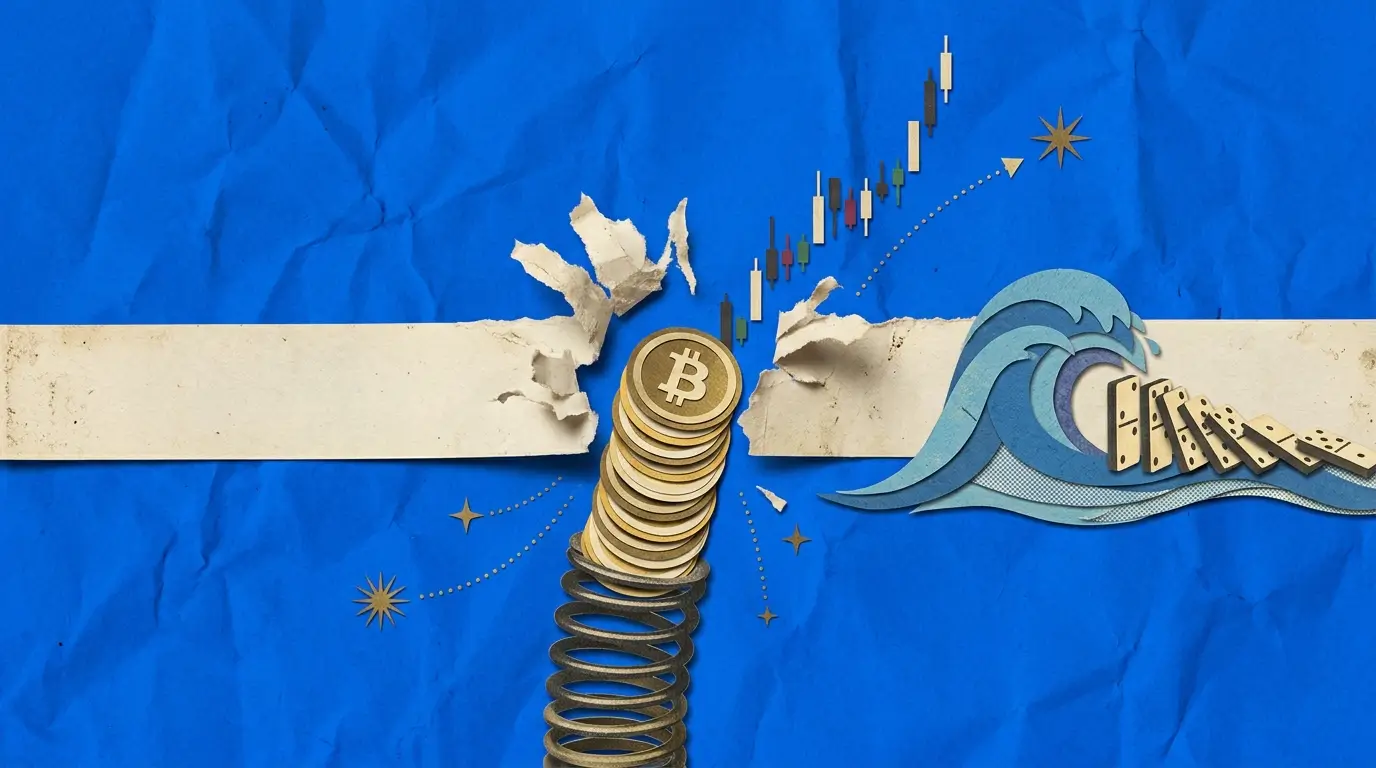
Bitcoin has traded in a narrow band between roughly $62,000 and $65,000 for several sessions, and 30-day implied volatility has settled near a long-held floor. The instinct is to read that as stability. The more accurate read is that cheap volatility lets traders build large directional positions cheaply, and when price eventually breaks through a level where those positions cluster, the move tends to accelerate rather than fade.
Bitcoin's Tight Range Is Compression, Not Calm
Four unresolved pressures are sitting underneath the $62,000 and $65,000 range, and each one is due to resolve within days:
The binary event is Friday: nonfarm payrolls data, the net number of jobs the U.S. economy added in July, is the catalyst the market is waiting on. The logic cuts both ways: a soft print revives rate-cut odds and gives Bitcoin room to push higher, while a hot print raises the odds the Fed holds rates steady and puts pressure on the current range. The specific consensus estimate, along with the exact levels where that pressure would show up (including the $60,200 area some are citing as a Fibonacci retracement level).
The labor data is already split: jobless claims held at 199,000 for a third straight week, below the 200,000 threshold that typically signals a tight labor market, while July's ADP private-payrolls print came in at just 44,000, the weakest reading in six months. The two data sets disagree, which is exactly why Friday's official number carries outsized weight.
A second binary sits on the same calendar: the Senate is still working against its own deadline on the CLARITY Act. Majority Leader Thune has reserved floor time for a vote, but Democrats have signaled a cloture vote would fail if filed as is, with ethics-enforcement language and illicit-finance provisions still unresolved.
On-chain valuation is a claim, not yet a confirmed one: some analysts are citing Bitcoin's network-value-to-transactions ratio as stretched relative to on-chain settlement activity, which would mean further upside needs a fresh catalyst rather than resting on fundamentals alone.
Treasury and ETF Buying Continued, but Broader Institutional Sentiment Has Not Confirmed It
A second story is unfolding beneath the flat price, and it does not fully agree with itself. Spot Bitcoin ETFs recorded new inflows this week, and at least two public companies added to their Bitcoin treasuries, while separate indicators of institutional sentiment stayed cautious.
Both things are true at once, and the honest read is that this is a divergence worth watching rather than a resolved trend.
ETF inflows resumed: spot Bitcoin ETFs took in a reported $244.4 million on August 6, with combined Bitcoin and ether ETF inflows near $305.2 million, per Adbytes.Media.
Two treasuries grew: SpaceX disclosed a holding of 18,712 BTC in its first earnings release, a figure corroborated by on-chain tracking showing the position has not been sold. Block Inc. added 85 BTC, bringing its total to 9,117 BTC and placing it 15th among public Bitcoin holders, per Trending AI News.
Exchange balances kept falling: roughly $99.4 million in Bitcoin moved off exchange custody into private wallets, per CryptoRank, consistent with longer-term holding intent, though intent itself cannot be confirmed from flow data alone.
The counter-signal: broader institutional positioning has stayed more cautious than the treasury and ETF activity above suggests, with fund flows and exchange premium data both pointing to muted U.S. buying pressure. Fed Chair Kevin Warsh's hawkish tone on inflation this week added a further headwind to rally attempts above $64,000.
XRP Whales Are Accumulating Without Moving Price; Ether Is the Asset Still Underwater
On-chain data across the three largest assets tells three different stories, and the divergence between them is more informative than any single price move.
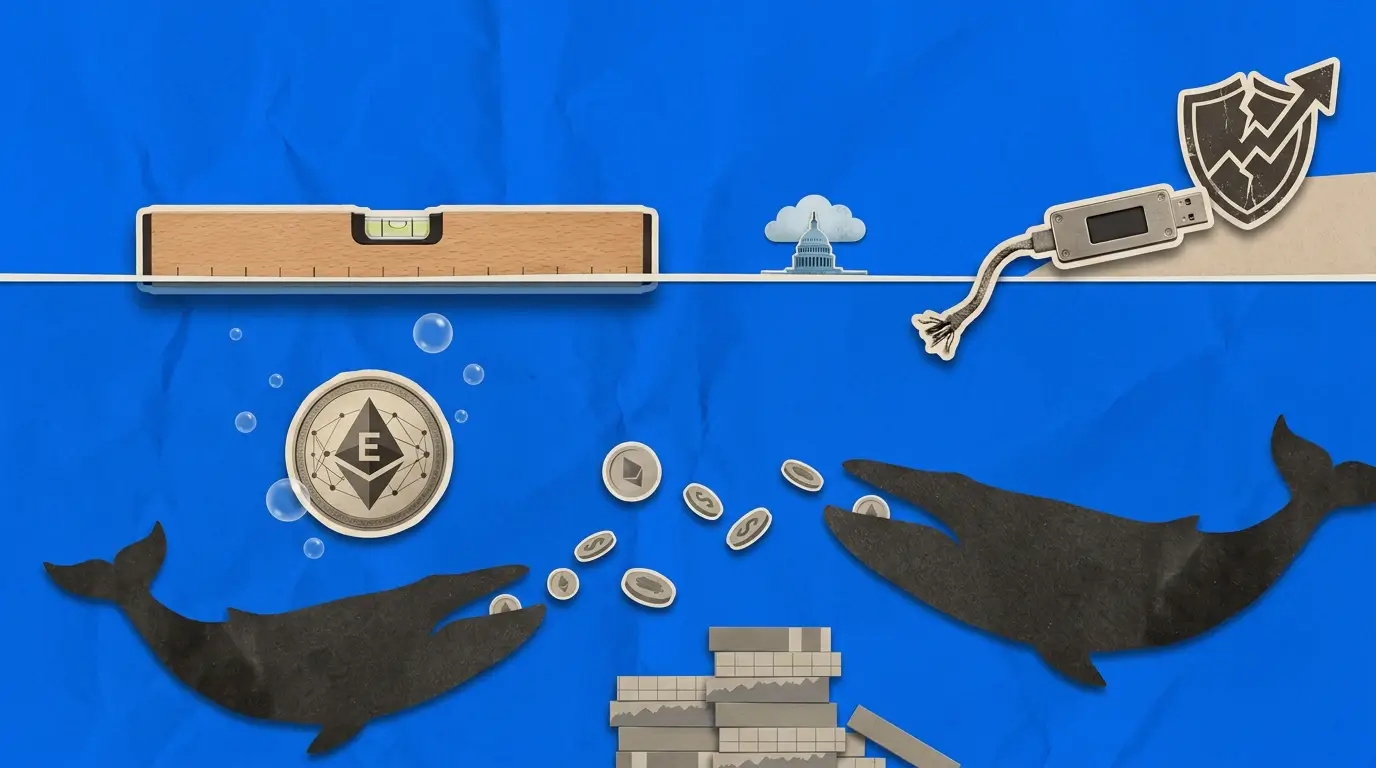
XRP whales are absorbing supply quietly: average spot order sizes have stayed in whale-sized territory throughout XRP's slide from around $2.40 in January to the current $1.00 to $1.20 range, per CryptoQuant, without lifting the price. The 90-day taker buy-sell delta has drifted to neutral from a buy-dominant start to the year, a pattern CryptoQuant characterizes as a basing range rather than confirmed capitulation or a confirmed breakout.
Ether is the one asset trading below its cost basis: ether trades near $1,895 against a realized price of roughly $2,450, meaning the aggregate holder base is underwater on paper. Bitcoin, by comparison, trades about 17% above its realized price near $52,900. CryptoQuant flags this as the single metric to watch, noting ether reached a similarly deep below-cost level in early 2025 before it found a bottom there.
The holder base is splitting internally: wallets holding 10,000 to 100,000 ETH have grown from roughly 14 million ETH in mid-2025 to a record 19.6 million, while the 1,000-to-10,000 ETH cohort has fallen from 15.6 million in January to about 12.9 million, indicating large holders are accumulating as mid-tier holders exit.
The Lesson
Two takeaways worth carrying past this week's specific numbers:
Cheap volatility is not the same as low risk: when options markets stop paying for both upside and downside protection, as they have now, it usually means positioning has gone quiet rather than safe, and quiet positioning is what fuels the sharpest moves once a catalyst lands.
Accumulation without a price reaction is still a data point, rather than a signal: whale buying that fails to move price, as with XRP this week, tells you supply is being absorbed, not that a floor has been confirmed. Treat it as one input among several, not a green light.
Readers looking to navigate binary weeks like this one without reaching for leverage can start with the Coinjuice ebook, Bitcoin Trading Without Leverage, or go deeper with a Coinjuice subscription, currently 30% off the annual plan where we start and complete trades and you will learn to snipe them independently.
Coinjuice Lens
Bitcoin Ownership. The Coldcard hardware wallet exploit that widened through this week is a live case study in a question Coinjuice has already examined directly: which wallet setup actually protects a holder, and where does the responsibility sit once the device leaves the store shelf. For how a hardware wallet can fail at that exact layer, see Can a Hardware Wallet Generate a Weak Bitcoin Seed?
What Investors Are Asking
Why does low Bitcoin volatility carry more risk than it appears to?
Cheap volatility means traders can build big positions cheaply. When enough of those positions stack up around one price, a move through that price forces a bigger, faster swing than usual. Right now, few traders are paying for protection in either direction, up or down, which leaves the market more exposed once today’s jobs data breaks the standoff.
Why is ether trading below its realized price when Bitcoin is not?
Most ether holders bought in around $2,450 on average. It's now trading near $1,895, so the average holder is underwater. Bitcoin holders, by contrast, are sitting about 17% above what they paid on average. Ether hit a similarly deep discount in early 2025 before it recovered, which is why that gap, not price alone, is the number analysts are watching for a real bottom.
News Behind Today's Pulse
"US filings for jobless benefits rise to 199,000 last week, but layoffs remain historically low" (AP News, Aug 6, 2026) — source for the 199,000 third-straight-week figure and the "labor market resilience" framing.
"ADP National Employment Report: Private Sector Employment Increased by 44,000 Jobs in July; Annual Pay was Up 4.4%" (ADP, Aug 5, 2026) — source for the 44,000 figure and "weakest since January/six-month low" framing (confirmed independently by Trading Economics, which also notes it came in well below the 70–75k forecast). (Same CryptoBriefing caveat as above.)
"CLARITY Act Vote: Floor Time Reserved, 60-Vote Gap Remains" (CoinNews, Aug 6, 2026) — source for Thune reserving floor time without a confirmed cloture filing. — "Vault: Democrats say Clarity's cloture vote is doomed" (Punchbowl News, Aug 4, 2026) — source for the more pessimistic read that Democrats expect the cloture vote to fail outright, not just risk delay. (Neither source confirms August 6 specifically as Thune's "last practical" cloture-filing day, or a ~14-working-day September fallback window.
"Bitcoin losses from Coldcard hack could swell to $130 million, Galaxy Research says" (The Block, Aug 4, 2026) — source for the $130M current tally (1,596–2,055 BTC across confirmed and suspected waves). — "BTC news: Coldcard urges users to move bitcoin as active wallet exploit continues" (CoinDesk, Aug 4, 2026) — source for the $114M interim figure. (I found no Fox Business/Forbes $89M figure and no Fortune/TechCrunch/Forbes $116M figure this session — don't publish those two specific citations until located directly.)
"SpaceX discloses 18,712 Bitcoin holdings in first earnings release" (CryptoCompass, Aug 6, 2026) source for the 18,712 BTC figure and confirmation the disclosure reflects an existing balance, not a new purchase (consistent with the "position has not been sold" framing).
Market Snapshot
Asset | Price | 24h Change | 7d Change |
Bitcoin (BTC) | $64,764.54 | +0.24% | +0.07% |
Ethereum (ETH) | $1,909.29 | +0.09% | −0.42% |
Solana (SOL) | $73.48 | −0.70% | −1.31% |
XRP | $1.0342 | −2.56% | −4.50% |
BNB | $589.17 | −0.72% | −0.44% |
DeFi and Institutional Metrics
Metric | Value |
DeFi TVL (ex-CEX) | $232.7B |
Lending TVL | $41.10B across 568 protocols, 2.23% annualized yield |
Liquid-staking TVL | $35.28B, 4.79% annualized yield |
RWA TVL | $26.73B across 125 protocols |
Institutional core (lending + LS + RWA) | $103.11B, 21.6% of non-CEX DeFi |
FAQ
Why is Bitcoin’s current tight trading range described as compression rather than calm?
Bitcoin has been trading between about $62,000 and $65,000 while 30-day implied volatility sits near a long-held floor. Cheap volatility lets traders build large directional positions cheaply, so when price breaks through clustered position levels, the move tends to accelerate instead of fading.
What key events could soon break Bitcoin out of its $62,000–$65,000 range?
Four pressures are in play: Friday’s U.S. nonfarm payrolls report, conflicting labor data between jobless claims (199,000 for three weeks) and July ADP payrolls (44,000), the Senate’s pending CLARITY Act vote with unresolved provisions, and concerns that Bitcoin’s network-value-to-transactions ratio looks stretched without a fresh catalyst.
How are ETF flows and corporate treasuries behaving compared with broader institutional sentiment toward Bitcoin?
Spot Bitcoin ETFs saw about $244.4 million of inflows on August 6, combined Bitcoin and ether ETFs took in around $305.2 million, SpaceX disclosed 18,712 BTC, and Block Inc. raised its holdings to 9,117 BTC. At the same time, broader institutional positioning remains cautious, with fund flows and exchange premium data signaling muted U.S. buying and Fed Chair Kevin Warsh’s hawkish tone adding a headwind.
Why is ether described as trading underwater, and how does this compare to Bitcoin and XRP?
Ether trades near $1,895 versus a realized price around $2,450, so the aggregate holder base is underwater, while Bitcoin trades about 17% above its realized price near $52,900. XRP whales have been placing large spot orders as price slid from roughly $2.40 to the $1.00–$1.20 range, but this accumulation has not lifted price, and CryptoQuant views it as a basing range rather than confirmed capitulation or breakout.
Disclaimer
The information provided in this article is for informational purposes only. It is not intended to be, nor should it be construed as, financial advice. We do not make any warranties regarding the completeness, reliability, or accuracy of this information. All investments involve risk, and past performance does not guarantee future results. We recommend consulting a financial advisor before making any investment decisions.
More like this


Written by

Andrew Kamsky
Andrew Kamsky is a Bitcoin analyst. He spent a decade in traditional finance across a Big Four firm and a listed fintech bank before going deep on Bitcoin full-time.