













Quick summary
Top 100 public Bitcoin holders span five continents and diverse industries, far beyond expectations
Companies use Bitcoin in three ways treasury accumulation, mining production, and operating balance-sheet holdings
Treasury firms dominate with 85.8 percent of holdings, while miners and operators share remaining
Treasury stocks add risks including premiums discounts, leverage, no redemption, and heavy concentration
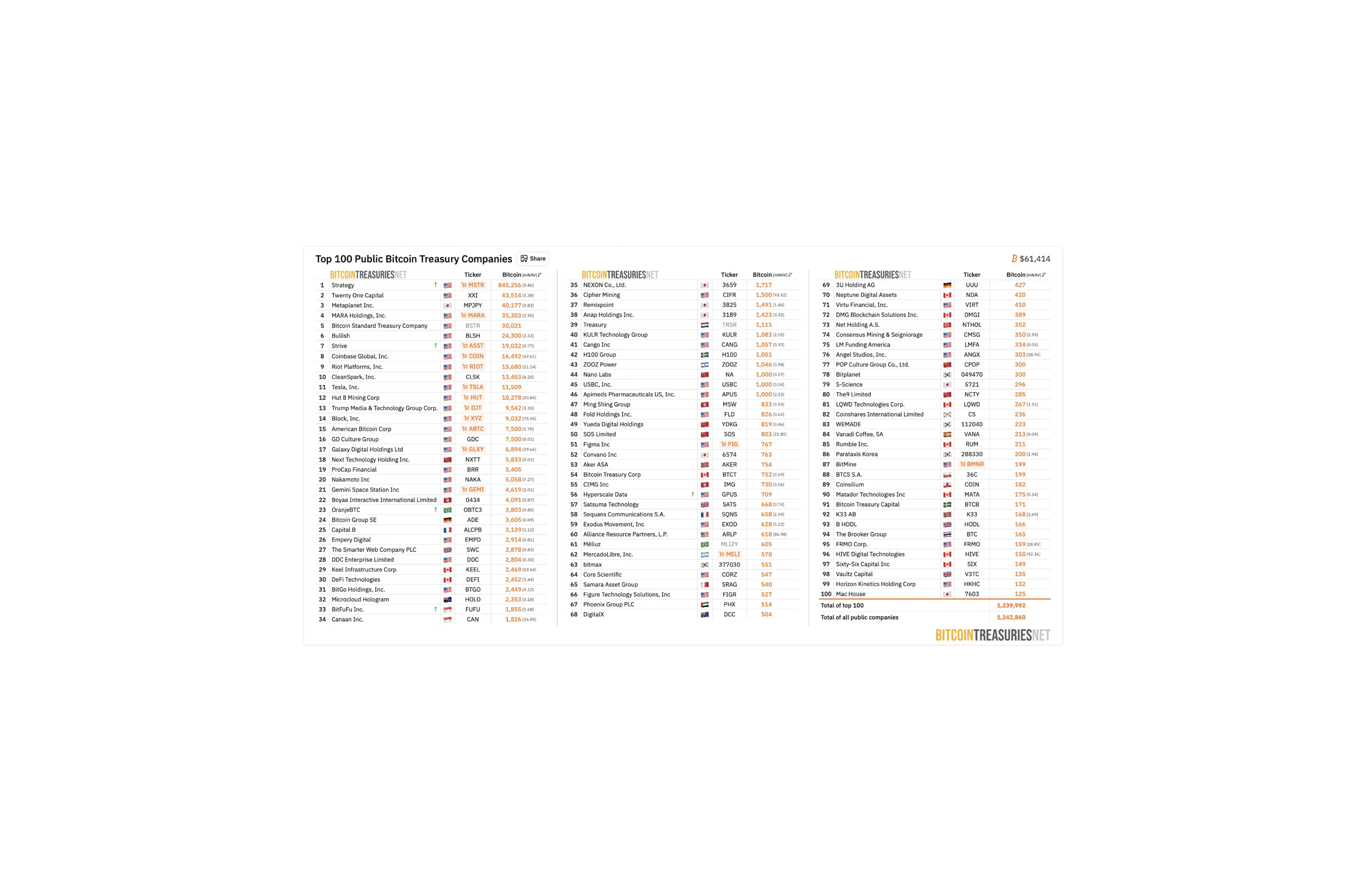
The 100 largest corporate Bitcoin holders include a Japanese hotel chain, a coal royalties business, a film studio, a Spanish coffee company and others. The list is wider than most investors expect.
A hundred companies spanning five continents, operating across wildly different sectors and business models, all holding the same asset on their balance sheets.
How Public Companies Use Bitcoin: Three Corporate Models
The top 100 public Bitcoin holders can be grouped into three categories based on how they use Bitcoin: treasury companies that exist to accumulate it, miners that produce it, and operating businesses that hold it alongside an unrelated core product.
Though where exactly a company falls is open to interpretation the list includes:
Type | Companies | BTC Held | Share |
Treasury Companies | 55 | 1,063,882 | 85.8% |
Bitcoin Miners | 19 | 93,855 | 7.6% |
Operating Businesses | 26 | 82,263 | 6.6% |
Total | 100 | 1,239,992 | 100% |
Source: company classifications applied across the DefiLlama and BitcoinTreasuries.net datasets, June 2026.
Bitcoin Mining Companies: Producing Bitcoin Instead of Buying It
The question miners answer: Can we produce Bitcoin cheaper than the market can buy it?
For miners, Bitcoin is inventory.
They produce it by converting electricity into hashrate, sell most of what they mine, and retain a portion on the balance sheet. The competitive edge is operational: a miner running on stranded hydropower produces Bitcoin at a fundamentally different cost than one running on grid electricity.
Several of the largest miners might hold more Bitcoin than they sell. Some of the largest include:
Company | Operational Focus | BTC Held |
MARA Holdings | Mining plus treasury retention | 35,303 |
Riot Platforms | Large-scale mining | 15,680 |
CleanSpark | Efficiency-focused mining | 13,453 |
Hut 8 | Mining plus AI and HPC | 10,278 |
American Bitcoin Corp | Mining venture | 7,500 |
BitFuFu | Cloud mining and services | 1,855 |
Canaan | Mining plus chip manufacturing | 1,826 |
Cipher Mining | Renewable-powered mining | 1,500 |
Core Scientific | Mining plus data centre and AI | 547 |
HIVE Digital | 150 |
Nineteen publicly listed mining companies in the top 100 collectively hold around 93,855 BTC.
Operating Companies That Hold Bitcoin on Balance Sheet
Operating businesses hold roughly 6.6% of corporate Bitcoin, the smallest category by holdings but the one with the most recognisable names. It also appears to be the fastest-growing category, driven largely by Coinbase and Block
Company | Core Business | BTC Held |
Coinbase | Crypto exchange | 16,492 |
Tesla | Electric vehicles | 11,509 |
Block | Payments and fintech | 9,032 |
Galaxy Digital | Crypto investment and trading | 6,894 |
MercadoLibre | E-commerce | 570 |
Figure Technology | Fintech lending | 527 |
Virtu Financial | Market making | 410 |
Rumble | Video platform | 211 |
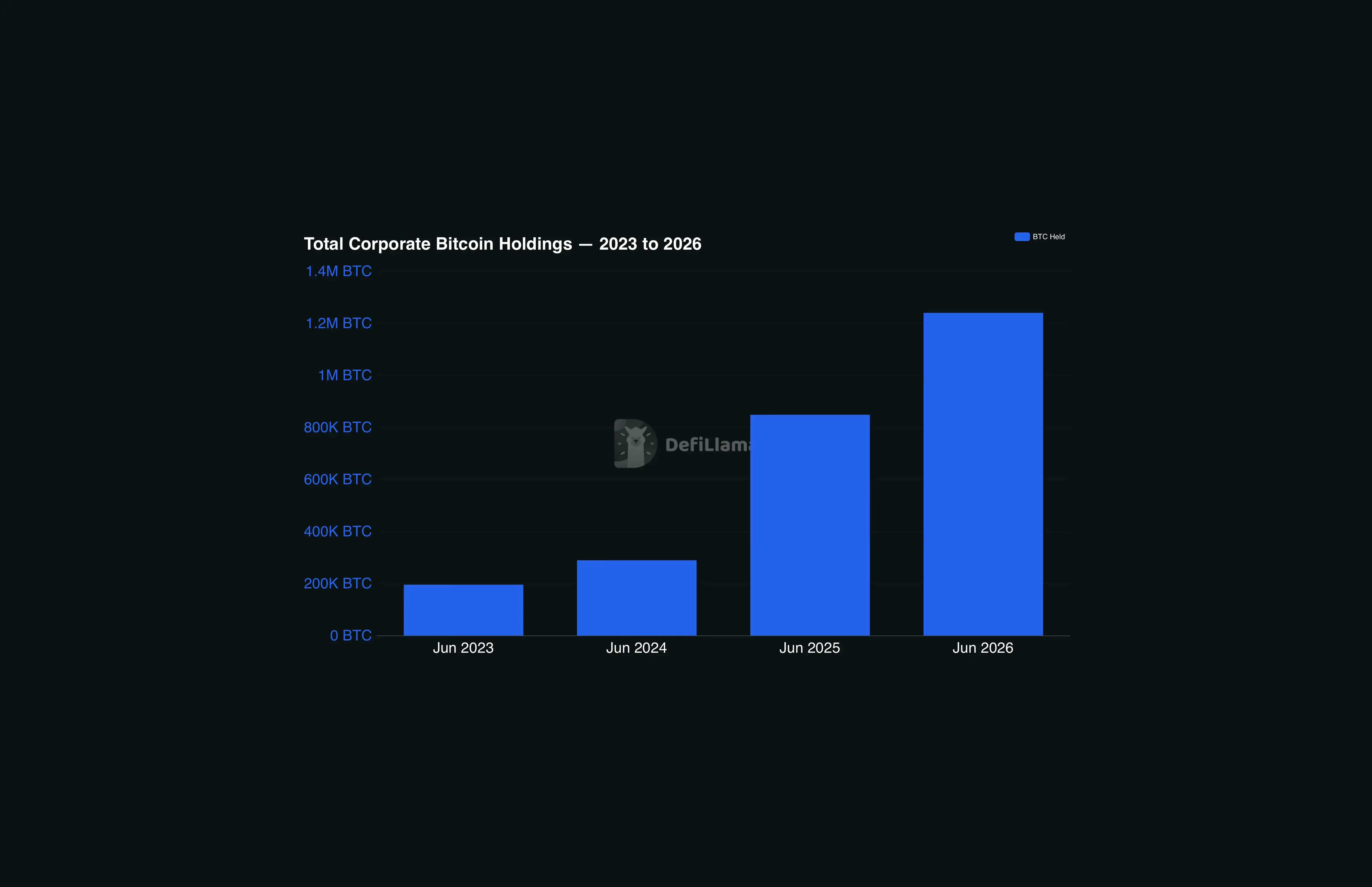
Corporate Bitcoin Adoption: From 8 Companies to More Than 100
Forty-five of the current 100 companies arrived in the past twelve months alone, bringing roughly 209,000 BTC with them. Of that new Bitcoin, around 72% came from treasury companies.
Year | Companies Tracked | BTC Held |
June 2023 | ~8 | 195,448 |
June 2024 | ~12 | 289,073 |
June 2025 | ~25 | 848,342 |
June 2026 | 100+ | 1,239,992 |
In 2023, public corporate Bitcoin ownership was almost entirely confined to miners and one software company that had started its Bitcoin accumulation.
Three years later it contains hotels, coffee shops, film studios and fashion retailers.
Anap Holdings (#38): 1,423 BTC. A Japanese women's fashion brand with a $25 million market cap that adopted a Bitcoin treasury strategy in 2025 alongside running clothing stores
Mac House (#100): 125 BTC. A Japanese men's casual wear retailer that decided to put Bitcoin on its balance sheet alongside selling jeans.
The list runs from Strategy, a $52 billion plus Bitcoin accumulation machine to a Japanese clothing retailer with 125 coins.
First Bitcoin Companies Categorized: Sector and Industry
The largest holder in software owns more Bitcoin than most countries.
The largest holder in coffee owns 213. Other industries include:
Industry | Largest Holder | BTC Held |
Software | Strategy | 845,256 |
Hospitality | Metaplanet | 40,177 |
Mining | MARA Holdings | 35,303 |
Crypto Exchange | Bullish | 24,300 |
Asset Management | Strive | 19,032 |
Automotive | Tesla | 11,509 |
Payments | Block | 9,032 |
Gaming | 4,091 | |
Food and Beverage | 2,804 | |
Fashion | Anap Holdings | 1,423 |
EV Technology | 1,046 | |
Coal | 618 | |
E-commerce | 570 | |
Film | 303 | |
Coffee | 213 |
Whether more entrants follow in each industry remains to be seen. For now, these companies mark the point at which Bitcoin reached a sector that had never held it before.
Coal: Alliance Resource Partners mines coal in Kentucky. BTN tracks its holdings at 618 BTC
Food and Beverage: DDC Enterprise is a US-listed Chinese food company with 2,804 BTC
E-commerce: MercadoLibre serves over 100 million active buyers across 18 countries and is worth over $100 billion. It holds 570 BTC.
Risks Associated With Bitcoin Treasury Companies
Treasury companies carry exposures that owning Bitcoin directly does not, these include:
Premium or discount to net asset value: a treasury stock can trade above or below the value of the Bitcoin it holds
Capital structure: accumulation is typically funded through equity and debt markets, introducing exposures that holding Bitcoin directly does not
No redemption mechanism: a shareholder cannot exchange shares for the underlying Bitcoin. The exposure is to the stock, priced by the equity market, not to the Bitcoin itself.
Leverage and forced selling: companies that borrow against their Bitcoin face margin and repayment obligations, and a falling price can force a sale at a loss to service debt
Concentration: Strategy alone holds more than two-thirds of all Bitcoin held by the top 100 public companies, so the category's reported figures are shaped heavily by a single company
Novelty: Most companies on this list adopted Bitcoin within the past year, in a rising market, following a template developed by a single pioneer. How these structures perform through a full market cycle remains to be seen.
Conclusion: What Investors Can Learn From Corporate Bitcoin Adoption
A treasury company exists to accumulate Bitcoin. A miner produces Bitcoin from electricity and hardware.
An operating business holds Bitcoin alongside an unrelated core product. Each model tracks something different: the treasury company against the capital raised to buy its Bitcoin, the miner against its cost of production, the operating business against its products, with Bitcoin a smaller line on the balance sheet.
Bitcoin is no longer held primarily by Bitcoin-native businesses. The asset now sits on balance sheets across industries whose core operations had nothing to do with digital money.
FAQ
What are the three main types of public companies that hold Bitcoin, and how do they differ?
The three types are treasury companies that exist to accumulate Bitcoin, Bitcoin miners that produce Bitcoin by converting electricity into hashrate and treat it as inventory, and operating businesses that hold Bitcoin on their balance sheet alongside an unrelated core product.
How is Bitcoin ownership distributed among the top 100 public corporate holders?
Among the top 100, treasury companies hold 1,063,882 BTC (85.8%), Bitcoin miners hold 93,855 BTC (7.6%), and operating businesses hold 82,263 BTC (6.6%), for a total of 1,239,992 BTC.
How has public corporate Bitcoin adoption changed from 2023 to 2026?
In June 2023 there were about 8 companies holding 195,448 BTC, rising to about 12 companies and 289,073 BTC in June 2024, about 25 companies and 848,342 BTC in June 2025, and over 100 companies holding 1,239,992 BTC by June 2026, with 45 of the current 100 joining in the past twelve months and bringing roughly 209,000 BTC.
What specific risks are associated with Bitcoin treasury companies compared with holding Bitcoin directly?
Risks include their shares trading at a premium or discount to net asset value, exposure from equity- and debt-funded capital structures, no mechanism to redeem shares for underlying Bitcoin, potential forced selling due to leverage and margin or repayment obligations, concentration risk because one company holds more than two-thirds of the category’s Bitcoin, and the novelty of structures that mostly launched in the past year in a rising market.
Disclaimer
The information provided in this article is for informational purposes only. It is not intended to be, nor should it be construed as, financial advice. We do not make any warranties regarding the completeness, reliability, or accuracy of this information. All investments involve risk, and past performance does not guarantee future results. We recommend consulting a financial advisor before making any investment decisions.
More like this
Written by

Andrew Kamsky
Andrew Kamsky is a Bitcoin analyst. He spent a decade in traditional finance across a Big Four firm and a listed fintech bank before going deep on Bitcoin full-time.