









Quick summary
Bitcoin trades modestly above key moving averages, testing resistance without confirming a breakout
Technical signals show a rare fourth bullish Fisher crossover, while cycle-bottom debates continue
Regulators advance tokenized markets via SEC sandbox, MiCA bank participation, and FX perps expansion
Coinjuice theses see $58,000 as leading bottom, with key support at $65,800-$74,000
Bitcoin's live price is $80,992, up 5.85% against its latest completed daily close and 3.64% above its 20-day average of $78,146. The move puts price 2.65% above its 50-week average of $78,915, trading modestly above trend rather than confirming an extended breakout.
Bitcoin is testing recovery-range resistance while regulators build the infrastructure for tokenized markets, and the distance between those two stories is what makes today's session worth reading past the price.
Price structure and the cycle-bottom debate:
Range test, not a range break: BTC sits 36% below its all-time high of $126,156, trading 2.65% above its 50-week average of $78,915 rather than clearing new territory. A sustained close well above that average would carry more weight than an intraday move.
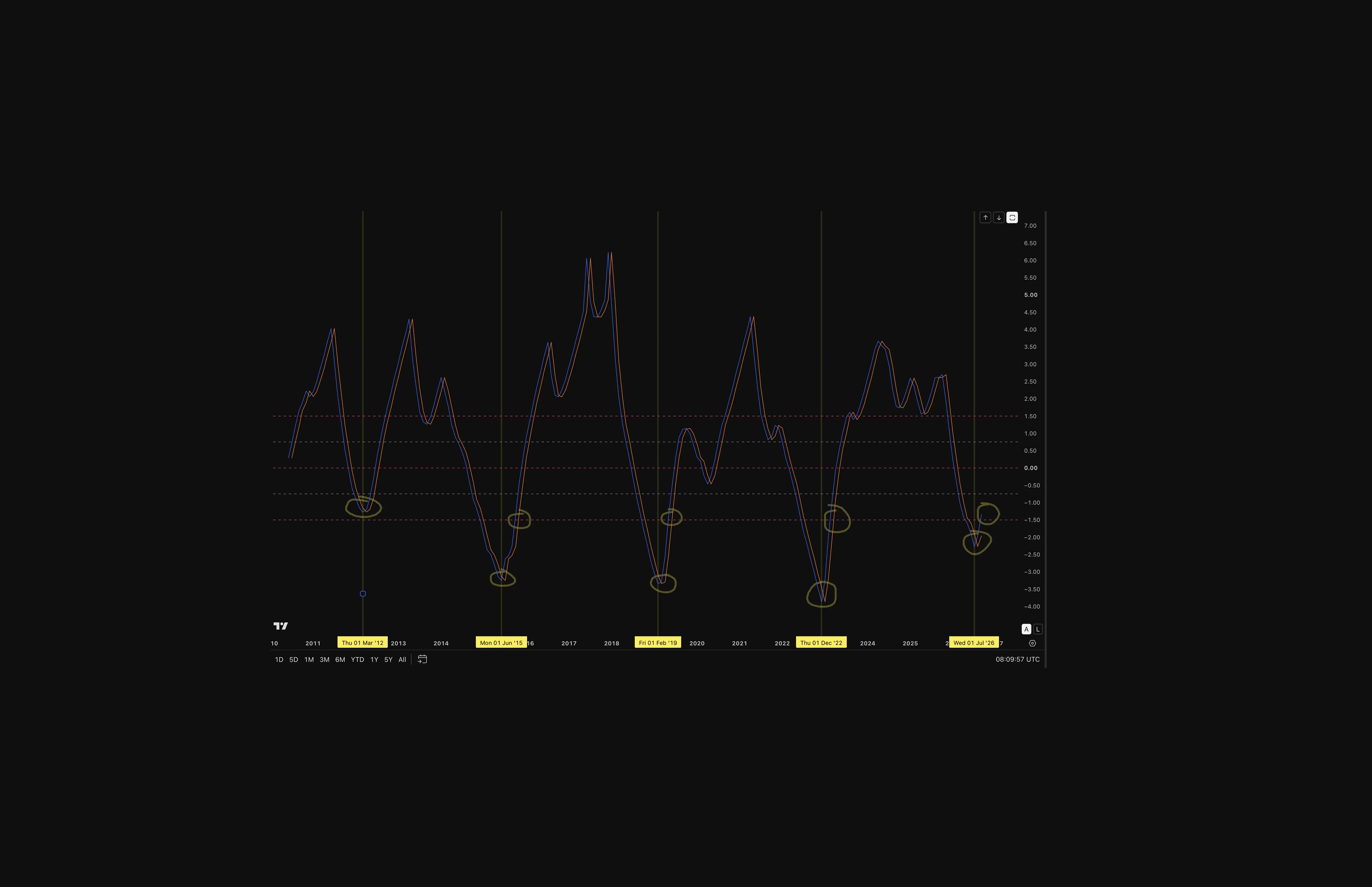
A rare technical crossover: Bitcoin's monthly Fisher Transform produced only its fourth historical bullish crossover, alongside a weekly bullish divergence. Both are analyst-identified technical signals, not confirmation of a structural trend change.
The cycle-bottom debate stays open: Onchain analyst James Check has argued Bitcoin's cycle bottom may already be in near $58,000, pointing to two capitulation events and long-term holders controlling roughly 80% of Bitcoin wealth. He has also cautioned against anchoring to the four-year cycle calendar, arguing the evidence should come from cost basis and holder behaviour, not the date.
Dominance holds, rotation stays narrow: BTC represents 73.86% of the combined market capitalization of BTC, ETH, SOL, BNB and XRP, and 59% of the entire crypto market, while the ETH/BTC ratio sits at 0.03233. Capital remains concentrated in Bitcoin rather than broadening into the rest of the basket.
Regulators Build the Rails for Tokenized Markets
Bitcoin is testing recovery-range resistance while regulators quietly build the infrastructure for tokenized markets, and two developments this week filled out that second half of the story.
A five-year sandbox for tokenized stocks: The SEC's new innovation exemption lets qualifying platforms operate markets for tokenized U.S. stocks without registering as national securities exchanges, provided each token carries the same voting rights, dividends and trading-halt obligations as the underlying share. The sandbox caps the most liquid names at 75 tickers and 0.25% of average daily volume per venue, and issuers keep a veto over who can tokenize their shares.
Bank participation in Europe keeps climbing: Banks now represent nearly 23% of providers on the EU's MiCA crypto register, up from about 17% in late June, as the total list grew from 243 to 349 providers over the same period. That shows infrastructure progress, however bank participation should not be seen as a signal of near-term Bitcoin demand.
Exchange infrastructure keeps expanding, and so does leverage: Binance is launching a 24/7 USD/BRL foreign-exchange perpetual contract on 21 September, offering up to 100x leverage and extending crypto-market infrastructure into currency markets. Expansion widens the market; it does not reduce the liquidation risk that comes with high leverage.
A reminder that infrastructure carries operational risk: A targeted cyberattack this week exposed exchange API details and trading data across 15 clients of an institutional crypto infrastructure provider, with some smaller funds reporting losses. Infrastructure growth and operational risk are expanding together, not one without the other.
Coinjuice Lens: Market Structure
This sits inside the theme Coinjuice has tracked since the reserve-bill coverage on September 17 and September 18: policy and market-structure progress moving ahead of confirmed flows. The SEC's tokenization sandbox extends the same regulatory debate covered in Are Bitcoin, Ethereum and Solana Securities? This time applied to equities rather than tokens. Read together, the editions show regulators building the rails for on-chain markets faster than trading behaviour is confirming demand for them.
This price action still follows the thesis Coinjuice has been running since summer.
June 12 gap-fill thesis: The gap-fill piece argued the gap down to $32k likely would not fill, conditional on weekly RSI clearing 56 and long-term holder supply continuing to rise.
August 28 bottom thesis: The bottom piece went further, naming the June 30–July 1, 2026 low near $58,000 as the leading bear-market bottom candidate, with confirmation resting on Bitcoin reclaiming its 50-week average near $81,200 and holding short-term holder realised price.
Both theses intact: Today's print, testing resistance 2.65% above the current 50-week average of $78,915, keeps both calls intact rather than breaking them.
What Bitcoin needs to hold: Bitcoin now needs to hold above the July low near $58,000 and the reassessment level at $65,800. A confirmed close below $65,800 would weaken the recovery structure, and a decisive move below $57,900 would invalidate the bottom thesis entirely.
What would not invalidate it: A pullback toward $71,000–$73,800, the short-term holder cost-basis retest zone the August piece flagged, would remain consistent with a drawdown recovery rather than break it.
News Behind Today's Read
Bitcoin adds to bull-market hopes as price metric prints fourth-ever bullish cross (Cointelegraph via TradingView). Source for Willy Woo's Fisher Transform reading: the fourth monthly bullish crossover in Bitcoin's history, plus the ongoing weekly bullish divergence tracking the 2022 bear-market bottom.
Bitcoin cycle bottom may already be in at $58K, says analyst James Check (Cointelegraph). Source for the cycle-bottom commentary from James Check and Zach Pandl, and the caution against anchoring to the four-year cycle calendar.
SEC Issues "Innovation Exemption" to Facilitate the Trading of Tokenized NMS Stock (U.S. Securities and Exchange Commission). Primary source for the five-year exemption, its voting/dividend/trading-halt parity requirement, and the symbol and volume caps on qualifying venues.
Banks double on EU MiCA crypto provider list as share hits 23% (Cointelegraph). Source for the bank-participation figures on the EU's MiCA register.
Binance launches 24/7 FX perps with weekend pricing system (Cointelegraph). Source for the 21 September USD/BRL perpetual launch and its leverage terms.
Go Deeper
Readers looking to navigate today's resistance test can start with the Coinjuice ebook, Bitcoin Trading Without Leverage, or go deeper with a Coinjuice subscription, currently 30% off the annual plan, where we start and complete trades and you will learn to snipe them independently.
This article was developed with the support of artificial intelligence tools as part of Coinjuice's editorial process and reviewed by our editorial team before publication.
FAQ
Why is Bitcoin's current move described as a range test rather than a range break?
Because Bitcoin is trading 36% below its all-time high of $126,156 and only 2.65% above its 50-week average of $78,915, which means it is modestly above trend without yet clearing new territory. A sustained close well above that average would be more significant than the current intraday move.
What is notable about the recent Fisher Transform signal for Bitcoin?
Bitcoin's monthly Fisher Transform has produced its fourth historical bullish crossover, accompanied by a weekly bullish divergence. Previous verified crossovers occurred in June 2015, February 2019, and December 2022, with the latest forming in July 2026 when BTC bottomed at $57,892 before closing near $62,810.
What does the SEC's new innovation exemption allow for tokenized U.S. stocks?
It allows qualifying platforms to operate markets for tokenized U.S. stocks without registering as national securities exchanges, provided each token has the same voting rights, dividends, and trading-halt obligations as the underlying share. The sandbox is limited to 75 of the most liquid tickers, caps volume at 0.25% of average daily volume per venue, and gives issuers a veto over who can tokenize their shares.
What price levels are key for maintaining Coinjuice's current Bitcoin bottom thesis?
Bitcoin needs to hold above the July low near $58,000 and the reassessment level at $65,800. A confirmed close below $65,800 would weaken the recovery structure, and a decisive move below $57,900 would invalidate the bottom thesis. A pullback toward $71,000–$73,800 would still be consistent with a drawdown recovery.
Disclaimer
The information provided in this article is for informational purposes only. It is not intended to be, nor should it be construed as, financial advice. We do not make any warranties regarding the completeness, reliability, or accuracy of this information. All investments involve risk, and past performance does not guarantee future results. We recommend consulting a financial advisor before making any investment decisions.
More like this
Written by

Andrew Kamsky
Andrew Kamsky is a Bitcoin analyst. He spent a decade in traditional finance across a Big Four firm and a listed fintech bank before going deep on Bitcoin full-time.