










Quick summary
Bitcoin trades at $77,462, slightly recovering but still below its 20-day average
September’s Bitcoin decline is milder than historical norms, during its seasonally weakest week
A Strategic Bitcoin Reserve bill passed a House committee but still faces full congressional approval
US spot Bitcoin ETFs saw net inflows after prior outflows, amid mixed macro and institutional signals
Cautious Recovery & Institutional Crosscurrents
Bitcoin's live price is $77,462, up 1.39% against Sept 17's completed daily close of $76,404, a close that itself rose 0.33% from Sept 16's $76,150. BTC remains 0.71% below its own 20-day average even after the bounce, while a Strategic Bitcoin Reserve bill clears a House committee on the same day ETF flows recover from a multi-session outflow stretch.The tension between policy momentum and flow data is the story today.
Bitcoin's September Drop Is Half Its Historical Average
Bitcoin sits 38.60% below its recorded all-time high of $126,156. Against Coinjuice's own 13-year September seasonality study, the month has closed lower in 8 of the past 13 years, with a median monthly return of -4.72% (open-to-close, 2013 to 2025).
This September, BTC is running a milder -1.39% month-to-date, from the September 1 open of $78,553 to the September 18 print of $77,462. A partial-month figure rather than a like-for-like match to the full-month historical benchmark, with 18 of 30 days elapsed. The calendar lines up as well: September 15 to 21 is historically the weakest week of the month, averaging -2.19% across 13 years, and Bitcoin has just entered it. The partial read for September 15 to 18 shows -0.91%, again softer than the seasonal average, with the historically weakest three-day stretch (September 19 to 21, averaging -1.98%) still ahead.
Macro backdrop: the market is digesting a fresh Federal Reserve rate hike and the possibility of further tightening, alongside resilient labor data, weaker housing activity and closely watched Treasury-yield signals, a mixed setup for risk assets.
On-chain signal: no current MVRV, SOPR or realized-cap reading was retrieved in this run, so the verified signal is price-based only: BTC trades above its latest close but below its 20-day average of $78,014, supporting a tentative recovery rather than proof of aggressive accumulation.
Mining and hash rate: no fresh hash-rate or miner-margin series was retrieved; a rising spot price alone does not establish that miners are becoming more profitable, since machine efficiency, electricity costs, subsidy revenue and transaction fees all factor into the margin.
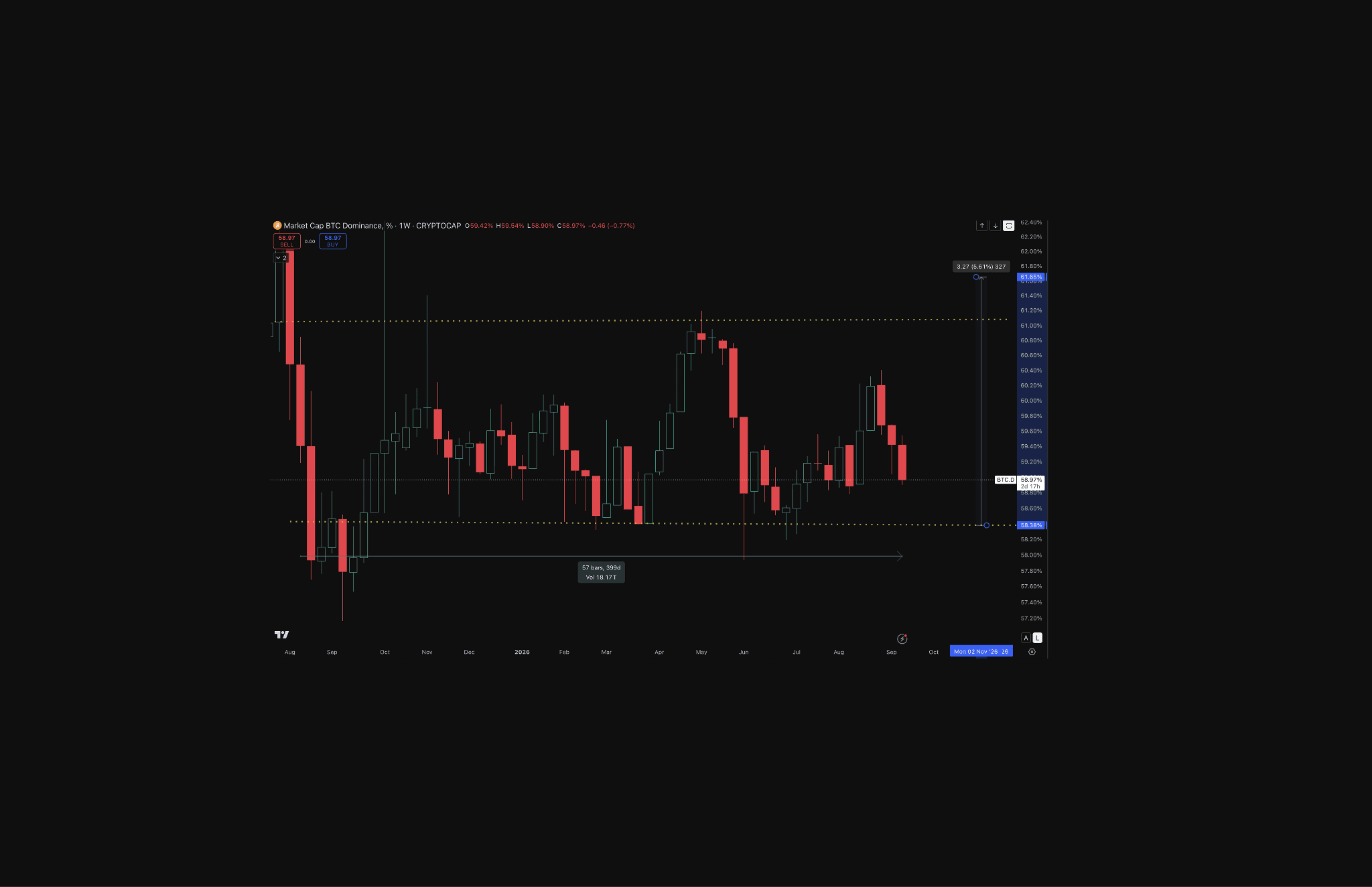
Dominance: BTC represents 73.95% of the combined market capitalization of BTC, ETH, SOL, BNB and XRP, a five-asset leadership proxy rather than total crypto dominance. Measured against the full market instead, Bitcoin's share sits at 59%. ETH/BTC is 0.03201.
Bitcoin Reserve Bill Advances, ETF Flows Wobble
Policy and flow data moved in different directions this week, which is the clearest evidence that Bitcoin's modest recovery is real, but institutional signals point in opposite directions until confirmed by sustained inflows.
Legislative progress: U.S. lawmakers advanced a bill that would codify a Strategic Bitcoin Reserve and require accounting and proof-of-reserve measures for federally controlled digital assets. Committee passage is meaningful, but the bill still needs approval from the full House and Senate before becoming law.
ETF flows: U.S. spot Bitcoin ETFs saw $159.9 million of net inflows on September 14, ending a four-session, roughly $462.7 million outflow streak that ran September 8 to 11. BlackRock's IBIT captured about 84% of the inflow ($134 million), with Fidelity second at roughly $53 million.
Traditional-finance entry: Deutsche Bank reportedly announced plans for digital-asset custody supporting Bitcoin and Ether for institutional and corporate clients, subject to regulatory approval, with a BaFin licence expected in October; launch timing and final scope remain unconfirmed.
Coinjuice Lens: Corporate Treasuries and Bitcoin Adoption
The reserve bill's committee passage sits inside a broader theme Coinjuice has tracked since launch: policy and balance-sheet adoption moving ahead of retail sentiment. The prior edition, What Happened in Bitcoin Today: September 17, 2026, covered the same ETF-flow volatility from the other side of the ledger; read together, the two editions show flows lagging policy rather than leading it.
News Behind Today's Read
US Bitcoin Reserve Bill Passes House Committee (Cointelegraph). Source for the Strategic Bitcoin Reserve bill's current committee-stage status and remaining legislative steps.
Deutsche Bank Brings Bitcoin Custody to Europe's Institutional Set (Bitcoin.com News). Source for Deutsche Bank's September 16 announcement, its planned Bitcoin and Ether custody service for institutional and corporate clients, and the pending BaFin regulatory clearance.
Bitcoin ETF Inflows Are Back, But BlackRock Is Carrying the Market Into the Fed Meeting (CryptoSlate). Source for the September 14 net inflow figure, the four-session $462.7 million outflow streak it ended, and the IBIT/FBTC split ($134.3 million and $53.3 million).
Onchain Malware Writes Surge 420% as North Korea and Iran-Linked Activity Rises (Cointelegraph). Source for the Chainalysis-linked reporting on malware instructions written to public blockchains, cited as a risk flag rather than a market driver.
Duration, Rallies and Stocks Recover as Wall Street Cheers Yesterday's Fed Hike, Potential Geopolitical Relief (Interactive Brokers). Source for the Federal Reserve, Treasury-yield, labor and housing context shaping the mixed macro backdrop.
Go Deeper
Investors who want to build this kind of process systematically can start with the Coinjuice ebook, Bitcoin Trading Without Leverage, or explore the Coinjuice subscription, currently 30% off the annual plan. New sources of information starting soon specifically for PRO members.
Market Snapshot
Asset | Price | Distance from ATH |
BTC | $77,462 | 38.60% below ATH ($126,156) |
ETH | $2,479 | 49.87% below ATH ($4,946) |
DeFi TVL | $89.27B | Base TVL, DefiLlama (+19.26% 30d) |
This article was developed with the support of artificial intelligence tools as part of Coinjuice's editorial process and reviewed by our editorial team before publication.
FAQ
Why did Bitcoin dip below its 20-day average despite the recovery?
A single positive daily close does not erase a preceding stretch of weaker closes that make up the moving average. BTC's last completed daily close (Sept 17) rose 0.33% to $76,404, and the live price has extended further to $77,462, yet the 20-day average of $78,014 still sits above both figures, meaning the recovery has not yet been sustained long enough to pull the average back up with it. A reclaim and hold above that level would mark a firmer short-term structural improvement; continued rejection keeps the recent range and a downside retest in play.
Does the Strategic Bitcoin Reserve bill mean Bitcoin is now an official U.S. reserve asset?
Not yet. The bill passed a House Financial Services Committee vote, which is a procedural step, not enactment. It still requires approval from the full House and the Senate, along with any subsequent reconciliation, before it could take effect.
How does Bitcoin’s current September performance compare with its historical September seasonality?
From September 1 to 18, Bitcoin is down about -1.39%, which is milder than the 13-year median September return of -4.72%. It has just entered the historically weakest week of the month (September 15–21, averaging -2.19%), and the weakest three-day stretch (September 19–21, averaging -1.98%) is still ahead.
What recent signals are coming from institutional Bitcoin products like ETFs and custody services?
U.S. spot Bitcoin ETFs saw $159.9 million of net inflows on September 14, ending a four-session $462.7 million outflow streak, with BlackRock's IBIT taking about $134 million and Fidelity about $53 million. Deutsche Bank has also announced plans for Bitcoin and Ether custody for institutional and corporate clients, pending BaFin regulatory approval.
Disclaimer
The information provided in this article is for informational purposes only. It is not intended to be, nor should it be construed as, financial advice. We do not make any warranties regarding the completeness, reliability, or accuracy of this information. All investments involve risk, and past performance does not guarantee future results. We recommend consulting a financial advisor before making any investment decisions.
More like this

Written by

Andrew Kamsky
Andrew Kamsky is a Bitcoin analyst. He spent a decade in traditional finance across a Big Four firm and a listed fintech bank before going deep on Bitcoin full-time.