









Quick summary
Bitcoin trades at $76,499, modestly higher but below short-term average and all-time high
Federal Reserve hikes rates to 3.75%-4.00%, widening real policy rate and signaling more
Bitcoin on-chain demand softens with negative ETF flows and stalled corporate treasury buying
CLARITY Act fails in Senate while American Reserve Modernization Act advances in House committee
Bitcoin trades near $76,499 on September 17, 2026, up 0.74% on its latest completed daily close but still 2.03% below its 20-day average and 39% below its all-time high of $126,155. That is a mild start against Bitcoin's own seasonal history: Coinjuice's own seasonality research flags September 19 to 21 as the historically weakest stretch of the month, averaging a loss of roughly 2% over the past 13 years, a window the market has yet to enter.
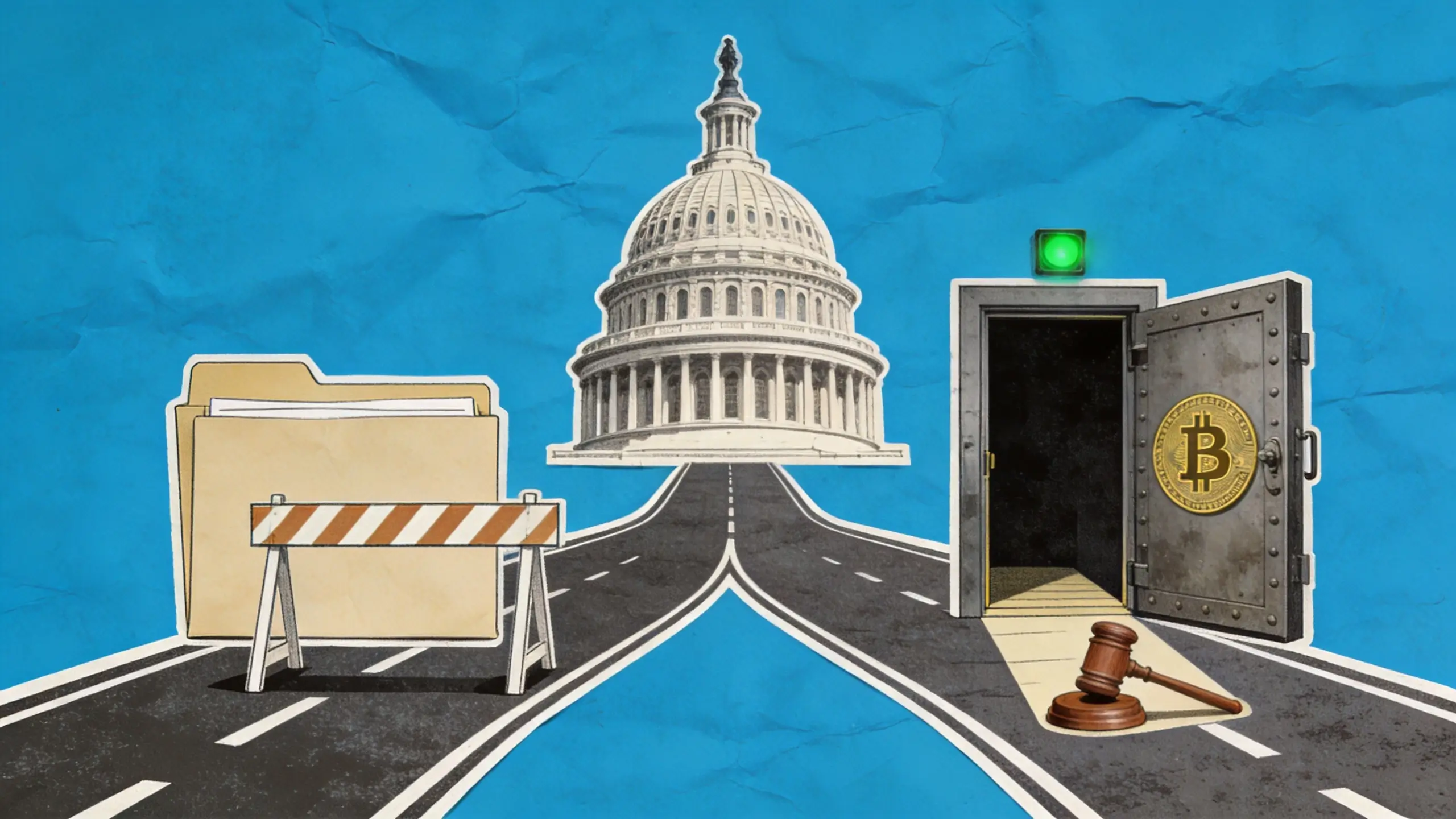
Policy is tightening without surprise while Bitcoin's on-chain demand stalls and Washington splits into one dead bill and one advancing. Underneath it, the Federal Reserve delivered exactly the rate move markets had already priced, the capital that funded the last month's recovery has stopped arriving, and Washington produced one confirmed loss and one confirmed gain for Bitcoin's legislative track in the same week.
Fed Hike Confirmed: A Real Rate That Keeps Widening
The Federal Reserve raised its target range by 25 basis points to 3.75% to 4.00% on September 16, 2026, the first increase in three years, per AFP. Markets had assigned a 92.5% probability to that exact outcome heading into the decision, per CoinDesk reporting from the prior session, so the move itself carried little new information.
The real rate widened anyway: US core inflation has fallen to 2.4%, its lowest reading since 2021, while the policy rate moved up. The gap between the two, the real policy rate, stood at 1.35 percentage points before the hike and sits closer to 1.5 points now, with no change in the inflation trend. It matters because Alice and Bob face higher borrowing costs while prices rise more slowly, squeezing their budgets and leaving less money to spend.
The bond market got there first: the 2-year Treasury yield had been pricing a hike for weeks, per Glassnode's September 16, 2026 research note, which is how a fully expected central bank decision can still tighten financial conditions further once it lands.
Policymakers signaled more to come: officials indicated another increase may be needed before year end, per AFP, which keeps the tightening bias in place regardless of where the September decision sits in memory a month from now.
Bitcoin Demand Stalls: Reserve Bill Advances While Capital Waits
The September 16, 2026 edition flagged short-term holders sitting on a month-long profit streak. The capital that built that base has since gone quiet. Realized Cap, the value of every coin priced at the level it last moved, posted its first daily outflow in 28 days on September 15, 2026, per Glassnode's Week 37 research note, with the following session's reading tracking negative too.
ETF flows turned negative first: US spot Bitcoin ETFs logged roughly $450 million in net outflows on September 15, 2026, their worst single day since June 25, per CoinDesk. Glassnode separately tracked about $334 million of net outflows across the week of September 8 to 14, 2026.
Corporate treasuries have mostly paused, though the exact scale is contested: Glassnode puts three-month net purchases at roughly 5,900 BTC, against 89,000 BTC in July 2025 alone. Either way, the group's average entry price of $80,500 sits above spot, leaving the cohort underwater.
One treasury reportedly kept buying, though the figures conflict: media reports (via a BitGo research note, ProCoinNews and Foreign Policy Journal) put Strive's purchase at 469 BTC for about $36.6 million between September 8 and 11, 2026, funded through its SATA preferred stock, lifting holdings to 25,000 BTC.
Legislation split the same way capital did: the CLARITY Act's failed Senate cloture vote on September 15, 2026 leaves crypto market-structure legislation without a near-term path in 2026, per CoinDesk, while the House Financial Services Committee passed the American Reserve Modernization Act in a 28-21 vote, per Cointelegraph. The bill would codify the 2025 executive order establishing a Strategic Bitcoin Reserve into federal law; it still needs the full House, the Senate and the president.
Policy is tightening without surprise while Bitcoin's on-chain demand stalls and Washington splits into one dead bill and one advancing. Neither the stalled Realized Cap nor the committee vote resolves anything on its own. Both mark a change from where each stood a week earlier.
Coinjuice Lens: Monetary Policy
Bitcoin barely moving after an expected Fed decision does not mean interest rates no longer matter. It may simply mean traders had already priced it in. What the Fed signals about its next move can still shift the market. Be sure to come back to Coinjuice today, for our latest research on how Fed decisions and expectations for interest rates affect Bitcoin.
Our coverage of financial repression and on-chain analytics follows the same principle.
For a practical trading framework, read Bitcoin Trading Without Leverage, or join Coinjuice, currently 30% off the annual plan, to follow our trades from entry to exit and learn to spot opportunities yourself.
News Behind Today's Read
Fed Raises Rates to Tackle Too-High Inflation (AFP). Source for the 25-basis-point hike to 3.75%-4.00% and the signal that another increase may be needed this year.
Crypto Clarity Act Flames Out in Failed U.S. Senate Vote (CoinDesk). Confirms the 49-50 cloture result and that market-structure legislation has no near-term path in 2026.
US Bitcoin Reserve Bill Passes House Committee (Cointelegraph). Source for the 28-21 committee vote on the American Reserve Modernization Act.
Deutsche Bank Nears Crypto Custody Service Debut for Institutional Clients (CoinDesk). Source for the planned regulated custody rollout covering bitcoin, ether, USDC and EURC.
The Week Onchain, Week 37 2026 (Glassnode). Source for the Realized Cap inflow break, the corporate treasury cost basis, and the ETF and stablecoin flow figures above.
Market Snapshot
Asset | Price | Distance from ATH |
BTC | $76,499 | 39% below ATH ($126,155.58) |
ETH | $2,442 | 51% below ATH |
DeFi TVL | $87.3B | Global TVL, DefiLlama |
This article was developed with the support of artificial intelligence tools as part of Coinjuice's editorial process and reviewed by our editorial team before publication.
Disclaimer
The information provided in this article is for informational purposes only. It is not intended to be, nor should it be construed as, financial advice. We do not make any warranties regarding the completeness, reliability, or accuracy of this information. All investments involve risk, and past performance does not guarantee future results. We recommend consulting a financial advisor before making any investment decisions.
FAQ
What did the Federal Reserve decide on September 16, 2026, and why did it not move Bitcoin much?
The Federal Reserve raised its target range by 25 basis points to 3.75% to 4.00%, the first increase in three years, per AFP. Markets had already assigned a 92.5% probability to that outcome, per CoinDesk, so the decision confirmed existing pricing rather than surprising it. The more consequential shift is structural: with core inflation at 2.4%, the real policy rate widened even though the headline move was fully expected.
What is the American Reserve Modernization Act, and how far along is it?
It is a bipartisan bill that would codify President Trump's 2025 executive order establishing a Strategic Bitcoin Reserve into federal law, requiring reserve bitcoin to be held for at least 20 years and backed by quarterly proof-of-reserve audits. The House Financial Services Committee passed it 28-21, per Cointelegraph. It still needs approval from the full House, the Senate, and the president, and it is a separate bill from the CLARITY Act, which failed its Senate cloture vote on September 15, 2026.
Why does a stalled Realized Cap matter for Bitcoin's price?
Realized Cap tracks the value of every coin at the price it last moved, so a rising reading means new capital is arriving on-chain. It rose for 27 straight days through September 14, 2026, funding the recovery into the recent range; it posted its first outflow in 28 days on September 15, per Glassnode. That does not confirm a reversal, but it does mean the buying that supported the range has paused, which is different from price falling on its own.
What does the article indicate about current Bitcoin demand from ETFs and corporate treasuries?
US spot Bitcoin ETFs saw roughly $450 million in net outflows on September 15, 2026, and about $334 million of net outflows over the week of September 8 to 14, while corporate treasuries have mostly paused with about 5,900 BTC in three-month net purchases versus 89,000 BTC in July 2025.
Disclaimer
The information provided in this article is for informational purposes only. It is not intended to be, nor should it be construed as, financial advice. We do not make any warranties regarding the completeness, reliability, or accuracy of this information. All investments involve risk, and past performance does not guarantee future results. We recommend consulting a financial advisor before making any investment decisions.
More like this


Written by

Andrew Kamsky
Andrew Kamsky is a Bitcoin analyst. He spent a decade in traditional finance across a Big Four firm and a listed fintech bank before going deep on Bitcoin full-time.