










Quick summary
Bellman and Livermore both stress decisions must depend on current position, not entry price
Bellman’s framework focuses on state, policy, and value to guide each new trading decision
Livermore advises letting profits run, cutting losses early, and ignoring missed entry targets
Averaging down without new information is risky, unlike fixed-schedule Bitcoin dollar-cost averaging
Jesse Livermore never studied dynamic programming. Richard Bellman, the mathematician who developed the framework in 1957, never traded stocks. Yet a 2014 paper by Nick Polson of the University of Chicago and Jan Hendrik Witte of Oxford places their ideas side by side, and they line up neatly.
Both arrive at the same basic lesson: a trading decision should depend on where a position stands now, not on the price paid to enter it.

Bellman’s Principle of Optimality in Trading
Bellman’s Principle of Optimality sounds complicated, but the central idea is simple:
State: Where the position and trading account stand today.
Policy: The rule guiding the next decision.
Value: The best possible outcome from where the trade stands now.
The original entry and forecast cannot be changed.
The only useful question is what makes sense from the current position.
Bitcoin at $80,000: Take Profit or Keep Holding?
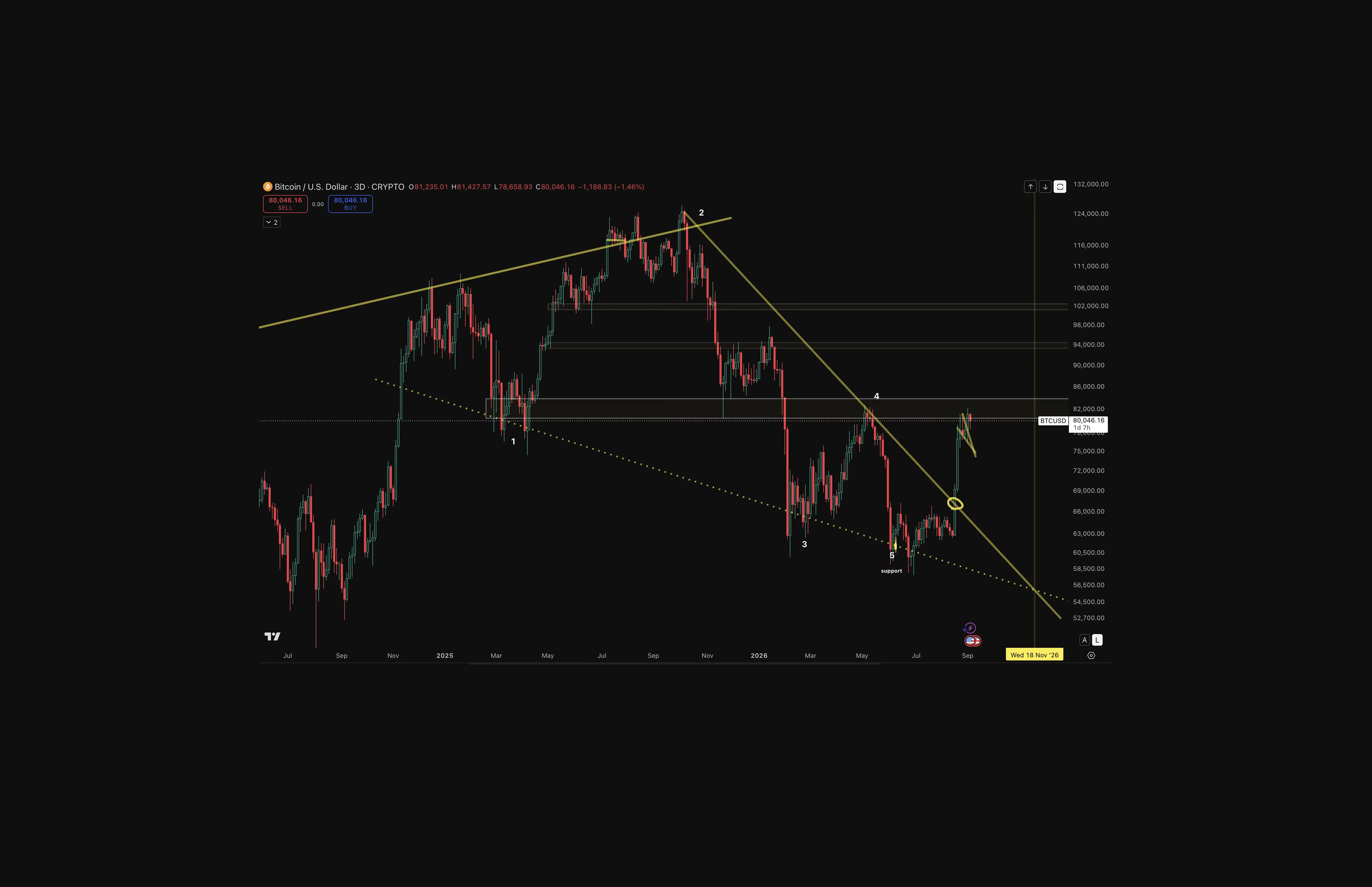
Bitcoin has climbed roughly 40% from its low near $58,000 and is now testing an old support and resistance area around $80,000. Traders who bought near the low are sitting on a profit. Anyone entering near $80,000 faces a very different level of risk.
Why hold: The base near $58,000 held and Bitcoin recovered to $80,000. Coinjuice reads the move as strength, although a dead-cat bounce cannot be ruled out until price holds above the widely watched 50-week moving average.
Why take profit: Bitcoin is testing resistance after a fast recovery. Bear markets can produce strong rallies before turning lower, while employment data, interest-rate expectations and other macro events can quickly change the direction, as covered in today’s Bitcoin market report.
Bellman’s principle does not give every trader the same answer.
Someone who bought near $58,000 may continue holding because the position remains profitable and the chart has improved. Bears waiting for $40,000 now face a different market at $80,000.
The decision must therefore be based on whether the 40% recovery represents strength or a dead-cat bounce as Bitcoin approaches the period historically associated with a four-year-cycle peak.
Why Livermore Cut Losing Positions
Livermore believed a trader should remain with a profitable position while the market continued to support it.
When price moved against the original idea, the position had to be reconsidered.
Let profits develop: A winning position suggests the original decision is still working.
Cut losses early: A losing position suggests the market may be proving the decision wrong.
Reassess a missed entry: If an expected price never arrived, an old target should not control the next decision. The market must be considered from its current price.
The traders aim is not to predict every move correctly. It is to prevent one incorrect or missed trade from controlling the next decision.
Why Averaging Down Is Not Bitcoin DCA
Averaging down means adding more money to a losing trade after the asset falls below its entry price. The paper argues that increasing the position is irrational unless new information, beyond the price decline itself, strengthens the original case. The distinction is straightforward:
Averaging down reacts to a loss: More capital is committed in an attempt to rescue the original trade.
DCA follows a fixed plan: The same amount is invested on a regular schedule, regardless of whether Bitcoin rises or falls.
Livermore warned against increasing the size of a losing trade. He illustrated the danger by moving from 200 shares to 400, then 800, 1,600 and 3,200. What begins as a manageable loss can eventually threaten the entire account.
A planned Bitcoin DCA strategy does not change its timing or investment amount in response to falling prices.
The Coinjuice guide to dollar-cost averaging Bitcoin explains the distinction further.
The Fixed-Value Trap
Averaging down often begins with a fixed belief about what an asset should be worth. Every decline then looks like a larger discount, even when the market is challenging the original view.
A lower price alone does not make the trade better. Conviction remains useful only while the evidence continues to support it.
The Lesson for Traders
The study’s conclusion is clear: every market view should be updated when new information arrives. A profitable trade may still deserve time to develop. A losing trade may need to be closed. Adding more money simply because the price has fallen does not make the original idea correct.
The lesson from Bellman and Livermore is that whatever decisions led to the present position, the next move should be based on where the market stands now. Past forecasts, missed entries and hopes no longer decide what happens next.
The Coinjuice trading guide explains how the same reasoning can be applied to position entities and exits without leverage. Further Bitcoin and market-structure research is available through the Coinjuice subscription plans.
FAQ
What is the main lesson shared by Bellman’s math and Livermore’s trading approach?
Both conclude that trading decisions should depend on where a position stands now, not on the price paid to enter it or on past forecasts.
How does Bellman’s Principle of Optimality apply to trading decisions?
It frames each decision around the current state of the position and account, the policy guiding the next action, and the best possible outcome from where the trade stands now, given that the original entry and forecast cannot be changed.
Why did Livermore advocate cutting losing positions?
He believed that a winning position indicates the original decision is still working, while a losing position suggests the market may be proving the decision wrong and must be reconsidered to prevent one bad trade from controlling future decisions.
What is the key difference between averaging down and a Bitcoin DCA strategy?
Averaging down adds more money to a losing trade in reaction to a loss, while Bitcoin DCA invests the same amount on a regular schedule regardless of price movements and does not change timing or size in response to falling prices.
Disclaimer
The information provided in this article is for informational purposes only. It is not intended to be, nor should it be construed as, financial advice. We do not make any warranties regarding the completeness, reliability, or accuracy of this information. All investments involve risk, and past performance does not guarantee future results. We recommend consulting a financial advisor before making any investment decisions.
More like this


Written by

Andrew Kamsky
Andrew Kamsky is a Bitcoin analyst. He spent a decade in traditional finance across a Big Four firm and a listed fintech bank before going deep on Bitcoin full-time.