









Quick summary
BIP-110 fork launched to restrict Ordinals stalled after two blocks as miners rejected it
Bitcoin price hovered near $63,874, with Ichimoku cloud break still needed for trend change
Hedge funds turned net long and ETFs saw strong weekly inflows despite Monday outflows
Strategy’s 1690 BTC sale and Hormuz tensions triggered sharp intraday Bitcoin price drop
Bitcoin's governance resolved itself in two blocks; one seller and Hormuz risk gave the rally back by Monday.
Bitcoin trades near $63,874, down roughly 1.6 percent on the day and essentially flat on the week. Underneath it, a contested Bitcoin fork resolved itself through nothing but economic incentive over the weekend, while Monday's session demonstrated how thin the resulting rally still was: one corporate seller and a shipping lane on the other side of the planet were enough to erase it.
BIP-110 Fails in Two Blocks: Bitcoin Governs Itself
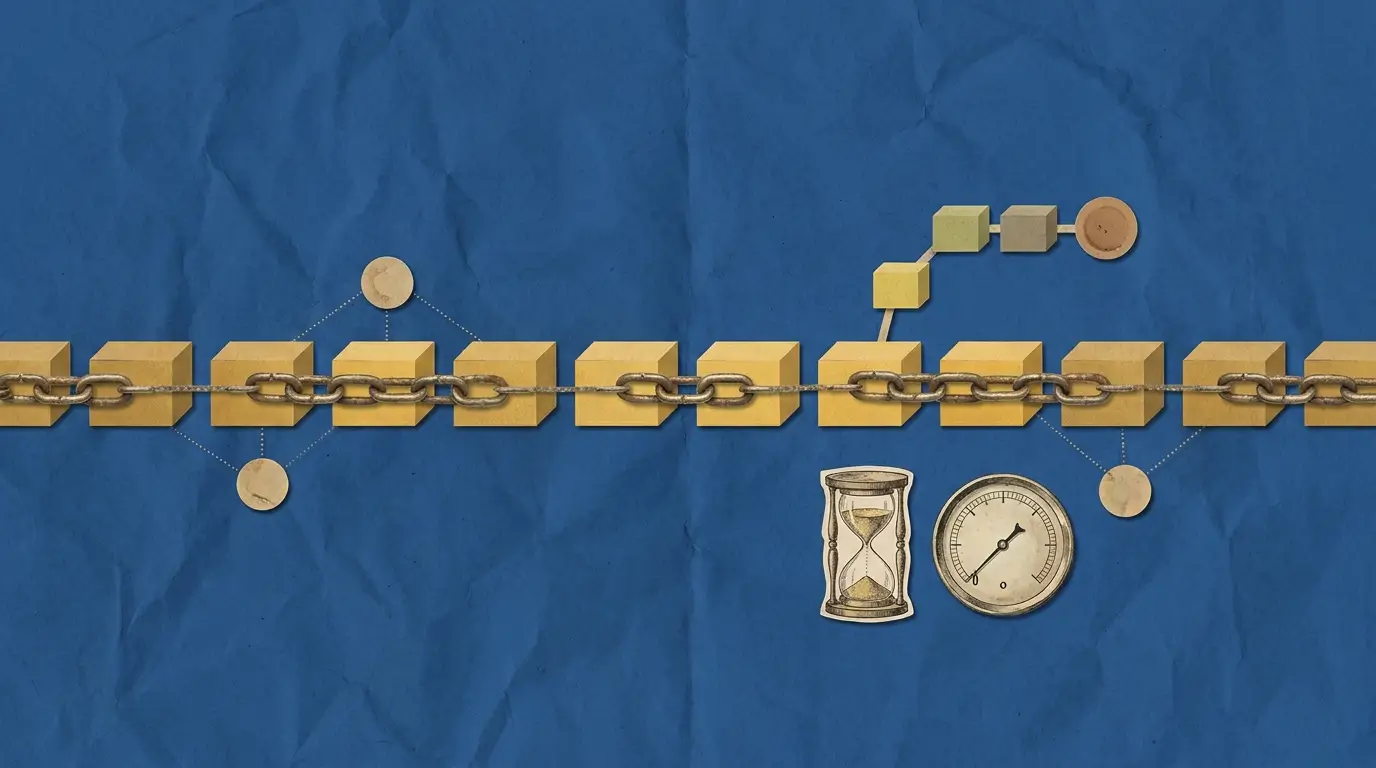
A proposal known as BIP-110, aimed at restricting Ordinals inscriptions from block space, failed to reach broad developer consensus and was rejected through normal channels. Its supporters forked anyway, launching a breakaway chain at block 961,632.
The fork inherited difficulty, not hashpower: the new chain carried Bitcoin's full mining difficulty but attracted only a sliver of the network's hashpower, making each block extremely slow and expensive to produce.
Miners chose the more profitable chain: the minority branch mined exactly two blocks before stalling permanently. The original chain continued uninterrupted, with essentially all liquidity, security, and activity intact.
No authority intervened: the outcome was not decided by a developer committee, an exchange delisting, or a regulator. BIP 110s rejection was decided by miners following the incentive that already governs the network: decentralized governance functioning exactly as designed.
Spot price sat near $65,000 through the resolution, range-bound in the upper half of its summer channel, with a sustained close above the Ichimoku cloud still the technical marker analysts are watching for a genuine trend change.
Why Did Bitcoin Fall Despite Bullish CME Data?
Two structural signals had been building in Bitcoin's favor heading into the week. Both were still true on Monday. Neither stopped the price from falling.
Hedge funds are now betting bitcoin goes up, not down a first in years: For a long time, big trading funds made money on a "safe" trade: buy bitcoin, then bet against it in the futures market, pocketing the small price gap between the two. That gap has shrunk to about 3 percent, which is now less than what a safe two-year government bond pays. So the safe trade has stopped paying, and funds are unwinding the "bet against it" side rather than replacing it leaving them plainly long. As CryptoQuant's CEO, Ki Young Ju, put it: "The suits are now betting on bitcoin's upside.”
ETF inflows were reported strong, though figures vary by tracker: roughly $754.7 million per SoSoValue, $865.3 million per Farside, and about $850 million per Bloomberg for the same week. None of these are confirmed against DefiLlama-tracked flow data. Same-day spot BTC and ETH ETF flows turned negative Monday, roughly −$144.7 million and −$14.6 million respectively, a more current data point worth weighing against the weekly inflow narrative.
Then Strategy sold 1,690 BTC: the sale, disclosed Monday and executed between August 3 and 9 at an average price of $64,262, raised $108.6 million used to repurchase STRC preferred shares. It was the company's fourth disclosed Bitcoin sale of 2026, bringing total 2026 sales to 6,948 BTC. Strategy's holdings now stand at 840,447 BTC against an average cost basis of $75,385.
The market reacted immediately: Bitcoin cracked below $64,000 shortly after the U.S. open, a daily loss near 2 percent that erased more than $20 billion in market capitalization in under four hours and liquidated $47 million in long positions against $12 million in shorts.
Hormuz added a second headwind: Iran's deputy speaker Ali Nikzad said reopening the Strait of Hormuz "has no military solution," and oil rose close to 5 percent on the news, alongside reports of Houthi attacks on Saudi energy infrastructure. The combination pulled risk appetite lower across equities and crypto together.
A cloture motion on the CLARITY Act remains filed but unresolved, with the first procedural Senate vote not expected before mid-September; this is a continuation of the delay already flagged in Tuesday's edition, not a new development.
The Lesson
A code dispute has settled itself in twenty minutes, with no appeal and no argument. A price cannot. One company selling coins, plus a headline out of Tehran, moved Bitcoin's short term price on Monday more than the entire weekend's fork drama did. So track two different things separately: whether Bitcoin's system still works, and what its price did today.
The first tells you the network is healthy. The second just tells you who sold first.
Coinjuice Lens
Category: On-chain behaviour / Bitcoin governance. The BIP-110 episode is a live version of the governance question Coinjuice has examined earlier in 2026 in detail. For the mechanics of how a Bitcoin governance dispute actually gets settled, and why forks fail without broad miner buy-in, see Conijuice interview with Jimmy Song, BIP-110 & Bytesize Bitcoin Governance.
Readers navigating volatility like Monday's without reaching for leverage can start with the Coinjuice ebook, Bitcoin Trading Without Leverage, or go deeper with a Coinjuice subscription, currently 30% off the annual plan, where we start and complete trades and you will learn to snipe them independently.
News Behind Today’s Pulse
"Coinsbuy confirms hack as investigator reports $7.9M stolen" (Cointelegraph, Aug 10) — source for the $8.07 million cross-chain drain across TRON and Ethereum. Coinsbuy has since restored deposit/withdrawal services and covered affected client funds; GoPlus Security's assessment describes the breach as consistent with compromised hot-wallet private keys or stolen administrator privileges.
"H100 Group Buys 2 Norwegian Firms, Adds 2,455 BTC to Treasury" (CoinMarketCap, Aug 10) — source for H100 Group's all-share, zero-cash acquisition that tripled its holdings from 1,051 to 3,506 BTC, structured on a pure Bitcoin-for-Bitcoin basis, vaulting it to Europe's No. 2 Bitcoin treasury behind Bitcoin Group SE.
"Hedge funds abandon structural shorts to bet on a bitcoin rally" (WordUp News, Aug 10) — source for the CME net-long positioning shift referenced in Section 2. (Lower-trust outlet — could not locate a tier-1 source for this specific Aug 10 quote.)
"Mastercard to acquire BVNK to connect on-chain payments and fiat rails" (CoinDesk, Mar 17) — source for Mastercard's agreement to acquire stablecoin infrastructure firm BVNK for up to $1.8 billion, its largest crypto deal to date; the deal remains pending and is expected to close before the end of 2026.
"Strategy Sells More Bitcoin, Increasing Its Cash Stockpile To $4.6 Billion" (IBTimes, Aug 10) — source for the 1,690 BTC sale (Aug 3–9, avg $64,262, $108.6M), the STRC buyback, and Strategy's 840,447 BTC holdings at $75,385 avg cost. (Flagging: not tier-1 — I could not find a CoinDesk piece on this specific week's sale; CoinDesk's Aug 3 coverage was of the prior week's 1,638 BTC sale.)
"Bitcoin ETF Flow (US$m)" (Farside Investors — primary data) — source for the ~$865.3M weekly net inflow figure and for Monday, Aug 10's reversal into net outflow (Farside shows −$144.6M that day across BTC funds).
"Bitcoin ETFs See Biggest Inflows Since April" (Bitcoin Magazine, citing Bloomberg, Aug 10) — source for the $850M Bloomberg-tracked weekly figure.
"Bitcoin's $65K recovery shows its growing immunity to bad news as ETFs and whales buy $2 billion" (DigitalMoneyBox, citing SoSoValue, Aug 7) — source for the $754.7M SoSoValue figure.
"Hormuz Nerves Cost Bitcoin $65,000 Mark Despite Solid Institutional Flows" (WordUp News, Aug 10) — source for Ali Nikzad's "has no military solution" quote and the ~5% oil move.
"Attention bitcoin holders: You can lose real BTC trying to sell coins from BIP-110 fork" (CoinDesk, Aug 8) — source for the BIP-110 mechanics (block 961,632 threshold, no automatic replay protection).
"Navigating the BIP-110 (RDTS) Activation" (Start9, live tracker) — source confirming the minority fork stalled after mining exactly two blocks.
Market Snapshot
Asset | Price | 24h Change | 7d Change |
Bitcoin (BTC) | $63,873.61 | −1.60% | +0.60% |
Ethereum (ETH) | $1,871.90 | −2.20% | +0.60% |
Solana (SOL) | $75.74 | −0.62% | +3.00% |
XRP | $1.0045 | −2.10% | −5.70% |
BNB | $599.06 | −0.46% | +1.75% |
FAQ
What was BIP-110 and what happened when its supporters forked the Bitcoin chain?
BIP-110 was a proposal to restrict Ordinals inscriptions from Bitcoin block space. After it failed to reach broad developer consensus and was rejected, its supporters launched a breakaway chain at block 961,632, but that minority fork mined only two blocks before stalling permanently while the original chain continued uninterrupted.
How did miners effectively decide the outcome of the BIP-110 fork?
The forked chain inherited Bitcoin’s full mining difficulty but attracted only a small share of the network’s hashpower, making blocks slow and costly. Miners followed the more profitable original chain, leaving the minority branch to stall after two blocks, with no intervention from developers, exchanges, or regulators.
Why did Bitcoin’s price fall on Monday despite bullish hedge fund positioning and strong ETF inflows?
Despite hedge funds shifting net-long on CME and weekly spot Bitcoin ETF inflows of roughly $755–$865 million by various trackers, Bitcoin fell after Strategy sold 1,690 BTC for $108.6 million and geopolitical tensions around the Strait of Hormuz pushed oil up about 5 percent, reducing risk appetite across equities and crypto.
What immediate market impact followed Strategy’s latest Bitcoin sale?
After Strategy’s sale of 1,690 BTC at an average price of $64,262 was disclosed, Bitcoin dropped below $64,000 shortly after the U.S. open, losing about 2 percent on the day, erasing more than $20 billion in market capitalization in under four hours, and triggering liquidations of $47 million in long positions against $12 million in shorts.
Disclaimer
The information provided in this article is for informational purposes only. It is not intended to be, nor should it be construed as, financial advice. We do not make any warranties regarding the completeness, reliability, or accuracy of this information. All investments involve risk, and past performance does not guarantee future results. We recommend consulting a financial advisor before making any investment decisions.
More like this

Written by

Andrew Kamsky
Andrew Kamsky is a Bitcoin analyst. He spent a decade in traditional finance across a Big Four firm and a listed fintech bank before going deep on Bitcoin full-time.