









Quick summary
Russia and others classify Bitcoin as property, enabling legally enforceable cross-border trade settlement
BIS data shows trillions in crypto flows, with distance and borders barely affecting Bitcoin transfers
Small Bitcoin transfers substitute for costly remittances and facilitate capital flight around traditional controls
Licensed, identity-reported corridors and property status, not new tech, are key to broader trade use
Russia's Duma just classified Bitcoin as property under civil code rather than currency, and carved out a lane for exporters to settle international trade in crypto while keeping the domestic payment ban intact. The detail worth sitting with is not the $3,800 retail cap. It is the legal mechanism: property status, not technology, is what turns Bitcoin from a speculative instrument into something a sanctioned exporter or an emerging-market trader can use to move value across a border.
The scholarly record on cross-border Bitcoin flows backs this up: researchers dug through actual blockchain transaction data from nearly 200 countries, and what they found explains why governments keep coming back to the same idea, legalize Bitcoin as property first, then let it be used for trade.
Why Bitcoin’s Legal Status as Property Matters
Classifying Bitcoin as property rather than currency sounds like a bookkeeping choice, but it isn't. Property, legally, means a tangible or intangible asset someone can own, sell, inherit, or use as collateral. That status gives Bitcoin holders standing in bankruptcy proceedings, contract disputes, and court judgments, the same legal footing as a warehouse of grain or a shipping container.
That matters more than it sounds for trade specifically: a letter of credit, a collateral arrangement, or a settlement contract needs an asset a court will recognize and enforce. Without that recognition, Bitcoin is a bet. With it, Bitcoin is a settlement instrument a counterparty's lawyer can actually underwrite.
Russia's move is basically a template other countries are copying: make Bitcoin legal property first, then open one controlled channel for whatever use case that the government cares about most, sanctioned trade settlement for Russia, cheaper remittances somewhere else.
Bitcoin Cross-Border Transaction Data
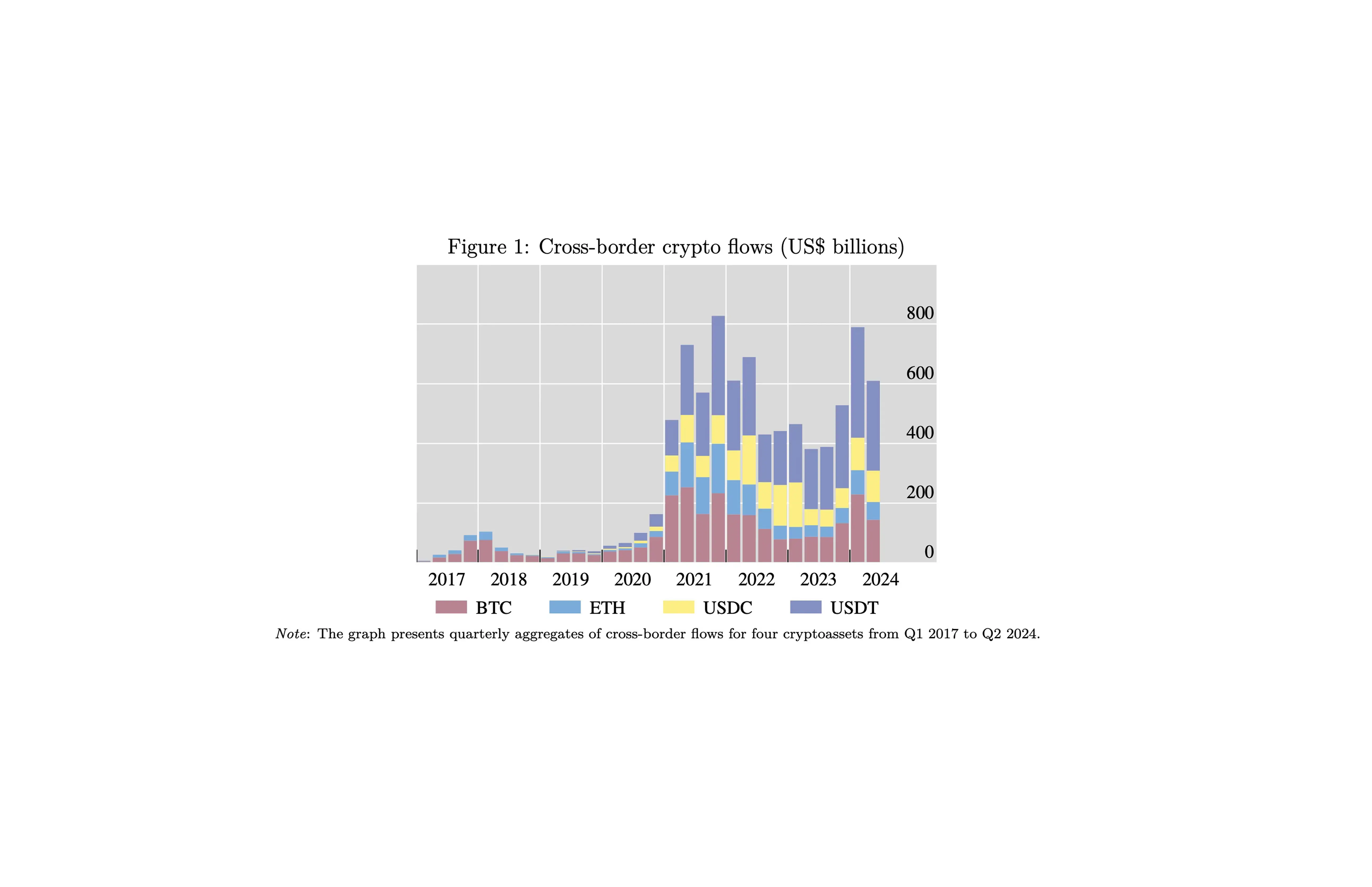
Auer, Lewrick, and Paulick's 2025 BIS working paper built a bilateral data set tracking Bitcoin, Ether, and major stablecoins across 184 countries from 2017 through mid-2024. Cross-border crypto flows peaked around $2.6 trillion in 2021, close to 12% of global goods trade that year, dipped to roughly $1.8 trillion in 2023, and have climbed back since, with stablecoins accounting for close to half the volume and native assets like Bitcoin and Ether making up the rest.
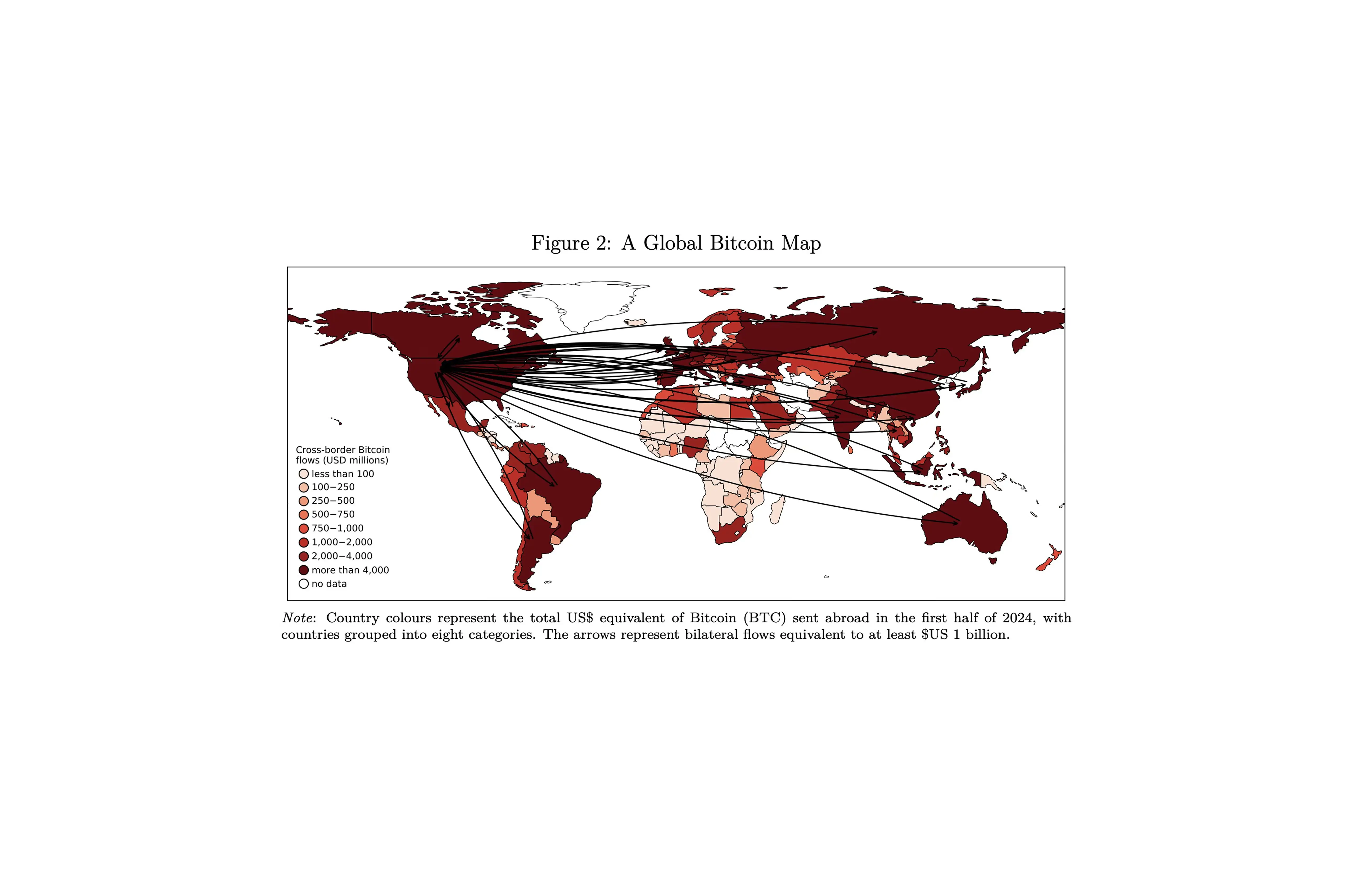
The United States and United Kingdom sit at the center of the network; BTC flows between the two countries grew about tenfold between 2019 and 2023-24, and together the pair accounted for roughly a fifth of all cross-border Bitcoin and Ether activity.
The paper's gravity-model framework, the same tool economists use to explain why banks lend more to neighboring countries and why trade shrinks with distance, produces the finding worth flagging: those frictions barely touch Bitcoin.
Distance almost stops mattering: a 1% increase in distance between two countries cuts cross-border bank lending by 0.6% and physical trade by 0.75%. For Bitcoin, the same 1% increase in distance cuts flows by just 0.08%, roughly a tenth of the drag on bank lending.
Sharing a border stops mattering entirely: two neighboring countries lend each other about 84% more through banks than distant countries do, and trade more than twice as much. For Bitcoin, sharing a border produces no measurable effect at all, the result is statistically indistinguishable from zero.
Shared language still helps, just less: a common language lifts bank lending by 44%. It lifts Bitcoin flows by about 13%, less than a third of the banking effect.
In simple terms: a Bitcoin transfer between neighboring, same-language countries and one between countries on opposite sides of the planet move at close to the same cost and speed. The frictions that shape where a bank will lend or where a container ship will sail, physical proximity, shared borders, shared language, mostly stop applying once the transfer happens on a blockchain instead of through a correspondent bank.
Readers looking to buy the dip or build a simple trading framework around regulatory volatility like these can find the full structure in the Coinjuice ebook.
Bitcoin for Remittances vs. Bitcoin for Speculation
The BIS data splits crypto flows into two behaviors wearing the same coin. Large-value Bitcoin transfers track global funding conditions and market volatility, the same pattern retail traders chase when they're speculating rather than transacting.
Small-value transfers correlate with something else entirely: the cost of traditional remittances. Where sending money home through a bank or a money transfer operator gets expensive, small Bitcoin transfers rise to fill the gap.
That split is the clearest evidence in the literature that Bitcoin already functions as working trade and remittance infrastructure for a segment of users, not a hypothetical use case waiting on better technology.
How Bitcoin Bypasses Capital Controls
The IMF's December 2024 working paper by Cardozo, Fernández, Jiang, and Rojas puts numbers behind what regulators already suspected: real money is moving across borders through Bitcoin and other crypto at a scale that matters, and the usual tools governments use to control money leaving the country barely work on it.
Crypto capital flight means people moving money out of a country through Bitcoin or other crypto instead of a bank, sidestepping the rules designed to stop that money from leaving.
Crypto capital flight is real money, not a rounding error: in Brazil alone capital flight hit a quarter of all portfolio money leaving the country. Knowing this means treating crypto flows as a genuine part of the capital-flow picture more than a side story.
These flows move on crypto's schedule, not the economy's: they track Bitcoin's price and global risk mood, not local remittances or regular investment. Knowing this means crypto outflows can spike even when nothing else in the traditional system looks stressed.
Here's how the workaround plays out (example): Anna exports grain and earns $100,000 abroad. Instead of bringing it home like the rules require, she buys Bitcoin with it overseas. Back home, Dmitri wants his savings out of the country but can't send dollars abroad either. Anna sells him that Bitcoin for local currency, so on paper she's "brought her earnings home." Dmitri then sells the Bitcoin overseas for dollars, landing exactly where the capital control was supposed to stop him. No bank wire ever crossed the border, just two separate, locally legal Bitcoin trades that add up to capital flight.
There's a real-world model for this: Japan requires its exchanges to report sender and receiver identity on every crypto transfer, the same standard banks already meet. It doesn't target the Anna-and-Dmitri round-trip specifically, but it makes both legs traceable to real people, and traceability is what makes that kind of workaround riskier to run.
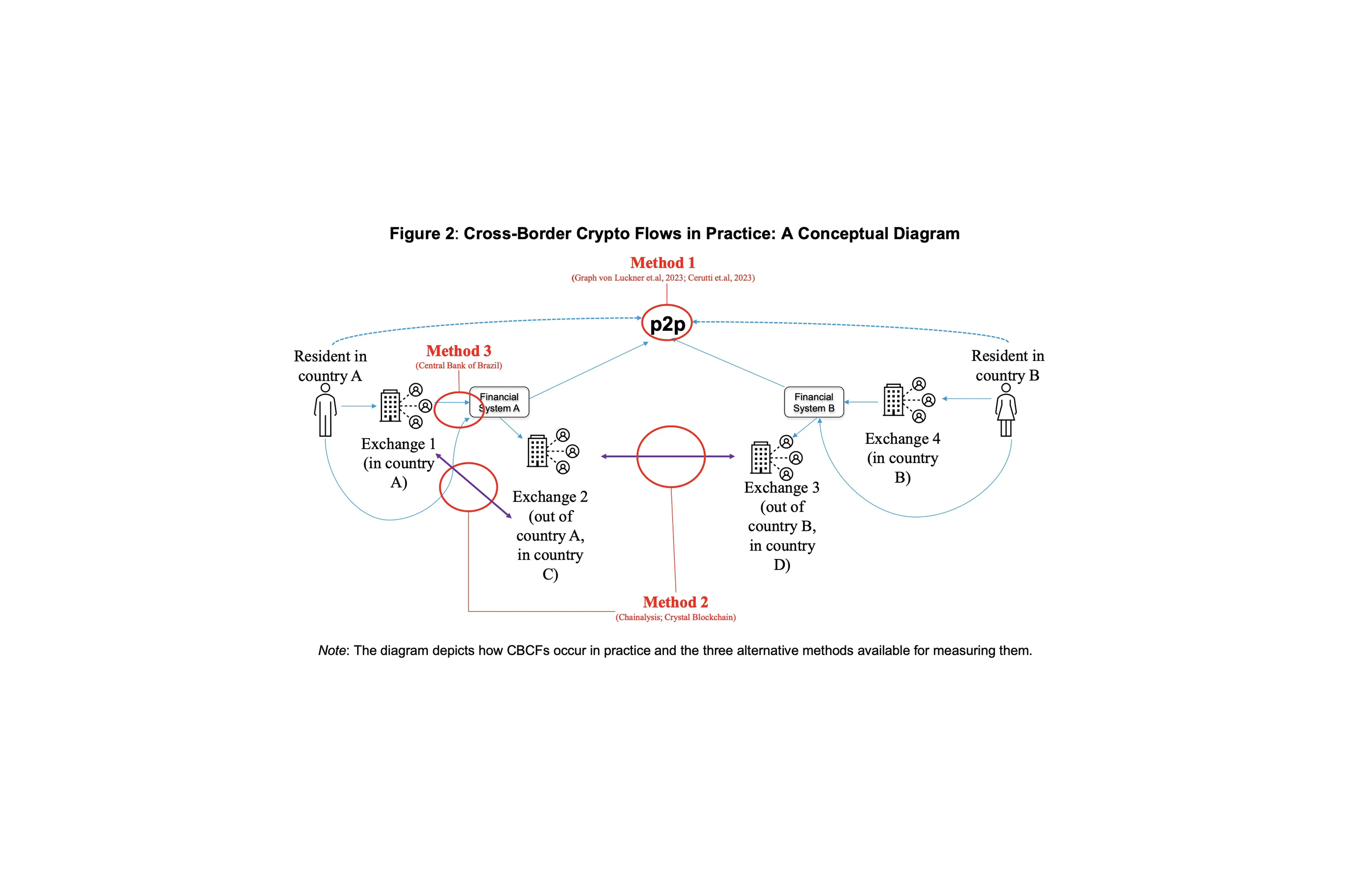
A blanket ban pushes activity underground and off the state's radar, exactly the unmonitored channel the IMF paper describes. A licensed, property-recognized corridor, built through registered exchanges and intermediaries required to report who is moving what, works on the same underlying logic as Japan's approach: legalize the asset, then make identity reporting the price of access.
Bitcoin Fees vs. Bank Transfer Fees
Sending money across a border the traditional way gets expensive fast, banks and wire services eat a chunk of it in fees, and that expense is exactly why the Bitcoin route keeps picking up more of the traffic.
Bank wires: charge fees averaging around 6% of the amount sent, with the priciest corridors, parts of Sub-Saharan Africa and the Pacific, charging past 8%, plus days of waiting for the money to arrive.
On-chain bitcoin: fees shift with network congestion, cheap when the network is quiet, pricier when it's busy.
Lightning network: Bitcoin's fast payment layer, moves small transfers for a fraction of a cent and settles in seconds instead of days.
The switch point: once bank fees pass roughly 8%, people shift to small Bitcoin transfers instead, mainly in high-fee markets or sanctioned routes like Russia's exporters.
Risks of Using Bitcoin for Cross-Border Trade
Bitcoin makes trade faster and cheaper, but it comes with real downsides worth knowing:
Price risk: Bitcoin's value can jump or drop 5-10% between agreeing on a price and actually getting paid, so either side could lose money just from the price moving.
No do-overs: once a Bitcoin payment is sent, it can't be reversed. If the goods never show up, there's no bank to call for a refund.
Easy to misuse: the same setup that helps a legit exporter get paid also makes it easier for someone to dodge sanctions, which is exactly how foreign regulators will likely see it.
Rules don't match up: other countries may not recognize Bitcoin as "property" the way Russia now does, so a deal that's legal on one side of the border might not hold up on the other.
Bitcoin Regulation and Legal Recognition
Legal recognition, not new technology, is the constraint that has held Bitcoin back from broader trade use. Lightning settlement, exchange liquidity, custody, has existed for years. What has been missing is a court willing to say a Bitcoin holding is enforceable property, and a regulator willing to say Bitcoin can settle a cross-border invoice.
Regulation follows use, not the reverse: The BIS and IMF research shows people were already sending real money across borders in Bitcoin for years before any government wrote rules for it. Russia's new law is just catching up to something that was already happening, not creating something new.
Property status is the unlock: without civil-code recognition, Bitcoin cannot back a letter of credit or survive a bankruptcy claim. With it, trade counterparties gain the legal footing to actually rely on it.
The corridor model is spreading: legalize the asset, then license a narrow trade-specific use case, is becoming the standard regulatory move rather than a Russia-specific one.
Outro
Bitcoin's role in cross-border trade was never a question of whether the technology could handle it, the data shows it already has for years, mostly at the small-value, remittance-driven end of the spectrum.
The open question has always been legal: whether a court, a bank, or a customs office will treat a Bitcoin balance as property a counterparty can enforce. Russia's law answers that question domestically. Watching which economies follow with, own property-status carve-outs is now the trade to track.
Be sure to check out the Coinjuice ebook for a framework built for exactly this kind of regulatory volatility, and subscribe to Coinjuice for research like this as it develops.
FAQ
Is Bitcoin used internationally?
Yes. BIS research tracking 184 countries found cross-border Bitcoin, Ether, and stablecoin flows peaking near $2.6 trillion in 2021, with small-value Bitcoin transfers specifically tracking the cost of traditional remittances, evidence of active transactional use, not just speculation.
Can you use Bitcoin to transfer money internationally?
Yes, Bitcoin moves across borders on-chain or through the Lightning Network, its faster settlement layer, without a bank or wire service in the middle. Fees and speed depend on the network and the transfer size, but Lightning routes small transfers for a fraction of a cent in seconds.
Which country uses Bitcoin as legal tender?
El Salvador adopted Bitcoin as legal tender in 2021, meaning it must be accepted as payment. Russia's 2026 law takes a different route, classifying Bitcoin as property rather than currency, which grants legal standing in contracts and court disputes without making it usable for domestic payments.
What is a cross-border payment system using blockchain?
A blockchain-based cross-border payment system settles transfers directly on a public ledger instead of routing through correspondent banks. Bitcoin's base network and the Lightning Network are both examples, moving value between countries without the multi-day delays and intermediary fees traditional wire transfers carry.
Disclaimer
The information provided in this article is for informational purposes only. It is not intended to be, nor should it be construed as, financial advice. We do not make any warranties regarding the completeness, reliability, or accuracy of this information. All investments involve risk, and past performance does not guarantee future results. We recommend consulting a financial advisor before making any investment decisions.
More like this


Written by

Andrew Kamsky
Andrew Kamsky is a Bitcoin analyst. He spent a decade in traditional finance across a Big Four firm and a listed fintech bank before going deep on Bitcoin full-time.