









Quick summary
Four recent studies show solar Bitcoin mining profitability varies widely, from losses to over 100 percent ROI
Location and local electricity prices drive outcomes, with Los Angeles highly profitable and Toronto, Montreal unprofitable
Large and small solar systems can beat selling electricity to the grid when power is actively managed
Three factors determine viability for miners local electricity costs, system scale, and energy routing strategy
Electricity is the largest ongoing cost in Bitcoin mining, which pushes many operators toward solar power as a way to cut expenses and emissions at the same time. The pitch sounds obvious: replace a monthly utility bill with free sunlight.
Four peer-reviewed studies published between 2023 and 2025 tested the claim directly, measuring real mining hardware against solar output across different cities, scales, and energy-management strategies. The research finds no universal answer where solar-powered mining returns anywhere from a loss to over 100% ROI, depending on three factors: local electricity pricing, system scale, and how power gets routed between mining, storage, and the grid.
How Location Affects Solar Bitcoin Mining Profitability
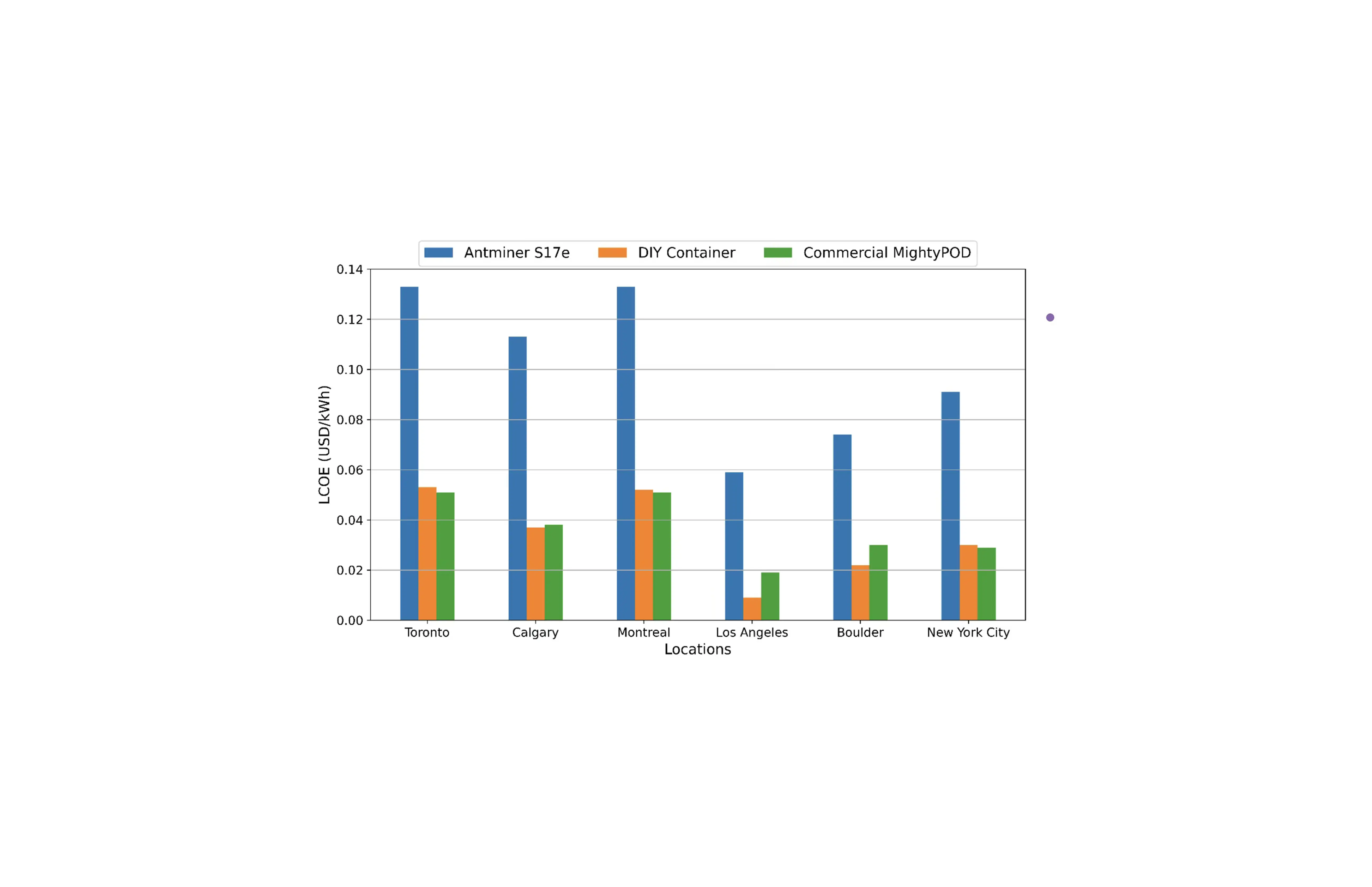
Western University researchers monitored live mining rigs and modeled solar output across North American cities, publishing results in Ledger (McDonald et al., 2023). Location determined most of the outcome:
Toronto and Montreal, negative ROI: Cheap grid electricity undercuts the cost of a solar installation before it can pay for itself.
Calgary, 8% ROI: Mid-range electricity pricing paired with decent sun produces a marginal but positive return.
New York, 34% ROI: Higher grid prices make solar competitive faster.
Boulder, Colorado, 64% ROI: Strong sun combined with above-average electricity costs improves the margin further.
Los Angeles, 104% ROI: High electricity prices and heavy solar exposure deliver the strongest return in the study.
Los Angeles container economics, 2.23-year breakeven: The study's most concrete case, a DIY shipping-container mining setup on agrivoltaic farmland in Los Angeles, broke even in 2.23 years and cleared $162,532 in profit per year.
Single-miner swing, from loss to profit: One Antminer S17e running on Los Angeles grid power lost $2,781 a year. The same miner powered by solar turned a $1,817 profit, a direct before-and-after comparison of identical hardware.
The pattern holds across every city in the study: profitability is a function of two compounding variables. More sun hours mean more power generated per panel. Higher grid electricity prices mean each of those kilowatt-hours is replacing something more expensive. Toronto loses on both counts. Los Angeles was the most profitable location to convert to PV-based mining of Bitcoin because of the high electric costs on the grid and high annual solar fluxes.
Benefit: For an operator evaluating a solar retrofit, the local electricity rate, not the panel technology, is the first number worth checking before committing capital.
Should a Big Solar Farm Mine Bitcoin, or Just Sell the Electricity?
A 2024 study published in Heliyon by Hakimi, Pazuki, Salimi, and Amidpour looked at a large solar farm near Abu Dhabi, sized to power a Bitcoin mining operation, using real electricity price data from 2020 through 2023. The researchers compared two options: use the solar power to run mining machines directly, or sell that power to the local grid instead.
Mining directly paid back in 3.5 years: Building the setup cost about $42 million ($33 million for the solar farm, $9 million for the mining machines). Running miners directly on the solar power earned that money back in about 3.5 years.
Selling to the grid took 8.1 years: Selling the same electricity to the grid instead took more than twice as long to pay off.
50,000 tons of CO2 avoided each year: Powering the miners with solar instead of fossil fuels kept about 50,000 tons of carbon out of the atmosphere annually, roughly the same as taking 10,700 cars off the road.
Benefit: If a company already has access to a large solar farm, using that power to mine Bitcoin directly pays for itself far faster than selling the electricity back to the grid, while also cutting a real amount of carbon pollution.
Small Solar Setups Can Turn a Real Profit Too, With the Right Management
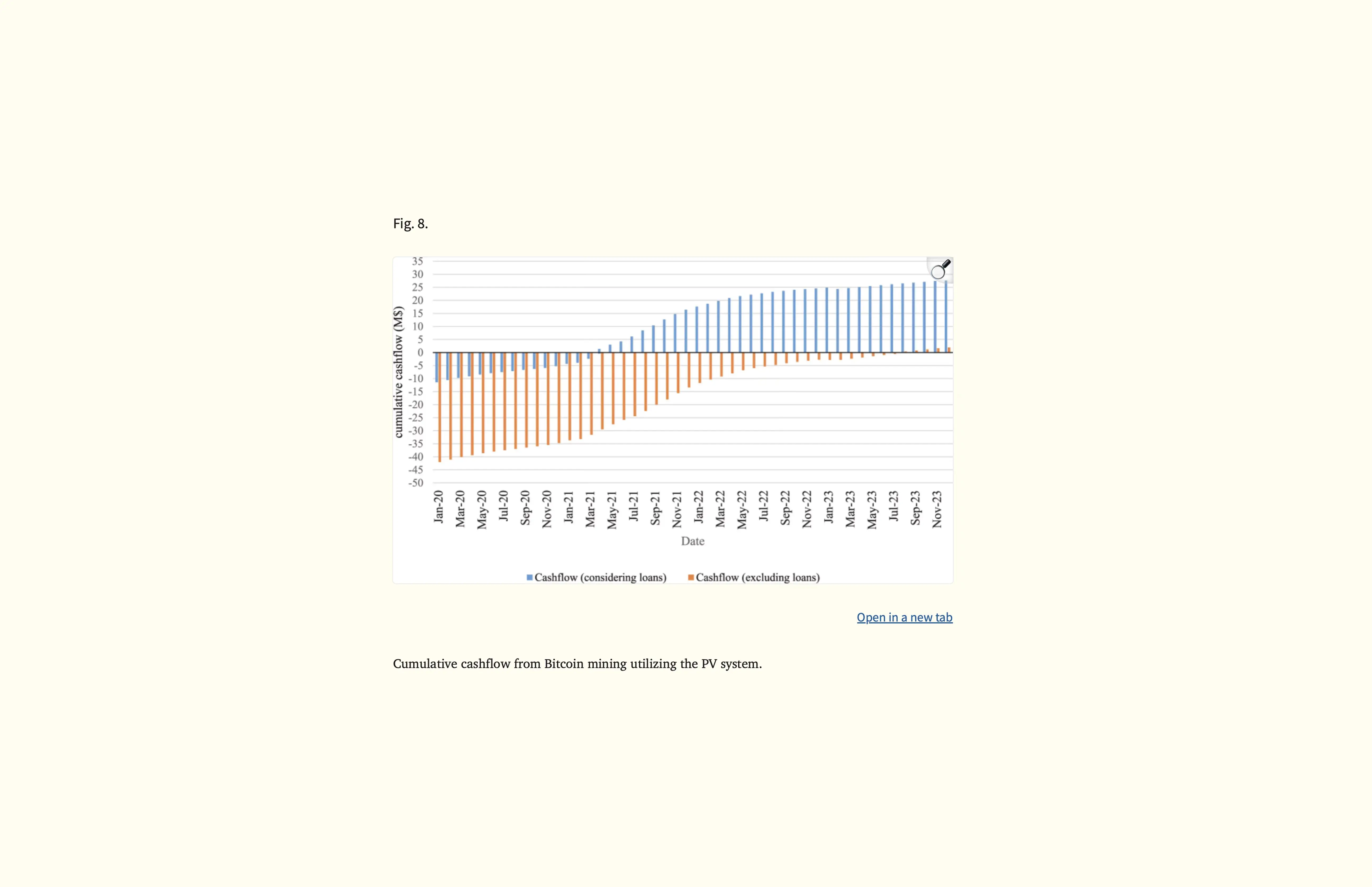
A 2025 study by researchers at De La Salle University in Manila asked a different question: how should a smaller solar setup split its power between mining, battery storage, and selling to the grid over a full year to make the most money (Lanting & San Juan, 2025)?
71.6% return in one year: With a $100,000 budget, the system earned a 71.6% return by shifting where the power went each month instead of just running miners nonstop.
95.9% of the electricity came from solar: Only 4.1% had to be bought from the grid, the rest came straight from the panels.
Starts turning a profit at $12,000: Even at this modest budget, the system already earns a 16.4% return, a solid starting profit, not just breaking even.
Bigger budgets pay off less per dollar past $40,000: Spending more than that still helps, but each extra dollar buys a smaller boost in returns.
Benefit: A company doesn't need a giant solar farm to make this work. Even a modest setup can turn a real profit, as long as someone actively decides each month where the solar power should go, instead of just pointing all of it at the miners and leaving it alone.
What Happens When the Sun Isn't Shining? Backup Power Keeps Miners Running
Solar panels have one obvious problem: no output at night or on cloudy days. A 2025 study titled "Maximizing Return on Investment in Cryptocurrency Mining Through Energy Optimization," published in Energies, built a system mixing solar, wind, and diesel generators, so mining hardware could keep running through the hours solar alone couldn't cover, instead of shutting down.
Diesel stepped in when solar and wind couldn't: The setup was built so a diesel generator would kick in and keep the miners running whenever there wasn't enough sun or wind, rather than letting them sit idle.
Built for Iran's specific fuel situation: Diesel was picked as the backup fuel because, in the Iranian setting this study is based on, natural gas and coal are hard to get for small operations. A different location with easier access to those fuels might not need diesel at all.
Benefit: For someone deciding between a solar-only setup and one with backup power, this 2025 study shows the basic idea: backup power keeps miners earning during the hours solar and wind fall short. What it doesn't prove is whether that setup actually made more money overall, since that part of the results wasn't available to check.
What the Research Means for Miners
Across all four studies, three variables consistently determine whether solar-powered mining pays off:
Local electricity prices
System scale
Energy-routing strategy
None of the four studies found solar mining profitable everywhere. Toronto and Montreal remain negative even in the most favorable comparison. Businesses thinking about adding solar to their mining setup can start with the city-by-city numbers from the McDonald study as a first check, then factor in the size and power-management lessons from the other three studies before spending any money.
The Bottom Line
Solar-powered Bitcoin mining is not a uniform strategy, it is a location-and-scale-dependent calculation. The research reviewed here shows returns ranging from negative in low-electricity-cost cities to over 100% ROI in high-cost, high-sun markets, with utility-scale plants and actively managed smaller systems both showing viable paths to profitability.
Operators evaluating a solar build should model three variables before investing: local electricity pricing, system scale, and energy-routing strategy.
Sunlight is free, but profitability is not, it has to be modeled.
Turn Research Into Action
Understanding the market is one skill. Trading it with a plan is another. The Coinjuice ebook teaches the trading framework behind our approach.
Continue Your Research
Enjoyed this research? Coinjuice PRO delivers market analysis, and live trade setups throughout the week.
FAQ
What key factors determine whether solar-powered Bitcoin mining is profitable?
Across four peer-reviewed studies, profitability depended on three main variables: local electricity prices, system scale, and how energy is routed between mining, storage, and the grid.
How does location affect the return on investment for solar Bitcoin mining?
Location largely determined outcomes: Toronto and Montreal had negative ROI, Calgary 8%, New York 34%, Boulder 64%, and Los Angeles 104% ROI. A Los Angeles shipping-container setup broke even in 2.23 years and generated $162,532 in profit per year.
Is it more profitable for a large solar farm to mine Bitcoin or sell electricity to the grid?
For a large solar farm near Abu Dhabi, using the power directly for Bitcoin mining paid back the $42 million investment in about 3.5 years, while selling the same electricity to the grid took 8.1 years to pay off, and avoided about 50,000 tons of CO2 annually.
Can small solar setups for Bitcoin mining be profitable, and how does energy management affect this?
A smaller system with a $100,000 budget earned a 71.6% return in one year by shifting power monthly between mining, battery storage, and selling to the grid, with 95.9% of its electricity from solar. Profitability started at a $12,000 budget with a 16.4% return, though returns per dollar decreased beyond $40,000.
Disclaimer
The information provided in this article is for informational purposes only. It is not intended to be, nor should it be construed as, financial advice. We do not make any warranties regarding the completeness, reliability, or accuracy of this information. All investments involve risk, and past performance does not guarantee future results. We recommend consulting a financial advisor before making any investment decisions.
More like this

Written by

Andrew Kamsky
Andrew Kamsky is a Bitcoin analyst. He spent a decade in traditional finance across a Big Four firm and a listed fintech bank before going deep on Bitcoin full-time.