










Quick summary
AI makes lots of things cheaper to produce, but research suggests AI does not get rid of scarcity or the need for money
A true world without scarcity would mean almost nothing important stays limited, or that prices get replaced by something else entirely
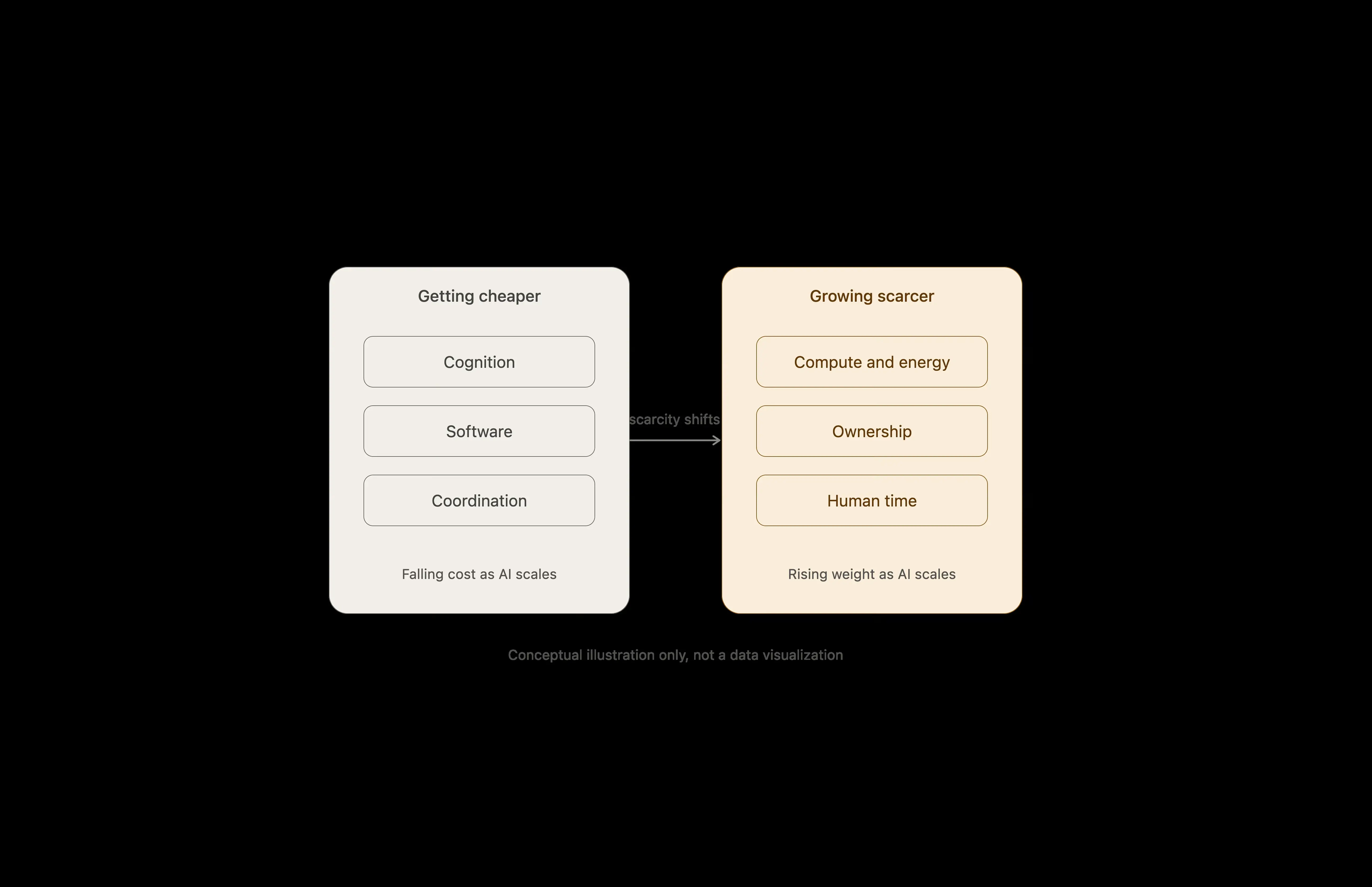
The research suggests technology tends to push scarcity around instead, into capital, energy, computing power, human time, and trust
Money, or something that works like it, is still needed to decide who gets access to what is limited
Every leap in automation brings back the same question: if machines can eventually make almost everything, why would anyone still need money? Artificial intelligence sharpens that question because AI makes cognitive work, like software, analysis, design, and coordination, cheaper to do.
The short answer suggested by the research examined here is no. Cheaper production is not the same as universal abundance, and money, or a money-like system of transferable credits and access rights, keeps its job wherever resources, ownership, and decision power remain limited. On balance, AI looks more likely to redefine and relocate scarcity than to abolish it.
The article below explains what a truly post-scarcity world would involve, what money does beyond payments, what the previous computing revolution can teach, and where four research papers land on the question.
What Would It Take for Money to Become Unnecessary?
Post-scarcity has a precise meaning: a condition in which important goods exist in such supply, at such low cost, and with such open access, no one needs to ration by price. Reaching it demands far more than capable AI. A world where money simply disappears, with nothing taking over its work, would need:
Scarcity removed across rival goods: food, housing, energy, and materials would need to exist in such supply, one person using them takes nothing away from anyone else.
Access made universal: making things cheaply means little if a few owners control the output; abundance only counts when ordinary people can reach it, not just when factories can make it.
Someone still decides who gets what: when two data centers want the same electricity, or two buyers want the same plot of land, a decision has to be made. Today prices make the call. Remove money, and something else must decide.
New tools for accounting and saving: families and businesses would still need ways to measure what things are worth, weigh options against each other, and set something aside for later.
There is also a second route worth naming. Scarce goods do not have to be rationed by price. Societies can and do distribute limited resources through:
Quotas: fixed shares assigned per person or per group, the way wartime ration books allowed each household so much sugar and fuel.
Lotteries: random assignment when claims exceed supply, the way oversubscribed green cards and popular marathon spots get drawn by chance.
Queues: allocation by waiting time rather than payment, the way public hospital waiting lists decide who gets surgery next.
Entitlements: eligibility rules granting access by status or need, the way pensions go to people above a certain age and disability support goes to people who qualify.
Administrative allocation: officials or institutions deciding case by case, the way a housing authority assigns public apartments or a university admissions office fills its seats.
Non-transferable access rights: permissions usable only by the holder, the way a driver's license or a library card works for one named person and cannot be sold.
Systems like these can take over from prices in specific areas without making scarcity go away. For money to vanish completely, with nothing stepping in to take its place, society would need to get rid of almost all scarcity that matters. Short of that, some non-price system would still be needed to decide who gets what.
And there's a catch: the moment people are allowed to trade or sell their ration coupons, hospital place, or housing permit, that coupon starts acting like money anyway. As a historical illustration outside the research pack, a version of this occurred during Russia’s post-Soviet privatisation programme: citizens received tradeable vouchers intended to distribute ownership of state companies, but many were subsequently acquired by a much smaller group of investors, contributing to the concentration of corporate ownership.
What Does Money Do Besides Pay for Things?
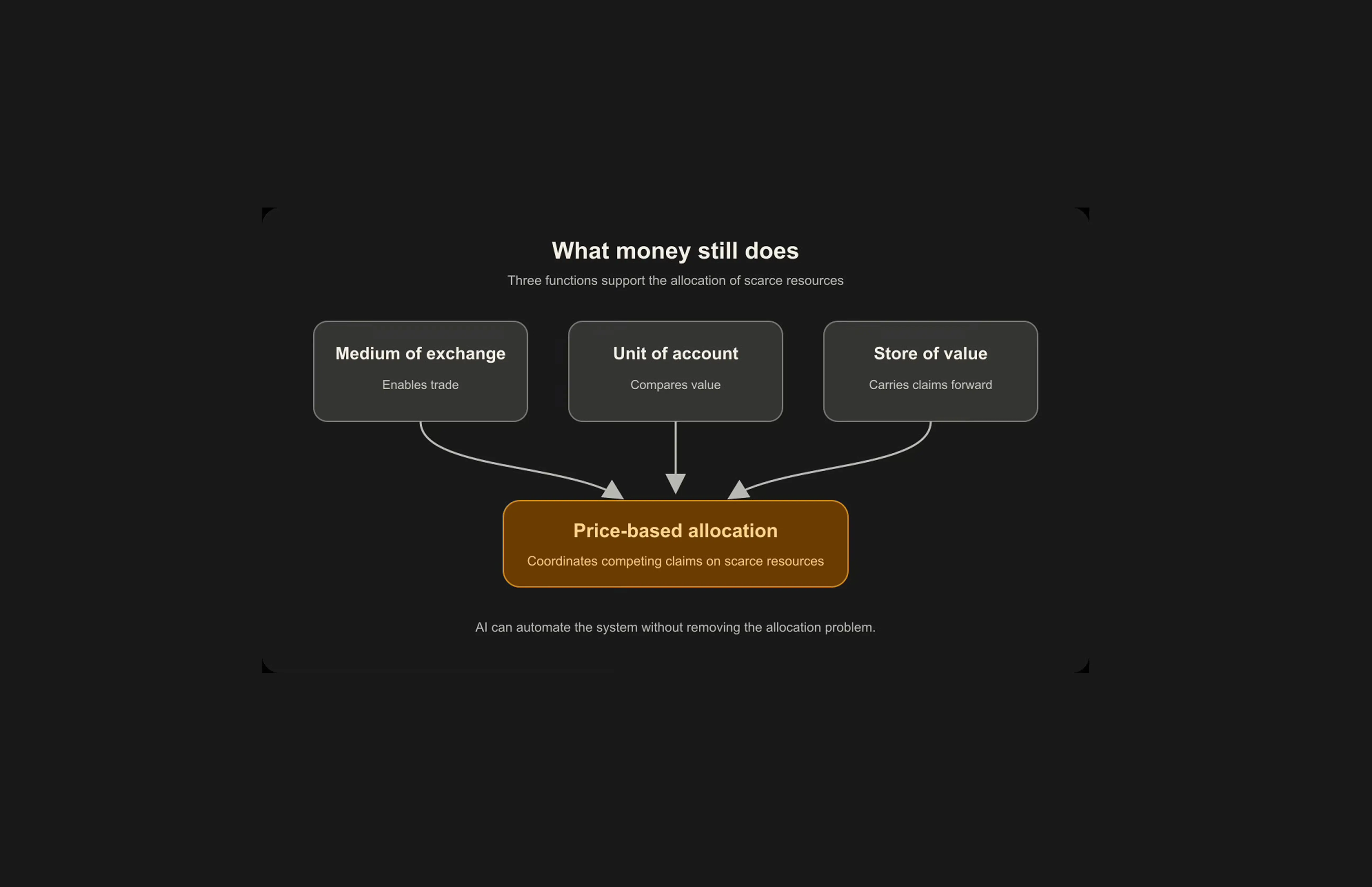
Money is a tool for communicating value, but it is usually pictured only as a payment method. Payments are only part of the story. Economists recognize three principal functions:
Medium of exchange: it lets strangers trade without matching wants directly.
Unit of account: it gives every good and service a common measuring stick, so an hour of labor, a laptop, and a kilowatt can be compared.
Store of value: it carries purchasing power across time, letting people save for future claims.
In economies built around markets, those three jobs also make prices work as a way of sharing out limited resources. Prices act like a constant, decentralized vote: when something gets scarce, its price rises, and that rise nudges people toward using less of it or making more of it, all without anyone in an office deciding case by case. So allocation is not a fourth thing money does. It's what happens when money's three real jobs get put to work inside a market.
AI can automate payments and even negotiate prices, yet the three functions, and the price system built on them, stay needed while anything desirable remains limited.
What Kind of Abundance Does AI Create?
Four ideas must stay separate, because collapsing one into another produces most of the confusion around the topic:
Technical abundance: AI lowers the cost of cognition, software, design, coordination, and some production. Marginal cost falls; it does not reach zero, since compute, electricity, and hardware still carry bills.
Economic scarcity: there just isn't enough of some things to go around. No matter how cheap software gets, there will only ever be so many houses within walking distance of the best schools.
Artificial scarcity: sometimes a thing itself is not scarce at all, but the rules around it make it act scarce. As a general illustration outside the research pack, once a song exists, making another copy costs almost nothing. Yet people still pay every month to stream it, because the record label owns the rights and decides who is allowed to listen legally. Much of that scarcity is not in the song itself, it's in the legal permission to access it, which rights holders and platforms control.
Distribution: being able to make a lot of something is not the same as everyone being able to get it. A country can produce mountains of food and still have people going hungry, because producing plenty and sharing it fairly are two different problems.
What Happened the Last Time Technology Sped Up?
The most rigorous evidence in the source pack is not about AI at all, which is exactly why it is useful. In a peer-reviewed study in the Journal of Economic Growth, economist Seda Basihos examines the computing revolution using United States capital data from 1970 to 2023. Two layers of the paper deserve separate treatment.
What the paper reports:
Computers wore out their usefulness faster: picture an office in the mid-1990s buying its first desktop computers and the software to run them, back when that kind of equipment was just becoming standard. Researchers estimate machines and programs like these lost their economic value at a growing rate, from about 4 in every 100 going obsolete each year before the mid-1990s to almost 7 in every 100 by the late 2010s. This number isn't measured directly, it's calculated from official depreciation records, and if you leave computers and software out of the count, the increase disappears entirely.
A boom, then a slowdown: think of productivity as how much gets produced for every hour someone works. Before 1995 that pace crept forward by about 1.70 percent a year. Once desktop computers and their software spread through offices, the pace sped up noticeably for roughly a decade, then cooled back down, settling at 1.47 percent, a step below where it started.
Workers took home a smaller share: the portion of national income going to workers, as opposed to owners of capital, fell from 62.6 percent to 56.9 percent over that same stretch, though how you define and measure that share involves some judgment calls of its own.
In a nutshell: The last time computers reshaped the economy, faster obsolescence didn't make things free, it made businesses spend more just to stay current, and it shrank the slice of income going to workers. As a general illustration outside the research pack, cheaper AI tools may lower the cost of starting a business today too, but that just means more people competing for the same customers' limited money, not money disappearing. If AI follows a similar pattern, the lesson isn't that scarcity goes away. It's that scarcity moves, and money keeps following it.
What the model proposes:
One plausible explanation, not a proven cause: the paper's model offers one way to make sense of what happened, not the final word on it. The idea is that as equipment goes out of date faster, businesses have to keep pouring money into replacing it just to stay current, rather than into new skills or higher wages. That, the model suggests, is part of why growth slowed down and workers ended up with a smaller share of the pie.
Basihos is careful to call accelerated obsolescence one plausible explanation among several for the labor share decline, not the single proven cause. Scarcity rarely disappears for one tidy reason. More often, it shifts, and where it lands is usually the harder, messier question.
The lesson, stated carefully: in the prior technology wave, acceleration did not dissolve scarcity. On the paper's account, it created a new scarcity, capital not yet outdated. Whether generative AI repeats the pattern is an educated guess, not a finding of the paper.
Could AI Weaken Demand Instead of Creating Plenty?
A working paper by Luca Fornaro and Martin Wolf, of CREI and the University of St. Gallen, models a scenario worth taking seriously precisely because it is the opposite of abundance:
Automation can shift who gets paid: when AI takes over more tasks, more of the income can flow to the people who own the machines and less to the workers who used to do the work. That matters because workers tend to spend nearly everything they earn, while owners tend to save a lot of theirs.
Spending may fall even as output rises: in the model, that shift in who gets paid can mean less total spending in the economy, even while businesses are producing more than ever, a situation the authors call an AI slump.
A trap that can catch everyone, even the winners: any single business that automates comes out ahead, lower costs, higher profits. But if enough businesses do it at once, workers across the economy end up with less to spend, and if that hits hard enough, even the businesses that automated can end up selling less than before.
Policy can soften it, not fix it automatically: in the model, if the central bank keeps interest rates low and the government adds things like wage subsidies or lower taxes on jobs, that combination can help keep people employed and spending. But nothing in the model says this happens on its own.
Two cautions apply.
The numbers behind this model are just an educated guess, since nobody really knows yet how AI will play out, and this is a working paper rather than something like a formally published central bank report, so it carries less official weight.
What makes the Fornaro and Wolf paper useful anyway is the idea itself: the risk closer at hand is not that AI gives us too much too fast, it is that ordinary people are left with too little money to spend. And in their model, the fix still runs through money, giving people more of it, not around it.
How Do Central Bank Researchers See AI and Money?
The most direct treatment of AI and the monetary system in the pack is a New York Fed Staff Report by Simone Lenzu, a formally released staff report, not peer-reviewed, carrying the standard note: its views are the author's, not an official Federal Reserve position. Its core message is recalibration, not obsolescence:
AI can push prices up or down, and nobody knows which wins: it can make things cheaper to produce, which should ease inflation. But if companies struggle to actually use it well while customers get ahead of themselves buying and investing anyway, prices can rise instead. Which way it goes depends on how AI gets adopted and how competitive each industry is.
The economy's usual benchmarks get harder to read: things like how much the economy could be producing at full capacity, and what interest rate keeps it balanced, get pulled in two directions at once, up because AI investment is booming, down because people worried about losing their jobs save more and spend less.
A specific bad combination becomes possible: if AI is not really making businesses more efficient yet, while stock prices are already betting it will, you can end up with rising costs and a shaky financial system at the very same time. Normally a central bank fixes one of those problems by moving interest rates. It cannot fix both at once with that one tool.
New weak points are showing up in the financial system: AI companies have been borrowing heavily to build data centers, over 100 billion dollars in new bonds from major AI firms in late 2025 alone. And when many banks and investors all lean on similar AI models to judge risk, a mistake in one model can spread across the whole system at once instead of staying contained.
Nothing in the report contemplates money losing its functions. The concern runs the other way: money's managers face a harder reading environment while the economy depends on it more intricately than before.
What Is the Strongest Case for a Post-Scarcity Future?
The strongest counterargument deserves a fair hearing. Suppose AI and advanced automation keep compounding until basic goods, food, power, housing components, and transport become so cheap and so plentiful, conventional prices fade across large parts of daily life. In a world like that, day-to-day life might start to feel like nobody has to worry about money anymore, groceries, gadgets, maybe even housing costs, all cheap and easy to get. But the things making all of that possible, the power plants, the computer chips, the raw materials, the land, would still be limited.
The feeling of abundance up front doesn't mean the ingredients behind that abundance stopped being scarce.
One paper in the pack argues along these lines. Milton Ayoki, in a self-archived working paper on the MPRA repository (not peer reviewed, and carrying internal inconsistencies such as a 2009 copyright line on a document dated 2025), contends AI collapses the cost of intelligence so completely, only three scarcities remain: atmospheric carbon space, human labor hours, and irreversible time. From there, he argues that society should value the wellbeing of future generations almost as highly as life today. That conclusion depends on three ambitious and unconventional assumptions:
AI keeps getting dramatically cheaper: The cost of using AI would need to continue falling without eventually levelling off.
Catastrophic risks keep declining: AI would need to make humanity progressively safer rather than creating new threats capable of causing widespread destruction.
Economic growth becomes extraordinarily high: The argument assumes future societies will produce far more than any economy has before. But greater future wealth alone does not mean we should value the future and the present equally.
The conclusion is one author's speculative position, not an established result, and remove any one of the three assumptions above and the argument gives way.
Even this highly optimistic paper accepts that scarcity does not disappear completely. Carbon limits, human working hours and time itself remain finite, so society must still decide how they are shared, used and valued. Taken together, the research suggests that AI moves scarcity from one part of the economy to another instead of eliminating it. Even in a supposed post-scarcity future, some things would remain limited and require a price or another method of allocation.
Why Would Abundance in One Area Not End Money Everywhere?
Localized abundance and economy-wide money coexist comfortably, for reasons visible in every prior technology wave:
Rival goods anchor the system: even if software and media flow freely, housing, energy, compute, minerals, water, and grid capacity remain rival, and rival goods need rationing, whether by price or by rule.
Positional goods cannot be abundant: status, prime locations, and first access are scarce by definition, and abundance everywhere else only raises their relative price.
Ownership concentrates claims: whoever owns AI systems and productive capital collects the surplus, and contested claims need a unit of account to settle.
Human time stays finite: care, trust, attention, and authenticity resist automation, and each carries an opportunity cost someone must measure.
Environmental limits remain: The atmosphere can absorb only so much additional carbon, so society still needs a way, through prices, limits or rules, to decide who can use that remaining capacity.
The most realistic outcome is not money vanishing, but money doing less work overall. Fewer everyday goods might carry a price tag, and a person's paycheck might matter less for determining what they can access. But underneath all of that, money, or something that works like it, credits, entitlements, quotas, access rights, would still be settling the claims that machines cannot settle on their own.
What Does This Mean for Bitcoin?
None of the research papers reviewed for this article examines Bitcoin. This section applies the article’s scarcity-relocation argument to Bitcoin as an illustration, rather than presenting a conclusion drawn from those papers.
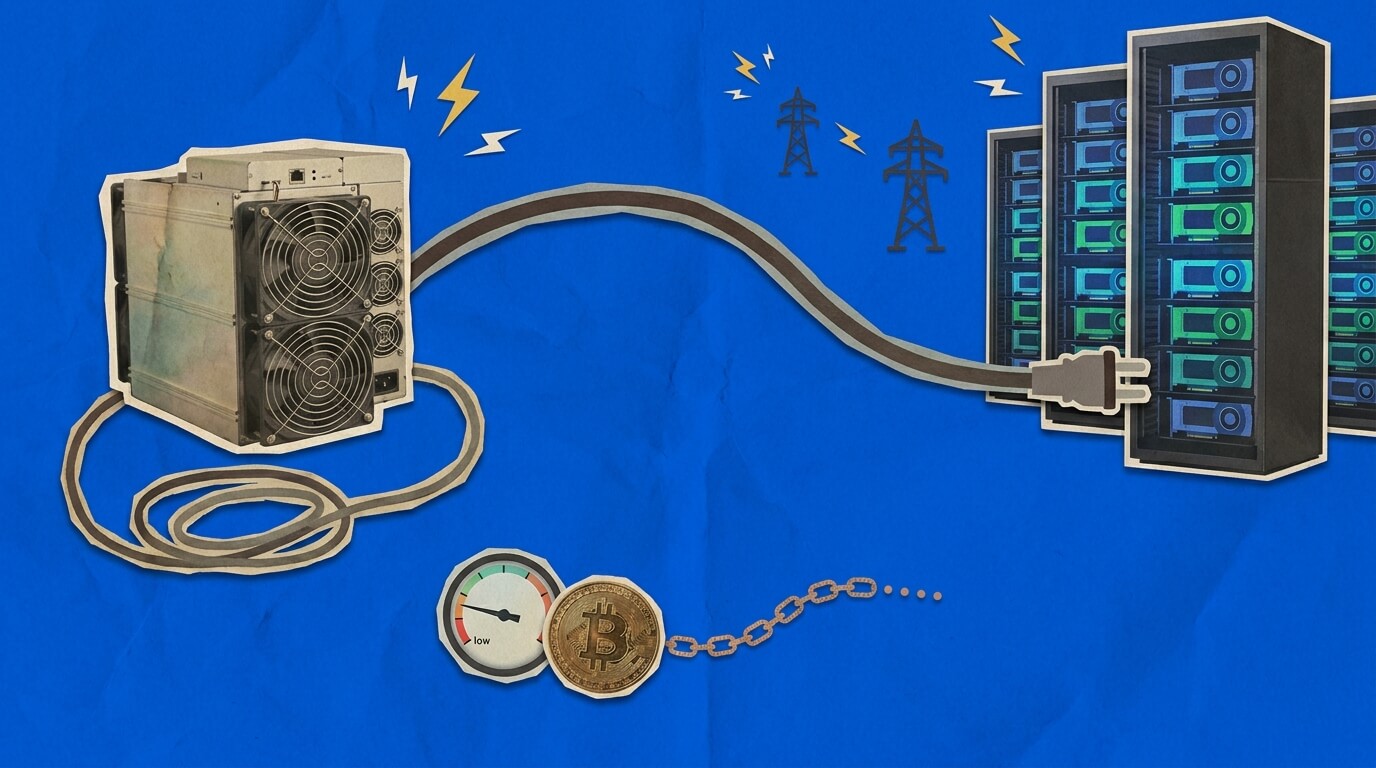
Bitcoin sits at the opposite end of the spectrum from AI-made abundance. AI keeps making reproducible things, software, images, analysis, digital services, cheaper and cheaper to produce. Bitcoin does the reverse: new coins get created on a fixed, pre-set schedule, and nobody, not a company, not a government, can decide to make more of it. The limit holds because thousands of computers around the world enforce it together, not because one authority controls the supply.
That contrast alone doesn't make Bitcoin automatically more valuable, though. Being scarce doesn't create demand by itself:
Trust still has to be earned: Bitcoin needs to keep proving it's secure, easy to buy and sell, and genuinely accepted by people and businesses, scarcity on its own convinces nobody.
Liquidity matters as much as scarcity: a scarce asset nobody can easily trade isn't very useful, so how smoothly Bitcoin moves in and out of cash matters just as much as its fixed supply.
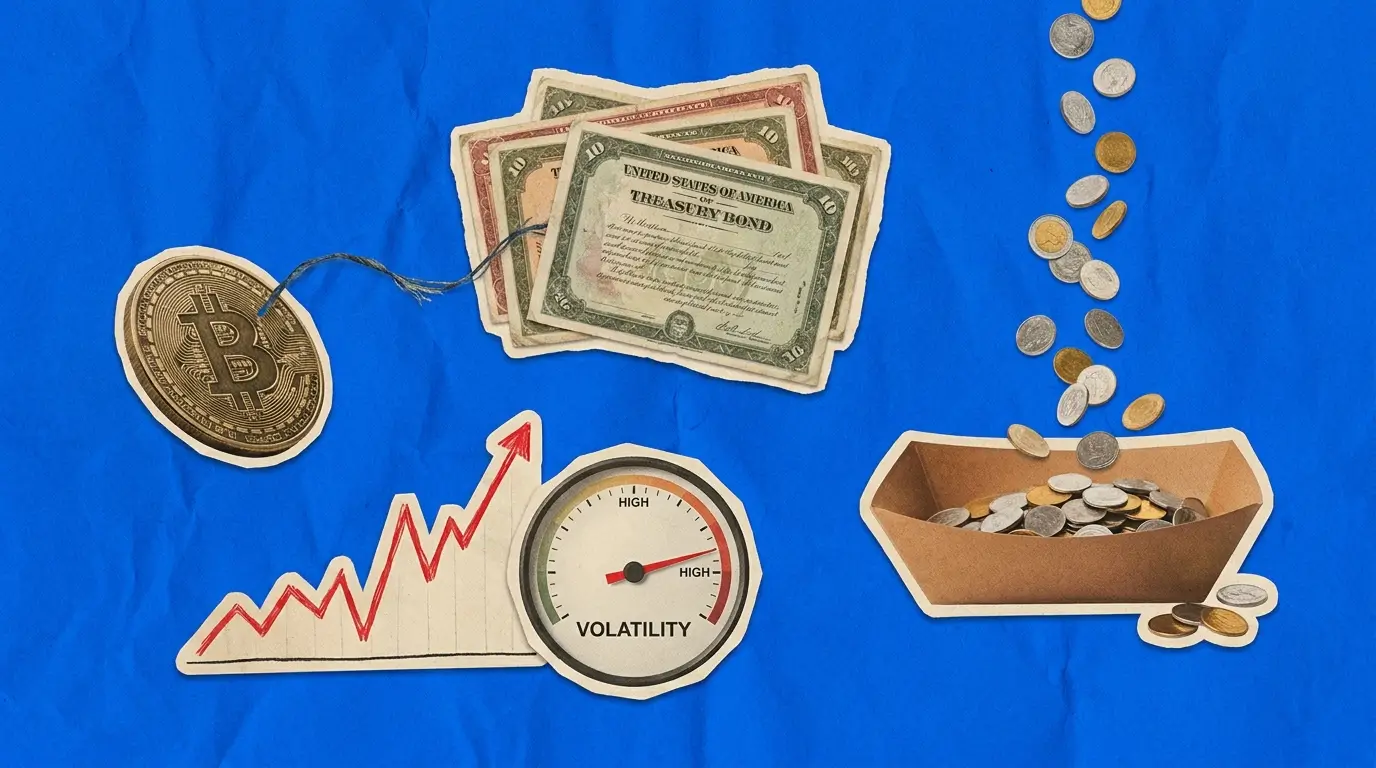
Price swings complicate Bitcoin’s monetary role: Bitcoin’s value still moves sharply over short periods, making it difficult to price everyday goods or safely store money needed soon.
A Coinjuice Bitcoin-denominated analysis comparing selected assets and commodities at snapshot dates from 2020 to 2026 found that many goods and services became substantially cheaper when measured in satoshis rather than dollars. Bitcoin advocates see this as evidence that a Bitcoin standard rewards long-term saving. Critics counter that the result largely reflects Bitcoin’s price appreciation over the selected period and can reverse dramatically during major drawdowns. Both observations can be true: Bitcoin can appreciate over the long term while remaining unreliable as a short-term unit of account.
The narrower, more defensible point is this: AI doesn't undo Bitcoin's core pitch by making scarcity pointless. If AI is pushing scarcity into energy, computing power, ownership, access, and people's attention, society still needs some way to measure and hand off economic claims, and Bitcoin is one option for that, a form of scarcity that isn't controlled by any single authority.
Whether that ends up making Bitcoin more valuable is a separate question this article isn't answering. What holds up is simpler: the idea behind Bitcoin, that scarcity can survive even fast-moving technological change, still stands.
Sidebar: When AI Writes the Economics Paper
One document in the Coinjuice source pack serves a different purpose. "Hedging the Singularity" is an experiment by Federal Reserve Board economist Andrew Y. Chen, generated almost entirely through an agentic AI process, with only the preface written by hand. A first-page disclaimer states its views are not necessarily those of the Federal Reserve Board or Federal Reserve System, but does not establish that the paper underwent formal Federal Reserve review.
The AI-generated paper raises a few ideas, though none are confirmed facts:
AI stocks as insurance: the paper argues investors might buy AI stocks as protection against a future where AI shrinks human income.
No direct way to own the source: since ordinary people cannot buy the AI systems themselves, shares in the companies building them become the closest substitute.
Government payouts as a backstop: the paper suggests the government could hand out money directly to soften that outcome, which quietly assumes something important, that money, or something like it, will still be around to hand out.
Chen is refreshingly honest about how messy the process was, naming his own errors, missing sources, and the times he had to intervene by hand. That honesty connects straight back to this article's argument: even a paper written almost entirely by AI could not make itself trustworthy. It still needed a scarce resource, human judgment, to decide what readers should believe. It also reveals that even the AI-generated paper’s proposed response to widespread automation still requires money to distribute economic support.
The same is true for the Coinjuice Research Hub: AI can speed up the research and the drafting, but a person still has to point it in the right direction and check what comes out, sentence by sentence. AI can help one person do more, but it cannot give anyone more motivation, more energy, more trust, more sense of belonging, or more hours in the day.
Scarcity does not disappear here either. It just shows up somewhere new, in the judgment needed to tell information that is simply plentiful apart from information that is worth trusting.
The Bottom Line
The people with the most at stake in this answer are not economists. They are workers watching their tasks get handed to machines, wondering whether their paychecks and the whole system behind them, still have a future.
The honest answer is neither utopia nor doom. Nothing in the evidence examined here shows AI eliminating scarcity or removing the need for money as a tool for managing it. Instead, scarcity appears to be moving house: away from software and into computing power and electricity, away from routine thinking and into human time and trust, and away from producing things and into deciding who owns them and who gets access.
AI can dramatically expand what one person is capable of creating. It cannot make that person's energy, time, trust, or need for belonging unlimited. Wherever scarcity remains, society must decide who gets what when there is not enough for everyone.
That job could remain with money and prices, shift to tradeable credits, or be handled through quotas, waiting lists and eligibility rules. But once people can exchange their assigned claims, those claims begin recreating money’s core functions. That is why money is so difficult to replace completely.
AI does not abolish scarcity. It moves scarcity somewhere else, and money, or something performing its functions, follows it there.
Research note: This article draws on peer-reviewed research, institutional reports and working papers. Each source’s publication status and limitations are identified where it appears.
If you enjoyed this content and want to learn a practical framework for buying during fear, managing rotations and selling into market recovery without liquidations, indicators or guesswork.
FAQ
Will AI make money obsolete?
No. Cheaper production from AI is not the same as universal abundance. As long as desirable resources, ownership, and decision power remain limited, money or a money-like system of transferable credits and access rights is still needed.
What conditions would be required for money to become unnecessary?
Important rival goods like food, housing, energy, and materials would need to be so abundant that one person’s use does not reduce anyone else’s. Access to these goods would have to be universal, and society would still need new tools for deciding who gets what, for accounting, and for saving, with almost all meaningful scarcity removed.
How does AI change scarcity in the economy?
AI lowers the cost of cognition, software, design, coordination, and some production, creating technical abundance. However, economic scarcity, artificial scarcity, distribution problems, and limits around things like housing, energy, compute, land, and human time remain. AI tends to move scarcity into new areas rather than eliminate it.
Why would money or money-like systems persist even in a more abundant future?
Rival goods, positional goods, concentrated ownership, finite human time, and environmental limits remain scarce, so society must still decide who gets what. This can be done through prices or through quotas, lotteries, queues, entitlements, administrative allocation, and access rights, but once such claims are tradable they start recreating money’s core functions.
Disclaimer
The information provided in this article is for informational purposes only. It is not intended to be, nor should it be construed as, financial advice. We do not make any warranties regarding the completeness, reliability, or accuracy of this information. All investments involve risk, and past performance does not guarantee future results. We recommend consulting a financial advisor before making any investment decisions.
More like this

Written by

Andrew Kamsky
Andrew Kamsky is a Bitcoin analyst. He spent a decade in traditional finance across a Big Four firm and a listed fintech bank before going deep on Bitcoin full-time.