










Quick summary
Five AI-related stocks in memory, storage, chips, and AI cloud outperformed Bitcoin in 2026
SanDisk and Micron massively outgained Bitcoin, breaking multi-year resistance before sharp pullbacks
AMD, Nebius, and Nvidia rose less versus Bitcoin and are currently testing key resistance levels
BTC Weight reframes each company’s value using Bitcoin’s fixed supply, separate from BTC price moves
This article looks at how five AI-linked stocks performed against Bitcoin in 2026. Memory and storage were some of the most popular AI stocks in 2026. Nvidia, the stock people mean when they say "AI stock," is flat for the year in dollar terms (+0.6%), but gained roughly 46% against Bitcoin in 2026, measured directly off the NVDA/BTC ratio chart. Bitcoin's own decline did most of that work.
Zooming out to capture the full cycle since ChatGPT launched in November 2022, Nvidia rallied about 401% against Bitcoin off its November 2022 low, and this month traded above a ceiling that had held since December 2016, the first time it's cleared that level since then. July's candle hasn't closed yet, so that's a test in progress.
SanDisk (SNDK): Up ~406% vs. BTC YTD 2026
What they do: SanDisk makes NAND flash memory chips and the storage products built on them, SSDs, memory cards, and the flash modules used in data centers and consumer devices.
When they went public: February 24, 2025, after spinning off from Western Digital. (The original SanDisk first went public in 1995, before WD acquired it in 2016.)
Why demand increased: Memory makers cut production during the 2022–2024 oversupply. That collided with 2026 AI data centers needing much more flash storage than expected, and supply couldn't keep up fast enough.
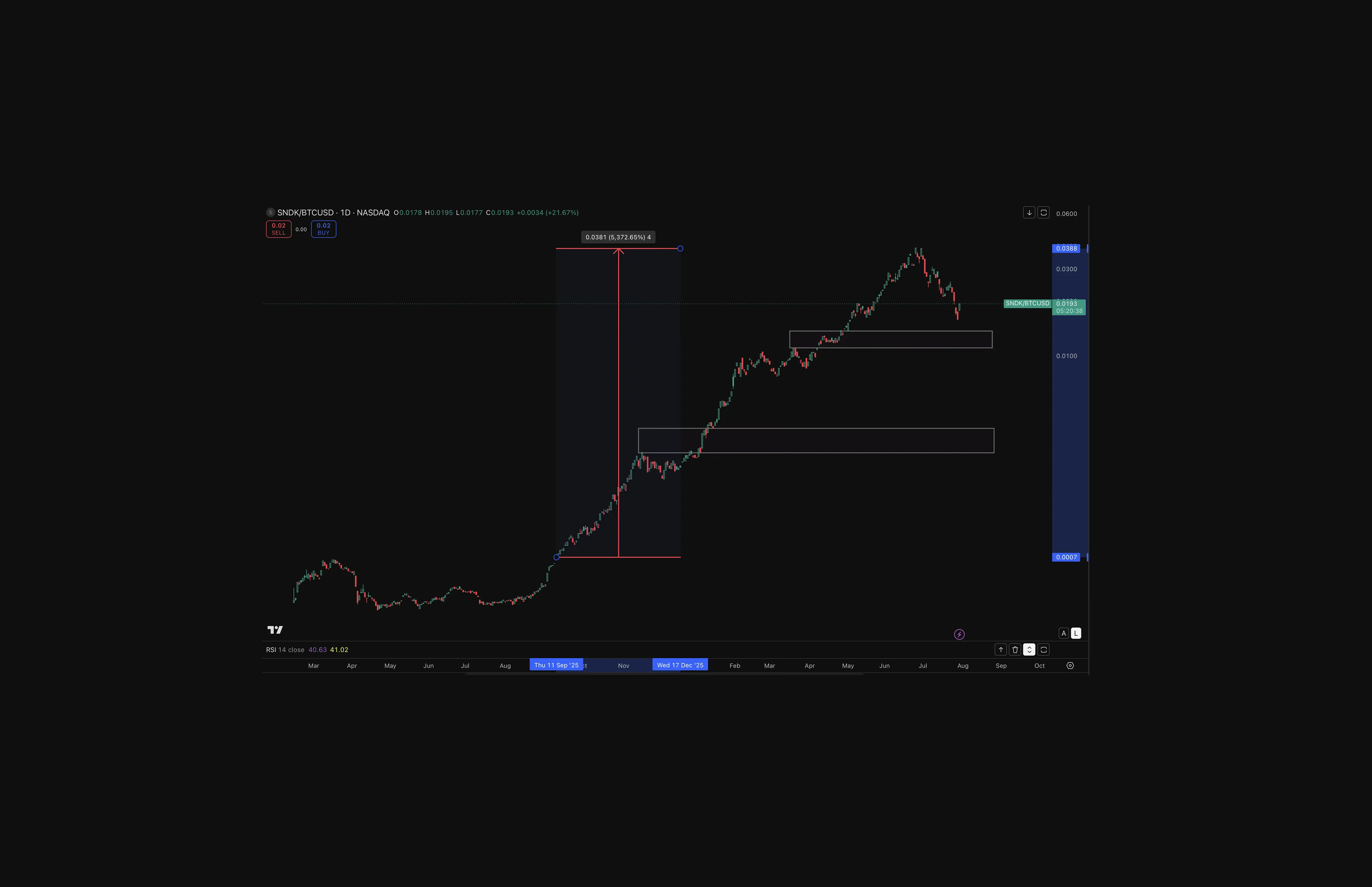
Technicals: SanDisk rallied over 5,000% against Bitcoin from its September 2025 breakout to a June 2026 high. Measured strictly for 2026 (Jan to now), it's up roughly 406% against Bitcoin, It's since pulled back about 50% from the June high, now sitting at a level that used to be resistance, which could act as support going forward.
Micron (MU): Up ~221% vs. BTC YTD 2026
What they do: Micron makes DRAM and NAND memory chips, including HBM (high-bandwidth memory), the memory used next to GPUs in AI accelerators.
When they went public: June 1, 1984 (Nasdaq). Survived multiple prior memory-industry boom-bust cycles.
Why demand increased: Micron spent years developing and qualifying HBM for AI chipmakers, and had supply agreements in place before hyperscaler AI spending accelerated in 2026, so it was ready to capture the demand as it hit.
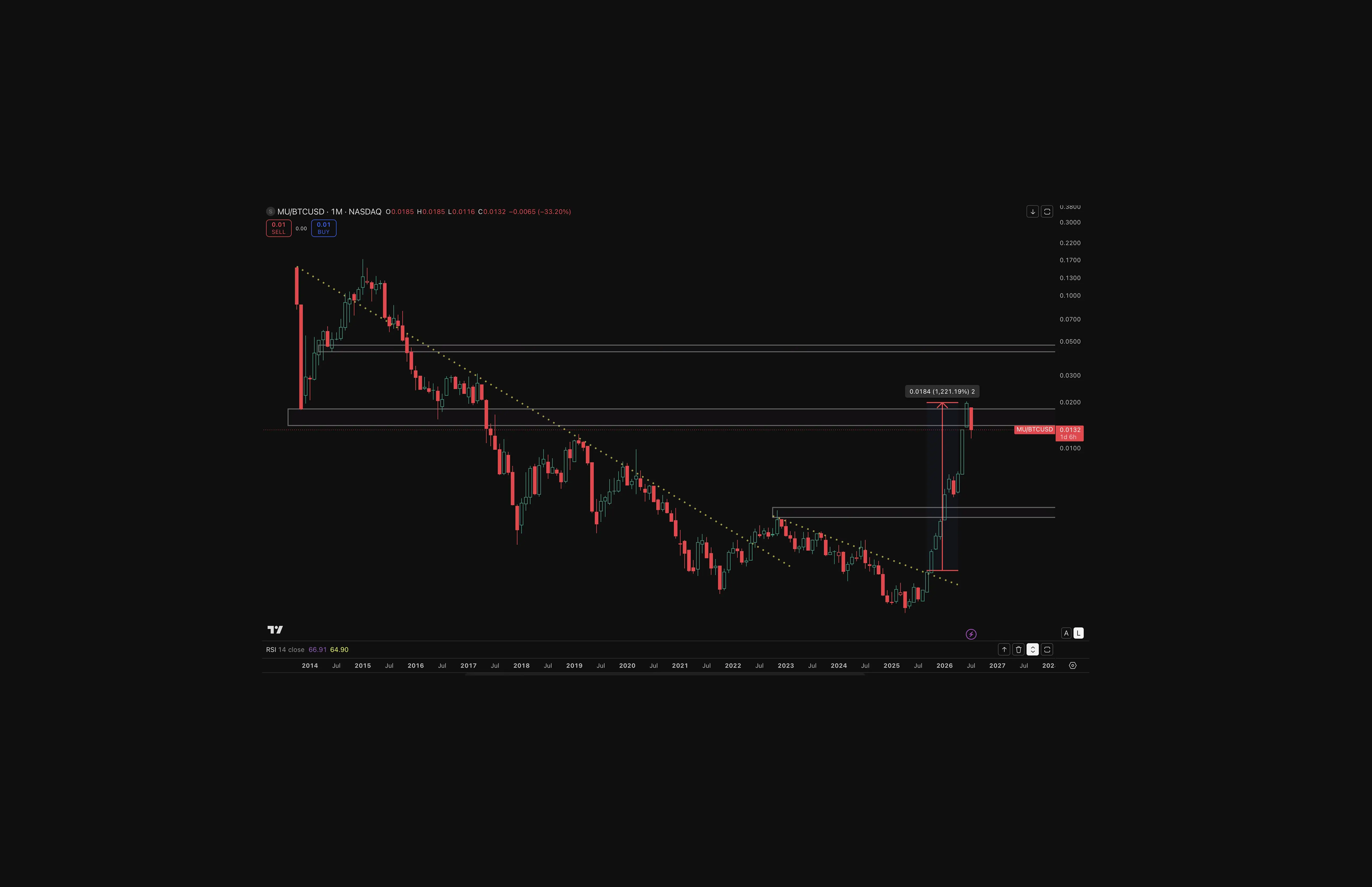
Technicals: MU/BTC broke an 11+ year downtrend against Bitcoin in 2025, then rallied roughly 1,221% to a 2026 high near 0.0199. Measured strictly for 2026 YTD, it's up roughly 221% against Bitcoin. It's since pulled back about 33% from that high, now trading near 0.0132, testing whether the broken downtrend holds as support.
Advanced Micro Devices (AMD): Up ~163% vs. BTC YTD 2026
What they do: AMD designs CPUs and GPUs, competing with Intel in processors and with Nvidia in AI accelerator chips (the MI300/MI350 series).
When they went public: September 27, 1972. The oldest company in this group by a wide margin, over 50 years public.
Why demand increased: AMD's MI300 and MI350 GPUs gave cloud providers a credible second supplier for AI accelerator chips, at a time when Nvidia alone couldn't ship fast enough to meet demand.
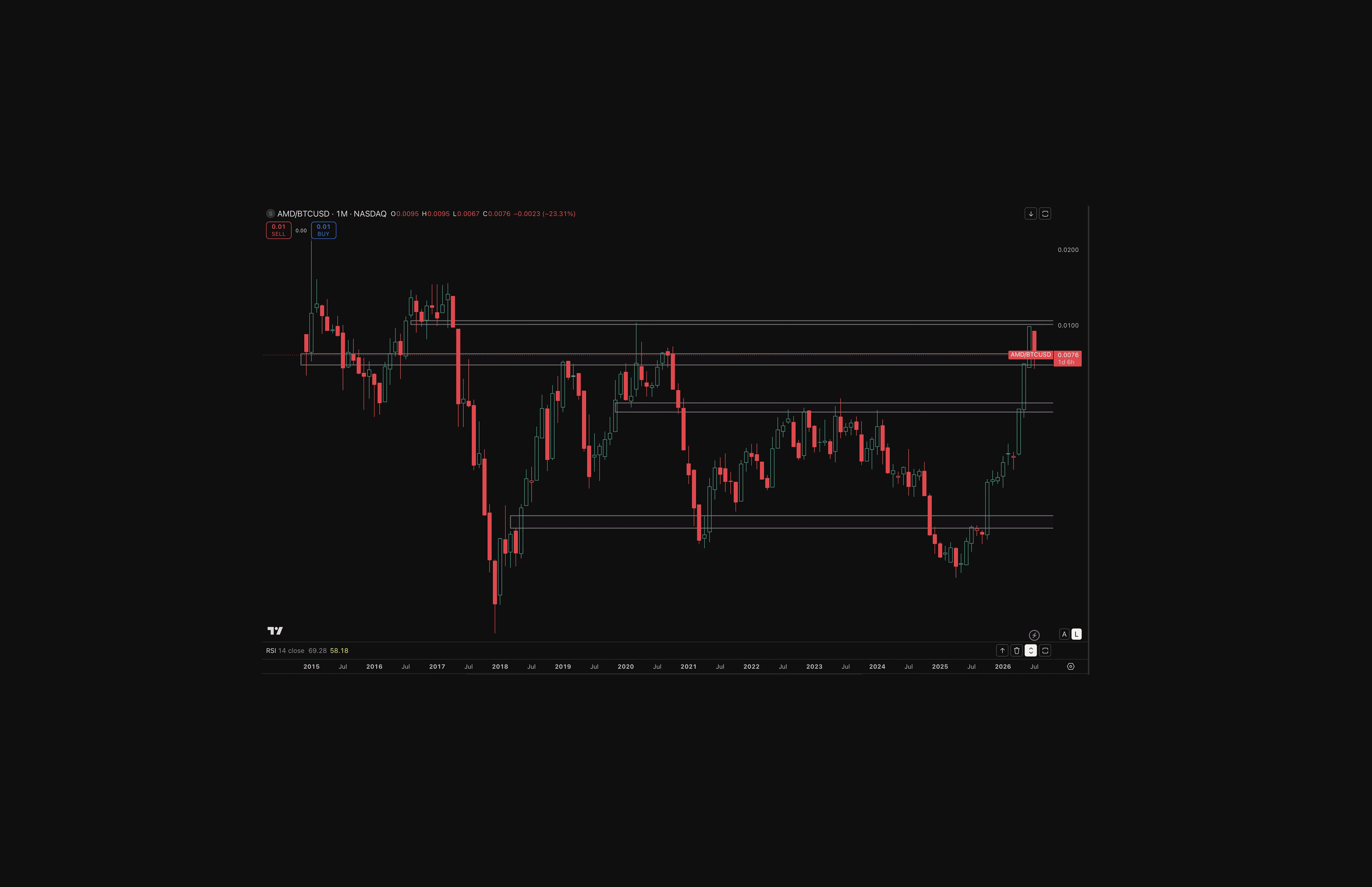
On the chart: AMD/BTC spent 2018–2025 basing between roughly 0.0024 and 0.0028, then rallied toward, but not into, the 0.0100–0.0135 zone, a historical resistance region AMD closed above in 13 separate months between January 2015 and April 2017, peaking near 0.0135 in March 2017. This month's high reached about 0.0095, just short of that zone, before pulling back. Month-to-date, the ratio is down roughly 23%, now trading near 0.0076, close to its 2015 level.
Nebius Group (NBIS): Up ~126% vs. BTC YTD 2026
What they do: Nebius runs GPU cloud infrastructure. It builds and rents out data-center compute to companies that need large-scale AI training and inference power but don't want to build their own data centers.
When they went public: October 21, 2024, under the NBIS ticker, though the corporate entity is older. It traded as Yandex N.V. on Nasdaq from 2011, was halted after Russia's invasion of Ukraine in 2022, then relaunched as Nebius after selling off Yandex's Russian operations and rebranding around AI cloud infrastructure.
Why demand increased: Demand for rented AI compute has outpaced what the big hyperscalers alone can supply, so companies needing GPU capacity have turned to smaller providers like Nebius to fill the gap.
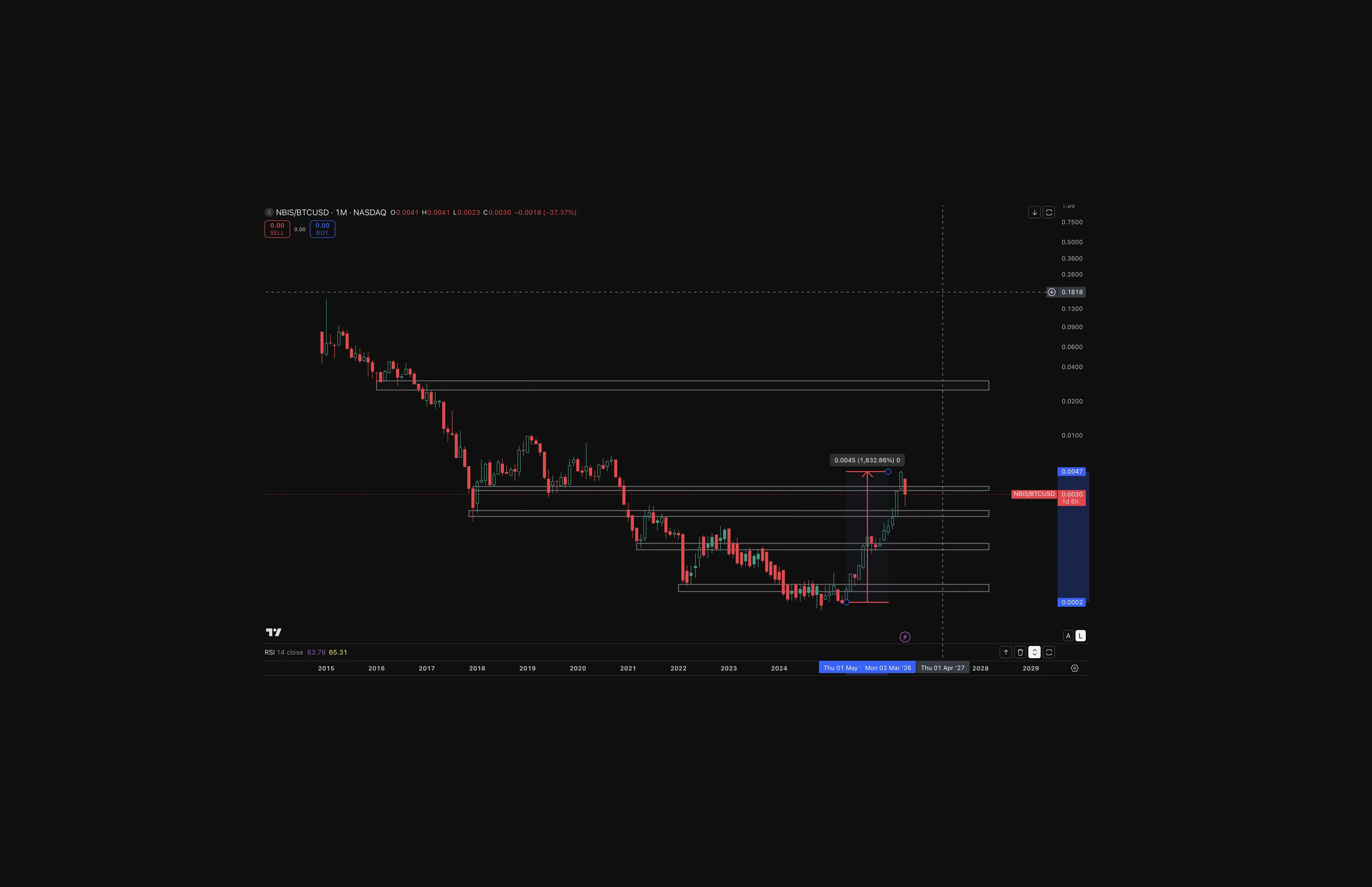
Technicals: NBIS/BTC rallied roughly 1,833% from its 2025 low to a high near 0.0047, the largest move in this group. Measured strictly for 2026 YTD, it's up roughly 126% against Bitcoin. Month-to-date, it's down roughly 37%, testing whether that old resistance holds as support.
Nvidia (NVDA): Up ~46% vs. BTC YTD 2026
What they do: Nvidia designs GPUs, originally for gaming, now the default chip for training and running AI models, plus the surrounding data-center hardware.
When they went public: January 22, 1999 (Nasdaq), priced at $12/share.
Why demand increased: Nvidia's chips became the default hardware for AI training as Blackwell shipments ramped and data-center demand grew, though by 2026 most of that growth was already expected and priced into the stock.
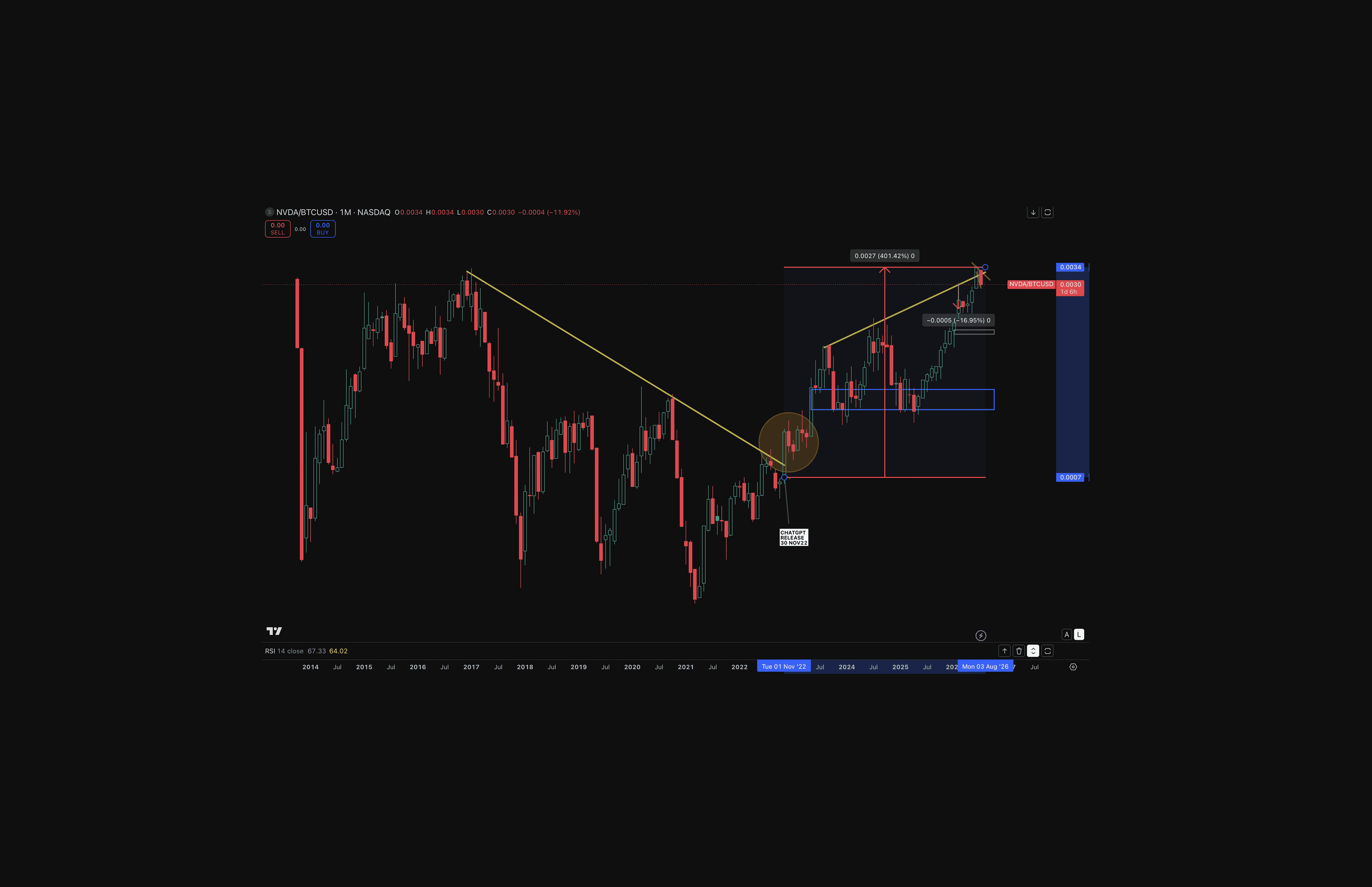
Technicals: NVDA/BTC bottomed the day ChatGPT launched (November 30, 2022) near 0.0007, then rallied about 401% to a marginal new high near 0.0034 this year, edging above its December 2016 peak of roughly 0.0028 for the first time since. Measured strictly for 2026 YTD, it's up roughly 46% against Bitcoin. This month's candle is still open and the price has pulled back to around 0.0030, still slightly above that old 2016 peak. So it's a test of whether the breakout holds, not a confirmed one yet.
The Rally Measured in BTC-Sized Units
Another way to see the size of these moves: divide each company's market capitalization by Bitcoin's fixed maximum supply of 21 million coins. Coinjuice has written about this framework before, both as a way of pricing global assets in Bitcoin and in a related BTC Weight audit.
The table below re-measures each company's dollar market value against Bitcoin's fixed 21-million-coin supply instead of the dollar. Bitcoin's price isn't part of the calculation. The table is another way to see the real scale of the increase.
Company | At move low | At move peak | Increase |
SanDisk | $209 | $16,456 | 78.8× |
Micron | $3,476 | $65,186 | 18.8× |
AMD | $6,072 | $45,101 | 7.4× |
Nebius | $207 | $3,466 | 16.7× |
Nvidia | $12,948 | $271,886 | 21.0× |
Calculated as each company's market capitalization divided by Bitcoin's maximum supply of 21,000,000 coins. This converts the size of the move into a single fixed-scale unit, not a measure of performance against Bitcoin's price.
Outro
Versus Bitcoin, “AI stocks” were not one trade. SanDisk and Micron broke multi-year resistance zones, while AMD and Nvidia are still testing important levels. Nebius sits somewhere in between, pulling back sharply after the steepest run of the group. July’s monthly candles remain open, so the final technical outcomes are not yet confirmed.
Bitcoin’s own drawdown is a separate story. Bitcoin is not being repriced on corporate execution or product cycles, but on liquidity and risk appetite—the same forces that have shaped its previous cycles.
Through 2028, the question is not Bitcoin versus AI. It is whether you would rather hold companies attempting to break above resistance after extended rallies, or Bitcoin—an asset whose investment case rests on scarcity and whose bear market may have roughly two months left to run.
Go deeper on how to position around this without leverage or liquidation risk: Bitcoin Trading Without Leverage — the ebook →
Want the ongoing data, levels and calls behind pieces like this one? See Coinjuice subscription plans.
FAQ
Which AI-linked stocks outperformed Bitcoin in 2026 and by how much?
Measured year-to-date in 2026 against Bitcoin, SanDisk is up roughly 406%, Micron about 221%, AMD about 163%, Nebius about 126%, and Nvidia about 30%.
What is BTC Weight and how is it used to evaluate these companies?
BTC Weight is each company’s market capitalization divided by Bitcoin’s fixed maximum supply of 21 million coins. It replaces a variable fiat unit base with a permanently fixed one to interpret the scale of each increase in corporate value, without using Bitcoin’s market price.
How have the charts of SanDisk, Micron, AMD, Nebius, and Nvidia behaved relative to Bitcoin?
SanDisk and Micron have broken multi-year resistance zones against Bitcoin. AMD and Nvidia are still testing resistance, and July is not closed yet, so those breakouts are unconfirmed. Nebius has had the steepest run in the group and is retreating hard off its highs, testing old resistance as support.
How does the article frame the choice between Bitcoin and AI stocks through 2028?
Through 2028, the choice is framed as whether to hold companies attempting to break out above resistance after extended rallies, or Bitcoin, whose investment case rests on scarcity and whose bear market may have roughly two months left to run. It is not framed as Bitcoin versus AI in general.
Disclaimer
The information provided in this article is for informational purposes only. It is not intended to be, nor should it be construed as, financial advice. We do not make any warranties regarding the completeness, reliability, or accuracy of this information. All investments involve risk, and past performance does not guarantee future results. We recommend consulting a financial advisor before making any investment decisions.
More like this



Written by

Andrew Kamsky
Andrew Kamsky is a Bitcoin analyst. He spent a decade in traditional finance across a Big Four firm and a listed fintech bank before going deep on Bitcoin full-time.