











Quick summary
Bitcoin’s rise toward $80,000 driven mainly by massive short covering, not new accumulation
Around $4 billion shorts liquidated over two days; ETF inflows strong but unconfirmed
Analysts split on whether move marks a bottom or temporary squeeze before macro catalysts
Altcoin gains remain selective as Bitcoin dominance stays high and DeFi bridges lead TVL
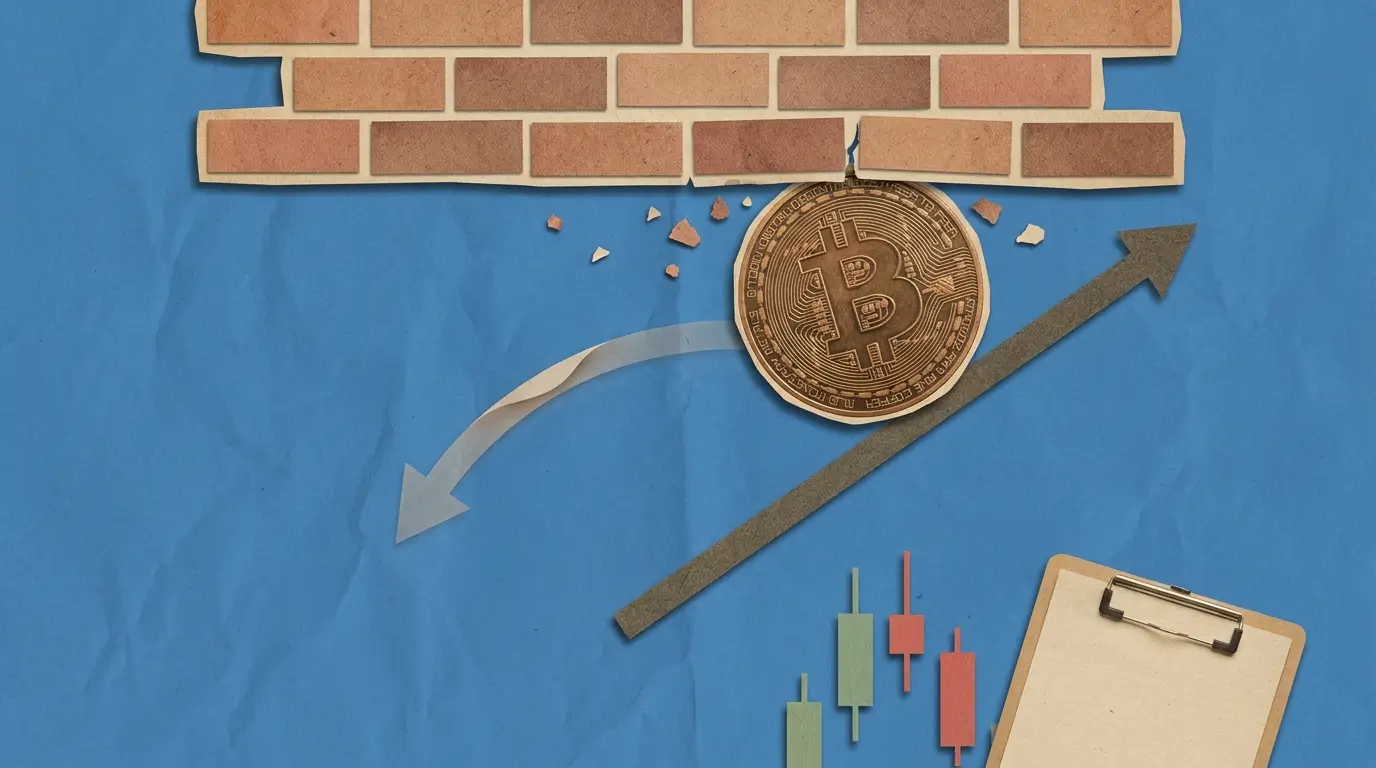
Bitcoin's push toward $80,000 rests on short covering more than fresh accumulation, while altcoin rotation stays selective, not broad-based.
Bitcoin's price action has been violent since August 17. Underneath the move toward $80,000, the more useful question is not how far the number moved but what moved it. Two days of forced short covering created most of the visible strength, and the market has not yet shown whether spot demand can hold the level once the squeeze finishes.
Short Covering Explains Most of Bitcoin's Move Toward $80,000
CoinDesk reported that more than half of Wednesday's 7.1% gain landed inside a single hour on roughly a third of the day's volume, with Binance processing $1.26 billion in bitcoin futures during one 60-second window, 361 times a typical minute. That pattern describes forced buying, not organic demand entering gradually.
Liquidation scale: Approximately $1 billion in short positions were closed in Friday's Asian session alone, out of $1.23 billion in total closures across 140,416 traders, following $3 billion liquidated Thursday, per CoinDesk.
Funding rate crowding: Bitcoin futures funding rates reportedly hit exchange maximums, a signal that leveraged long positioning has become expensive and one-sided, per CoinDesk citing analyst Tobias Bauer.
Accumulation caveat: CoinShares head of research James Butterfill was cited as saying accumulation by large holders remains modest in scale, calling the rally "primarily a macro story rather than a crypto-specific one."
ETF flows: U.S. spot bitcoin ETFs reportedly saw net inflows in the $600 million range on Thursday, the strongest single day since early May. That figure traces to secondary aggregator data (AiCoin, tracking IBIT and FBTC flows) rather than a figure directly confirmed in CoinDesk's own reporting, which separately cited $517.2 million for August 19 and roughly $800 million for August 21. The magnitude is plausible and consistent across sources, but the specific figure should be read as reported, not confirmed against a single named outlet.
Analysts are split on what happens next. Bitwise Research Analyst Ishmael Asad reportedly called the rally the strongest indication yet that Bitcoin has bottomed, pointing to the Treasury's expanded bond buybacks and the SEC's proposed Regulation Crypto framework as catalysts. Lo:Tech researcher Adam McCarthy reportedly cautioned that much of the rally was driven by liquidations rather than sustained buying, leaving Bitcoin vulnerable once the short squeeze runs out, per Decrypt.
Both views come from the same CoinDesk reporting and should be read as competing interpretations of the same data, not as a resolved question. U.S. flash PMI data lands Friday, and the Jackson Hole symposium next week, where Federal Reserve Chair Kevin Warsh and other central bank governors are scheduled to speak, is widely cited as the next catalyst that could confirm or unwind the current move.
Altcoins Are Moving, but Bitcoin Still Holds the Basket
Zcash led close-to-close movers at 10.8%, followed by XRP at 9.6%, while Solana gained 1.4% and bitcoin slipped 0.9% over the same window. Earlier intraday readings showed a wider spread, with XRP as high as 14.0% and Zcash at 12.4%, before both eased into the close. That gap between the intraday and close-to-close figures is itself a reminder that daily percentage moves depend heavily on the window measured, and the broader rotation pattern still points to selective participation rather than a market-wide altcoin cycle.
Bitcoin dominance: Bitcoin represents 74.1% of the combined market cap of a tracked BTC, ETH, SOL, BNB, and XRP basket, confirming that market leadership remains concentrated even as some altcoins post larger daily percentage moves. On a broader total-market basis, Bitcoin dominance reads 59.50% on the monthly chart, still consolidating in a range roughly between 58% and 62% after pulling back from a 2025 high near 66%.
Ethereum's position: Ethereum traded at $2,445, 50.6% below its all-time high. The ETH/BTC ratio stands at 0.0315, supporting CoinDesk's reporting that the ratio is testing resistance near 0.03 against its 50-week exponential moving average, a level that has historically preceded periods of ETH outperformance when broken decisively.
Solana infrastructure: Solana traded at $94.90, 67.6% below its all-time high. Cointelegraph reported Solana reduced its target slot time to 350 milliseconds as part of an ongoing effort to lower network latency.
DeFi category leadership: Excluding centralized exchanges, bridges lead tracked base total value locked at $51.6 billion, ahead of liquid staking at $50.7 billion and lending at $49.2 billion, per DefiLlama. Category figures overlap and should not be summed as independent capital pools.
MANTRA update: The MANTRA Chain outage flagged earlier in the session has been resolved. The team reported the Cosmos-EVM module vulnerability was patched and block production resumed between 06:28 and 06:55 UTC, with no user funds affected according to the team's own statement, which has not yet been independently verified beyond that disclosure.
The Lesson
Bitcoin's push toward $80,000 rests on short covering more than fresh accumulation. A squeeze can move price fast without moving conviction at the same speed. The useful habit is separating two questions: did the price move, and did the reason people are buying change? This week, the answer is yes to the first and “we will see” to the second. That gap tends to close only after forced selling has fully drained from the market, at which point price either holds on its own or gives back the move.
Coinjuice Lens
This pattern connects to trading psychology as a recurring Coinjuice category. Forced short covering produces the visual signature of demand in wide green candles, heavy volume, breakout headlines, without necessarily reflecting a change in how holders view the asset.
The volume in this move backs that up: BTC trading volume ran roughly 2x the prior 41-day average on August 20 and 2.5x on August 21, the two days the squeeze accelerated, before climbing further to about 3x baseline on August 22 as price pulled back from the highs. Notably, the initial breakout day, August 19, actually traded on below-average volume, the heavy volume built in after the move started, once shorts were already being forced out, rather than leading it.
Readers newer to reading these moves can review the framework in the CoinJuice ebook, Bitcoin Trading Without Leverage, which walks through why leveraged positioning amplifies moves in both directions.
News Behind Today's Read
"BTC price breaks out of six-week range to top $71,000. $3 billion in shorts wiped out" (CoinDesk, Aug 20, 2026) — source for the Treasury buyback tailwind and the short-squeeze mechanics behind the push toward $80K.
"What's Next for Bitcoin After Historic Rally? Experts Weigh In" (Decrypt, Aug 20, 2026) — source for the $517M ETF inflow figure and the "bottom vs. squeeze fade" analyst disagreement; cross-referenced against CoinDesk.
"Solana Cuts Blockchain Slot Time to 350 Milliseconds" (Cointelegraph, Aug 21, 2026) — source for the Solana latency-reduction change.
"MANTRA Token Plunges to All-Time Low During Chain Outage" (Cointelegraph, Aug 21, 2026) — source for the exploit/halt itself; the resumption.
What Investors Are Asking
Does a short squeeze this large mean the bear market is over?
Not on its own. A squeeze forces existing short positions to close, which pushes price higher without requiring any new buyer to believe the asset is undervalued. CoinShares' Butterfill was cited noting large-holder accumulation remains modest, and CoinDesk's own reporting flagged the rally as primarily macro-driven. Confirmation would look like sustained ETF inflows and accumulation continuing after the liquidation cascade fully clears, something not yet visible in the data available August 22, 2026.
Why does Bitcoin dominance matter if some altcoins are posting bigger daily gains?
Dominance measures how concentrated market value is in bitcoin relative to the rest of the tracked basket. At 74.1%, bitcoin still holds the large majority of that combined value even though Zcash and XRP posted larger percentage moves on a close-to-close basis August 22, 2026. Large percentage gains on smaller market caps can coexist with continued bitcoin leadership; the two are not contradictory.
Market Snapshot
Asset | Price | Distance from ATH | Note |
Bitcoin (BTC) | $77,574 | 38.5% below ATH | Intraday range reported between $77,000 and $79,400 earlier in the session; close-to-close move of -0.9% |
Ethereum (ETH) | $2,445 | 50.6% below ATH | ETH/BTC ratio at 0.0315, testing resistance near 0.03 per CoinDesk |
Solana (SOL) | $94.90 | 67.6% below ATH | Close-to-close move of +1.4%; intraday reading earlier in the session showed +5.9% |
DeFi Total Value Locked | $87.2 billion (base TVL) | Not applicable | Bridges lead category TVL at $51.6 billion, per DefiLlama |
This article was developed with the support of artificial intelligence tools as part of Coinjuice's editorial process and reviewed by our editorial team before publication.
FAQ
What mainly drove Bitcoin’s move toward $80,000 this week?
Most of the move was driven by two days of forced short covering, with more than half of a 7.1% daily gain occurring in a single high-volume hour that reflected liquidations rather than gradual organic buying.
How large was the recent wave of Bitcoin short liquidations?
About $3 billion in shorts were liquidated on Thursday, followed by approximately $1.23 billion in closures across 140,416 traders on Friday, including around $1 billion during Friday’s Asian session.
Are altcoins in a broad-based rally compared with Bitcoin?
No. While Zcash and XRP posted strong close-to-close gains and Solana rose modestly, the rotation remains selective, and Bitcoin still represents 74.1% of the combined market cap of a tracked BTC, ETH, SOL, BNB, and XRP basket.
Does the recent short squeeze mean the Bitcoin bear market is over?
Not by itself. A short squeeze forces shorts to close and can push prices higher without new value-driven buying, and confirmation would require sustained ETF inflows and continued large-holder accumulation after the liquidation cascade clears, which is not yet visible in the available data.
Disclaimer
The information provided in this article is for informational purposes only. It is not intended to be, nor should it be construed as, financial advice. We do not make any warranties regarding the completeness, reliability, or accuracy of this information. All investments involve risk, and past performance does not guarantee future results. We recommend consulting a financial advisor before making any investment decisions.
More like this

Written by

Andrew Kamsky
Andrew Kamsky is a Bitcoin analyst. He spent a decade in traditional finance across a Big Four firm and a listed fintech bank before going deep on Bitcoin full-time.