









Quick summary
Bitcoin trades near four-month highs on strong ETF inflows and supportive macro conditions
Mining margins are pressured by high power costs and competition from AI compute demand
Tether shut its $120 million Uruguay mining project over a power allocation contract dispute
Bitcoin price resilience contrasts with stressed mining economics, highlighting separate demand and cost dynamics
ETF demand and macro tailwinds are keeping Bitcoin's price resilient, even as mining margins crack under power and AI competition.
Bitcoin trades at $77,502, still 38% below its $126,156 all-time high. One part of Bitcoin's infrastructure — mining — is under real margin pressure from power costs and competing uses like AI compute. That's a separate question from Bitcoin's price, which is holding near four-month highs on reported ETF demand and a supportive macro backdrop.
Bitcoin Demand Climbs: Mining's Cost Side Keeps Straining
ETF demand and macro tailwinds are keeping Bitcoin's price resilient, even as mining margins face AI competition. Reported coverage points to the strongest weekly spot ETF inflow in roughly ten months, alongside U.S. Treasury buyback plans that reportedly pulled long-term yields lower and improved risk appetite.
Price action has outrun the flow data that supposedly drives it: Bitcoin's latest close sits meaningfully above its 20-day average, a pace that rewards patience over chasing the move.
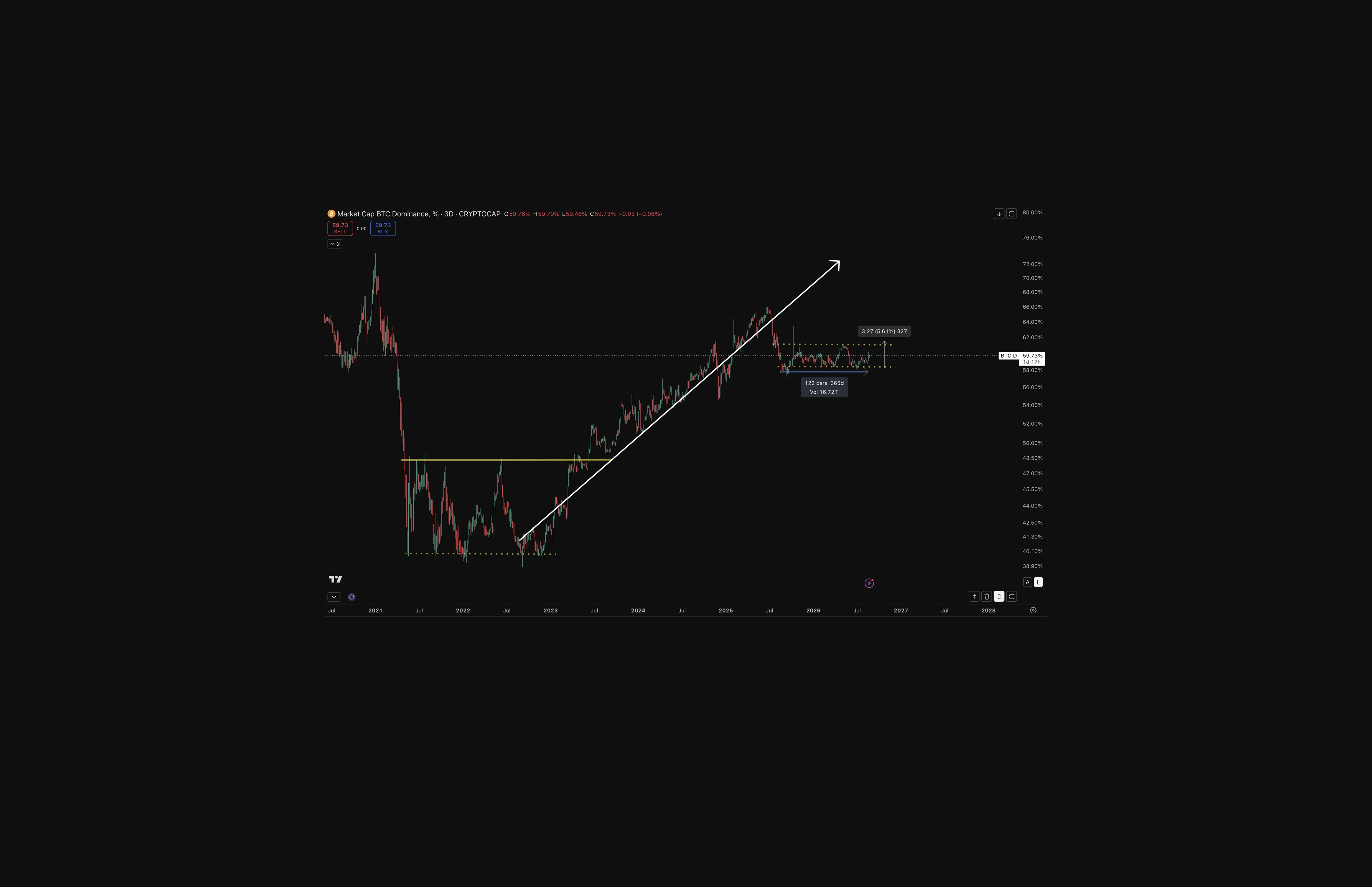
Bitcoin dominance sits at 74.3% of the combined BTC/ETH/SOL/BNB/XRP basket, pointing to concentrated leadership rather than broad-based rotation.
On the broader total-market measure, BTC.D: has been holding inside a tighter band, roughly 58.35% to 61.15%, for the better part of a year (currently 59.72%, following a multi-year climb from the 2023 lows near 45%.
Uruguay Exit Exposes Bitcoin Mining's Cost Problem
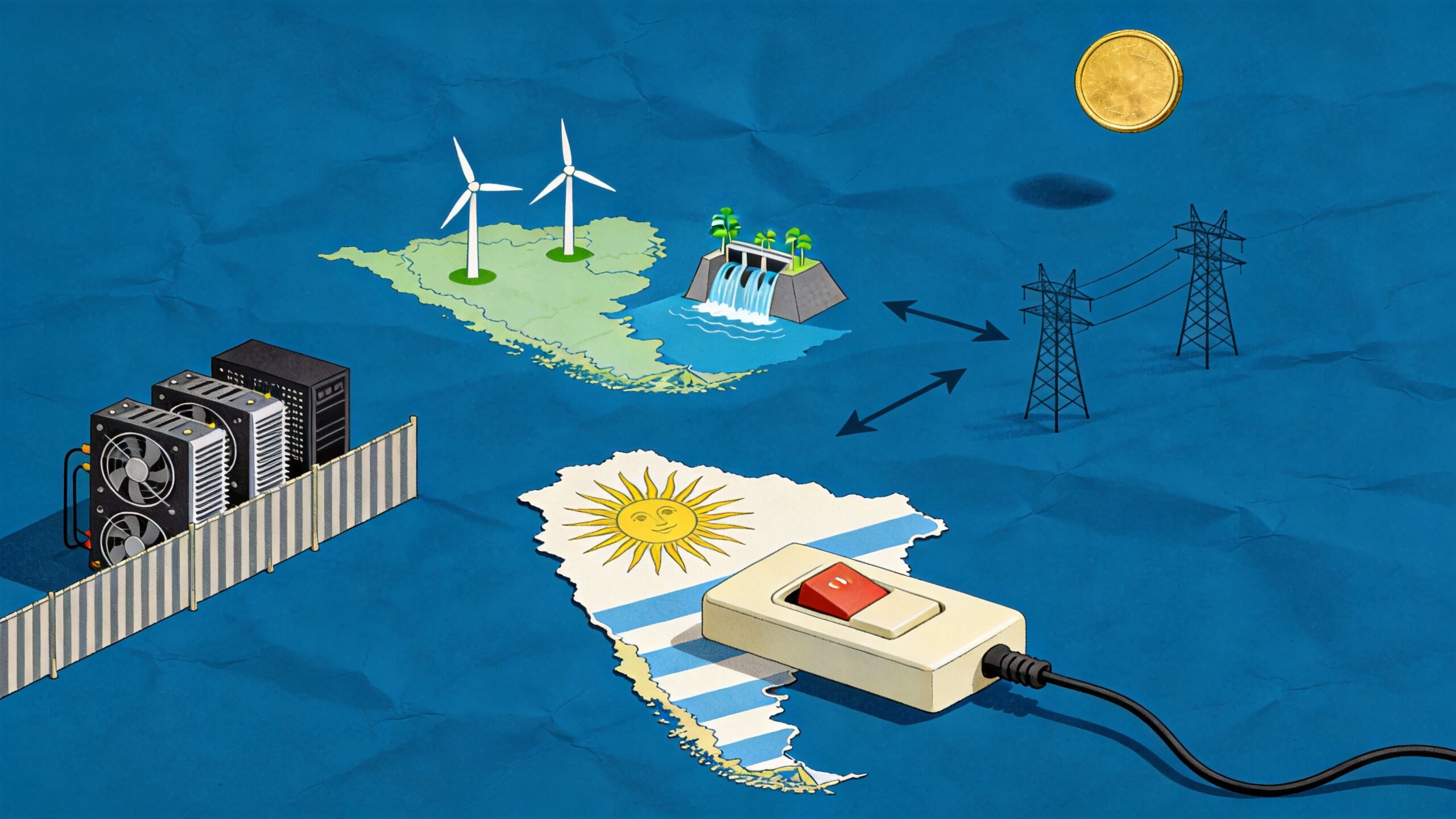
Tether has shut down its $120 million Bitcoin mining project in Uruguay after a contract dispute with UTE, the state power utility, over how much electricity the sites were entitled to draw. Microfin, Tether's local entity, stopped paying its power bills and told Uruguayan labor authorities it would lay off most of its staff there.
Contract interpretation split the sides: Tether treated the agreed power allocation as a floor that could later expand; UTE treated it as a ceiling, and the two never reconciled an amended contract.
The project was not isolated bad luck: Reuters reporting tied the exit to a broader pattern, where high power prices, Bitcoin's price level, and the option to repurpose sites for AI data centers are compressing mining economics across the board.
Tether has not exited mining generally: the company still holds a roughly 70% stake in Adecoagro, a renewable energy company, with a stated plan to route surplus power there into mining, so this reads as a site-level retreat rather than a strategic reversal.
The Lesson
Infrastructure stress and price strength are not contradictions. Bitcoin's price is a liquidity and demand question answered by an entirely different set of buyers than the ones running mining rigs, who face a margin business exposed to power costs and competing uses for the same electricity. Readers interested in separating those two layers can start with the Coinjuice ebook, Bitcoin Trading Without Leverage, or go deeper with a Coinjuice subscription, currently 30% off the annual plan, where we start and complete trades and you will learn to snipe them independently.
Coinjuice Lens: Mining
No existing Research Hub piece addresses mining margin compression directly, so no internal link is placed here rather than forcing a weak connection. This gap is a candidate for a future evergreen explainer on the economics of Bitcoin mining under rising power and AI-computer competition.
News Behind Today’s Read
Tether Halts $120 Million Bitcoin Mining Project in Uruguay Due to Power Dispute — Bloomingbit (PANews), August 24, 2026. Primary account of the contract dispute and shutdown, sourced to Reuters.
Week Ahead: Jackson Hole Puts Fed and Inflation in Focus — Schwab Network. Covers the PCE, GDP, durable-goods, and Jackson Hole catalysts shaping this week's macro backdrop.
BTC USD — Bitcoin Price and Chart — TradingView. Notes the weekly ETF asset rise alongside a still-negative year-to-date ETF flow figure, the source of this edition's reported-not-confirmed caveat.
Market Snapshot
Asset | Price | Distance from ATH | 7d Change |
BTC | $77,502 | 38.6% below ATH ($126,156) | +22.7% (CoinGecko) |
ETH | $2,460 | 50.3% below ATH ($4,946) | +27.0% (CoinGecko, re-verified) |
This article was developed with the support of artificial intelligence tools as part of CoinJuice's editorial process and reviewed by our editorial team before publication.
FAQ
Why is Bitcoin’s price holding up despite stress in the mining sector?
Bitcoin’s price is being supported by strong reported spot ETF demand and a supportive macro backdrop, even as mining margins come under pressure from power costs and competition from AI compute.
What happened with Tether’s Bitcoin mining project in Uruguay?
Tether shut down its $120 million Bitcoin mining project in Uruguay after a contract dispute with the state power utility UTE over how much electricity the sites were entitled to draw, and its local entity Microfin stopped paying power bills and moved to lay off most staff.
How did Tether and UTE disagree over the power contract?
Tether treated the agreed power allocation as a floor that could later expand, while UTE treated it as a ceiling, and they never reconciled an amended contract.
Does Tether’s Uruguay shutdown mean it is exiting Bitcoin mining entirely?
No. Tether still holds a roughly 70% stake in Adecoagro, a renewable energy company, with a plan to route surplus power there into mining, so the Uruguay move is described as a site-level retreat rather than a strategic reversal.
Disclaimer
The information provided in this article is for informational purposes only. It is not intended to be, nor should it be construed as, financial advice. We do not make any warranties regarding the completeness, reliability, or accuracy of this information. All investments involve risk, and past performance does not guarantee future results. We recommend consulting a financial advisor before making any investment decisions.
More like this



Written by

Andrew Kamsky
Andrew Kamsky is a Bitcoin analyst. He spent a decade in traditional finance across a Big Four firm and a listed fintech bank before going deep on Bitcoin full-time.