










Quick summary
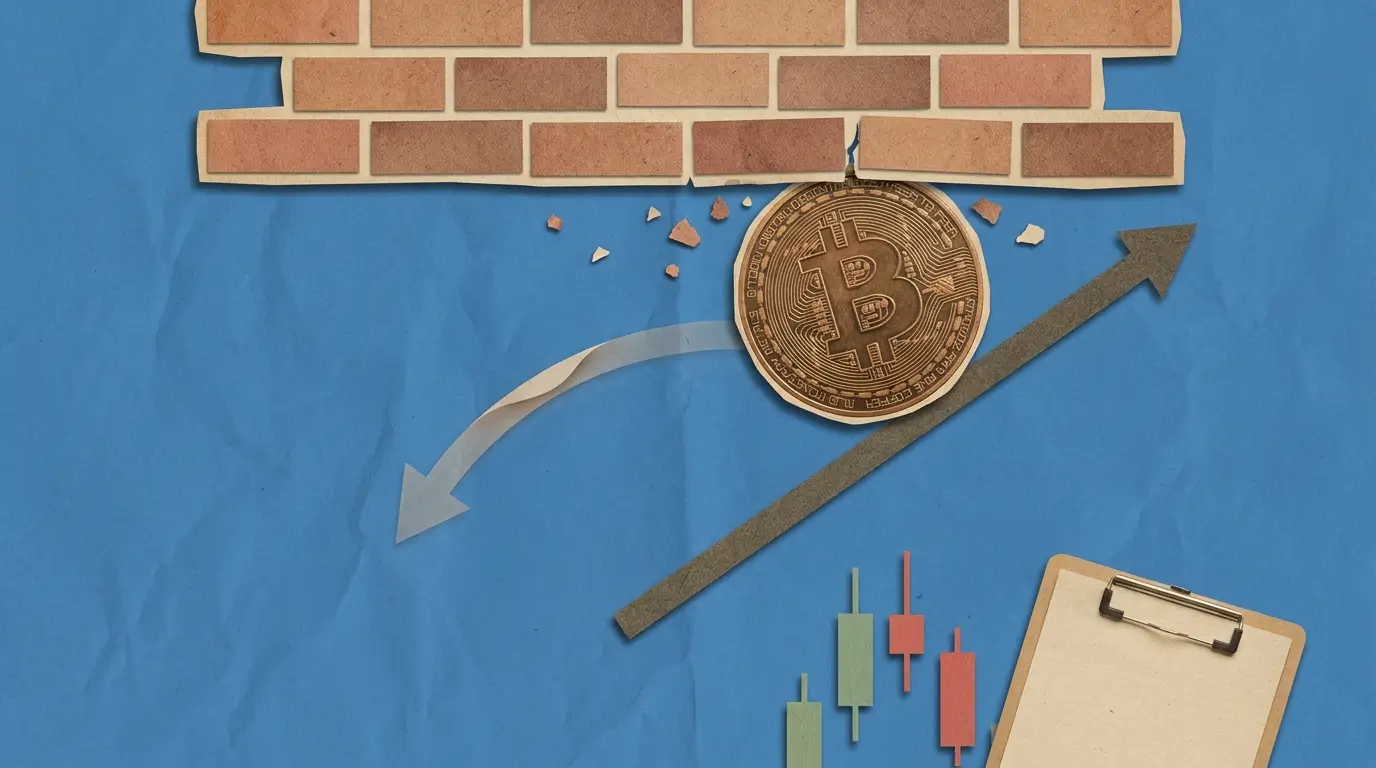
Bitcoin jumped about 15 percent to 77,535 dollars, breaking an eleven-week range.
Rally driven mainly by bond-yield pullback and forced short liquidations exceeding 4.1 billion dollars.
Unverified spot ETF inflows and rising margin-borrow rates suggest traders are rebuilding short positions.
Trump administration is pushing the Digital Asset Market Clarity Act, still short Senate votes.
Bitcoin trades at $77,535, having climbed roughly 15% since Monday and reclaimed levels it hadn't held in eleven weeks. The question is what actually moved the price of Bitcoin: publications have cited a bond market reprieve triggered a wave of forced short closures, and Washington spent Wednesday making the case for why the rally should have legs beyond the squeeze.
The Squeeze Behind the Bitcoin Price Increase
Bitcoin's six-week range broke because of a bond market development, not a crypto one. A White House signal supporting larger Treasury buybacks eased the broader bond selloff that had pushed the 30-year yield toward 5.34% earlier in the week.
The mechanism was rates, rather than crypto demand: yields pulled back and the Dollar Index fell to a three-month low, removing the pressure that had kept non-yielding assets like Bitcoin range-bound.
The move itself was fast and forced: price ran from the $64,000 area to above $72,000, a move that forced approximately $2.7 billion in short positions closed, according to Straits Times and CoinDesk's live-updates coverage.
BTC followed an earlier squeeze this same week: $1.4 billion was liquidated within a single four-hour window prior to Wednesday's move.
ETF flows offer a constructive but unverified signal: U.S. spot Bitcoin ETFs reportedly drew $517.2 million in net inflows on August 19, their largest single day since early May, according to Cointelegraph and CoinDesk citing SoSoValue data. ETF flow figures are consistently among the least reliable numbers to verify same-day and should be read as reported rather than confirmed.
Re-shorting activity would undercut the demand read: Bitcoin's margin-borrow rate has reportedly climbed from roughly 3.9% to 4.6%, which would suggest traders are already rebuilding short positions into the strength. This figure could not be independently corroborated in this pass and should be treated as reported, not confirmed.
Washington's Clarity Act Push
The second thread running through the week is political, not technical.
The meeting itself: President Trump hosted the chief executives of Coinbase, Ripple, Gemini, Chainlink Labs, Robinhood and Kraken at the White House on Wednesday, calling on Congress to pass what he described as a fair version of the Digital Asset Market Clarity Act.
The private follow-up: Chainlink Labs CEO Sergey Nazarov told CoinDesk that Trump moved the group into the Oval Office for further discussion and described the administration as viewing the bill's passage as achievable, citing a small number of outstanding issues and specific senators who still need to be persuaded.
The regulatory backdrop: the meeting preceded the first gathering of the new CFTC Innovation Advisory Committee on Thursday, which includes executives from Kraken, Anchorage Digital, Grayscale and OKX.
The sticking point is unchanged from prior coverage: Democratic negotiators have sought ethics limits on Trump's personal crypto involvement, a demand that sits awkwardly against a bill the White House is actively promoting.
The math is still short: the Senate is expected to return to the bill in September, with roughly six additional Democratic votes still needed to clear the 60-vote threshold.
That leaves an open question sitting underneath Thursday's price action: whether the move to $77,535 has already priced in Clarity Act passage, or whether a Senate vote in September is still a catalyst waiting to happen.
The Lesson
A rally built on forced short covering and a rally built on new demand can look identical for a day. The way to tell them apart is not the size of the move, it's what happens after the forced sellers are gone: does spot buying continue, or does price stall exactly where the squeeze ran out of shorts to liquidate.
To put this distinction into practice, start with the Coinjuice ebook, Bitcoin Trading Without Leverage. For ongoing analysis and complete trade walkthroughs, from identifying a setup to managing its outcome, explore a Coinjuice subscription. The annual plan is currently 30% off and includes a free copy of the ebook. The goal is to help you develop the skills to identify and execute these opportunities independently.
Coinjuice Lens: Market Structure
From a technical perspective, the break above $72,000 reads as a technical reaction out of a falling wedge, a pattern where price compresses into a narrowing downward channel before resolving upward. A confirmed close above the wedge’s upper boundary would provide the stronger signal, with the measured move from the pattern’s base suggesting a probability-based target near the wedge’s highest point.
News Behind Today’s Read
Bitcoin (BTC) approaches $72,000 as Strategy (MSTR) and Coinbase (COIN) continue rally (CoinDesk, Aug 20, 2026) — covers the bond-market trigger and live-updates the scale of the short squeeze.
US Debt Buyback Boost Sends Bitcoin To Multimonth High Above $69,000 (Cointelegraph, Aug 19, 2026) — sources the Treasury buyback size increase driving the yield pullback.
Bitcoin ETFs draw $517M in largest one-day inflow since early May (Cointelegraph, Aug 20, 2026) — reported ETF flow figure citing SoSoValue, unverified against DefiLlama.
Live updates: Bitcoin ETFs draw $517 million, ether pulls $189 million in biggest inflows in months (CoinDesk, Aug 20, 2026) — corroborates the ETF inflow figure with the same SoSoValue sourcing.
Crypto surge triggers record US$2.7 billion of short liquidations (Straits Times, Aug 20, 2026) — sources the $2.7 billion short-liquidation figure used in place of an earlier, uncorroborated $3B estimate.
Trump pushes Congress to move on Clarity Act during White House crypto event (CoinDesk, Aug 19, 2026) — sources the Nazarov interview, the Clarity Act push, and CFTC Innovation Advisory Committee detail.
Market Snapshot
Asset | Price | 24H / Note |
BTC | $77,535 | 38.5% below ATH |
ETH | $2,353 | 52.4% below ATH |
DeFi TVL | $84.7B | — |
FAQ
What triggered Bitcoin’s breakout from its six-week trading range?
Bitcoin’s range broke due to a bond market development: a White House signal supporting larger U.S. Treasury buybacks eased the broader bond selloff, pulling back yields and pushing the Dollar Index to a three-month low, which removed pressure on non-yielding assets like Bitcoin.
How large was the recent short squeeze in Bitcoin?
Bitcoin’s price ran from around $64,000 to above $72,000, forcing approximately $2.7 billion in short positions to close, following an earlier squeeze the same week in which $1.4 billion was liquidated within a single four-hour window.
What role did U.S. spot Bitcoin ETFs and margin-borrow rates play in the move?
U.S. spot Bitcoin ETFs reportedly drew $517.2 million in net inflows on August 19, their largest single day since early May, while Bitcoin’s margin-borrow rate reportedly rose from about 3.9% to 4.6%, suggesting traders may be rebuilding short positions; both figures are reported but not independently confirmed.
What is the Digital Asset Market Clarity Act’s current status in Washington?
President Trump urged passage of a fair version of the Digital Asset Market Clarity Act in a White House meeting with major crypto CEOs and later continued discussions in the Oval Office; the administration views passage as achievable, but roughly six additional Democratic votes are still needed in the Senate to reach the 60-vote threshold when the bill is revisited in September, amid Democratic demands for ethics limits on Trump’s personal crypto involvement.
Disclaimer
The information provided in this article is for informational purposes only. It is not intended to be, nor should it be construed as, financial advice. We do not make any warranties regarding the completeness, reliability, or accuracy of this information. All investments involve risk, and past performance does not guarantee future results. We recommend consulting a financial advisor before making any investment decisions.
More like this


Written by

Andrew Kamsky
Andrew Kamsky is a Bitcoin analyst. He spent a decade in traditional finance across a Big Four firm and a listed fintech bank before going deep on Bitcoin full-time.