











Quick summary
Bitcoin trades near $85,800, below its all-time high, with modest early October gains
Falling Fed hike odds and a $50M short squeeze drove much of last week’s buying
US spot Bitcoin ETF inflows are heavily concentrated in BlackRock’s IBIT, while others see outflows
On-chain exchange outflows and thin trading suggest buying is narrow, not broad-based demand
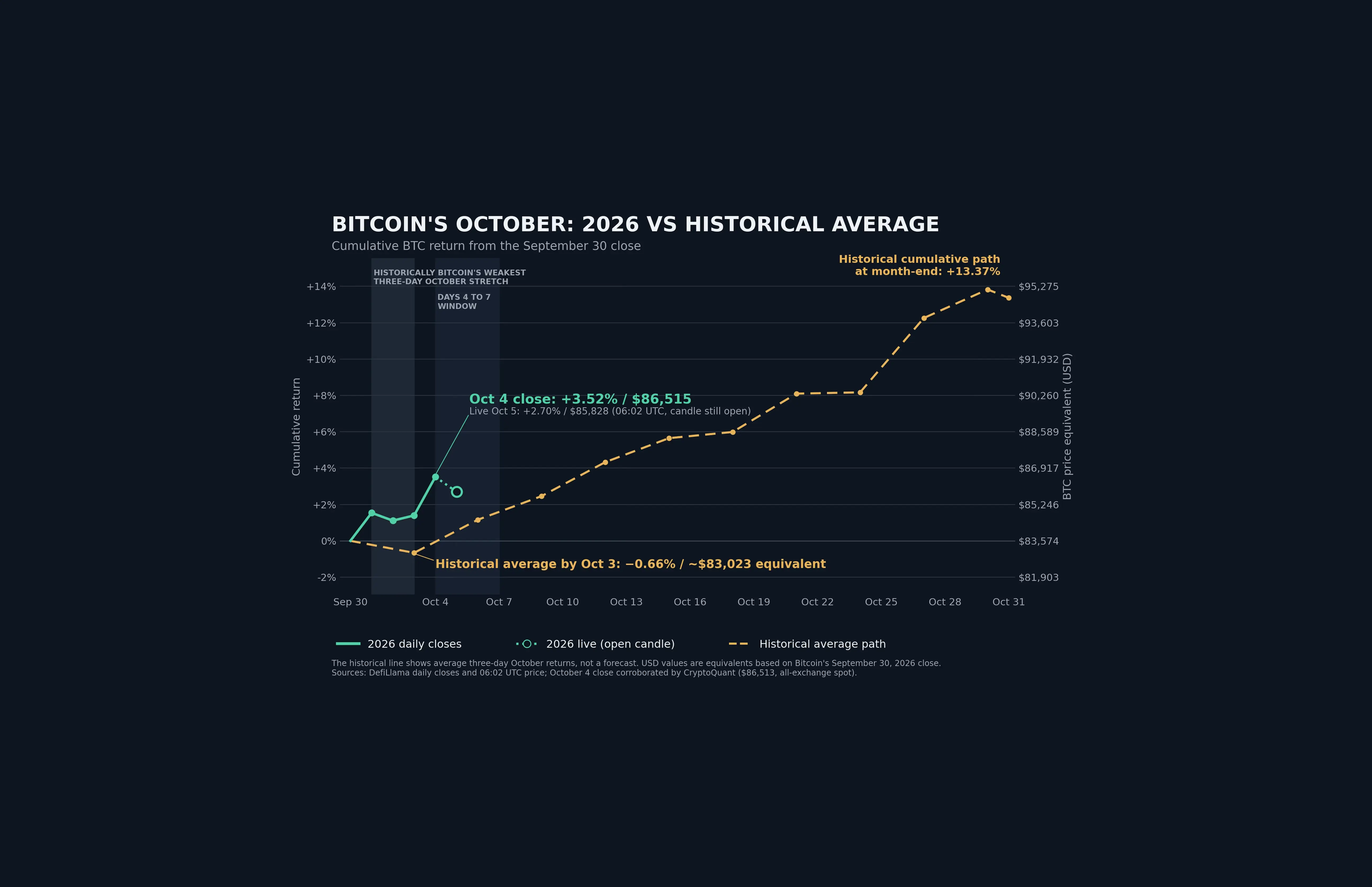
Bitcoin traded at $85,828 at 06:02 UTC on October 5, 2026. That put it 31.97% below its all-time high of $126,156 and up about 2.70% month to date from the September 30 close of $83,574. Coinjuice's 13-year October study found that days 4 to 7 have historically carried most of the month's early gains.
Measured from the October 4 open of $84,743, Bitcoin was up about 1.28% with that window still open. CryptoSlate's Sunday snapshot placed the price at $85,276, above $85,000 but below the $86,000 area reached before the September jobs report. The weekend held the gains, while new data on the week's buyers points to a narrow base. Rate relief arrived, but short covering and a single fund supplied the visible buying.
Bitcoin's $50M Short Squeeze: Forced Buying Before Payrolls
Glassnode's post-payroll study, published October 3, rebuilt the week hour by hour, and the forced buying arrived before the data did:
Hike odds fell in steps: Glassnode's fed funds futures calculation put the odds of a quarter-point hike at the October 28 meeting at 66% on Monday, September 28. By 15:00 UTC on October 2 they were 22%, per its study. The largest drops followed a speech by New York Fed President John Williams and the softer PCE report. Payrolls added a smaller step. Cooler inflation gives the Fed less reason to raise rates, and investors tend to buy riskier assets like Bitcoin when rates look set to stay lower.
Fed officials set the tone: Williams said there was "no need for urgency" after the September hike, and the odds fell from 66% to 50% within two hours. Vice Chair Philip Jefferson added on October 1 that the Fed may need more time and more data before its next step.
The squeeze came first: The biggest burst of the week hit at 04:20 UTC on October 2, when $50 million of short positions were liquidated in 10 minutes. That was eight hours before the jobs release, with no data due at that hour. Shorts made up about 60% of the week's liquidations. A liquidation closes a leveraged bet that has lost too much, and closing a short means buying.
Leverage built, then partly unwound: Open interest rose $2.1 billion in the 24 hours before the report, about 2.5% measured in coins. It kept rising for about an hour after the release, then fell $1.5 billion as Bitcoin slid. That was more than half of what traders had added since midday on October 1.
Long rates did not ease: The 2-year Treasury yield fell on fading hike bets while the 10-year rose to near 5.2%, widening the gap between them to 42 basis points.
Interpretation: The market priced out most of an October hike over four sessions, and Bitcoin's response to each step was small or short-lived. The most forceful buying of the week came from short sellers forced to close, a source of demand that runs out once those positions are gone.
72% of October's ETF Flows Went to One Fund: IBIT
The ETF inflows that resumed on October 1 rest on narrower ground than the group totals suggest:
One fund outran the group: BlackRock's IBIT took in $195.6 million on October 1, while US spot Bitcoin ETFs as a group took in $102.7 million, per Crypto Briefing.
Most of the field sold: Six of the nine funds with non-zero flows on October 1 were net sellers. Fidelity's FBTC lost $60.7 million, Grayscale's GBTC $31.4 million, ARK 21Shares' ARKB $7.7 million and Bitwise's BITB $6.9 million. Grayscale's Bitcoin Mini Trust added $14.6 million.
A month of concentration: From September 3 to October 2, IBIT took in $2.09 billion of the $2.92 billion that flowed into tracked US spot Bitcoin ETFs, about 72%, per DefiLlama.
Friday's figure is provisional: Decrypt's tracker and DefiLlama both show a $31.7 million net inflow on October 2, the session of the jobs report. That total is made up of $29.3 million into FBTC and $2.4 million into MSBT. Farside's flow table left the IBIT entry for that day blank, as CryptoSlate noted.
Thin trading underneath: Glassnode's September 30 study put combined spot-exchange and US spot ETF trading volume at about $6.4 billion a day, per CryptoSlate. That is near the bottom of its range since the ETFs launched.
Sentiment eased, then firmed: Alternative.me's Fear & Greed Index read 65 on October 4 and 70 on October 5, both in its "Greed" band, after 72 on October 2. Coinjuice's study of every Fear & Greed reading of 69 tracks how Bitcoin performed after readings in that zone.
A sceptical crowd on new highs: Traders on Myriad, a prediction market owned by Decrypt's parent company, put 93% odds on Bitcoin not setting a new all-time high in 2026, per Decrypt.
Coinjuice Lens: On-Chain Behaviour
Liquidation data and ETF flow tables each describe one kind of buyer, and both carry caveats. A net fund figure can hide sellers inside it, and forced short covering stops once the shorts are gone. Wallet data offers a third view. Coinjuice's Balance Watch for the week to October 1 used CryptoQuant data. It found that labelled exchange wallets recorded a 9,625 BTC net outflow over seven days and 18,997 BTC over 30 days. The same report cautions that an outflow can be a custody transfer or a move between platforms rather than a purchase. Put together, these three signals show different kinds of buying, but none of them proves on its own that the price can hold above $85,000-$86,000. Rates eased, but the buying so far has come mostly from traders closing losing bets and one large fund, not from broad new demand.
Readers looking to trade a squeeze-driven range without becoming its fuel can start with the Coinjuice ebook, Bitcoin Trading Without Leverage, or go deeper with a Coinjuice subscription, where we start and complete trades and you will learn to snipe them independently in our private group.
News Behind Today's Read
Pricing Out the Hike (Glassnode). Source for the fall in October hike odds, the Williams and Jefferson comments, the pre-payroll short squeeze, open interest and liquidation data, the funding read, implied volatility and the yield curve.
Bitcoin's $85,000 Recovery Awaits Proof That ETF Investors Kept Buying After Payrolls (CryptoSlate). Source for the Sunday price snapshot, the blank Friday IBIT entry, the trading volume baseline and the ISM services schedule and August readings.
BlackRock's IBIT Buys $195.6 Million of Bitcoin in a Day, $1.57 Billion Over the Past Month (Crypto Briefing). Source for the IBIT inflow against the group total on October 1.
Bitcoin Open Interest Jumps $2.3 Billion as Traders Pay More for Bullish Positions (CoinDesk). Source for the CoinGlass funding rate figure set against the Glassnode read.
'Uptober' Starts Green as Bitcoin ETFs Draw $134 Million (Decrypt). Source for the October 2 inflow from Decrypt's tracker and the Myriad odds on a new all-time high.
Continue the read: Oct. 3 · Oct. 2 · Oct. 1
Market Snapshot
Asset | Price | Distance from ATH |
BTC | $85,828 | 31.97% below ATH ($126,156) |
ETH | $2,708 | 45.24% below ATH ($4,946) |
ETH/BTC | 0.03155 | Spot ratio, DefiLlama |
DeFi TVL | $96.27B | Base TVL, excl. staking, borrowed, pool2 and vesting, DefiLlama |
Data as of 06:02 UTC, October 5, 2026 (partial daily candle). Source: DefiLlama. ETF flows, including fund-level figures and the 30-day IBIT share, are DefiLlama-tracked; the October 2 figure is provisional pending Farside's IBIT entry. Rate-hike odds, liquidations, open interest, funding, implied volatility and yields are from Glassnode research; the 22% October hike estimate is Glassnode's own futures-based calculation, not CME FedWatch. The Sunday price snapshot, trading volume and ISM schedule are from CryptoSlate. Fear & Greed readings are from Alternative.me, prediction-market odds from Decrypt, and exchange netflows from CryptoQuant via Coinjuice's Balance Watch.
This article was developed with the support of artificial intelligence tools as part of Coinjuice's editorial process and reviewed by our editorial team before publication.
Disclaimer
The information provided in this article is for informational purposes only. It is not intended to be, nor should it be construed as, financial advice. We do not make any warranties regarding the completeness, reliability, or accuracy of this information. All investments involve risk, and past performance does not guarantee future results. We recommend consulting a financial advisor before making any investment decisions.
FAQ
Why did Bitcoin rally before the September 2026 jobs report?
Glassnode found the largest short squeeze of the week at 04:20 UTC on October 2, when $50 million of short positions were liquidated in 10 minutes, eight hours before the report. Over the same week, futures-implied odds of an October rate hike fell from 66% to 22%. Shorts made up about 60% of the week's liquidations.
Why did IBIT take in more than all Bitcoin ETFs combined on October 1?
BlackRock's IBIT drew $195.6 million on October 1, while the US spot Bitcoin ETF group netted $102.7 million. The gap came from outflows at other funds, including $60.7 million from Fidelity's FBTC and $31.4 million from Grayscale's GBTC, per DefiLlama. A group figure is a net total, so one large inflow can offset several outflows.
What happens to Bitcoin after a short squeeze?
A short squeeze forces bearish traders to buy back their positions, which can push the price up quickly. Once those positions are closed, the buying stops unless other buyers step in. After the October 2 jobs report, Bitcoin open interest fell $1.5 billion as the price slid, and $11 million of long positions were liquidated, per Glassnode.
What are the next macro checkpoints for Bitcoin in October 2026?
The ISM services survey for September is scheduled for October 5 at 10:00 a.m. ET. Glassnode named the September CPI report on October 14 as the next major input before the Federal Reserve's October 28 decision. It put the odds of an October hike at 22% as of October 2.
Disclaimer
The information provided in this article is for informational purposes only. It is not intended to be, nor should it be construed as, financial advice. We do not make any warranties regarding the completeness, reliability, or accuracy of this information. All investments involve risk, and past performance does not guarantee future results. We recommend consulting a financial advisor before making any investment decisions.
More like this

Written by

Andrew Kamsky
Andrew Kamsky is a Bitcoin analyst. He spent a decade in traditional finance across a Big Four firm and a listed fintech bank before going deep on Bitcoin full-time.