









Quick summary
DOG Bitcoin is a fixed supply Rune on Bitcoin, airdropped via Runestone holders
Dogecoin runs on its own blockchain, forked from Litecoin's codebase, created as lighthearted 2013 crypto satire
DOG relies on Bitcoin security and fair-drop narrative but has notable holder concentration risks
Dogecoin enjoys ETFs, regulatory recognition, and ongoing issuance, unlike DOG’s capped on-chain token
Search "DOG" and you'll quickly find there isn't just one. You might land on DOGS on TON, or Dogecoin, or DOG (Bitcoin) a Bitcoin Rune launched on April 20, 2024, right on the Bitcoin halving.
Despite the similar names, DOG (Bitcoin) and Dogecoin have no relationship beyond sharing a dog mascot. One runs on Bitcoin, the other has its own blockchain, and they were built with completely different philosophies.
Here's what actually separates them.
DOG (Bitcoin), Explained
DOG's own history, drawn from its project blog, starts with Leonidas, a Bitcoin Ordinals advocate the project credits as its inspiration while explicitly stating it has no formal affiliation with him. In April 2024, Leonidas airdropped "Runestone" to 112,383 early holders of Bitcoin's Ordinals protocol.
The Runestone inscription itself, at 3.97MB, was mined into block 832,947 via Marathon Digital's Slipstream service in collaboration with OrdinalsBot, setting the record for the largest block in Bitcoin's history at the time, nearly four megabytes against a standard block of roughly one.
Each Runestone held at the block 840,269 snapshot entitled its holder to 889,806 DOG tokens, and Leonidas stated plainly that holding a Runestone was the only way to receive the DOG airdrop.
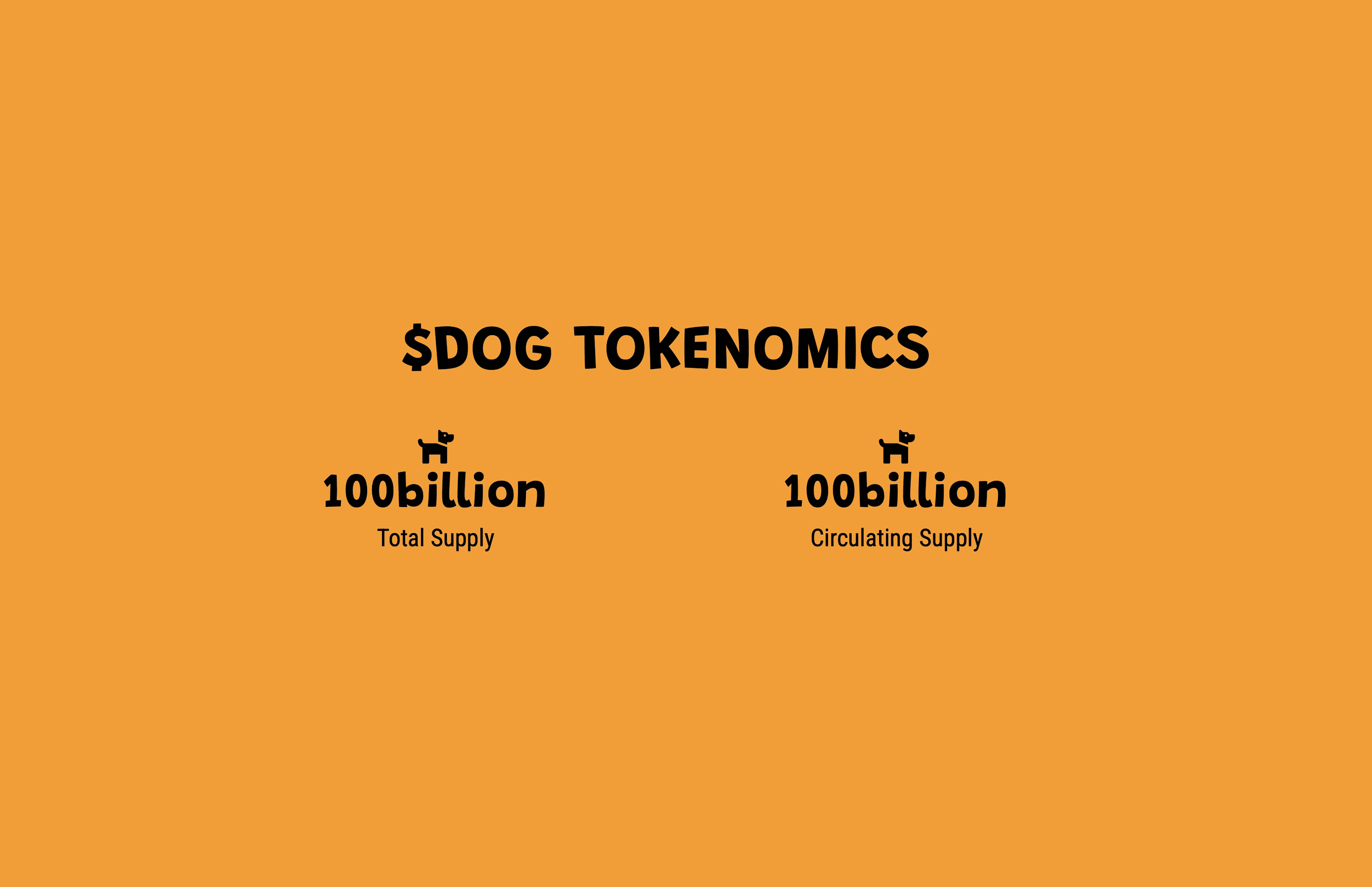
DOG etched on the same block that triggered Bitcoin's fourth halving, securing the third-ever Rune, and the entire 100 billion supply went out as a single airdrop: no presale, no team allocation.
By the project's own account, DOG reached a market capitalization of roughly $500 million within 24 hours of launch. External trackers put its June 2024 peak closer to $1 billion.
In December 2024, the project rebranded from its original etched name, "DOG•GO•TO•THE•MOON," to the simpler "Dog (Bitcoin)," explicitly to make the project more approachable for newcomers unfamiliar with Runes or Ordinals.
Dogecoin (DOGE), Explained
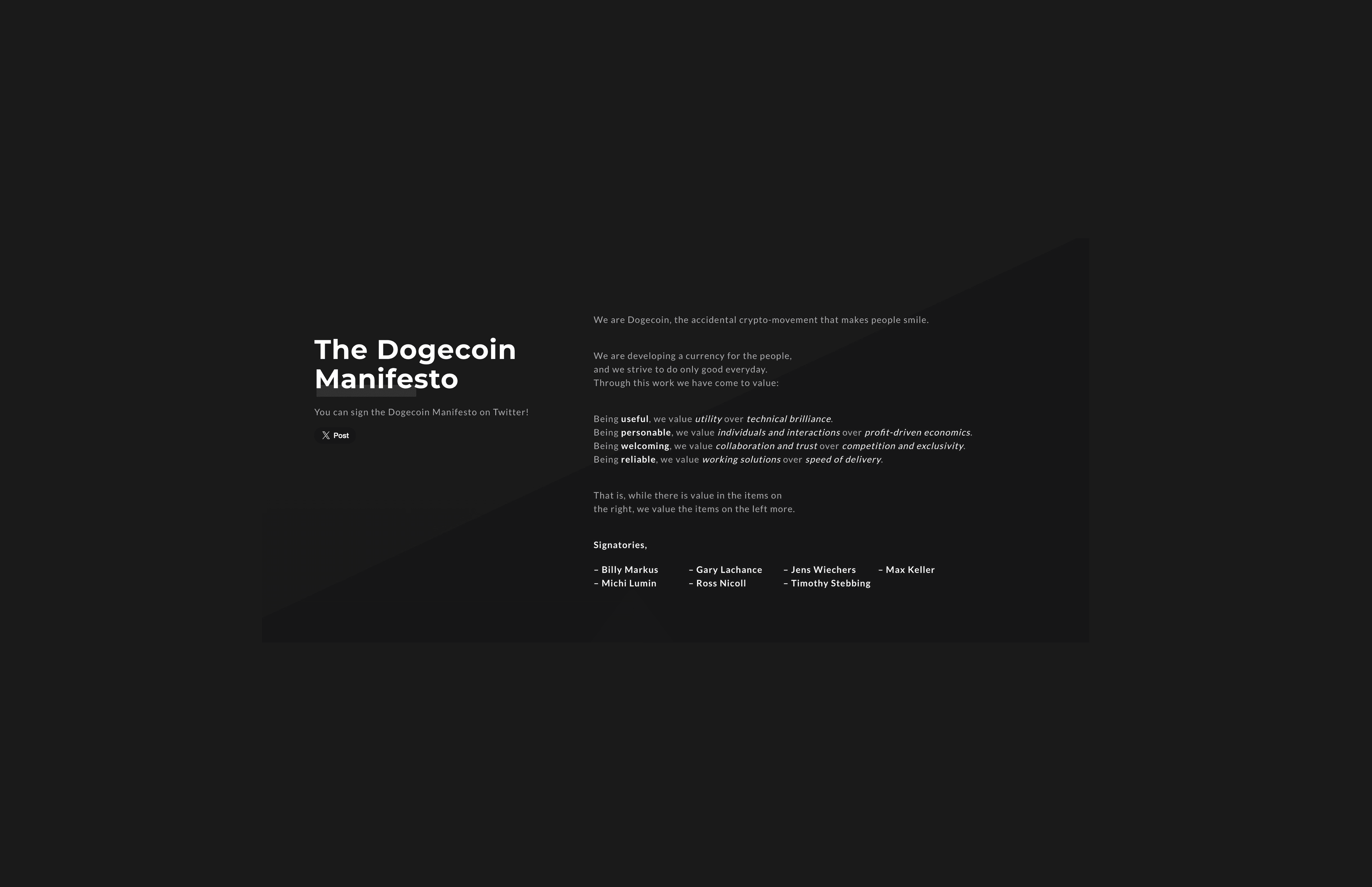
Dogecoin needs less introduction: Created in a few hours in December 2013 by Billy Markus and Jackson Palmer as a parody of Bitcoin's hype-driven mania.
Codebase: Built by forking Litecoin, and merge-mined with Litecoin since 2014.
Supply: Mints roughly 5 billion new DOGE a year, with no maximum cap.
Governance: Steered by the Dogecoin Foundation, a nonprofit whose advisory board has included both founders, Vitalik Buterin, and a representative for Elon Musk's family office.
If you're curious how DOG stacks up against another major meme contender outside the Dogecoin comparison, see how it fares against PEPE.
Is DOG connected to DOGE? Two Different Launches
Dogecoin holds roughly a $11.18B market cap which dwarfs DOG's ~$59.84M, a gap of nearly 187x. Dogecoin has roughly 2.75 million addresses holding at least $1 worth of DOGE, versus DOG's roughly 86,000 known Bitcoin holders.
Both projects describe themselves as fair launches, and both avoided the presale-and-VC-allocation model that defines most token launches. Both are seperate.
DOG (Bitcoin)
Total supply: 100,000,000,000 DOG (one hundred billion) fixed, one-time
Distribution: 100% premined and airdropped in a single event at block 840,000 (April 20, 2024)
Ongoing issuance: None. Supply is closed, no more DOG will ever be created
Built on Bitcoin: DOG exists as a Rune, a token standard built directly into Bitcoin's own transaction structure. There is no separate app, company, or blockchain required, so it lasts exactly as long as Bitcoin does.
Dogecoin (DOGE)
Circulating supply: ~170.69 billion DOGE and counting
Distribution: No premine, no ICO always mined publicly since December 2013
Ongoing issuance: ~5 billion new DOGE minted every year, indefinitely
Inflation rate: ~3.1% annually (2025), declining toward ~2% by 2050
Are DOG and Dogecoin Related?
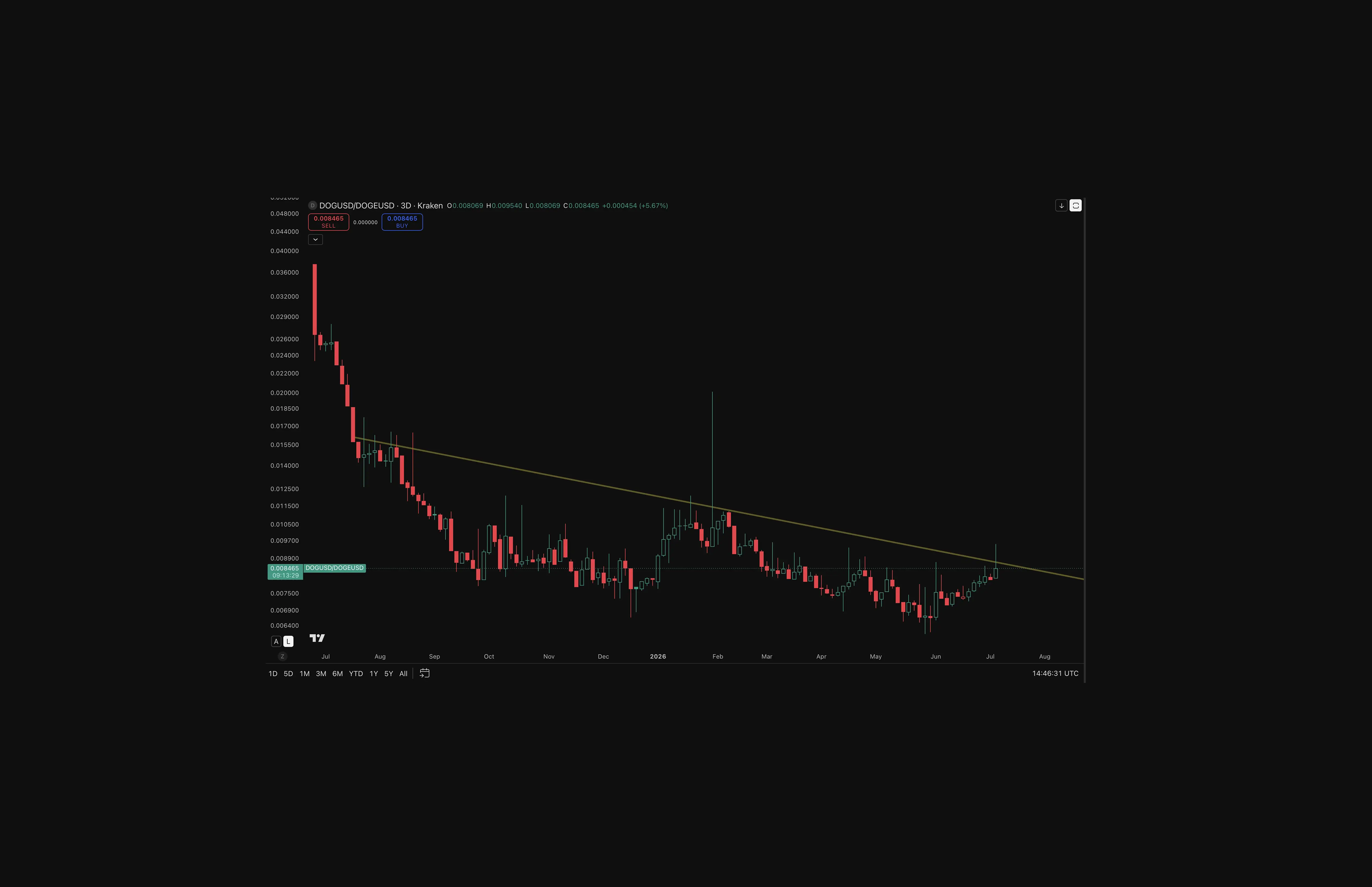
No structural relation: DOG sits inside Bitcoin's own Runes token standard, while Dogecoin runs as its own independent Layer 1 blockchain. The only thing they share is proof-of-work mining and the word "dog."
Head to head
DOG (Bitcoin) | Dogecoin (DOGE) | |
Price (July 8, 2026) | ~$0.000604 | ~$0.0721 |
Market cap | ~$60.4M | ~$11.18B |
Supply | 100B, fixed and fully circulating | ~170.7B and rising forever |
Max supply | 100B, hard cap | None |
Inflation | 0% | ~2.93% per year |
Native blockchain | None, settles on Bitcoin L1 | Own chain |
Consensus | Bitcoin's SHA-256 proof-of-work | Scrypt proof-of-work, merge-mined with Litecoin |
Leadership | Pseudonymous, no formal organisation | Dogecoin Foundation (nonprofit) |
ETF access | None | REX-Osprey DOJE (Sept 18, 2025), 21Shares TDOG (Jan 22, 2026) |
Regulatory status | None | Classified a digital commodity by SEC/CFTC, March 17, 2026 (effective March 23, 2026) |
DOG vs DOGE: Consensus and Security
DOG doesn't run its own consensus mechanism. It settles through Bitcoin's SHA-256 proof-of-work, inheriting the security budget of the largest hash rate in the industry, the same finality as any BTC transaction.
Dogecoin secures its own chain using Scrypt proof-of-work, merge-mined with Litecoin since 2014, which lets Litecoin miners mine DOGE blocks at effectively no extra cost.
That relationship has kept Dogecoin's hash rate substantial, but its security is borrowed from Litecoin's miner base rather than fully independent, worth knowing rather than assuming either way.
Is DOG (Bitcoin) Really Rug-Proof? What the On-Chain Data Shows
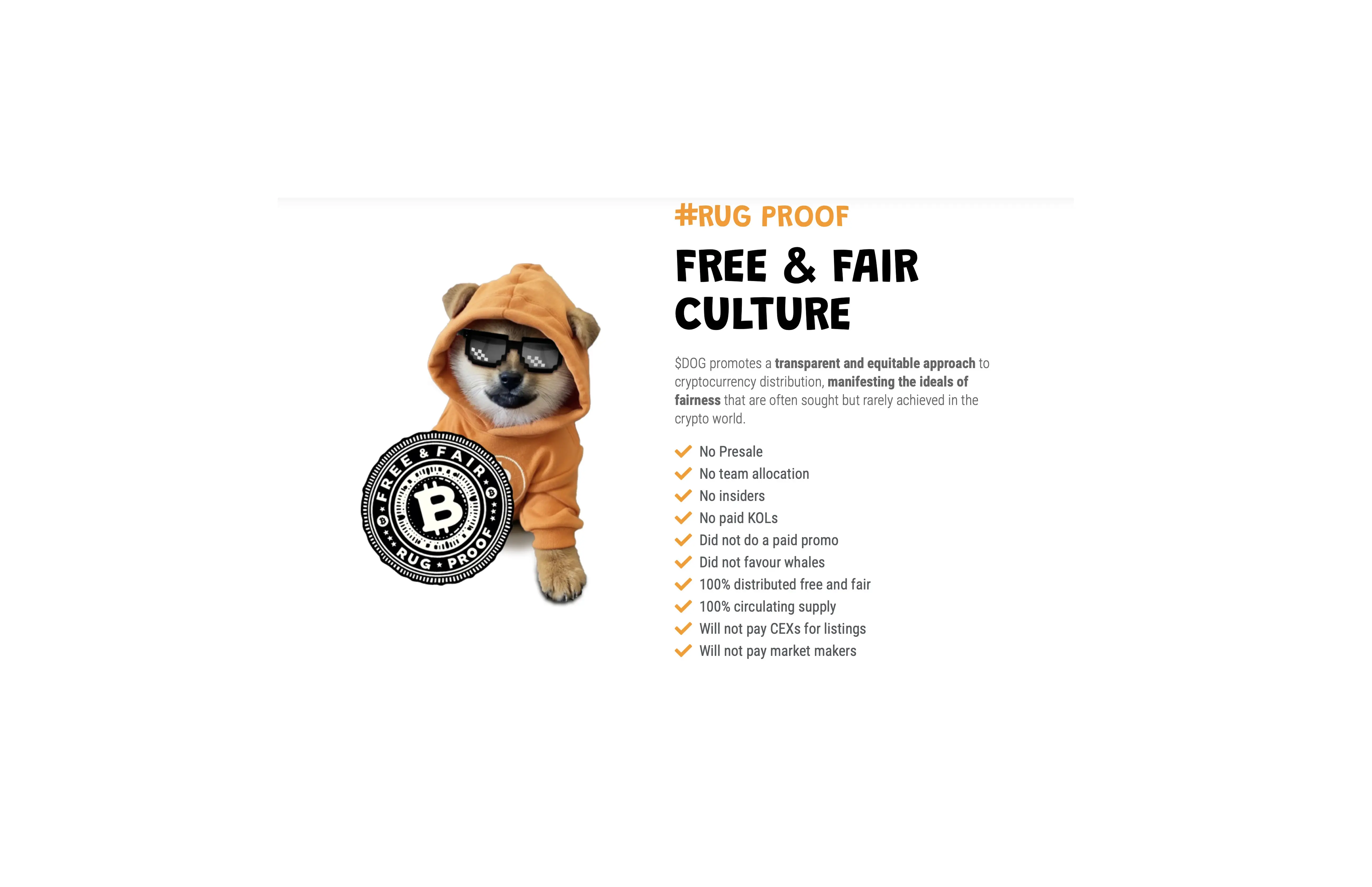
DOG's own marketing is unusually specific about its launch ethics: no presale, no team allocation, no insiders, no paid influencers, and it states plainly that it "did not favour whales."
That claim holds up for the airdrop mechanism itself, which genuinely had no reserved allocation for anyone.
It's worth separating that from a different fact: on-chain holder data for DOG's Solana-bridged version currently shows one wallet holding roughly 97.6% of tracked supply.
Nearly 90,000 different wallets hold DOG on Bitcoin, and the top 5 of them together own about a quarter of all the coins ever made. The single biggest holder alone controls just over 1 in every 10 DOG in existence. It's not known publicly who's actually behind that top wallet, it could be an exchange, an early holder, or something else entirely.
Listings and Institutional Access
Dogecoin has two U.S.-listed ETFs and, as of March 2026, formal digital commodity classification from the SEC and CFTC.
DOG has none of that.
DOG's current official buying venues span Kraken and others.
Why Some Bitcoiners Hold DOG (Bitcoin): Thesis, Not a Prediction
The actual thesis some Bitcoin-native holders give:
Bitcoin-native settlement: exposure without trusting a second chain's security model
Fixed, already fully-circulating supply: no future unlock schedule to model
A one-time fair distribution: no VC allocation, no presale, ever
Direct exposure to Runes: Bitcoin's own answer to token standards, rather than a Solana or Ethereum meme
A different risk thesis entirely: inheriting Bitcoin's security budget rather than a smaller chain's
Fee revenue for miners: Runes activity generates real transaction fees paid directly to Bitcoin miners. A way to keep miner income growing as the block subsidy keeps halving every four years.
The Other Side: Risks to Weigh
No revenue, no backing: DOG has no protocol, business, or cash flow behind it. Its value rests entirely on community belief, the same as any memecoin.
Concentration risk: the top five wallets alone hold roughly a quarter of all DOG on Bitcoin, meaning a small number of holders could move the price meaningfully.
Thin, young liquidity: limited trading history means sharp price swings are common.
The miner-fee argument cuts both ways: higher fees for miners also mean higher costs for everyday Bitcoin payments, a debate that's been running in the Bitcoin community since the original Ordinals inscription boom.
Permanent mistakes: a broken transaction burns the tokens involved outright, with no way to reverse it.
Copycat risk: open etching access means look-alike Rune names can be created to impersonate established tokens like DOG itself.
DOG (Bitcoin) and Dogecoin are both highly volatile assets with materially different risk profiles. Do your own research, and verify any bridge or custody claims independently before trading either.
Takeaway
DOG and Dogecoin end up asking different questions entirely. Dogecoin asks whether a community can turn a deliberately inflationary internet joke into a lasting currency, propped up by a decade of mining, memes, and now regulatory recognition. DOG asks whether Bitcoin's newest token standard can produce an enduring asset without changing a single one of Bitcoin's own monetary rules.
They aren't competing versions of the same idea but two different experiments that happen to share a mascot.
If fixed-supply, no-leverage thinking is what draws you to DOG's side of that argument, that same discipline is the whole premise behind How to Trade Without Leverage, $19.99 on Gumroad. And if you want to keep tracking how DOG and other Bitcoin-native assets are trading, that's exactly what we break down weekly for PRO subscribers.
FAQ
Are DOG (Bitcoin) and Dogecoin related in terms of technology or structure?
No. DOG (Bitcoin) is a Rune token that settles on Bitcoin Layer 1, while Dogecoin is its own independent Layer 1 blockchain. They only share proof-of-work mining and a dog mascot.
How was DOG (Bitcoin) launched and distributed?
DOG has a fixed total supply of 100 billion tokens, all premined and airdropped in a single event at Bitcoin block 840,000 on April 20, 2024. There was no presale, no team allocation, and no ongoing issuance.
How does Dogecoin’s supply and inflation work?
Dogecoin has no maximum cap, with roughly 5 billion new DOGE minted every year. Its inflation rate is about 3.1% annually in 2025, declining toward around 2% by 2050.
What are key security and consensus differences between DOG (Bitcoin) and Dogecoin?
DOG (Bitcoin) does not run its own consensus mechanism and instead inherits Bitcoin’s SHA-256 proof-of-work security. Dogecoin secures its own chain using Scrypt proof-of-work and has been merge-mined with Litecoin since 2014, effectively borrowing security from Litecoin’s miner base.
Disclaimer
The information provided in this article is for informational purposes only. It is not intended to be, nor should it be construed as, financial advice. We do not make any warranties regarding the completeness, reliability, or accuracy of this information. All investments involve risk, and past performance does not guarantee future results. We recommend consulting a financial advisor before making any investment decisions.
More like this
Written by

Andrew Kamsky
Andrew Kamsky is a Bitcoin analyst. He spent a decade in traditional finance across a Big Four firm and a listed fintech bank before going deep on Bitcoin full-time.