









Quick summary
Bitcoin bounces to 63,652 dollars with steady ETF inflows, Ether ETFs see outflows
Market positioning shows rising Bitcoin futures interest, low volatility and stable institutional DeFi collateral
Coldcard hardware wallet bug enables predictable keys, causing 100M dollars plus confirmed Bitcoin theft
FBI counterintelligence agent allegedly stole over 1M dollars in crypto using seized private keys
Today's market is telling us capital is consolidating into Bitcoin while trust keeps cracking everywhere else.
Bitcoin is trading at $63,652, up a modest 0.31% from Monday's close, after bouncing roughly 1.8% off an intraday low of $62,520. Read the chart alone and today looks like a quiet stabilization after four days of grinding lower and self-custody uncertainty. Underneath it, a widening ETF gap opened between Bitcoin and Ether, BlackRock rolled out two new tokenized cash products built for stablecoin reserves, and a senior FBI counterintelligence agent walked into headquarters to confess he'd been draining crypto wallets from his own investigations.
Bitcoin's Relief Bounce Is Real, But the ETF Math Explains Why It's Bitcoin Doing the Bouncing and Not Ether
The rebound looks clean on a chart. The flows underneath it explain why Bitcoin caught the bid and Ether didn't.
The bounce: BTC is up 0.31% from Monday's close of $63,455 to $63,652, a modest gain after four red days that had pushed price as low as $62,520 in early trading, a roughly 1.8% recovery off that low. Bitcoin sits 49.5% below its all-time high.
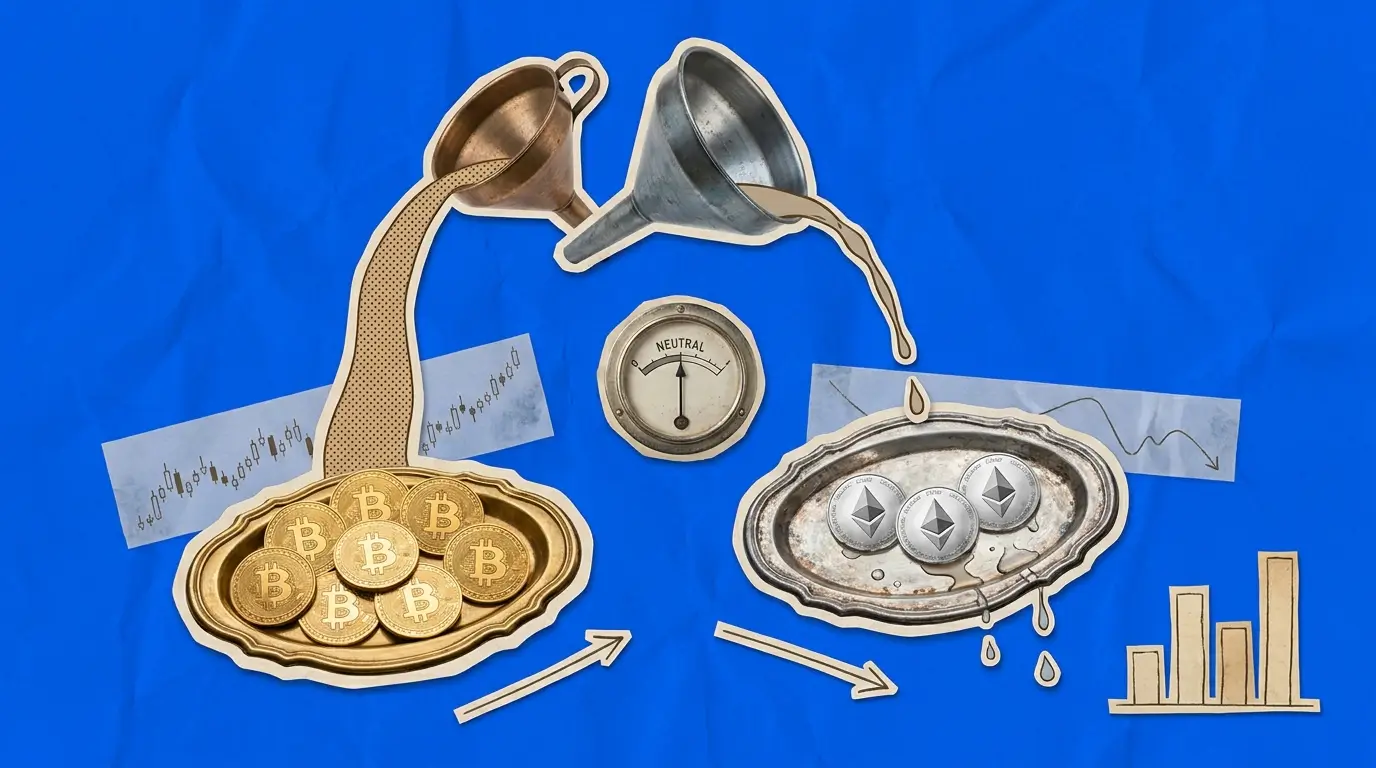
The flow split: spot Bitcoin ETFs pulled in $170.1M on August 3 while spot Ether ETFs bled $11.9M in the same session. The pattern has held for weeks now: Bitcoin's ETF inflows stay consistent, Ether's swing in and out with no conviction.
The positioning: Bitcoin futures open interest climbed to 772K BTC, a one-month high, with funding rates running +4% annualized, a moderate bullish lean rather than crowded leverage. Bitcoin's options volatility index (BVIV) sits at 37%, showing no fear premium building.
The institutional core: lending, liquid-staking and RWA protocols, the closest thing DeFi has to institutional collateral, held roughly steady at $101.58B combined, close to the $101.11B first reported. A previously circulated claim that this represents 21.4% of a $229.4B non-CEX DeFi market does not hold up: combined DeFi TVL currently reads closer to $112.7B, not $229.4B, so that share figure is dropped here pending a reconciled denominator rather than published as fact.
The complication: not every institutional signal points the same way. Bitmine Immersion, the largest Ethereum treasury company, bought 10,399 ETH (~$19.1M) last week and has staked roughly 4.9M of its 5.8M ETH holdings, about 85%. The same day, Strategy disclosed selling another 1,638 BTC (~$105M). The ETF flows say Bitcoin; the two largest treasury companies say something messier.
The plumbing: BlackRock launched two blockchain-based money-market products, BSTBL (a tokenized share class on Ethereum, with BNY Mellon as transfer agent) and BRSRV (a multi-chain fund with daily dividend reinvestment, using Securitize as transfer agent and tokenization provider), both designed to qualify as reserve assets under the GENIUS Act.
What's next: Friday's CPI print is the binary event this bounce is pre-positioning for. A soft print weakens the dollar and extends the relief toward $65K; a hot print does the opposite and re-tests $60–62K, where open interest is already crowded enough that a liquidation cascade becomes possible.
Custody Failures Are Multiplying, and the Newest One Wore an FBI Badge
A five-year-old firmware bug and a federal agent with top-secret clearance failed the same test this week, just from opposite directions.
The hack, confirmed count: the Coldcard hardware-wallet exploit, a firmware flaw that let affected devices generate predictable, non-random keys, is confirmed at $100M+ across 1,596 BTC and roughly 7,300 addresses spanning three verified waves, per Galaxy Research data cited by Cointelegraph on August 4. A fourth wave that could push the total toward $130M has not been confirmed by Galaxy, which is still working through victim reports.
The market's shrug: despite the dollar figure climbing, Bitcoin's options market shows zero stress, BVIV flat at 37%, no hedging demand, no fear premium. On-chain, Bitcoin's Adaptive Sell-side Risk Ratio has fallen to accumulation-phase territory per CryptoQuant, the market is treating this as a self-custody event, not a systemic one.
The insider case: an FBI supervisory special agent with top-secret clearance working counterintelligence at FBI headquarters was arrested July 31 for allegedly stealing more than $1M in crypto from wallets belonging to foreign individuals his own unit was investigating. He allegedly used his access to FBI systems to extract private keys and made as many as a dozen transfers to himself, then routed the funds through Kraken and Suilend, a DeFi lending protocol on the Sui blockchain. Most reporting (NBC, Bloomberg Law, Decrypt, KCRA) names him Patrick Yaroch; (CoinDesk's coverage spells it Yarmoch).
The unravel: the agent walked into the FBI himself to disclose what he'd done, before being suspended, fired and arrested. Investigators found AI chat logs asking how to move $1M to Europe and which app worked best in Portugal, alongside unreported trips to Germany, Portugal and Grenada and family travel already booked to Portugal for next month. He's now in detention in Alexandria, Virginia.
The through-line: Coldcard's flaw meant a device could generate a compromised key without a human ever needing to make a mistake. The FBI case is the opposite failure, a human with legitimate access needing no device flaw at all. Different mechanisms, same lesson: custody risk isn't only about who holds the keys, it's about everyone and everything upstream of them.
The smaller bright spot: amid the custody noise, a solo miner reportedly struck block 960,804 early Monday for a 3.157 BTC reward (~$199,300). This figure comes from a single unverified report; no independent confirmation was found either way.
The Lesson
Custody risk doesn't stay in one lane. This week it hit a five-year-old hardware wallet and a federal agent with top-secret clearance, two completely different trust models, the same underlying failure. The question worth asking isn't just "who holds my keys," it's "who else has access to the systems that touch my keys."
Coinjuice Lens: Self-Custody
This extends the framework from Coinjuice's self-custody guide: holding your own keys only reduces risk if everything upstream of that key, the device, the firmware, and apparently the institutions meant to police crypto crime, can also be trusted. The Coldcard flaw and the FBI case are structurally different failures, but they land on the same lesson this Pulse flagged after July 31's Coldcard coverage: custody is a chain, and a chain is only as strong as its least-verified link.
A week where trust breaks at the device layer and the institutional layer at the same time is exactly the setup the Coinjuice ebook, How to Trade Bitcoin and Altcoins Without Leverage was built for: buying fear and selling recovery, no leverage, no indicators, no guesswork. For trade setups behind pieces like this one, see Coinjuice pricing.
News Behind Today's Pulse
Bitcoin (BTC), ether (ETH) prices decline as Coldcard exploit enters a fifth day (CoinDesk, Aug 3, 2026) — original source for BTC open interest (772K), funding rates (+4%), and BVIV (37%) readings; its Coldcard loss figure has since been superseded by same-day Cointelegraph reporting.
Coldcard Bitcoin Theft Tops $100M Across 3 Waves (Cointelegraph, Aug 4, 2026) — source for the corrected Coldcard figures: $100M+ confirmed, 1,596 BTC, ~7,300 addresses, three verified waves, with a fourth wave unconfirmed pending victim reports.
Spot Bitcoin ETFs pull in $170M while Ether ETFs bleed $11M in a single session (CryptoBriefing, Aug 4, 2026) — source for the ETF inflow/outflow divergence; cross-checked against warehouse data ($170.1M / −$11.9M).
FBI insider-theft case — majority-source basis for the agent's name (Yaroch), used alongside CoinDesk (Yarmoch):
Feds charge FBI agent they say stole nearly one million in Crypto from Russia (NBC News)
FBI Agent Allegedly Turns Himself in for $1 Million Crypto Theft (Bloomberg Law)
FBI agent accused of stealing nearly $1 million in cryptocurrency (KCRA)
U.S. FBI intelligence agent arrested in connection with theft of $1 million in crypto (CoinDesk — spells it Yarmoch)
U.S.-Japan intervention revives yen carry trade fears for bitcoin (CoinDesk, Aug 3, 2026) — source for the USD/JPY intervention level and Bitcoin's -0.90 correlation with the yen.
Market Snapshot
Metric | Value |
Bitcoin (BTC) | $63,652 (+0.31% vs. Monday's $63,455 close; −49.5% from ATH) |
Bitcoin intraday low | $62,520 (BTC recovered ~1.8% off this low to current price) |
Ethereum (ETH) | $1,867 (+0.22% vs. prior close; −62.3% from ATH) |
ETH/BTC ratio | 0.0292 |
Solana (SOL) | $73.84 (−74.8% from ATH) |
XRP | $1.079 (−70.4% from ATH) |
BNB | $591.61 (−56.9% from ATH) |
Bitcoin ETF inflows (Aug 3) | $170.1M |
Ethereum ETF outflows (Aug 3) | −$11.9M |
BTC futures open interest | 772K BTC (1-month high) |
BTC funding rate (annualized) | +4% |
Bitcoin options volatility (BVIV) | 37% |
Institutional core TVL (Lending + LS + RWA) | $101.58B; "% of total DeFi" figure withdrawn, see note below |
Coldcard hack, confirmed | $100M+ (1,596 BTC, ~7,300 addresses, 3 verified waves) |
Coldcard hack, unconfirmed 4th wave | Could reach ~$130M total; not yet confirmed by Galaxy Research |
Bitmine ETH purchase (last week) | 10,399 ETH (~$19.1M) |
Bitmine total ETH holdings | ~5.8M ETH (~4.8% of supply); ~4.9M ETH staked (~85%) |
Strategy BTC sale (same session) | 1,638 BTC (~$105M) |
Solo miner reward, block 960,804 | 3.157 BTC (~$199,300) — single-source, unverified |
FAQ
Why did Bitcoin bounce while Ether lagged?
Bitcoin bounced because spot Bitcoin ETFs pulled in $170.1M on August 3, showing consistent inflows, while spot Ether ETFs saw $11.9M of outflows and have been swinging in and out with no conviction.
What is the scope of the Coldcard hardware-wallet exploit?
The Coldcard exploit, a firmware flaw that let devices generate predictable, non-random keys, is confirmed at over $100M in losses across 1,596 BTC and roughly 7,300 addresses over three verified waves, with a possible fourth wave that could push the total toward $130M still unconfirmed.
What is the main custody lesson highlighted by the Coldcard hack and the FBI agent case?
Both events show that custody risk extends beyond who holds the keys to everyone and everything upstream of them, reinforcing that custody is a chain only as strong as its least-verified link.
What new blockchain-based products did BlackRock launch and what are they designed for?
BlackRock launched BSTBL, a tokenized share class on Ethereum with BNY Mellon as transfer agent, and BRSRV, a multi-chain fund using Securitize as transfer agent and tokenization provider; both are designed to qualify as reserve assets under the GENIUS Act and are built for stablecoin reserves.
Disclaimer
The information provided in this article is for informational purposes only. It is not intended to be, nor should it be construed as, financial advice. We do not make any warranties regarding the completeness, reliability, or accuracy of this information. All investments involve risk, and past performance does not guarantee future results. We recommend consulting a financial advisor before making any investment decisions.
More like this

Written by

Andrew Kamsky
Andrew Kamsky is a Bitcoin analyst. He spent a decade in traditional finance across a Big Four firm and a listed fintech bank before going deep on Bitcoin full-time.