










Quick summary
Bitcoin is not a direct hedge against AI disruption, but a potential policy response play
Research shows Bitcoin’s value proposition centers on fixed, slowing supply versus expanding fiat money
Bitcoin can't protect jobs or company competitiveness from AI, only a possible hedge against monetary expansion, and even this is conditional
Recent data shows Bitcoin fell while gold and stocks rose during an AI focused, tight policy year
Does Bitcoin protect investors from AI disruption? Current evidence suggests it does not protect them from the technology itself. The stronger case is that Bitcoin may benefit from how governments and central banks respond.
The argument sounds simple. AI takes jobs, governments create more money to soften the economic damage, and Bitcoin gains because nobody can expand its supply. Yet every step in that chain depends on what happens next. To test the claim, this article compares academic research, market commentary and Bitcoin’s recent performance. The evidence points to a conditional answer: Bitcoin resembles a bet on future monetary easing rather than direct protection from AI.
The Case for Bitcoin as an AI Hedge
The bullish argument arrives from two directions that get treated as one. Separating them is worth doing, because they reach a similar destination by different roads and carry different weight.
Visser’s double debasement: Fund manager Jordi Visser argues in The Age of Abundant Intelligence and Scarce Bitcoin that investors could face pressure from two directions. Government money creation can reduce the purchasing power of currency, while widely available AI can help competitors copy the products and services that once made individual companies valuable.
Why Bitcoin enters the argument: Currency depends on governments limiting how much currency they create. Company shares depend partly on businesses protecting company advantages from competitors. Bitcoin depends on neither, because no company controls the network and its supply cannot be increased beyond the rules built into the Bitcoin protocol.
This remains an opinion: Visser calls these two pressures double debasement. The idea offers one explanation for why investors might choose Bitcoin, but academic research has not tested whether AI causes money to move from currencies and company shares into Bitcoin.
The academic support comes from elsewhere and reaches a narrower conclusion.
Morillon’s position against monetary expansion: In Bitcoin’s Value Proposition: Shorting Expansionary Monetary Policies, Thibaut Morillon argues that part of Bitcoin’s value may come from giving investors a position against continued monetary expansion.
What the comparison rests on: Bitcoin’s supply growth is known ahead of time and slows after each halving. Morillon compares that schedule with the growth of broad money supplies during the decade ending in 2020.
Currency | Issuing economy | Supply being compared | Finding through 2020 |
US dollar | United States | Broad money supply against Bitcoin supply | Dollar supply grew faster |
Euro | Euro area | Broad money supply against Bitcoin supply | Euro supply grew faster |
British pound | United Kingdom | Broad money supply against Bitcoin supply | Pound supply grew faster |
Japanese yen | Japan | Broad money supply against Bitcoin supply | Yen supply grew faster |
Chinese yuan | China | Broad money supply against Bitcoin supply | Yuan supply grew faster |
Bitcoin | Global network | Circulating Bitcoin supply | Supply growth slowed after each halving |
What grew faster than what: Between 2011 and 2020, the total supply of each national currency examined grew faster than Bitcoin’s circulating supply. Central banks added money to their economies, while Bitcoin’s rules reduced the rate of new coin creation after each halving.
Why the difference matters: If demand remains present, an asset whose supply grows more slowly may become scarcer relative to currencies whose supply grows more quickly. This difference forms the mechanical basis of Morillon’s argument.
What this does not prove: Slower supply growth does not automatically make Bitcoin more valuable. Bitcoin’s price still depends on demand, while money supply growth alone does not reveal what happened to purchasing power or exchange rates.
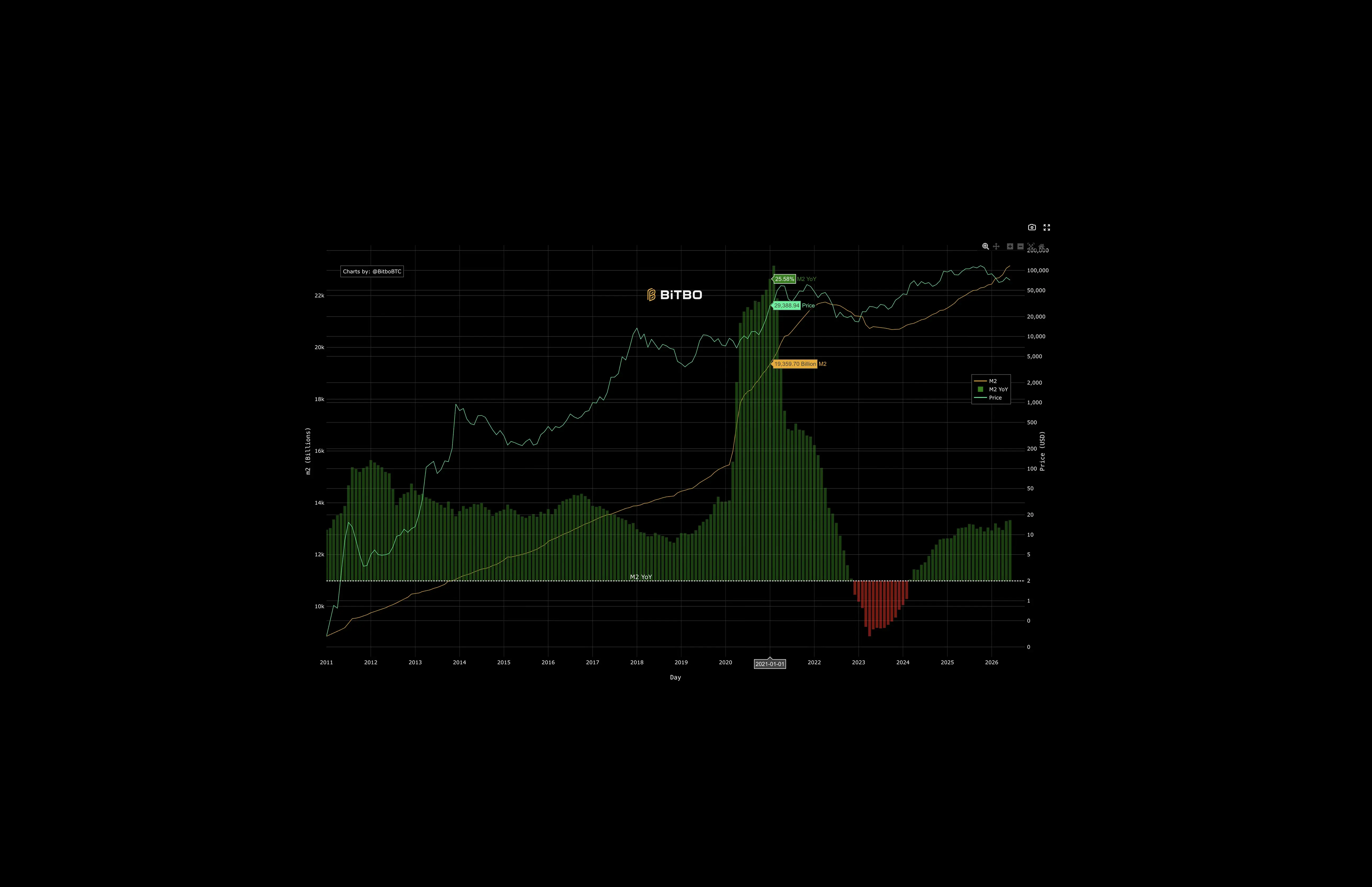
Where the argument stops: Morillon’s conclusion is conditional. Bitcoin may benefit if monetary expansion continues, but the paper does not establish that Bitcoin is protected from every form of economic pressure.
He did not study AI: The paper does not examine artificial intelligence. Applying Morillon’s monetary argument to a government response caused by AI disruption is an extension, not the author's finding.
What Would Bitcoin Actually Be Hedging?
AI risk often gets treated as a single threat, even though it can affect investors in several different ways. Bitcoin’s fixed supply directly addresses only one: the risk that governments respond by creating more money. Separating these risks shows what holding Bitcoin may protect against and what it cannot.
Losing work to software: Bitcoin’s fixed supply cannot protect someone’s income or employment. Its rules control how many bitcoins can be created, not whether AI could make money obsolete or replace someone’s job. Buying Bitcoin therefore does not remove the financial risk of losing work to AI automation.
The official response to job losses: This is the risk Bitcoin’s supply rules address most directly. If AI related unemployment leads governments and central banks to spend more, create more money or change interest rates and monetary policy, Bitcoin’s supply rules would remain unchanged while the amount of government money could increase. For a Bitcoin holder, that policy response may matter more than the job losses themselves.
Companies losing their edge: Bitcoin does not face the risk of competitors copying its products or services because the Bitcoin protocol is not a company.
Two limits apply when treating Bitcoin as protection against AI disruption:
Bitcoin’s fixed supply does not prevent the price from falling: The supply rules limit how many bitcoins can exist, but they do not guarantee a minimum price or continued demand.
Slow risk and fast risk are separate problems: The effects discussed above may develop over several years. AI controlled trading could affect Bitcoin within a single trading session, although no evidence reviewed here shows that an AI agent has caused a live Bitcoin crash. Coinjuice examined that separate risk in what research shows about AI trading bots and Bitcoin flash crashes.
Whether the money itself is being diluted or replaced is a further question again, and readers weighing the scarcity argument will find that side of it in our look at whether AI makes money obsolete or simply moves scarcity elsewhere.
The Safe Haven Problem
Using daily data from August 2010 to February 2018, Luis de la Horra, Gabriel de la Fuente and Javier Perote examined what drove Bitcoin demand in The Drivers of Bitcoin Demand: A Short and Long Run Analysis. They found:
Bitcoin did not behave like a safe haven: When gold rose, demand for Bitcoin tended not to rise with it. The authors therefore found no evidence that investors bought Bitcoin for protection when traditional markets were under pressure.
Short term demand appeared speculative: Changes in volatility influenced demand over shorter periods, suggesting that traders were reacting to price movements. Coinjuice explains how traders interpret these movements in How to Start Trading in 2026.
Long term demand had a different explanation: The authors suggest that investors may have valued what Bitcoin could eventually become as a payment method rather than how widely BTC was already being used.
The evidence is dated and incomplete: The sample ends on 28 February 2018, when Bitcoin traded near $10,398. It therefore misses the remainder of the 2018 bear market, including Bitcoin’s fall toward $3,200 that December. It also predates spot Bitcoin ETFs, major corporate holdings and today’s institutional market, so its findings cannot settle whether Bitcoin behaves as protection in 2026.
What Bitcoin Has Done To Date
Since the academic evidence stops in 2018, recent behaviour has to be checked separately. The year to August 2026 is a useful window, because AI capital spending, AI job anxiety and AI concentration in equity markets ran through all of it. All figures below are point to point price changes.
Bitcoin fell hard: Bitcoin traded around $63,500 on 13 August 2026, roughly 47 per cent below its level a year earlier, and near half its October 2025 high of about $126,000.
Gold rose to records: Gold traded around $4,400 per ounce on 12 August 2026, roughly 31 per cent higher than a year earlier.
Shares rose too: The S&P 500 closed at 7,748.50 on 12 August 2026, finishing well above its level a year earlier.
Policy stayed tight throughout: The Federal Reserve held its target range at 3.50 to 3.75 per cent on 29 July 2026 on a 9 to 3 vote, with dissenting members preferring an increase.
The reading matters more than the numbers. Across a year defined by AI market themes, gold rose while Bitcoin fell, and shares rose alongside gold. Anyone holding Bitcoin as AI insurance was not paid for that view during the period when the risk was most visible.
Two limits keep this comparison in perspective.
This is performance, not correlation: These figures show what each asset did over the same stretch. They do not measure how Bitcoin moves against shares day to day, which is a separate calculation.
Timing does not prove causation: Bitcoin declined during a year when AI shares rose, but tighter policy, energy prices and Middle East conflict were also affecting markets.
Readers weighing Bitcoin against owning the AI buildout directly will find that comparison in Bitcoin versus AI stocks in 2026.
Is Bitcoin an AI Hedge, a Policy Hedge or Both?
Bitcoin does not appear to protect investors from AI disruption directly. The stronger argument is that it could benefit from the government and central bank response.
An AI hedge remains unsupported: Bitcoin would need to gain value when AI causes job losses, weakens companies or damages the economy.
A policy hedge is more plausible: If officials respond to AI disruption by cutting interest rates or creating more money, Bitcoin’s fixed supply may become more attractive.
The evidence remains incomplete: Morillon studied monetary expansion rather than AI. Visser presents an argument rather than a tested finding. The de la Horra study found no evidence that investors bought Bitcoin for protection during its sample period.
What might happen: Bitcoin could fall with shares when an AI shock first hits, then recover if central banks cut interest rates or add more money to the economy. No study has recorded that full chain of events.
What has happened so far: Bitcoin fell while interest rates remained high. Central banks have not yet responded with lower rates or more money, so we cannot know whether Bitcoin would benefit from that response.
Bitcoin therefore looks more like a possible hedge against the policy response to AI than protection from AI itself.
Conclusion
Bitcoin is not automatically an AI hedge. Its fixed supply may make it attractive when AI disruption produces monetary expansion, but a productivity boom could keep interest rates higher than inflation, making assets that pay interest more attractive and creating the opposite pressure on Bitcoin.
The recent record sharpens that rather than softening it. Through the year in which AI dominated markets, Bitcoin fell while gold and shares rose, which is one window during a tightening cycle and not a permanent verdict.
That leaves a clear answer to the question this article set out to test. Bitcoin does not directly hedge AI disruption, but it may benefit if that disruption eventually produces monetary easing.
Readers looking to trade these tricky market conditions without using leverage can continue with the Coinjuice ebook, Bitcoin Trading Without Leverage. A yearly Coinjuice member receives the book at no additional cost.
FAQ
Does Bitcoin currently protect investors directly from AI disruption?
No. Bitcoin does not appear to protect investors directly from AI disruption such as job losses, weaker companies, or broader economic damage caused by AI.
What risk related to AI does Bitcoin’s fixed supply address most directly?
Bitcoin’s fixed supply most directly addresses the risk that governments and central banks respond to AI-related unemployment or disruption by creating more money or easing monetary policy.
What did research on Bitcoin demand up to early 2018 conclude about its safe haven role?
Using data from August 2010 to February 2018, researchers found no evidence that investors bought Bitcoin as a safe haven, because Bitcoin demand did not tend to rise when gold rose and short-term demand appeared speculative.
How did Bitcoin, gold, and shares perform in the AI-focused year to August 2026?
Over that year, Bitcoin fell sharply to about $63,500, roughly 47% below its level a year earlier, while gold rose around 31% to record highs and the S&P 500 finished well above its level a year earlier, during a period when monetary policy remained tight.
Disclaimer
The information provided in this article is for informational purposes only. It is not intended to be, nor should it be construed as, financial advice. We do not make any warranties regarding the completeness, reliability, or accuracy of this information. All investments involve risk, and past performance does not guarantee future results. We recommend consulting a financial advisor before making any investment decisions.
More like this



Written by

Andrew Kamsky
Andrew Kamsky is a Bitcoin analyst. He spent a decade in traditional finance across a Big Four firm and a listed fintech bank before going deep on Bitcoin full-time.