









Quick summary
Bitcoin trades near $65,675, slightly down amid Iran strikes, oil spike, regulatory delays
BTC stuck in range as markets await Iran de-escalation, Clarity Act, and FOMC outcome
AI advances, including Claude aiding Jacobian conjecture work, increasingly attract speculative capital over Bitcoin
Institutional money now weighs AI compute alongside TradFi, CeFi, DeFi, challenging Bitcoin’s hedge narrative
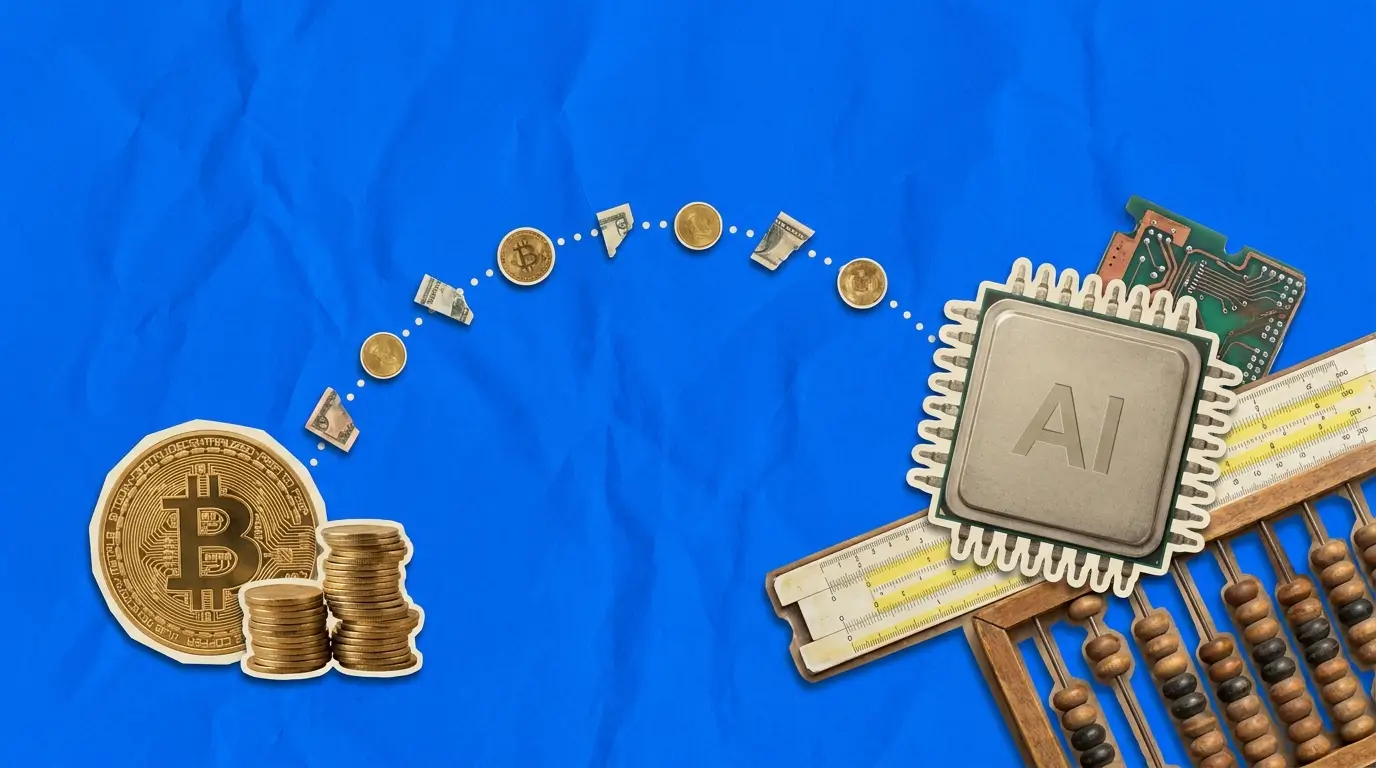
Today's market is telling us Bitcoin's real competition isn't the Fed or Iran, it's AI's capital gravity.
Bitcoin sits at $65,674.75, down about 0.62% from July 22's $66,083.46 close, a small pullback, but one with no shortage of excuses: U.S./CENTCOM strikes on Iran, oil pushing toward $80 a barrel, and a Digital Asset Market Clarity Act vote that collapsed again over a Senate ethics dispute. All of that is getting blamed for the dip, and all of it is real. But the more interesting number today is a ratio: Bitcoin divided by the 10-year Treasury yield peaked back in 2021 and has never reclaimed that level, not even when BTC hit its October 2025 all-time high of $126,155.58.
Something has been quietly capping Bitcoin's real return for years, and this week handed the clearest hint yet of what it is: mathematics an AI model can now do on its own.
Geopolitics Bought the Dip a Reason, But Not the Real Story
Two binary events are compressing Bitcoin into a holding pattern, and the market is choosing preservation over conviction while it waits them out.
Iran strikes keep oil-driven inflation risk alive: Secretary of State Rubio called Iran "not serious" about peace talks after an 11th consecutive day of U.S. strikes, and WTI crude is pushing toward $80/barrel, a fresh reason for traders to de-risk this week.
The Clarity Act stall pushes regulatory clarity into August: the Senate's ethics/enforcement dispute (DOJ vs. state AGs) means a vote isn't likely before early August, so the regulatory overhang persists through the FOMC window.
Warsh's "no bailout" line is more nuanced than the headline suggests: Fed Chair Kevin Warsh testified on July 14 that "we do not want to be in the bailout business, full stop." He was pressed three times on whether that extends to crypto and stablecoins specifically and never gave a flat no, so read this as the Fed signaling distance from crypto risk, not a formal policy ruling out support.
The setup into next week is genuinely two-sided: if Iran de-escalates by Friday and the July 28–29 FOMC leans dovish, BTC likely sees a relief rally toward $67–69K. A hawkish surprise or a continued Clarity Act stall points back toward $62–64K.
Bitcoin's Real Competition Just Made Progress on an 87-Year-Old Math Problem
Anthropic's Claude Fable 5 helping make progress on the Jacobian conjecture, open since 1939, is a bigger long-run threat to Bitcoin's narrative than any single Fed meeting.
What happened, in plain English: an AI solving an 87-year-old math problem on its own is a capability jump, and every jump like it makes AI a more convincing place to park speculative money than Bitcoin. That's the direct implication: capital that used to treat Bitcoin as the asymmetric bet increasingly treats AI as the better version of that same bet, because AI keeps handing investors visible proof (a solved conjecture this week, something else next month) while Bitcoin's story stays comparatively static in 2026.
The ratio that never came back: the BTC/10-year yield ratio peaked in 2021 and has never recovered, even though last October's nominal all-time high above $126,000, a sign speculative capital started drifting from crypto toward something else well before this year's AI headlines.
Coinjuice called this trade months ago: back in February, "NVDA vs BTC: Is the AI Trade Topping Against Bitcoin?" flagged this exact tension, and the gap has only widened since.
Bitcoin's own miners are hedging against it: several of Bitcoin's largest miners have rebuilt themselves into AI data-center operators, selling BTC to fund the pivot, effectively hedging their own asset by building the thing that's out-competing it for capital.
The question this leaves investors with: why hold a token that trades as a sidecar to the AI cycle when they can own the vehicle itself?
The Lesson
Bitcoin doesn't need the Fed's mercy or a quiet Middle East to hold its range this week but it does need investors who still believe it's the best available hedge, not the second-best version of the AI trade.
Coinjuice Lens: Bitcoin Adoption
This extends a thread Coinjuice has been pulling since February's "NVDA vs BTC: Is the AI Trade Topping Against Bitcoin?" and May's "TradFi vs CeFi vs DeFi vs Bitcoin: The Four Financial Systems Emerging in 2026."
The four-system framework needs a fifth column: institutional money isn't just choosing between TradFi, CeFi, DeFi, and Bitcoin anymore it's increasingly choosing AI compute over all four.
Capability jumps now move markets like macro data: a model making genuine progress on an 87-year-old open problem in mathematics is a capability signal that pulls capital the way a rate cut or an ETF approval used to.
Bitcoin's counterargument still holds, but it's a harder sell: no CEO, no earnings call, no model that gets leapfrogged by a competitor next quarter. That structural case hasn't changed, it's just competing against a more visibly compounding alternative.
News Behind Today's Pulse
Here's why bitcoin bulls should take a closer look at interest rates (CoinDesk, July 22) — source for the BTC/10-year Treasury yield ratio analysis and the Alphabet-earnings/AI-trade watch. Note: Rubio's Iran quotes trace to separate CNBC/Fox coverage, not this piece — flag if you want that split out.
"Hello there the jacobian conjecture is false thanx" (Fast Company, July 21) — quotes Levent Alpöge's original X post in full; I couldn't pull the raw tweet URL directly this session, so this is the closest verifiable source quoting it.
Bitcoin ETFs see $930M inflow in six days (Crypto Briefing, July 22) — confirms the six-day streak, $203M on July 21, IBIT at $164M.
Bitcoin long-term holder supply hits all-time high of 16.64 million BTC (syndicated from Crypto Briefing, July 22) — LTH supply ATH.
Nasdaq-listed Zhibao Technology To Take 3,500 Bitcoin In Proposed PIPE Financing (Bitcoin Magazine, July 22) — non-binding term sheet, not a closed deal.
Capital B Plans 10-for-1 Reverse Stock Split For September (Bitcoin Magazine, July 20) — I couldn't find a BitcoinNews.com piece on this; swapping in Bitcoin Magazine's coverage since it's the direct confirmed source (Cointelegraph also covered it if you'd rather use that outlet instead).
Market Snapshot
Metric | Value |
Bitcoin (BTC) | $65,674.75 |
Bitcoin, 24h change | −0.62% (vs. July 22 close of $66,083.46) |
Bitcoin, distance from ATH | −47.9% |
Bitcoin ATH | $126,155.58 (October 2025) |
Bitcoin market cap | $1.317T |
Ethereum (ETH) | $1,918 |
Ethereum, distance from ATH | −61.1% |
ETH/BTC ratio | 0.0293 |
10-year Treasury yield | ~4.8% |
Fed funds rate | 3.5%–3.75% |
Next FOMC meeting | July 28–29, 2026 |
ETF inflow streak | 6 consecutive days ($203M July 21; IBIT $164M) |
Long-term holder supply | 16.64M BTC (all-time high) |
Corporate BTC treasuries (global) | $125B+ |
WTI crude | ~$80/barrel |
Data as of July 23, 2026. Price, 24h change and market cap re-pulled and verified. News per CoinDesk, Crypto Briefing, Bitcoin Magazine, and BitcoinNews. Zhibao term sheet and Warsh testimony caveated above as non-final/nuanced. Not financial advice.
FAQ
Why did Bitcoin dip to around $65,675, and what short-term factors are influencing its price?
Bitcoin is at $65,674.75, down about 0.62% from the prior close, with traders pointing to ongoing U.S./CENTCOM strikes on Iran, WTI crude pushing toward $80/barrel, and another collapse of the Digital Asset Market Clarity Act vote over a Senate ethics dispute. These, along with uncertainty around Iran and the upcoming July 28–29 FOMC meeting, are encouraging risk-off positioning and a holding pattern.
What is meant by Bitcoin’s ‘real competition’ being AI rather than the Fed or geopolitics?
Speculative capital that once treated Bitcoin as the main asymmetric bet is increasingly viewing AI as a better version of that bet. Capability jumps like Anthropic’s Claude Fable 5 helping make progress on the 87-year-open Jacobian conjecture provide visible proof that pulls capital into AI, while Bitcoin’s narrative is described as comparatively static in 2026.
What does the BTC/10-year Treasury yield ratio indicate about Bitcoin’s performance?
The ratio of Bitcoin to the 10-year Treasury yield peaked in 2021 and has never returned to that level, even when Bitcoin reached its October 2025 all-time high of $126,155.58. This is presented as a sign that something has been capping Bitcoin’s real return and that speculative capital began drifting away from crypto before the most recent AI headlines.
How are Bitcoin miners and institutional investors responding to the growing AI trade?
Several of the largest Bitcoin miners have turned themselves into AI data-center operators, selling BTC to fund that pivot and effectively hedging their Bitcoin exposure. More broadly, institutional money is described as not just choosing among TradFi, CeFi, DeFi, and Bitcoin, but increasingly choosing AI compute over all four.
Disclaimer
The information provided in this article is for informational purposes only. It is not intended to be, nor should it be construed as, financial advice. We do not make any warranties regarding the completeness, reliability, or accuracy of this information. All investments involve risk, and past performance does not guarantee future results. We recommend consulting a financial advisor before making any investment decisions.
More like this


Written by

Andrew Kamsky
Andrew Kamsky is a Bitcoin analyst. He spent a decade in traditional finance across a Big Four firm and a listed fintech bank before going deep on Bitcoin full-time.