







Quick summary
Binance assembles $6.34 billion backstop after record hack; withdrawals paused, deposits unaffected
Attacker used EIP 7702 to drain funds and split 18,270 BTC across nineteen wallets
Strategy reported record $20.91 billion bitcoin gain, modest net BTC buying, STRC near par
Bitcoin ETFs saw $643 million outflows and BTC price clings narrowly above 200 day trend
Bitcoin traded at $77,174 at about 05:59 UTC on October 31, 2026, 39% below its $126,156 all-time high, after a completed October 30 close of $77,221. The drop into the $76,000 area matched the first limit mapped in the Coinjuice LIVE session on Bitcoin’s drop to $76K after the Binance hack, which set a daily close above $78,570 as the level to reclaim; price stalled near $78,600 on October 30 and closed below it.
The largest exchange theft on record and the largest corporate Bitcoin holder both spent the week proving the same point: when stress arrives, someone’s balance sheet has to carry it.
Binance Refund: A $6.34B Backstop Meets 18,270 Unfrozen Bitcoin
The October 30 Read covered the breach itself. The developments since then shift the question from what was taken to who pays and what happens to the coins:
The backstop: Binance says it has set aside more than $6.34 billion of its own money to restore customer balances, against an estimated $6.3 billion drained from its hot wallets, per CoinDesk. About $5 billion is already held in the exact tokens taken. The remainder, roughly $1.3 billion by subtraction, is being bought on public markets and over the counter. Separately, Binance says partners have frozen about $3 billion of the stolen assets.
Access: Withdrawals remain paused. In its October 30 update, Binance said it is targeting a phased restart within about 34 hours, subject to security checks, with proof-of-reserves results due by November 2. Binance says deposits remain unaffected.
The Ethereum mechanism: The attacker used EIP-7702, the May 2025 Pectra feature that lets ordinary wallets run smart contract code, to drain about $2.5 billion in ether and tokens from one Binance wallet in under four minutes. A single transaction carried 50 signed authorizations, and the malicious delegation stayed active for nearly four hours before the wallet revoked it, per CoinDesk.
The entry point: Binance’s preliminary finding pointed to a compromised DevOps engineer’s laptop as the source of the valid signatures. It later said investigators had found additional points of breach, but no evidence that wallet private keys were stolen.
The bitcoin leg: The attacker split 18,270 stolen BTC, worth about $1.4 billion, into 19 wallets: 17 holding exactly 1,000 BTC, one holding 832.5 BTC and one holding 437.7 BTC. As of a CoinDesk trace at 04:23 UTC on October 30, none had moved onward. Bitcoin has no issuer that can blacklist an address, so the coins can only be stopped once they reach an exchange, an OTC desk or a swap service.
The precedent: TRM Labs, which attributes the theft to North Korea’s TraderTraitor unit with high confidence, notes the same unit spent about 10 days converting stolen ether into bitcoin after the February 2025 Bybit theft. One investigator told CoinDesk attribution is not definitive, since North Korean groups usually move stolen funds faster than the Binance attacker has.
Freeze versus recovery: Tether froze more than $1.56 billion in USDT and Circle about $823 million in USDC, with Ripple and World Liberty Financial also freezing assets. Lawyers quoted by CoinDesk stress that a freeze is not recovery, since ownership still has to be established, and some question why smaller victims, such as those of the roughly $290 million Drift hack in April, rarely get the same speed.
The hedge: In the eight hours after the hack, Paradigm traded about $590 million in notional bitcoin options blocks, roughly half of Deribit block volume, mostly puts at $74,000 to $78,000 strikes. Paradigm’s Nicolas Quatravaux read the placement near spot as conviction hedging rather than crash bets. Standard Chartered warned weakness may persist until hack details emerge and frozen coins are released.
The equity read: On October 30, Coinbase closed down 10.6%, Strategy 7.8% and Robinhood 7.2%, per DefiLlama equity data. Analysts at Cantor Fitzgerald, TD Cowen and Compass Point called the selloff a possible buying opportunity; TD Cowen argued the hack exposed weaknesses at Binance, not in Bitcoin’s technology. Compass Point expects pressure on stablecoin supply and DeFi lending withdrawals and is watching BTC’s $75,000 to $77,000 range.
STRC Rebound: Strategy Spent Q3 Defending Its Credit, Not Stacking
While Binance drew on its own balance sheet, Strategy’s Q3 results showed a company that used its record quarter to reinforce the liability side:
The headline numbers: Strategy reported a $20.91 billion fair value gain on its bitcoin in Q3 and operating income of the same size, the largest in its history, with net income of $19.53 billion, per its Q3 earnings release filed with the SEC. It held 848,517 BTC as of October 25.
Barely any net buying: The filing shows Strategy bought 7,218 BTC and sold 5,552 BTC in the quarter, a net addition of about 1,666 BTC.
Where the money went: $assets now total $5.07 billion, about 3.4 years of preferred dividend and interest coverage. Year to date, Strategy has repurchased about $2.04 billion of STRC at an average $97.39 per share.
The result: STRC closed at $99.99, its highest close since May, a penny from par, after falling to around $75, per the Bitcoin Balance Sheet recap of the earnings call. STRC moves to daily dividends from November 1.
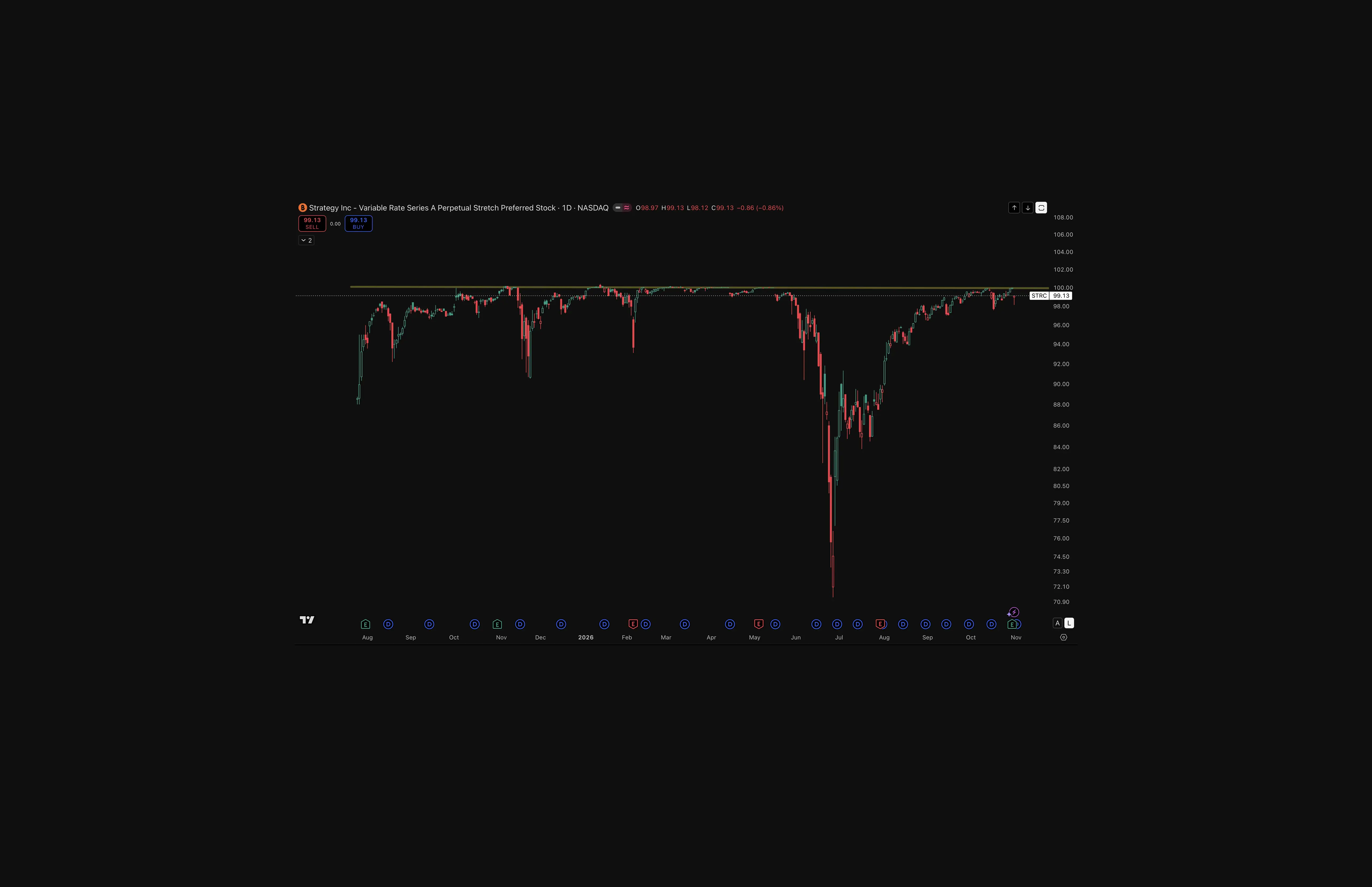
The new playbook: CEO Phong Le said issuing digital credit is now the primary way Strategy buys bitcoin, with part of each raise going to the dollar reserve and the rest to BTC. New MSTR shares are reserved for periods when mNAV expands aggressively.
The treasury claim: Michael Saylor said treasury companies acquired 220,000 BTC this year, which he put at 165% of all bitcoin mined. That figure is his stated view and has not been verified against BitcoinTreasuries.net.
Leadership: Strategy CFO Andrew Kang steps down on November 5 and stays on in an advisory role through December 31. Reza Virasteh becomes Strategy’s CFO from January 1, 2027, alongside CEO Phong Le as co-principal financial officer.
ETF Flows: The Inflow Streak Breaks With a $643M Exit
ETF | 24h Flow (Oct 30) | 5-Day Flow (Oct 26 to 30) |
IBIT | −$233.7M | +$176.9M |
FBTC | −$201.0M | −$166.0M |
ARKB | −$129.5M | −$129.5M |
GBTC | −$53.3M | −$53.3M |
Four-fund total | −$617.5M | −$171.9M |
All funds | −$643.2M | −$202.4M |
Source: DefiLlama ETF flow data, latest reported flow day October 30, 2026. The window covers the five trading days from October 26 to 30.
Streak over: Four straight inflow days ended in the first session after the hack, and the October 30 outflow of $643.2 million exceeded the roughly $440.8 million that came in across October 26 to 29 combined.
No fund spared: All four funds bled, with IBIT and FBTC carrying about 70% of the four-fund outflow.
Technicals: BTC Clings to Its 200-Day Trend as Bands Widen
Indicator (1D) | Reading | What it means |
200-day EMA (long-term trend) | $76,419, rising; October 30 close about 1.05% above | The main daily uptrend still holds, by a thin margin |
Bollinger Bands (position) | October 30 close below the lower band of $78,053 | Price remains outside its usual range |
Bollinger band width | 8.06%, above its 60-day median of 7.44%; no squeeze | Volatility has expanded out of the compressed range |
MACD (momentum) | Histogram negative and deepening: −228, −383, −495 over three days | Short-term momentum is falling faster |
MACD divergence | None in the latest 60 daily readings | Momentum is moving with price, not against it |
20-day SMA | $81,331; October 30 close 5.05% below | Price sits well under its short-term average |
Source: Indicators calculated on DefiLlama completed daily closes through October 30. Bollinger Bands use 20 periods and two standard deviations, with a 60-day median band-width test.
Thin cushion: The gap to the 200-day EMA narrowed from about 1.8% on October 29 to about 1.0%.
Range broken, not compressed: Band width moved back above its median, so the break below the lower band now comes with expanding volatility rather than a quiet base.
Moving Averages Across Timeframes
Timeframe | 20-period | 50-period | 200-period |
1D | $81,334 (price −5.01%) | $81,904 (price −5.67%) | $73,121 (price +5.66%) |
3D | $81,076 (price −4.71%) | $71,680 (price +7.79%) | |
1W | $72,376 (price +6.75%) | $76,064 (price +1.57%) |
Source: Simple averages calculated on CryptoQuant daily closes (all exchanges, BTC/$spot), against the CryptoQuant October 30 close of $77,261, with thanks to CryptoQuant for the data. The DefiLlama close used elsewhere in this edition is $77,221. Percentages show price versus each average.
Short end lost: Price sits below the 1D 20 and 50 and the 3D 20, all clustered between $81,000 and $82,000.
The line that matters: The 50-week average sits 1.57% below the October 30 close, the same level the LIVE session flagged as the one to hold into the November 1 weekly close.
For technical analysis from a wide range of analysts, see the CryptoQuant QuickTake community.
Coinjuice Lens: Trading Psychology
The October 30 session saw more than $1.5 billion in liquidations, mostly longs, discussed on the Coinjuice LIVE session, while patient limit orders near $76,000 filled into the same move. Leverage turned a custody failure at one exchange into forced selling across the market, the dynamic examined in Coinjuice’s guide to a non-leveraged crypto portfolio.
Readers looking to prepare for a weekly close test of the 50-week average can start with the Coinjuice ebook, Bitcoin Trading Without Leverage, now 15% off with the code TRADE15OFF, or go deeper with a Coinjuice subscription, currently 30% off the annual plan, where we start and complete trades and you will learn to snipe them independently.
Something new is about to land NEXT WEEK: the Coinjuice merchandise store is kicking off and we are excited to share it with you. Make sure to sign up and we will send you an early bird discount that only our pre-members will gain for our merch!
Also please follow us on FB, YouTube, IG and X, it would mean a lot to us! Follow along on YouTube to catch the Coinjuice live sessions.
News Behind Today’s Read
Binance arranges $6.34 billion to cover losses from biggest crypto hack ever (CoinDesk). Source for the backstop size, the $5 billion held in matching tokens and the $3 billion partner freeze, alongside CoinDesk’s report on the wider breach and withdrawal restart.
Binance hacker splits $1.4 billion of bitcoin into 19 wallets that no one can freeze (CoinDesk). Source for the 18,270 BTC peel chain, the unmoved wallets and the Bybit conversion precedent, alongside CoinDesk’s EIP-7702 explainer for the four-minute drain.
Wall Street analysts urge investors to buy crypto stocks on weakness after $6.3 billion Binance hack (CoinDesk). Source for the Cantor, TD Cowen and Compass Point views, alongside CoinDesk’s report on how big bitcoin traders responded for the Paradigm options flow data.
Crypto experts question double standard after issuers freeze billions in Binance hack (CoinDesk). Source for the Tether and Circle freeze figures and the Drift comparison.
Strategy Announces Third Quarter Financial Results (SEC filing). Source for the 848,517 BTC holding, the 7,218 BTC bought and 5,552 BTC sold, the $5.07 billion reserve and the STRC buybacks, alongside the Bitcoin Balance Sheet recap for the digital credit comments.
Continue the read: Oct. 30 · Oct. 29 · Oct. 28
Market Snapshot
Asset | Price | Distance from ATH / reference |
BTC | $77,174 | 38.83% below ATH ($126,156) |
ETH | $2,240 | 54.71% below ATH ($4,946) |
ETH/BTC | 0.02903 | Spot ratio, DefiLlama |
DeFi TVL | $84.89B | Base TVL, DefiLlama |
BTC share of five-asset basket | 75.57% | BTC/ETH/SOL/BNB/XRP; narrow proxy, not market-wide dominance |
Data as of October 31, 2026, about 06:03 UTC, DefiLlama.
This article was developed with the support of artificial intelligence tools as part of Coinjuice’s editorial process and reviewed by our editorial team before publication.
FAQ
Will Binance customers get their money back after the October 2026 hack?
Binance says it has set aside more than $6.34 billion of its own funds to restore balances, against an estimated $6.3 billion stolen. About $5 billion is already held in the exact tokens taken, and the rest is being bought on public markets and over the counter. Withdrawals remain paused, with Binance targeting a phased restart subject to security checks and proof-of-reserves results due by November 2.
Why can’t the stolen bitcoin be frozen like USDT and USDC?
Tether and Circle issue their stablecoins and can blacklist addresses. Bitcoin has no issuer, so the 18,270 stolen BTC sitting in 19 wallets can only be stopped when they reach an exchange, OTC desk or swap service that refuses or freezes them.
How much bitcoin did Strategy buy in Q3 2026?
Strategy bought 7,218 BTC and sold 5,552 BTC in the quarter, a net addition of about 1,666 BTC, per its SEC filing. Most of its capital went into a $5.07 billion dollar reserve and about $2.04 billion of STRC buybacks year to date.
What happened to spot Bitcoin ETF flows after the Binance hack?
On October 30, all four major spot Bitcoin ETFs recorded outflows totaling $617.5 million, led by IBIT at about $234 million and FBTC at about $201 million, with all funds together losing $643.2 million. This ended a four-day inflow streak, and the single-day outflow exceeded the roughly $440.8 million that came in between October 26 and 29.
Disclaimer
The information provided in this article is for informational purposes only. It is not intended to be, nor should it be construed as, financial advice. We do not make any warranties regarding the completeness, reliability, or accuracy of this information. All investments involve risk, and past performance does not guarantee future results. We recommend consulting a financial advisor before making any investment decisions.
More like this

Written by

Andrew Kamsky
Andrew Kamsky is a Bitcoin analyst. He spent a decade in traditional finance across a Big Four firm and a listed fintech bank before going deep on Bitcoin full-time.