







Quick summary
Uniswap is a broad DEX for any token pair, strong volume and collected fees
UNI offers growth upside via fee-funded token burns, but no direct immediate yield
Curve specializes in low-fee stablecoin swaps, sharing 50 percent of fees with lockers
CRV emphasizes steady income from stablecoin activity, while Uniswap is a higher-growth bet
A decentralized exchange is where traders swap one cryptocurrency for another without needing a company in the middle. Connect a wallet, pick two coins, the trade happens instantly on-chain.
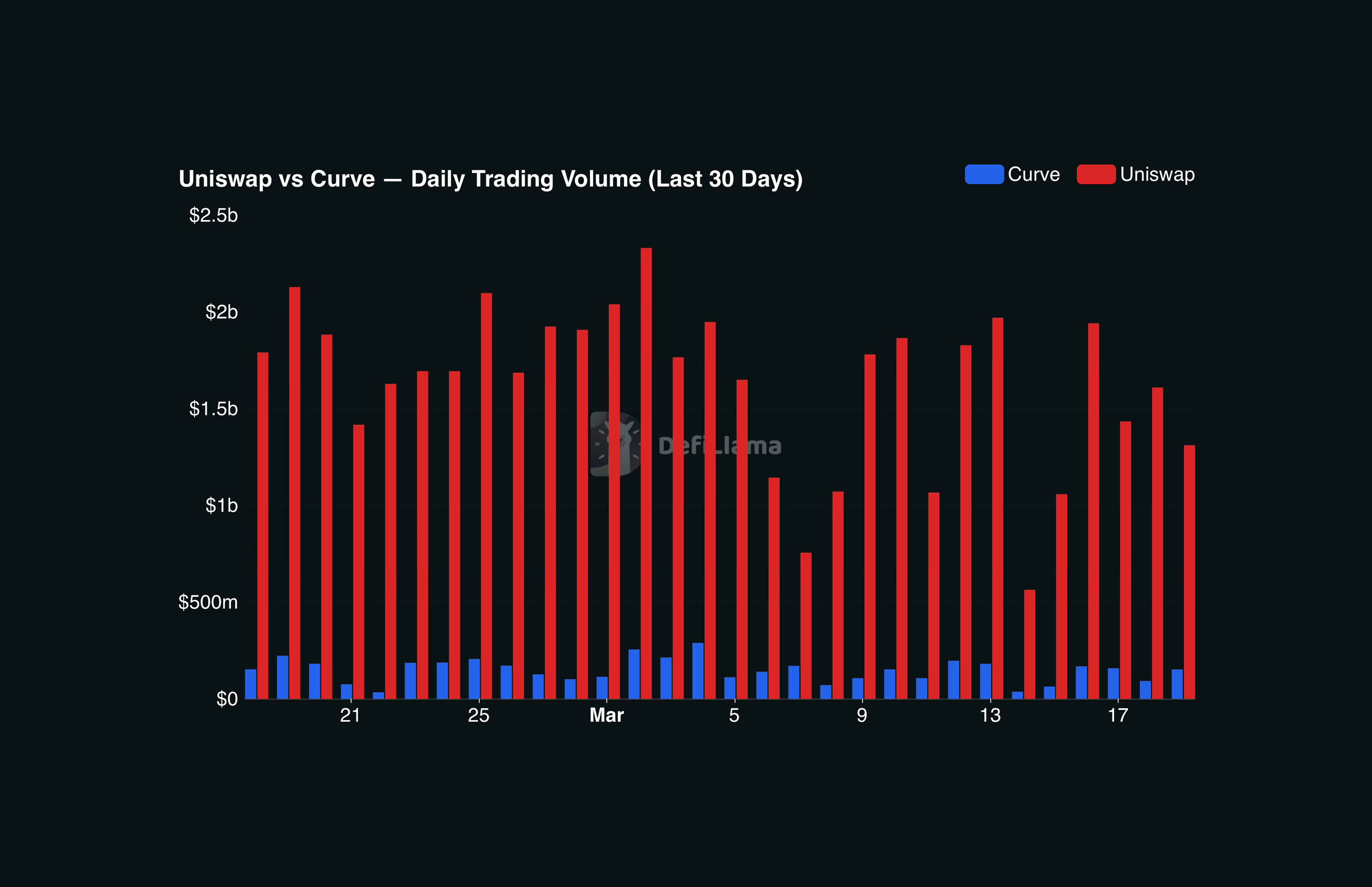
Uniswap dominates by volume: $49B in trading activity over the last 30 days. PancakeSwap is #2 globally at $29.4B. But this article examines Uniswap vs. Curve because they represent two fundamentally different architectural approaches to DEX design.
Uniswap uses the constant-product formula (x·y=k) for any token pair. Curve uses a specialized StableSwap invariant designed for stable assets. These mechanics explain why each protocol thrives in different market conditions — and why the volume disparity is intentional, not a design failure.
Understanding which one wins in a given situation depends on what traders actually need and which model aligns with their strategy.
DEX Comparison: Uniswap vs Curve by the Numbers
Metric | Uniswap | Curve |
30-Day Volume | $49.46B | $4.38B |
Trading Range | Any token pair | Stablecoins |
Protocol Fees Collected | $44.52M | $4.06M |
Focus | Breadth | Specialization |
Uniswap Explained: High Volume, High Growth Potential
Uniswap, with a market cap of $2.25B, focuses on traders who swap any cryptocurrency for another. Ethereum for Dogecoin. Bitcoin for a rare altcoin. Anything.
Uniswap leads on two fronts: volume and breadth. It processes more trades than any other DEX and supports thousands of token pairs. Meaning any coin, any combination, not just stablecoins. That breadth is what sustains the volume; more pairs mean more traders, more traders mean more fees.
As Uniswap handles so many types of trades, Uniswap processes way more volume than Curve — around 11x more in the last 30 days.
How Uniswap Turns Volume Into Token Value
Uniswap's dominance in trading volume has a direct financial implication for anyone holding UNI.
Over the past three years, the protocol processed $2.2 trillion in cumulative trading volume. A number that makes the fee math worth paying attention to. More trading volume = more fees collected = more money for growth.
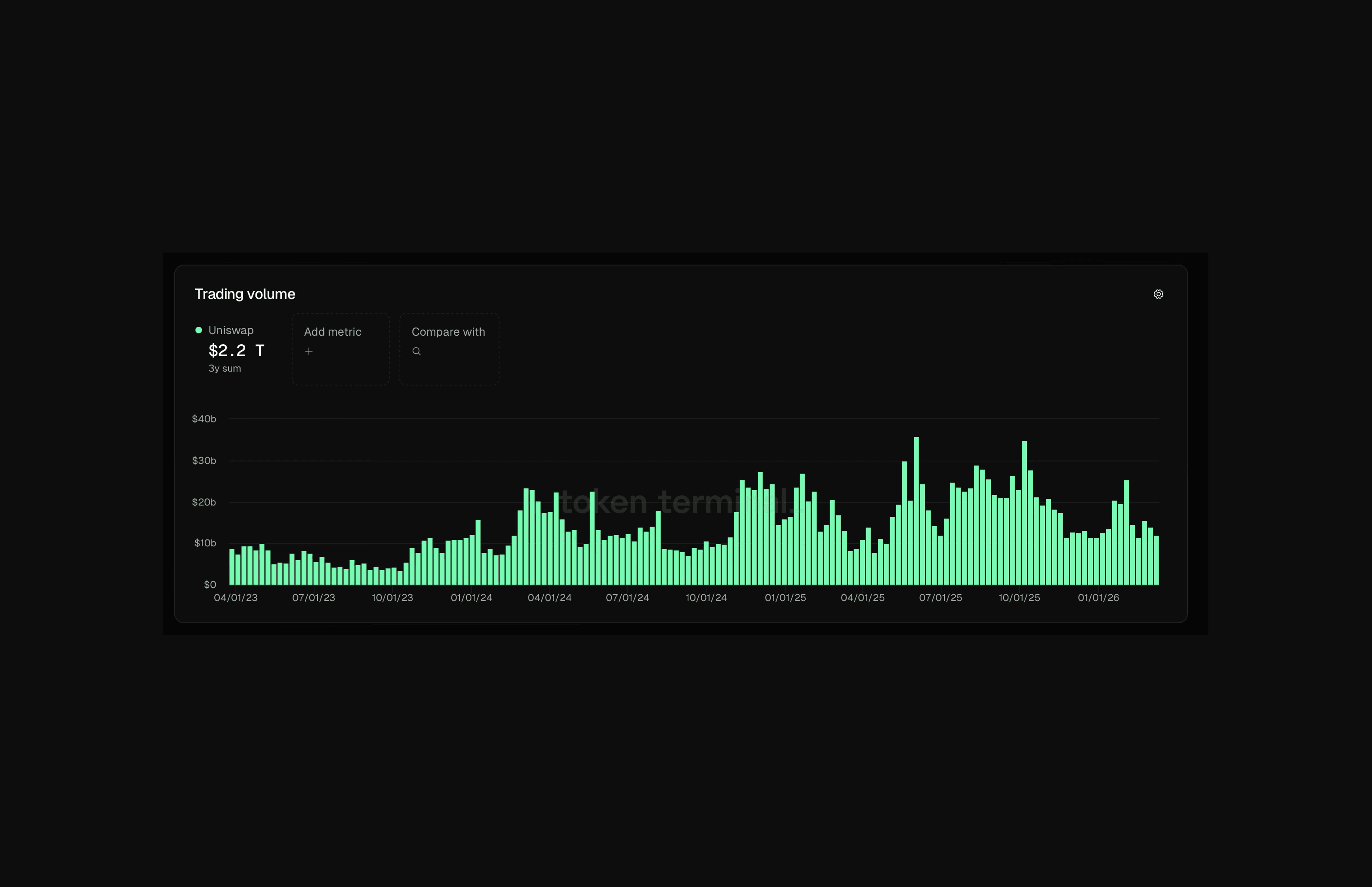
Uniswap recently activated a system where protocol fees fund token burns. The thesis: if burns work AND that drives scarcity AND markets value that scarcity, then UNI holders benefit. But that chain depends on execution.
What $1,000 in UNI Looks Like for Token Holders
Here are a few options:
No immediate yield: Indirect yield via burns fees fund token buybacks and burns, reducing supply rather than paying dividends
Price-dependent returns: UNI is designed so that IF burns work AND IF that drives scarcity AND IF market buys the scarcity, THEN price appreciates
Scarcity-driven growth: Price appreciates only if protocol fees compound into real scarcity
Execution bet: Success depends entirely on Uniswap delivering on its growth promise
When to Use Uniswap
Uniswap is the right choice when flexibility and access are the priority:
Any token pair: Trade beyond stablecoins; any cryptocurrency, any combination
Deep liquidity: Access the strongest liquidity pools for major coins
New & niche tokens: Get early access to emerging or hard-to-find tokens
Uniswap Associated Risks
Like any high-growth protocol, Uniswap carries real risks worth understanding:
Smart contract risk: Code vulnerabilities could expose funds to loss
Valuation risk: The market is pricing in heavy growth; if that doesn't materialize, UNI could fall sharply
Growth dependency: Returns only flow if fees keep generating and token burns keep compounding
Cyclical exposure: When crypto trading volume drops, Uniswap's fee revenue drops with it
Curve Finance: The DEX Built For Stablecoin Income
What It Does
Curve is built for one specific job: swapping stablecoins designed to hold parity with $1, namely USDC, USD₮, and DAI.
That specialization pays off for traders. By focusing exclusively on stablecoins, Curve charges lower fees than Uniswap on every stablecoin swap, saving money on each and every trade.
Why Specialization Matters for CRV Holders
Token holders who lock CRV for extended periods (veCRV) earn a direct cut of every swap fee. This means long-term holders get paid in real yield — not promises, but actual dollars flowing back to them every day.
What $1,000 in CRV Looks Like for Token Holders
For CRV holders, the story is income first, appreciation second:
Immediate yield: Token holders who lock CRV for 4 years (veCRV) earn 50% of all swap fees as yield
Predictable income: It could be $30/year, it could be $100/year; depends on total veCRV TVL. But the mechanism is consistent
Income over appreciation: Yield is the primary return; price growth is a bonus
Bear market resilience: Stablecoin demand holds up when the rest of crypto crashes
When to Use Curve
Curve is the right choice when stability and yield are the priority:
Stablecoin swaps: The lowest fees available for stablecoin-to-stablecoin trades
Steady yield: Lock CRV and earn consistent fee income over time
Large volume trades: The bigger the stablecoin trade, the more fee savings compound
Curve Associated Risks
Curve's consistency comes with its own limitations:
Stablecoin only: Limited scope; swapping non-stablecoin tokens isn't what Curve is built for
Market size risk: If stablecoin trading slows, so does Curve's revenue
Volume pressure: Stablecoin trading has declined recently, putting real pressure on Curve's fee income
Smart contract risk: Curve has experienced four on-chain incidents totalling $65M+, including a $3M exploit in February 2026 and a $240,000 LlamaLend incident on March 2, 2026. Any protocol holding stablecoin liquidity at scale carries this risk
Founder concentration risk: Curve founder Michael Egorov's repeated CRV liquidations ($140M+ in 2025) create structural sell pressure on the token independent of protocol performance.
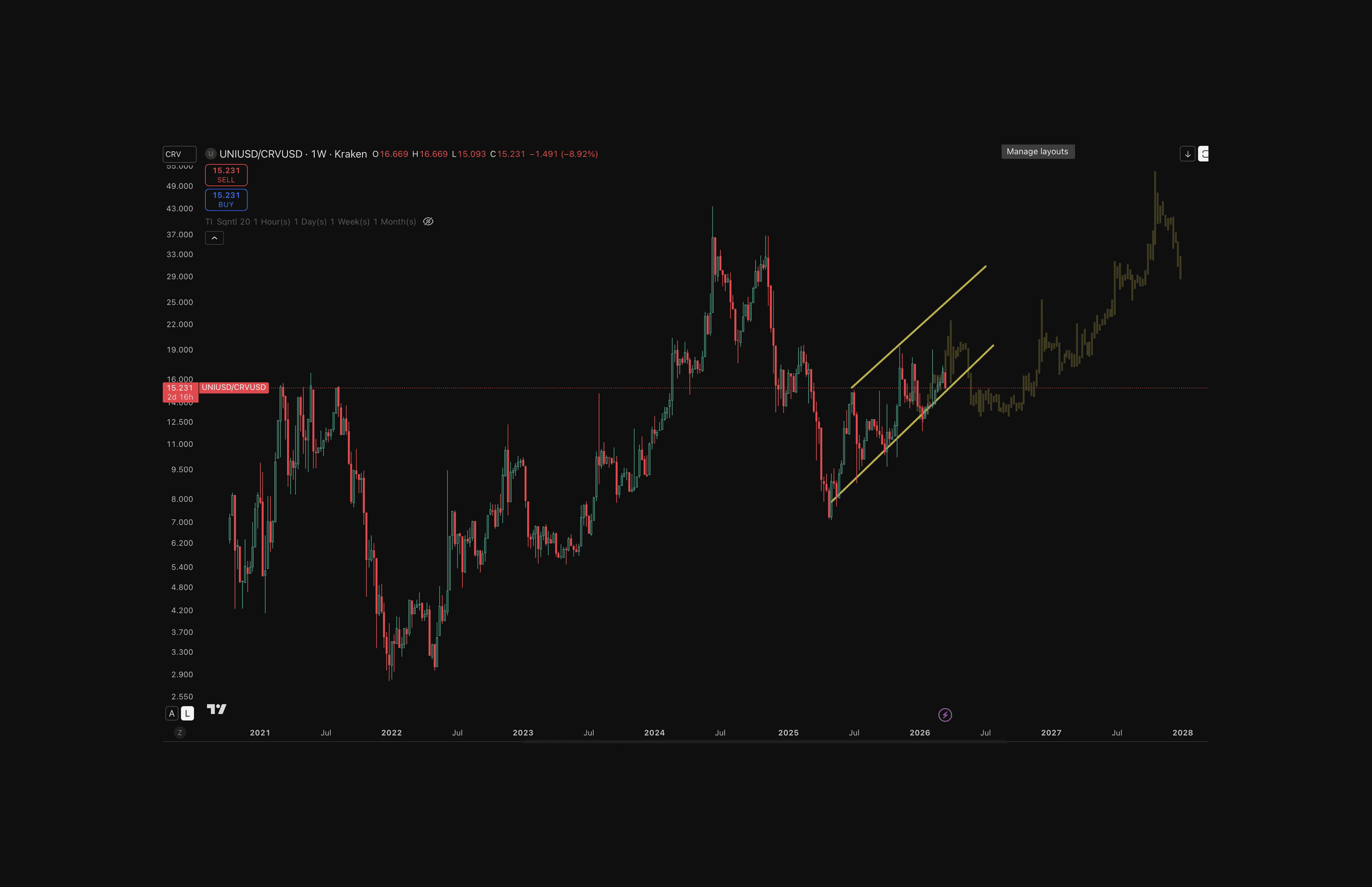
Uniswap vs Curve: Two Protocols Two Different Bets
Uniswap = Growth bet. Individual token appreciates if the protocol wins.
Curve = Income bet. Individual token pays in fees every day, regardless of price.
Uniswap Or Curve: Which DEX Is Right For Your Strategy
Two protocols, two strategies neither is wrong:
Choose Uniswap: if strategy is broad, risk tolerance is high, and conviction is growth
Choose Curve: if strategy is stablecoins, risk tolerance is lower, and conviction is consistency.
Conclusion
Uniswap and Curve aren't really competing. They're solving different problems for different people.
Uniswap is built for volume, breadth, and growth. If crypto trading expands, UNI holders win. If the burn mechanism delivers, UNI holders win more. But both of those are bets on the future.
Curve doesn't ask you to bet. Lock tokens, earn fees, repeat. Stablecoins matter in bull markets and bear markets — which means Curve's income stream doesn't switch off when sentiment does.
The question isn't which protocol is better. It's which one fits your strategy.
Growth over income — choose Uniswap. Income over growth — choose Curve. Both are valid. Neither is obvious.
FAQ
How do Uniswap and Curve differ in what assets you can trade?
Uniswap supports swapping any cryptocurrency pair, including major coins and niche tokens, while Curve is specialized for swapping stablecoins such as USDC, USDT, and DAI.
How do UNI and CRV tokens reward their holders?
UNI holders benefit indirectly from Uniswap’s success through protocol fees funding token burns, which only help if UNI’s price appreciates, while locked CRV holders earn a direct share of swap fees as real yield paid consistently over time.
When is Uniswap the better choice compared to Curve?
Uniswap is better when flexibility and access matter most, such as trading any token pair, using deep liquidity for major coins, or accessing new and niche tokens, and for strategies focused on broad exposure and growth with higher risk tolerance.
Why might an investor choose Curve over Uniswap?
An investor might choose Curve for stablecoin-focused strategies, lower fees on stablecoin swaps, steady yield from locking CRV and earning fees, and more consistent income that can hold up in both bull and bear markets.
Disclaimer
The information provided in this article is for informational purposes only. It is not intended to be, nor should it be construed as, financial advice. We do not make any warranties regarding the completeness, reliability, or accuracy of this information. All investments involve risk, and past performance does not guarantee future results. We recommend consulting a financial advisor before making any investment decisions.
More like this

Written by

Andrew Kamsky
Andrew Kamsky is a Bitcoin analyst. He spent a decade in traditional finance across a Big Four firm and a listed fintech bank before going deep on Bitcoin full-time.