








Quick summary
Pumpfun is a Solana launchpad enabling oneclick nocode token creation with instant liquidity
From Q1 2024 to Q1 2026, pump.fun generated $1.348 billion in cumulative revenue and $1.01 billion in cumulative profit
Q1 2026 revenue is 89m with 51m costs and 39m gross profit
Earnings fully fund PUMP token buybacks while rising costs competition security and regulation pose risk
When Pump.fun launched on January 19, 2024, it introduced a straightforward proposition: launch a tradeable token in one click, for free. No coding required, no upfront capital, just a Solana wallet and sixty seconds.
The execution matched the pitch. Users could upload an image, write a description, deploy a token, and immediately have a trading pair with built-in liquidity. Pump.fun has since released thousands of daily token launches in memecoins, community projects, experimental tokens, and everything in between. Pump.fun became the default launchpad for Solana's token economy.
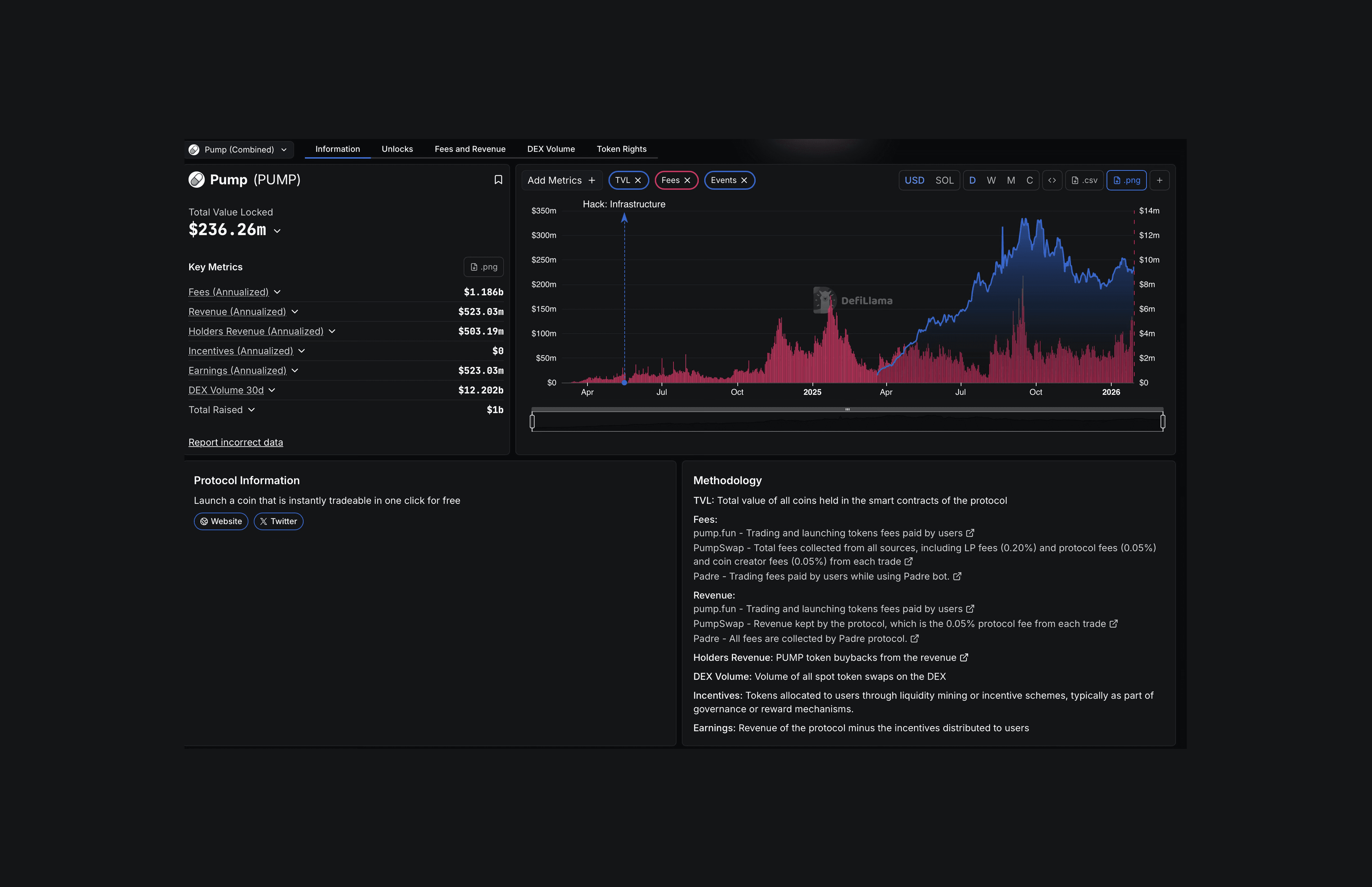
The numbers reflect sustained usage. From Q1 2024 through Q1 2026, pump.fun has generated $1.348 billion in cumulative revenue. The platform currently sits at a $236.26 million total value locked (TVL), with $523.03 million in annualized revenue as of January 28, 2026.
Revenue Model and Token Economics
Pump.fun operates on a fee structure that generates revenue from four sources:
LaunchpadFee: Trade fees collected from token launches on the pump.fun platform
ProtocolFees: Trading fees retained by the pump.fun protocol from each transaction
DexLPFees: Fees earned by liquidity providers who supply capital to trading pairs
DexCreatorFees: Trading fees allocated to token creators from activity on their launched tokens
The Q1 2026 breakdown shows $89.92 million in gross protocol revenue. After deducting $50.52m in costs (paid to liquidity providers and token creators), the protocol generated $39.39m in gross profit for the quarter.
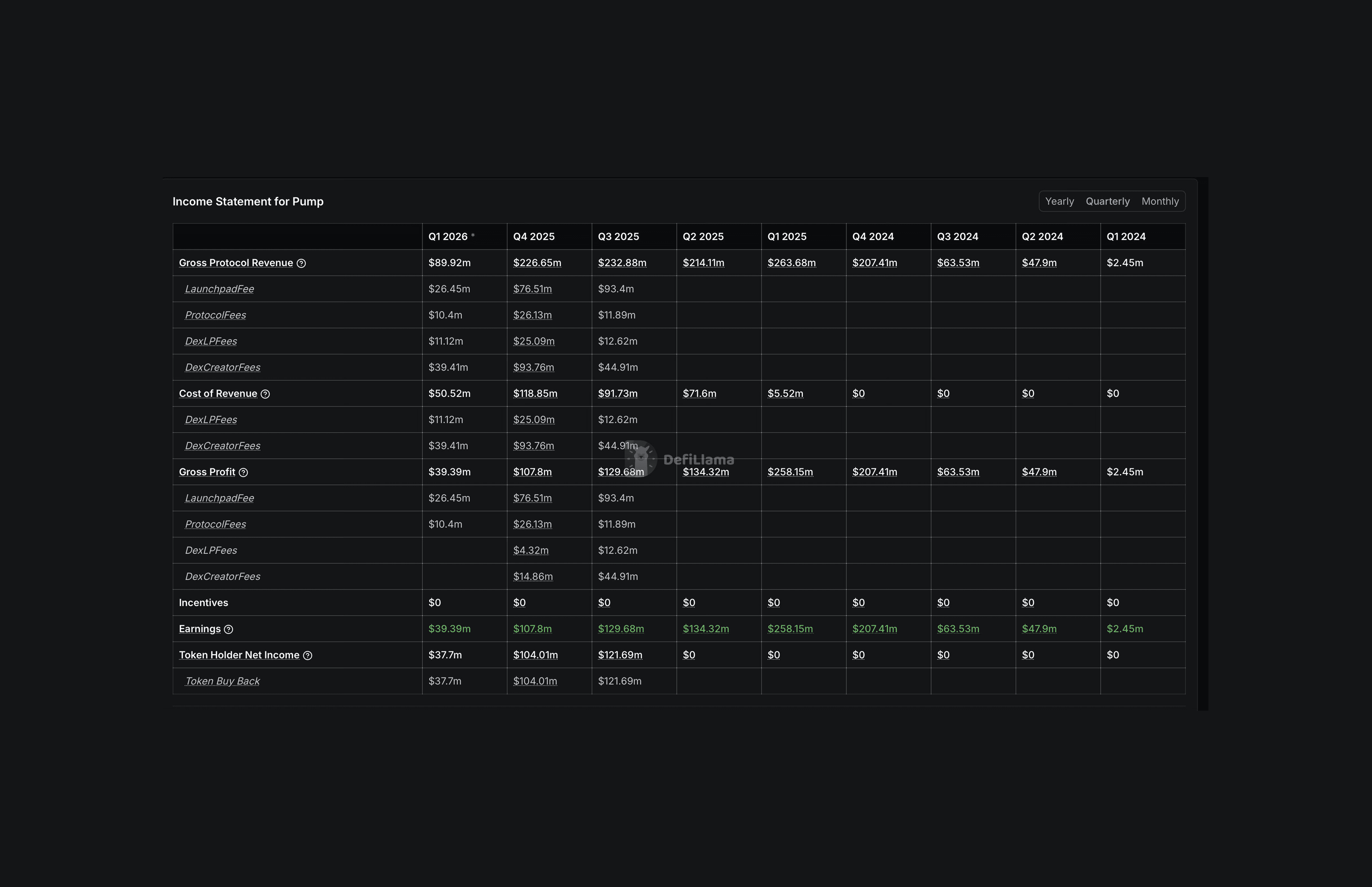
Since inception, pump.fun has generated $1.348 billion in cumulative revenue and $1.01 billion in cumulative profit.
Starting in Q3 2025, the protocol implemented a buyback mechanism where 100% of earnings flow into $PUMP token repurchases. The protocol has distributed $263.4 million to token holders through buybacks, representing 26% of all-time profits returned to holders since the mechanism launched.
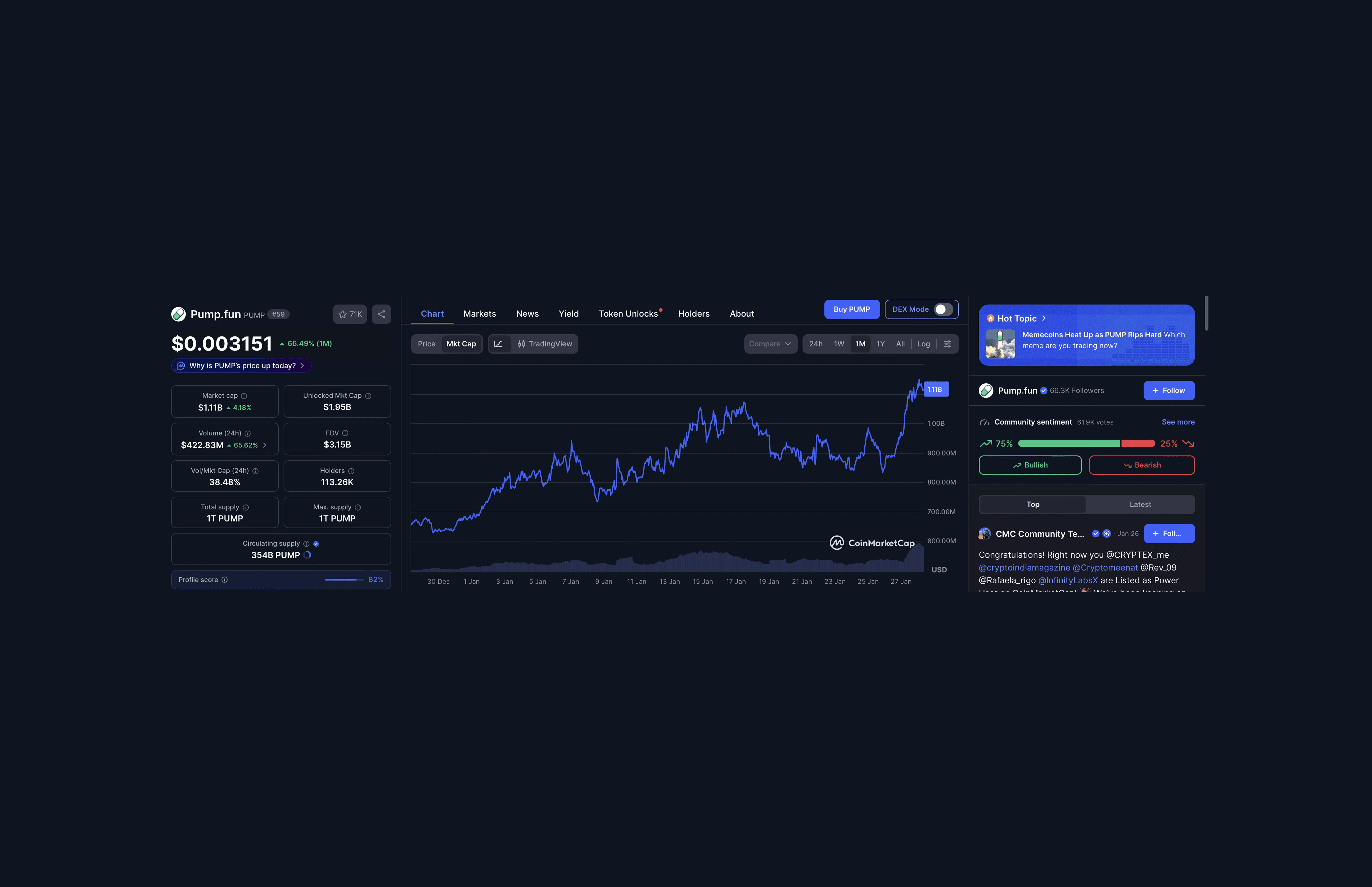
The $PUMP token currently trades at $0.0031 with a market cap of $1.11 billion.
Pump.fun: Quarterly Performance Analysis Since Q12024
The income statement shows distinct phases of rapid growth, a peak, and subsequent normalization while still sustaining significant revenue generation:
Q1 2024: Revenue began modestly at $2.45 million.
Q2 2024: A sharp acceleration occurred, with revenue reaching $47.9 million.
Q3 2024: Growth continued to $63.53 million.
Q4 2024: Revenue increased to $207.41 million, marking the first quarter above $200 million.
Q1 2025: Revenue peaked at $263.68 million, the highest single-quarter result in pump.fun’s history.
Q2–Q4 2025: Revenues normalized but remained elevated at $214.11 million, $232.88 million, and $226.65 million, respectively.
Q1 2026 (current): Revenue in 2026 is marked at $89.92 million as at January 28, 2026.
Cost Structure and Profitability
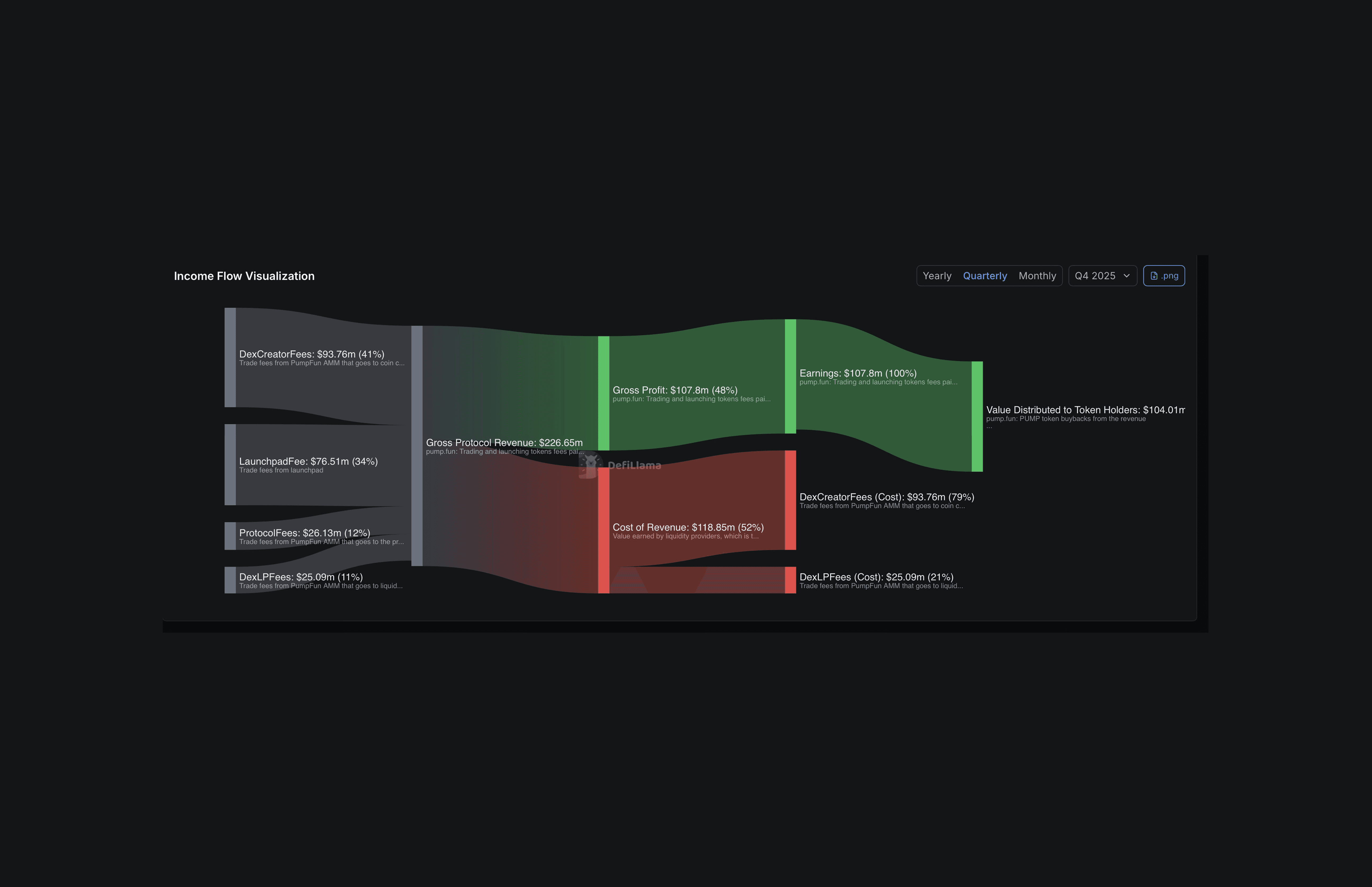
Pump.fun’s cost structure, illustrated in the screenshot above, shifted materially in 2025, introducing revenue-sharing expenses while preserving overall profitability:
2024: The protocol reported zero cost of revenue
Q1 2025: Costs first appeared at $5.52 million
Q2 2025: Costs increased sharply to $71.6 million
Q3 2025: Expenses continued rising to $91.73 million
Q4 2025: Costs reached $118.85 million
Q1 2026 (current): Reported costs declined to $50.52 million
With the introduction of revenue-sharing expenses now fully visible, the margin profile and downstream profitability implications become clearer.
Cost composition: Expenses consist of DexLPFees and DexCreatorFees
Current margin profile: 56% of gross revenue flows to costs ($50.52m / $89.92m), leaving 44% as gross profit ($39.39m)
Profitability impact: Despite added costs, the protocol remains profitable, with annualized holder revenue of $583.19 million, exceeding reported protocol revenue due to the buyback-based distribution model.
Infrastructure and Operations
On May 16, 2024, pump.fun experienced an infrastructure hack where a private key was compromised, resulting in a $2 million loss. This occurred during Q2 2024, which still produced $47.9 million in revenue.
The protocol recovered and continued growing through subsequent quarters. More recently, pump.fun announced the Pump Fund in January 2026, a $3 million "Build in Public Hackathon" representing the protocol's new investment arm for early-stage projects.
Pump.fun Risk Analysis: Key Downside Factors
While pump.fun has demonstrated strong revenue generation, several risks could materially impact future performance and tokenholder returns:
Revenue Contraction: Revenue peaked at $263m in Q1 2025 and declined 66% to $89.92m in Q1 2026. With two months remaining in the quarter, revenue visibility is limited and downside risk might arrise.
Margin Compression: Costs expanded from 0% of revenue in 2024 to 56% in Q1 2026, compressing gross margins from 100% to 44%. Even stable revenues now translate into materially lower earnings.
Competitive Pressure: The launchpad market has low barriers to entry. Competitors offering lower fees or improved features could siphon liquidity, weakening pump.fun’s network effects to new token launches.
Security Risk: A $2m infrastructure breach in May 2024 highlights ongoing smart contract and operational risks.
Buyback Sustainability: Since Q3 2025, 100% of earnings fund $PUMP buybacks. If profitability declines, the primary value accrual mechanism for holders weakens, potentially reversing buy pressure.
Market Dependence: Revenue is tightly linked to Solana meme coin activity. Reduced retail speculation or broader crypto market downturns would immediately impact protocol income.
Regulatory Exposure: Permissionless token launchpads face potential scrutiny related to securities law, fraud facilitation, and compliance obligations, which could restrict operations or increase costs.
Liquidity & Supply Risk: With 65% of total supply still unlocked, future distributions could create selling pressure. In stressed conditions, liquidity may thin rapidly, limiting exit options for larger holders.
Technical Dependency: Pump.fun operates entirely on Solana, making it vulnerable to network outages, congestion, or technical failures that directly halt revenue generation.
Conclusion
As of January 28, 2026, pump.fun holds $1.186 billion in annualized fees across its entire ecosystem. The current annualized revenue of $523.03 million places pump.fun among the higher-earning protocols in decentralized finance.
The buyback model creates direct value distribution to token holders, with $583.19 million in annualized holders revenue exceeding the protocol's own revenue through the mechanism's design.
The platform's fee model, charging on launches and trades, means revenue directly correlates with platform usage. Each token deployment and each trade generates fees, creating a business model tied to network activity rather than external dependencies.
We track pump.fun and protocols like it closely at Coinjuice. Before joining our PRO community, make sure to learn our framework first, it'll give you the foundation for reading these metrics as they develop.
Learn the framework: How to Trade Without Leverage
Then subscribe for weekly analysis: Coinjuice PRO
FAQ
What does Pump.fun enable users to do, and what are the basic requirements?
Pump.fun lets users launch a tradeable token on Solana in one click, for free. Users can upload an image, write a description, deploy a token, and instantly get a trading pair with built-in liquidity. It requires only a Solana wallet, no coding, no upfront capital, and about sixty seconds
How does Pump.fun generate revenue and what is its current profitability profile?
Pump.fun earns fees from four sources: LaunchpadFee (trade fees on launches), ProtocolFees (trading fees kept by the protocol), DexLPFees (fees to liquidity providers), and DexCreatorFees (fees to token creators). In Q1 2026, it reported $89.92 million in gross revenue, $50.52 million in costs (DexLPFees and DexCreatorFees), and $39.39 million in gross profit, with 56% of revenue going to costs and 44% remaining as gross profit.
What is the $PUMP token buyback mechanism and how much value has been returned to holders?
Since Q3 2025, 100% of Pump.fun’s earnings are used to repurchase $PUMP tokens. The protocol has distributed $263.4 million to token holders through buybacks, equal to 26% of all-time profits since the mechanism began. Annualized holder revenue is $583.19 million, and $PUMP trades at $0.0031 with a market cap of $1.11 billion.
What are the main risks that could affect Pump.fun’s future performance and tokenholder returns?
Key risks include revenue contraction from the Q1 2025 peak to Q1 2026, margin compression as costs rose to 56% of revenue, competitive pressure from other launchpads, security risk highlighted by a $2 million hack in May 2024, potential weakening of buyback-driven value if profits fall, dependence on Solana meme coin activity and broader crypto markets, regulatory scrutiny of permissionless launchpads, liquidity and supply risk with 65% of total supply still unlocked, and technical dependency on the Solana network.
Disclaimer
The information provided in this article is for informational purposes only. It is not intended to be, nor should it be construed as, financial advice. We do not make any warranties regarding the completeness, reliability, or accuracy of this information. All investments involve risk, and past performance does not guarantee future results. We recommend consulting a financial advisor before making any investment decisions.
More like this


Written by

Andrew Kamsky
Andrew Kamsky is a Bitcoin analyst. He spent a decade in traditional finance across a Big Four firm and a listed fintech bank before going deep on Bitcoin full-time.