









Quick summary
Russia’s 2026 framework legalises crypto trading but keeps all domestic payments banned
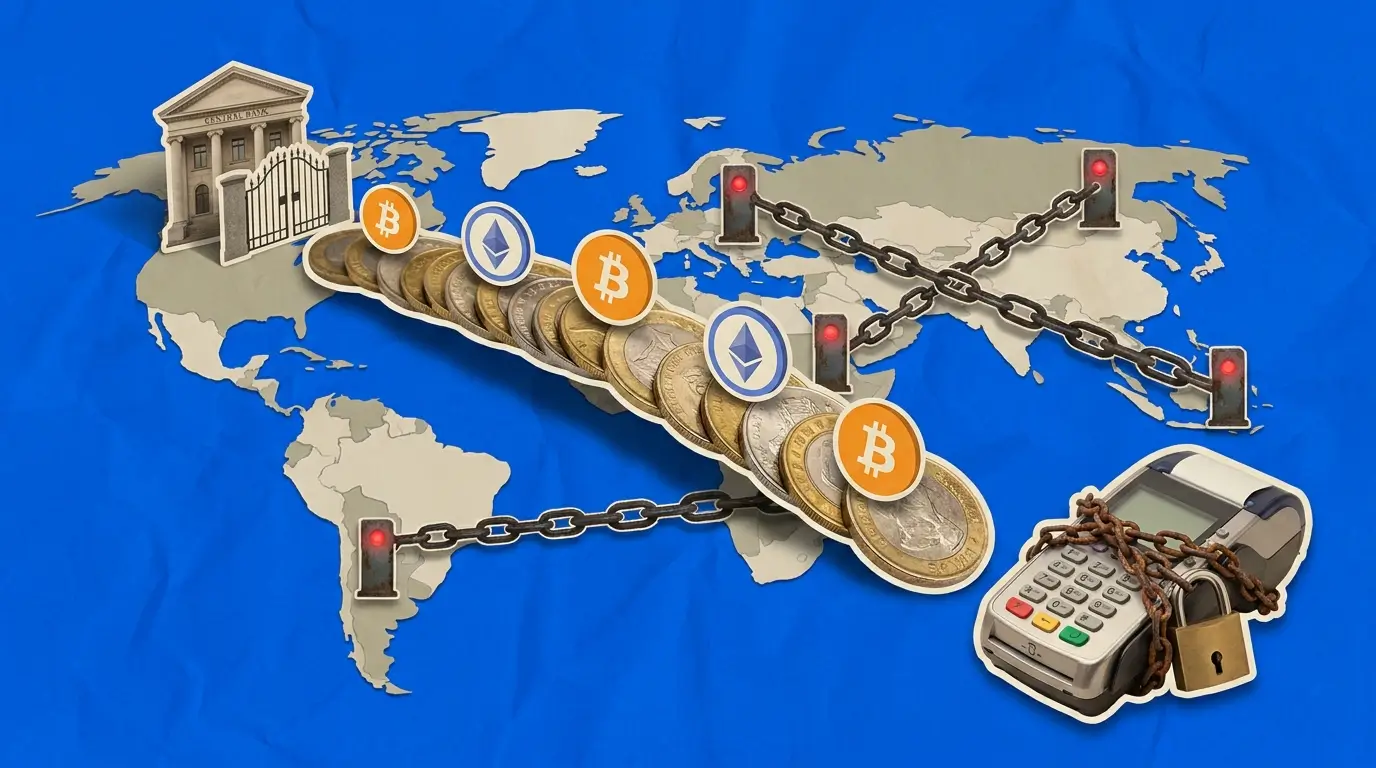
Bank of Russia becomes sole crypto regulator, licensing intermediaries and enforcing whitelisted asset access
Retail investors face testing and 300,000 ruble annual caps per intermediary, institutions largely unrestricted
Law enables sanctioned cross-border crypto settlements, with full effect 2026 and criminal penalties 2027
A containment-first model that permits trading, restricts payments, and reshapes how Russian capital moves across borders.
The Bank of Russia has released a concept of cryptocurrency regulation and submitted its legal proposals to the Government. Cryptoassets will be accessible to both qualified and non-qualified investors under different rules for each.
The CBR's own release published 23, December, 2025, makes its position clear: cryptoassets have "no identifiable issuer," are "not guaranteed by any jurisdiction," are "highly volatile," and "involve sanction risks." Despite those warnings, the Russian cryptocurrency framework brings activity already operating at scale under formal federal supervision for the first time, driven by Western sanctions pressure and the need for transparent payment infrastructure. For anyone asking what the rules actually are, who can buy what, and when enforcement begins, here is the full picture.
Russia's 2026 Crypto Law Explained: Bitcoin and the New Rules
The 2025 concept does not appear in a vacuum. Russia's crypto rulebook traces back to 2020, when President Putin signed the Law on Digital Financial Assets, legislation that came into force on January 1, 2021. For the first time, cryptocurrency had a legal identity in Russia: owning it was permitted, trading it was permitted, but paying for a coffee, a car, or anything else inside Russia with it was not.
The ruble remained the only legal tender. Crypto was defined as a digital financial asset, a recognised instrument, but not a means of payment.
Russia's Crypto Legal History: From the 2020 Foundation to the 2026 Framework
The 2020 law was Russia's starting line. Five years later, the Bank of Russia's December 2025 release picks up where that legislation left off. The original law left three critical gaps:
Supervision: No single authority owned day-to-day oversight, so compliance standards drifted between intermediaries and investors had no clear regulator to turn to
Intermediary licensing: No defined rules on who could legally operate as an exchange, broker, or custodian meaning traders routinely used platforms with no formal authorisation to handle their funds
Enforcement: No penalties when operators failed or disappeared, so bad actors faced minimal deterrent and users had limited recourse to recover losses.
For five years, that grey zone is where most activity actually lived, tolerated, reported inconsistently, and enforced unevenly.
The April 2026 legislation does build on top of the supervisory structure that the original law never defined — licensing regimes, investor categories, reporting thresholds, criminal penalties. The domestic payments ban stays in place.
What changes is the architecture around it.
Key Structural Elements
The April 2026 legislation passed first reading with 327 of 340 deputies in favour. The package confirmed by the Russian Ministry of Finance on March 30, 2026 consists of three linked bills:
On digital currency and digital rights (О цифровой валюте и цифровых правах): The main legislation establishing the legal framework for crypto circulation, licensing, and investor categories.
Amendments to existing federal laws: Updates to current legislation to align with the new digital currency regime, ensuring the framework integrates with banking, tax, and financial supervision rules.
Changes to the code on administrative offences (Кодекс РФ об административных правонарушениях): Introduces administrative liability for operators and intermediaries that violate the new requirements.
Inside Russia's 2026 Crypto Bill: The Seven Pillars of the New Framework
With the package confirmed and first reading passed, seven structural elements define how the Russian cryptocurrency framework will function in practice:
Currency asset classification: Digital currencies and stablecoins are classified as currency assets legally recognised instruments that can be bought and sold, but not used to settle payments inside Russia. Crypto is simultaneously recognised as property, granting owners full judicial protection in court proceedings including bankruptcy and inheritance cases.
CBR as primary regulator: The Central Bank of Russia retains sole authority to license market participants — exchanges, brokers, banks, trust managers, and digital depositories — meaning crypto supervision runs through existing financial infrastructure rather than a new dedicated agency.
Eligibility criteria for retail assets: The CBR confirms non-qualified investors will be restricted to "the most liquid cryptocurrencies, which will be subject to certain criteria stipulated by law." Specific thresholds remain to be confirmed in secondary legislation. In practice, BTC and ETH are the primary instruments expected to clear the bar at launch.
Explicit sanctions circumvention language: State Duma Budget Committee deputy chairman Kaplan Panesh stated on the record that the bill "allows Russian companies to use cryptocurrency to pay foreign counterparties, circumventing sanctions restrictions" The first time a Russian lawmaker has publicly framed the legislation in those terms.
Second reading still ahead: The bill has passed only the first of three Duma readings. Deputy Finance Minister Ivan Chebeskov has stated the Ministry is working through a large volume of proposals from banks, market participants, and law enforcement, meaning the final text may shift materially before it becomes law.
Phased enforcement timeline: If passed, the legislation takes effect July 1, 2026. Criminal liability for unlicensed intermediaries activates separately on July 1, 2027 — with penalties equivalent to unlicensed banking activity. That gap gives operators a one-year window to align with the new licensing regime.
Privacy coins prohibited: The CBR confirms qualified investors will have access to "any cryptocurrencies, except for anonymous ones (whose smart contracts conceal information about token transfers to accounts)." This prohibition applies across all investor categories.
Bitcoin and Ethereum: Two-Tier Access and What It Means for Adoption
Russia ranks among the world's top countries for crypto adoption. Chainalysis recorded over $376 billion in crypto transactions in the country between July 2024 and June 2025. BTC, ETH, and stablecoins USDT and USDC dominate that volume.
The framework introduces a two-tier investor model that determines who can access what and under what conditions:
Parameter | Non-Qualified (Retail) | Qualified (Institutional / Professional) |
Eligible assets | Whitelisted most-liquid cryptocurrencies only | All cryptocurrencies except anonymous/privacy coins |
Annual purchase cap | 300,000 RUB (~$3,900) per intermediary | No volume cap |
Mandatory testing | Yes | Yes |
Market positioning | Limited retail exposure | Primary venue for institutional capital |
The Ministry of Finance package confirms the 300,000 ruble cap directly: "не более 300 тыс. руб. в год через одного посредника" no more than 300,000 rubles per year through one intermediary, and only after passing a knowledge test.
If a retail investor uses multiple licensed intermediaries, they could theoretically buy more than 300,000 RUB total across them but each individual intermediary caps them at that amount.
Cross-Border Payments: The Sanctions Channel and Its Limits
Western sanctions following Russia's 2022 invasion of Ukraine reshaped the country's financial architecture and accelerated its pivot toward crypto as a cross-border settlement layer. Sanctions pushed Russia off SWIFT and out of mainstream correspondent banking.
Cryptocurrency pipelines offer a workaround that does not require access to US dollar clearing.
A summer 2024 law formalised what had already been operating informally: digital currency payments in international trade are permitted, while the domestic payments ban remains. The 2025 framework and April 2026 legislation clarify the cross-border rules further.
What is now permitted:
Foreign account purchases: The CBR confirms residents will be able to "purchase cryptocurrencies abroad (using their foreign accounts)" giving individuals a compliant path to hold assets outside the ruble system.
Overseas transfers via Russian intermediaries: Previously acquired crypto can be transferred overseas through Russian intermediaries, provided tax authorities are notified. The Ministry of Finance states directly: "Об иностранных операциях резиденты будут обязаны уведомлять ФНС России" — residents must notify the Federal Tax Service of foreign operations.
Direct foreign settlement: Russian companies can use crypto to settle payments directly with foreign counterparties. Payments must go to foreign entities routing through domestic intermediaries to circumvent the domestic ban remains prohibited.
Eight eligible exchange institutions: The framework identifies eight existing licensed Russian exchange institutions — including Moscow Exchange and St. Petersburg Exchange — as eligible to handle crypto trades, with additional crypto-specific platforms permitted to register separately. Any transfer exceeding 100,000 rubles (~$1,300) must be reported to the CBR and Rosfinmonitoring.
Enforcement Gaps: Where the Framework Falls Short
The framework's credibility depends on enforcement capacity and that capacity has material limitations:
The Grey-Zone operator problem: Blacklisted Russian exchange Garantex relaunched as Grinex in Kyrgyzstan in 2025 after international sanctions shut it down. Firms operating through unlicensed venues must migrate to approved platforms before July 2026 or face penalties from mid-2027.
Criminal liability introduced: The Ministry of Finance package introduces administrative liability for operator violations, while parallel criminal legislation proposes fines up to 1 million rubles and prison sentences up to seven years for unlicensed intermediaries.
The 2027 enforcement lag: Illegal intermediaries face no new meaningful penalties until July 2027 giving the grey market over a year to operate after the formal framework takes effect. The July 2026 legislative deadline does not mark the start of active enforcement.
How Russia's Framework Compares to EU MiCA
Russia's approach shares structural features with the EU's Markets in Crypto-Assets regulation but diverges fundamentally in intent and design:
Dimension | EU MiCA | Russia's 2026 Framework |
Primary goal | Integration, cross-border interoperability | Supervision, monetary sovereignty |
Retail access | Disclosure-based with investor protections | Capped at 300,000 RUB/year, gated by testing |
Market design | Harmonised rulebook, authorised CASPs | Whitelisted assets, licensed exchange venues |
Domestic payments | Crypto services regulated; legal tender set nationally | Prohibited entirely |
Stance on stablecoins | Issuer-licensed, reserve and disclosure-based | Permitted for cross-border, banned domestically |
The EU's October 2025 sanctions package, which banned transactions involving the A7A5 stablecoin and restricted crypto services to Russian-based entities places the two frameworks in direct opposition.
State Duma financial markets committee chairman Anatoly Aksakov stated in December 2025 that cryptocurrencies would never become money in Russia and could only function as investment instruments. The April 2026 legislation confirms that position structurally.
Conclusion
Russia's 2026 framework legalises crypto trading while keeping domestic payments banned. Whitelisted cryptocurrencies become accessible through licensed Russian intermediaries, but retail investors are capped at 300,000 rubles per year and must pass a knowledge test.
Cross-border settlement gets a legal lane, enabling Russian companies to pay foreign counterparties directly in crypto as a structural response to sanctions pressure.
The law takes effect July 1, 2026. Criminal penalties for unlicensed operators activate July 1, 2027, leaving a one-year gap between the legislative deadline and active enforcement.
The framework formalises what was already happening at scale, tightens what operated in a grey zone, and positions the Bank of Russia as sole licensing authority. For market participants with Russian exposure, the twelve months between July 2026 and July 2027 are the compliance window that matters.
FAQ
Can cryptocurrencies be used for everyday payments inside Russia under the 2026 framework?
No. Owning and trading crypto are permitted, but using it to pay for goods or services inside Russia remains prohibited, and the ruble stays the only legal tender.
What are the main restrictions for non-qualified (retail) crypto investors in Russia?
Retail investors are limited to whitelisted, most-liquid cryptocurrencies, face an annual purchase cap of 300,000 rubles per licensed intermediary, and must pass a knowledge test before buying.
When do the new Russian crypto rules and related criminal penalties take effect?
The legislation is set to take effect on July 1, 2026, while criminal liability for unlicensed intermediaries activates separately on July 1, 2027.
Are Russian companies allowed to use cryptocurrency for cross-border payments?
Yes. Russian companies can use crypto to settle payments directly with foreign counterparties, but domestic crypto payments remain banned and routing through domestic intermediaries to bypass this is prohibited.
Disclaimer
The information provided in this article is for informational purposes only. It is not intended to be, nor should it be construed as, financial advice. We do not make any warranties regarding the completeness, reliability, or accuracy of this information. All investments involve risk, and past performance does not guarantee future results. We recommend consulting a financial advisor before making any investment decisions.
More like this


Written by

Andrew Kamsky
Andrew Kamsky is a Bitcoin analyst. He spent a decade in traditional finance across a Big Four firm and a listed fintech bank before going deep on Bitcoin full-time.