







Quick summary
Across ten OECD countries, 2025 salaries bought 83–91 percent fewer satoshis than 2020
Bitcoin outpaced wages and other assets, so asset ownership receded despite pay increases
Fuel became costlier in euros but cheaper in satoshis, boosting sats purchasing power fivefold
Coinjuice concludes saving in satoshis historically outpaced wages but stresses results are not forecasts
A Taurex study published in September 2026 compares OECD average salaries for 2020 and 2025 with stocks, gold and Bitcoin in 34 countries. Taurex is a London-based forex and CFD broker founded in 2017, offering more than 1,500 instruments across currencies, stocks, crypto and commodities. Taurex says investment affordability deteriorated across the 34 countries it analysed.
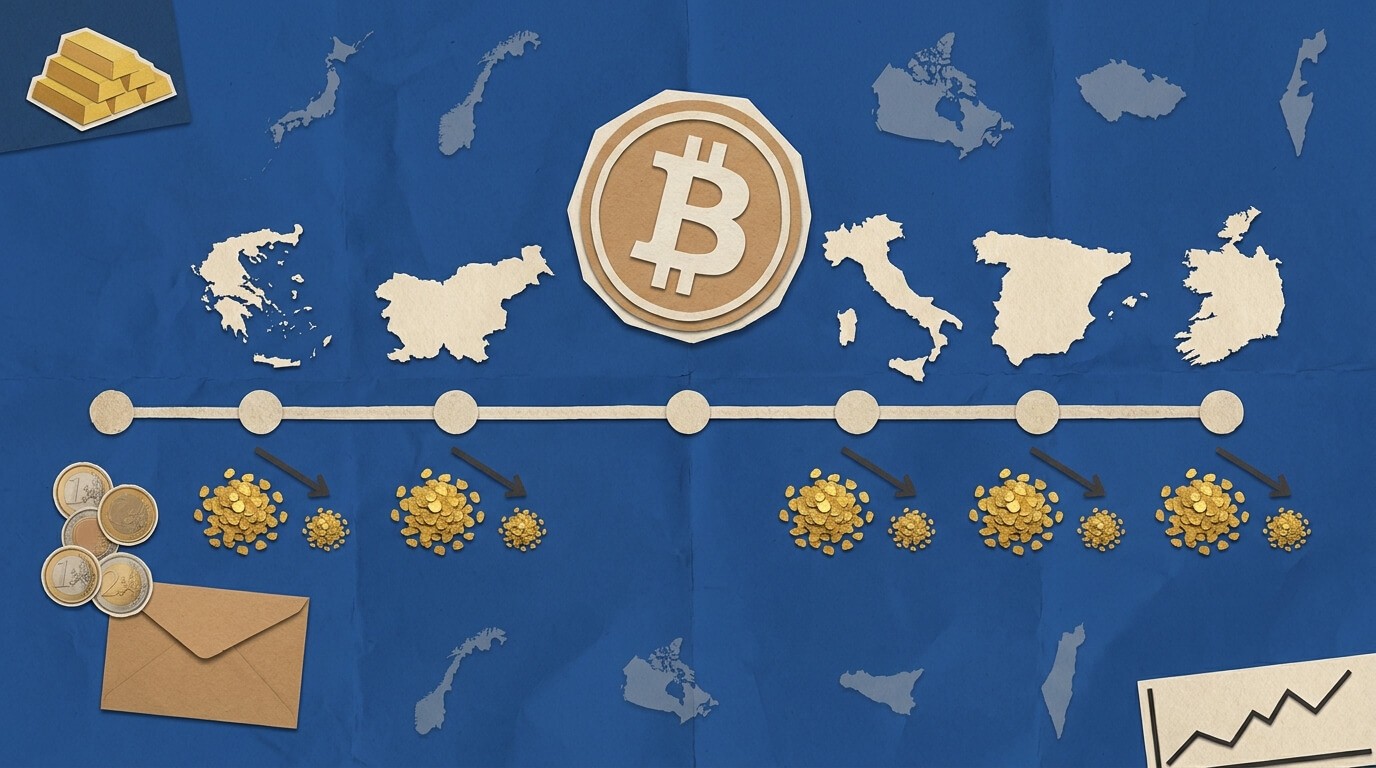
In this article, Coinjuice restated the Bitcoin results in satoshis for ten countries, then priced petrol and diesel in satoshis for 2020, 2025 and 2026 in five of the ten: Greece, Slovenia, Italy, Spain and Ireland. In the ten tabulated, the average salary bought 83% to 91% fewer satoshis in 2025 than in 2020. A litre of fuel also became markedly cheaper in satoshi terms. Wages in OECD countries rose between 2020 and 2025, yet the same salary now buys fewer stocks, less gold and less than one Bitcoin in all ten countries below. Workers relying on wages alone may find asset ownership moving further away despite pay rises.
How Many Satoshis Did a Salary Buy in 2020 and 2025?
Taurex, ranks countries by the fall in stock purchasing power, led by Greece at 56.6%. The Taurex summary does not state whether salaries are gross or net, whether prices are year-end or average figures, or whether indices include dividends. Its window runs from 2020 to 2025, and a different window would give different figures.
Salary divided by a price measures relative affordability, not investor returns.
How to read the table below: Read the row for Greece, ranked first. The average Greek salary in 2025 bought approximately 57% fewer stocks than the average Greek salary in 2020. In gold, it fell from 10.4 ounces to 6.2. In Bitcoin, it fell from 1.65 to 0.21. In satoshis, the Greek wage fell from 165 million to 21 million, a drop of 87%.
Rank | Country | Stocks vs 2020 | Gold oz per salary | BTC per salary | Satoshis per salary | Sats change |
1 | Greece | -56.6% | 10.4 to 6.2 | 1.65 to 0.21 | 165M to 21M | -87.3% |
2 | Slovenia | -45.4% | 17.1 to 12.4 | 2.72 to 0.42 | 272M to 42M | -84.6% |
3 | Czechia | -40.0% | 11.0 to 8.5 | 1.75 to 0.29 | 175M to 29M | -83.4% |
4 | Japan | -39.5% | 24.7 to 10.1 | 3.93 to 0.34 | 393M to 34M | -91.3% |
5 | Israel | -37.4% | 27.5 to 17.7 | 4.39 to 0.60 | 439M to 60M | -86.3% |
6 | Italy | -36.4% | 18.8 to 11.5 | 2.99 to 0.39 | 299M to 39M | -87.0% |
7 | Norway | -35.1% | 34.7 to 20.6 | 5.52 to 0.70 | 552M to 70M | -87.3% |
8 | Spain | -32.5% | 17.9 to 11.6 | 2.85 to 0.39 | 285M to 39M | -86.3% |
9 | Canada | -30.6% | 30.5 to 17.9 | 4.85 to 0.60 | 485M to 60M | -87.6% |
10 | Ireland | -30.2% | 33.1 to 20.9 | 5.28 to 0.71 | 528M to 71M | -86.6% |
Source: Taurex, September 2026. Gold in ounces per annual salary. Satoshi columns are Coinjuice conversions of Taurex’s rounded coin counts, so approximate.
Observation: Across the ten tabulated countries, the satoshi income is between 83.4% and 91.3% lower in 2025 than in 2020.
Interpretation: Bitcoin’s price rose faster than wages by a wide margin, and a Taurex analyst called the framing of pay rises beyond inflation technically accurate and also quite misleading.
Benefit: Measuring pay in satoshis exposes a gap the currency figure hides.
Bitcoin’s Fall Gives a 2025 Wage About 21% More Satoshis
The 2025 column above prices each wage at Taurex’s 2025 Bitcoin price, which Coinjuice derives at about €89,400 per Bitcoin from Taurex’s own figures. The table below keeps those 2025 sats and adds the same unchanged wage priced at Bitcoin’s $82,652 on 8 October 2026, with an ECB EUR/USD rate of 1.1186 (about €73,889 per Bitcoin). 2026 wages are not yet known, so the second column is an illustration.
How to read the table below: Read the row for Greece. The average Greek salary in 2025 was 18,801 euros. At Taurex’s 2025 Bitcoin price, the wage bought 21.00 million sats. Bitcoin is cheaper now than it was on average in 2025, so the same €18,801 buys more BTC: 25.44 million sats instead of 21.00 million, which is approximately 21% more.
Country | Salary 2025 (EUR) | Sats at 2025 price (Taurex) | Same wage at 8 Oct 2026 price | Change |
Greece | 18,801 | 21.00M | 25.44M | +21.1% |
Slovenia | 37,569 | 42.00M | 50.85M | +21.1% |
Italy | 34,733 | 39.00M | 47.01M | +20.5% |
Spain | 35,121 | 39.00M | 47.53M | +21.9% |
Ireland | 63,379 | 71.00M | 85.78M | +20.8% |
Taurex’s coin counts are rounded to two decimals, so changes are approximate.
Bitcoin trades about 35% below its record of $126,198 on 6 October 2025. Against Taurex’s implied 2025 Bitcoin benchmark, the fall is smaller, about 17% in euros, so the unchanged wage buys about 21% more sats than a year of 2025 prices allowed. The gap to 2020 stays wide: Greece’s 25.44M sats today compare with 165M in 2020.
What Did a Litre of Fuel Cost in Euros in 2020, 2025 and 2026?
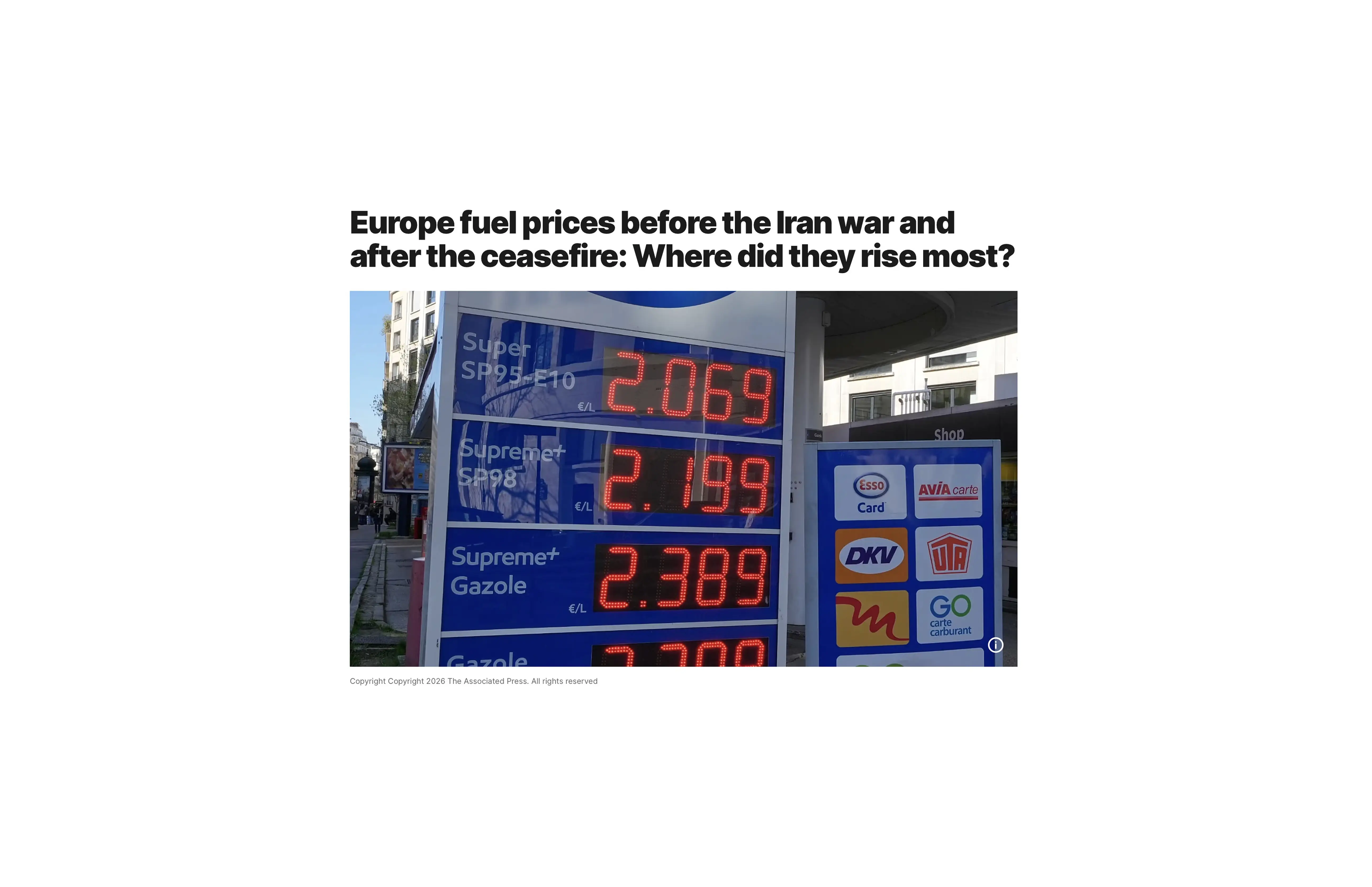
Fuel gives an everyday cost to set against the asset figures. Each column uses the same EU Weekly Oil Bulletin week, national average prices with taxes included, so the three years are comparable. Petrol and diesel appear separately.
Country | Petrol 5 Oct 2020 | Petrol 6 Oct 2025 | Petrol 5 Oct 2026 | Diesel 5 Oct 2020 | Diesel 6 Oct 2025 | Diesel 5 Oct 2026 |
Greece | 1.424 | 1.751 | 2.203 | 1.134 | 1.544 | 2.166 |
Slovenia | 1.002 | 1.464 | 1.763 | 0.999 | 1.489 | 1.981 |
Italy | 1.388 | 1.709 | 2.073 | 1.263 | 1.636 | 2.273 |
Spain | 1.162 | 1.482 | 1.849 | 1.029 | 1.413 | 1.918 |
Ireland | 1.239 | 1.717 | 1.983 | 1.134 | 1.664 | 2.164 |
Euros per litre. Sources, fuel-prices.eu reproducing the EU Weekly Oil Bulletin: Greece 2020, 2025, 2026; Slovenia 2020, 2025, 2026; Italy 2020, 2025, 2026; Spain 2020, 2025, 2026; Ireland 2020, 2025, 2026.
In euros, petrol rose 49% to 76% between October 2020 and October 2026, and diesel rose 80% to 98%. At the 2025 wage, Greece’s average salary bought 12,177 litres of diesel in the 6 October 2025 week and 8,680 in the 5 October 2026 week, a fall of 29%. Ireland’s fell from 38,088 to 29,288 litres, a fall of 23%.
What Did a Litre of Fuel Cost in Satoshis in 2020, 2025 and 2026?
Bitcoin prices come from CoinMarketCap’s 5 October 2020 snapshot ($10,793, about €9,172 at the ECB rate of 1.1768), its 6 October 2025 snapshot ($124,753, about €106,827 at the ECB rate of 1.1678) and the 8 October 2026 price above.
Country | Petrol sats/L 2020 | 2025 | 2026 | Diesel sats/L 2020 | 2025 | 2026 |
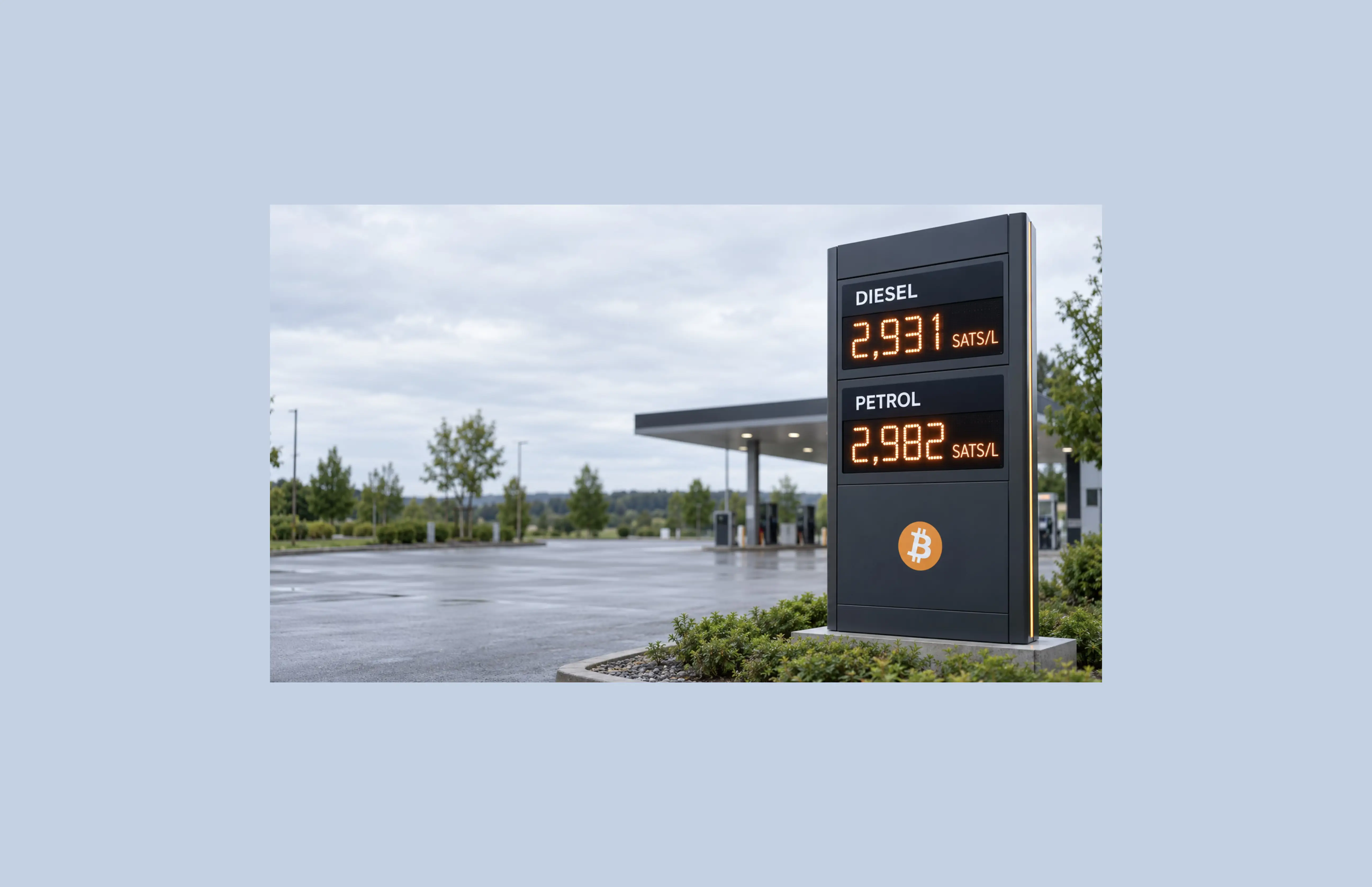
Greece | 15,526 | 1,639 | 2,982 | 12,364 | 1,445 | 2,931 |
Slovenia | 10,925 | 1,370 | 2,386 | 10,892 | 1,394 | 2,681 |
Italy | 15,133 | 1,600 | 2,806 | 13,771 | 1,531 | 3,076 |
Spain | 12,669 | 1,387 | 2,502 | 11,219 | 1,323 | 2,596 |
Ireland | 13,509 | 1,607 | 2,684 | 12,364 | 1,558 | 2,929 |
How Many Litres of Fuel Does One Million Satoshi Buy?
One million satoshis is 0.01 Bitcoin, or one hundredth of a coin. For October 2026, Coinjuice used Bitcoin’s price from October 8, 2026 and fuel prices from the week of October 5, 2026, so the two dates sit three days apart.
Country | Petrol litres per 1M sats, Oct 2020 | Oct 2026 | Diesel litres per 1M sats, Oct 2020 | Oct 2026 |
Greece | 64 | 335 | 81 | 341 |
Slovenia | 92 | 419 | 92 | 373 |
Italy | 66 | 356 | 73 | 325 |
Spain | 79 | 400 | 89 | 385 |
Ireland | 74 | 373 | 81 | 341 |
Satoshi values move with Bitcoin’s price. The 2025 column sits at a price near the record, so it shows the lowest sat cost of a litre.
Observation: In October 2020, one million sats bought the least petrol in Greece (64 litres) and the most in Slovenia (92 litres). By October 2026, one million sats bought 335 litres in Greece and 419 in Slovenia, about five times as much in each. In euros, the same litre of petrol rose from €1.424 to €2.203 in Greece (up 55%) and from €1.002 to €1.763 in Slovenia (up 76%). Diesel followed the same pattern: Italy bought the least in 2020 (73 litres) and Slovenia the most (92 litres), and by 2026 Italy bought 325 litres and Spain 385, four to five times as much. Holding satoshis insulated the cost of inflation as designed.
Interpretation: Fuel became dearer in euros and cheaper in satoshis over the same six years, while the average salary lost ground to Bitcoin. Pricing everyday goods in satoshis, as in the Bitcoin unit of account study and the satoshi price of a full English breakfast, turns the cost of living into small, countable numbers.
Benefit: Measured in satoshis, both points land together. Greece’s average wage bought 87.3% fewer sats between 2020 and 2025, and one million sats bought five times as much Greek petrol between October 2020 and October 2026. Wages lost ground to the asset, and the asset gained ground on fuel, so a saver counting in sats sees what a euro price hides. Both findings are historical, not forecasts.
What Saving in Satoshis Offers
The 2020 start and the October 2026 end are two dated points, so a different pair would give different multiples, and Bitcoin can fall as well as rise.
The Taurex figures show historical asset appreciation relative to wages, and the fuel tables show historical everyday prices. Neither predicts future prices. Coinjuice’s analysis is that buying and holding sats gives savers direct exposure to the asset whose price has outpaced wages, rather than remaining unexposed to an asset that, over the period measured, outpaced wages. Holding needs a custody plan, covered in the self-custody security layers guide. Coinjuice’s ebook on trading without leverage covers position sizing.
Pay rises and falling asset affordability can coexist, and workers relying on wages alone may find asset ownership moving further away despite pay rises.
Disclaimer
This article is for information only and is not financial, investment or tax advice. Bitcoin’s price is volatile and can fall as well as rise. The figures describe historical relationships between wages, asset prices and fuel prices, and they do not predict future results or show what happened to total living costs. Readers should do their own research before making any decision.
FAQ
What did Taurex measure?
Taurex compared OECD average salary data for 2020 to 2025 with stocks, gold and Bitcoin in 34 countries and published the findings in September 2026.
How many years of average salary buy one Bitcoin?
At Taurex’s 2025 figures, Greece needed about 4.8 years of average salary to buy one Bitcoin, up from about 0.6 years in 2020. The ten countries tabulated ranged from about 1.4 years (Norway and Ireland) to 4.8 years (Greece) in 2025.
How many satoshis are in one Bitcoin?
One Bitcoin equals 100,000,000 satoshis.
How does Coinjuice convert euros to satoshis?
Satoshis equal the euro price divided by the BTC/EUR rate, multiplied by 100,000,000. On 8 October 2026 one euro was about 1,353 sats.
Does the data prove saving in Bitcoin protects living standards?
No. It shows historical asset appreciation relative to wages and historical fuel prices in satoshis. It does not establish future performance.
Disclaimer
The information provided in this article is for informational purposes only. It is not intended to be, nor should it be construed as, financial advice. We do not make any warranties regarding the completeness, reliability, or accuracy of this information. All investments involve risk, and past performance does not guarantee future results. We recommend consulting a financial advisor before making any investment decisions.
More like this

Written by

Andrew Kamsky
Andrew Kamsky is a Bitcoin analyst. He spent a decade in traditional finance across a Big Four firm and a listed fintech bank before going deep on Bitcoin full-time.