









Quick summary
BIP-361 proposes a three-phase migration to quantum-resistant cryptography before quantum computers mature
Phase A gives about three years to move coins from old addresses to quantum-safe ones
Phase B freezes remaining legacy-address coins, with Phase C aiming to recover some via seed proofs
BIP-361 pairs with BIP-360’s Dilithium-based infrastructure and faces governance, hard-fork, immutability debates
BIP-361 is a formal Bitcoin Improvement Proposal that lays out a structured, three-phase plan for migrating Bitcoin away from cryptography that quantum computers could eventually break, before they actually break it.
A protocol-level decision that will affect every Bitcoin holder, and one worth understanding now while the timeline is still measured in years.
Why Quantum Computers Threaten Bitcoin
Bitcoin's security rests on a type of math called elliptic curve cryptography (ECC). Three things have to hold for Bitcoin security to remain:
Digital signature: When a transaction is sent, a wallet produces a signature using the private key
Network verification: The network confirms that signature using the public key
One-way protection: No one can work backwards from a public key to derive the private key.
As long as all three points hold, the coins stay safe.
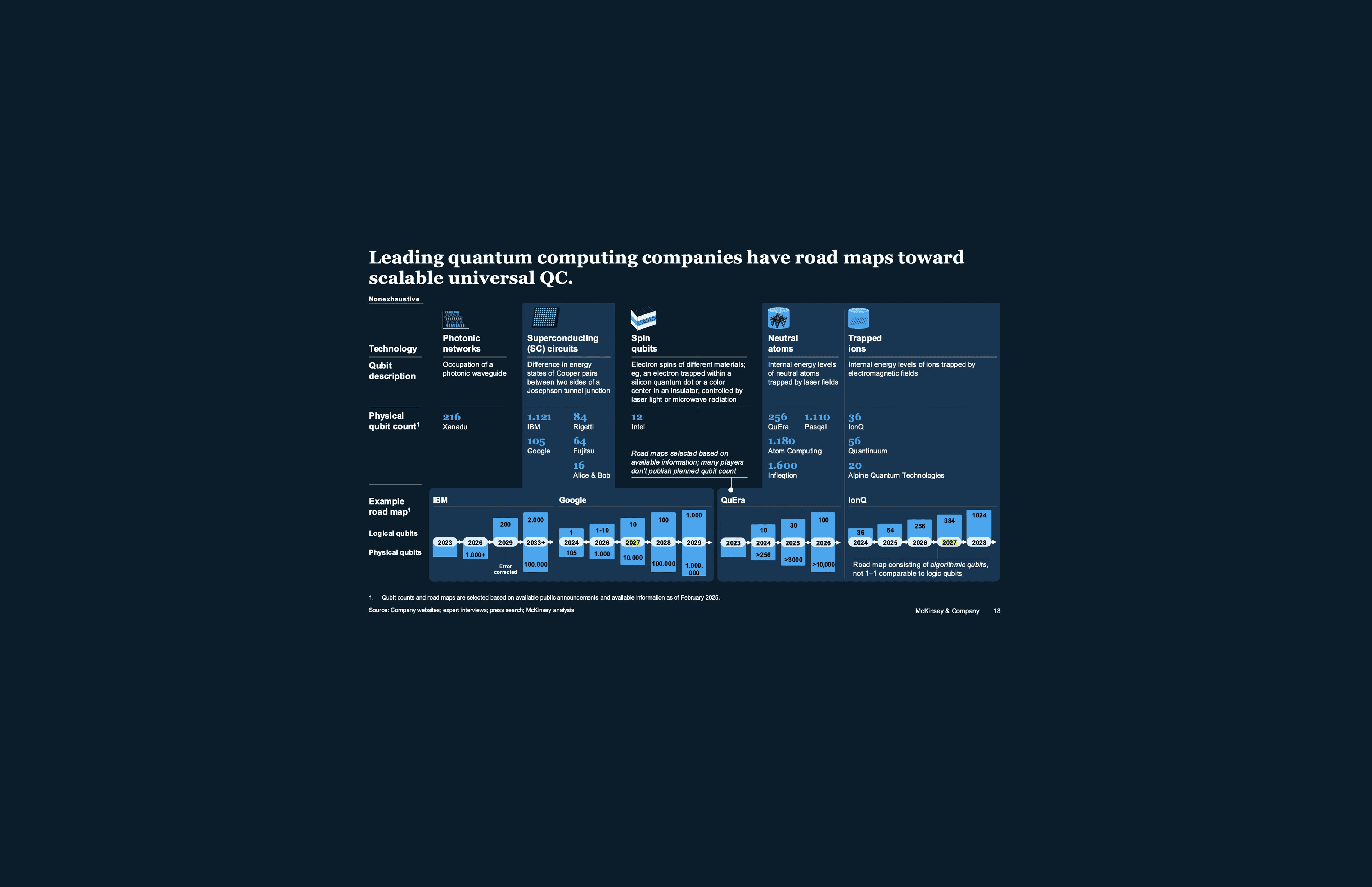
Classical computers cannot perform that reversal of the public key to private key in any practical timeframe. Quantum computers running an algorithm called Shor's algorithm, however, could and academic roadmaps now place cryptographically relevant machines arriving between 2027 and 2030, with recent algorithmic advances potentially compressing that window by up to 20×.
Bitcoin Addresses That Have Already Sent Funds Are Vulnerable
Bitcoin addresses that have already sent a transaction have their public key permanently recorded on the blockchain.
Once that public key is visible, a sufficiently powerful quantum computer could derive the private key and access the funds. As of early 2026, 34% of Bitcoin's entire UTXO set contains addresses with exposed public keys. At current prices, hundreds of thousands of BTC sit in that category.
What BIP-361 Actually Is
BIP-361, formally titled "Post-Quantum Migration and Legacy Signature Sunset," was authored by Jameson Lopp, Christian Papathanasiou, Ian Smith, Joe Ross, Steve Vaile, and Pierre-Luc Dallaire-Demers. Published as an informational draft on February 11, 2026, it is not a panic response, it is a structured migration plan designed to convert a future emergency into a managed process.
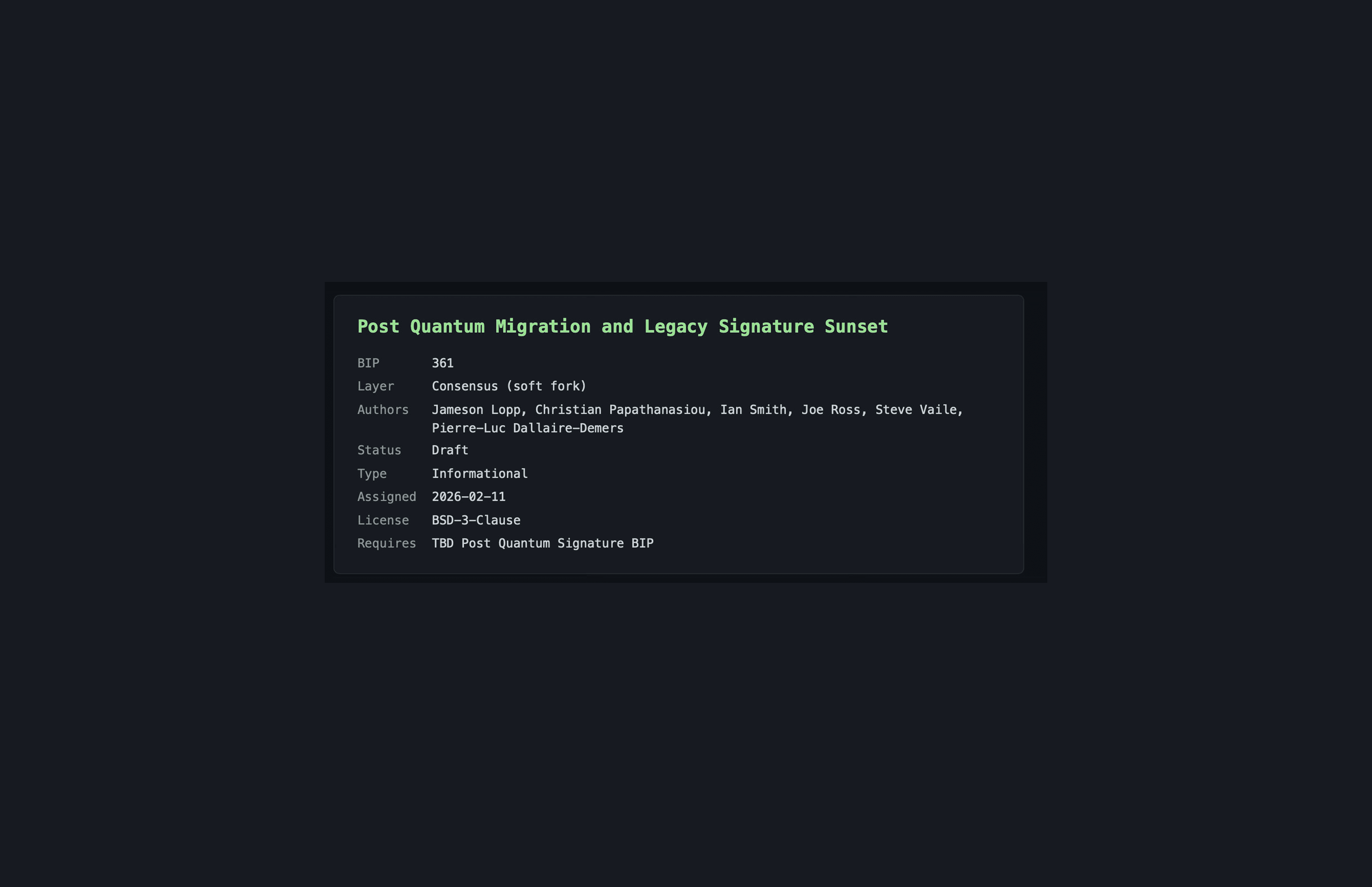
BIP-361 follows a similar proposal pattern with one distinction: the threat it is responding to is a class of computing that did not exist when Bitcoin launched.
Bitcoin's Three-Phase Quantum Migration Plan: What Holders Need to Know
Phase A: The Migration Window — why new addresses matter immediately
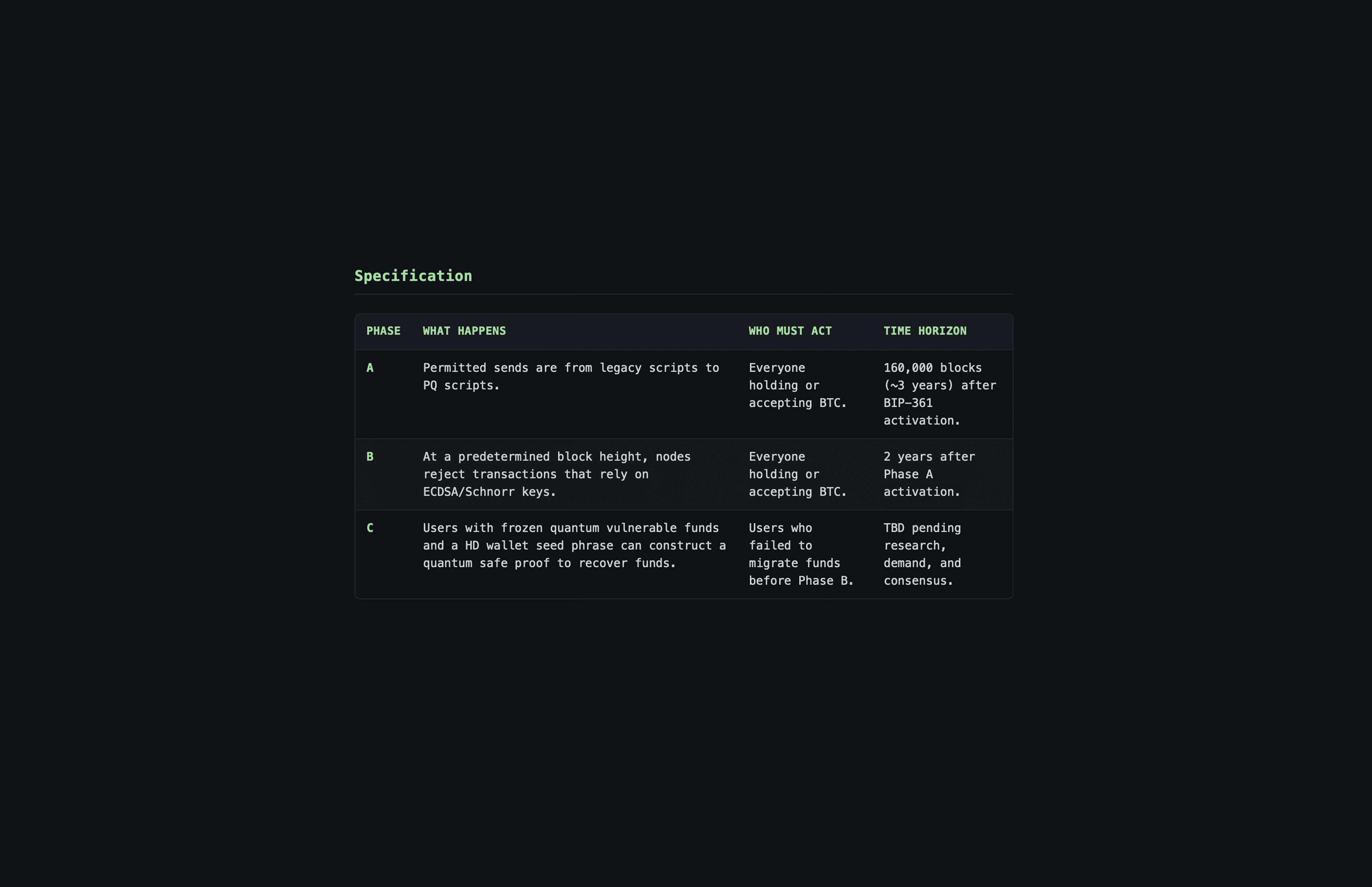
If BIP-361 activates, roughly three years after it does, the network stops accepting Bitcoin sent to old-style addresses. Any Bitcoin moved to a quantum-resistant address during this window is no longer at risk. Holders who act here are done, they have nothing further to worry about.
The 160,000-block window, approximately three years at Bitcoin's average ten-minute block time, is deliberate. Bitcoin upgrades historically take time to coordinate across wallets, exchanges, and hardware, and the proposal is designed to give the ecosystem a realistic runway to move.
Phase B: The Signature Sunset — what happens to coins left behind
Two years after Phase A ends, at a pre-announced block height, nodes will reject any transaction attempting to spend from a legacy ECDSA or Schnorr address. Coins in quantum-vulnerable addresses at that point become frozen.
The implication is direct: coins that have not been moved to quantum-resistant addresses by the sunset will be inaccessible until their owners can prove ownership through quantum-safe cryptographic methods. For holders who lost seed phrases, or for long-dormant wallets, recovery becomes uncertain.
Coins attributed to Satoshi Nakamoto, estimated at roughly 1.1 million BTC across thousands of addresses fall into this category. Given Satoshi's absence from the ecosystem, those coins would almost certainly remain frozen.
Supporters of Phase B argue this is the only way to eliminate the attack surface. A quantum attacker targeting Bitcoin would not announce itself; it would drain vulnerable addresses silently, gradually, over time. The sunset converts that threat from covert theft into a permanently closed door.
Phase C: The Recovery Mechanism — still in development
Phase C is the safety net for any holder who missed the Phase B deadline. If coins are frozen, this mechanism would allow a holder to prove ownership — using their seed phrase — without exposing the private key. Prove ownership, recover access.
There is a significant caveat. Phase C is built around BIP-39 seed phrases, which were not introduced until 2013. Any Bitcoin held in wallets created before that date — including coins attributed to Satoshi Nakamoto — used a different key system that this recovery method cannot reach. For those coins, Phase C offers no path back.
The mechanism remains under active research and is not yet fully specified. Whether it works in practice, and for whom, will be a significant factor in how the broader community evaluates the proposal as a whole.
How BIP-361 and BIP-360 Work Together
Think of it as policy and infrastructure. BIP-361 sets the rules, what has to happen and when. BIP-360, developed by BTQ Technologies, builds the road, the new opcodes that make quantum-resistant transactions possible in the first place. Without BIP-360, or a comparable proposal, there would be no quantum-safe address type to migrate to.
BIP-360 runs on Dilithium (ML-DSA), a post-quantum signature scheme ratified by NIST in 2024. BTQ's testnet has mined over 100,000 blocks using this infrastructure, moving the proposal from theory into something that can be tested and validated in practice.
What Bitcoin Retail Holders Can Do Right Now
BIP-361 has not yet been activated. But the vulnerability it addresses — exposed public keys — can be mitigated today, regardless of how the proposal ultimately proceeds. Where a holder stands depends on one thing: whether their address has ever sent a transaction or not.
A retail holder is actively mitigating against a quantum threat if they:
Have never spent from the address: The public key has never been exposed. Provided the coins remain in self custody, they carry no current quantum exposure. Modern address formats — bech32 and Taproot — do not reveal the public key until the first spend.
Have previously sent from an older address: The public key is already on-chain. The most meaningful step available today is to consolidate into a fresh, unspent address and avoid reusing it — reducing the window of exposure. Pay-to-public-key (P2PK) addresses — common in Bitcoin's earliest transactions from 2009 to 2010 — are the highest priority. The public key is embedded directly in the script, making exposure unconditional regardless of spend history.
The Governance Debate
No Bitcoin protocol change of this scale moves without contested debate, and BIP-361 is no exception.
The Hard Fork Question
BIP-361 is classified in the proposal as a soft fork. Charles Hoskinson, Ethereum co-founder and founder of Cardano, has challenged this directly. In a public response to the proposal, Hoskinson argued that freezing legacy transaction types at the consensus layer cannot be achieved without a hard fork and that the proposal's authors are aware of this.
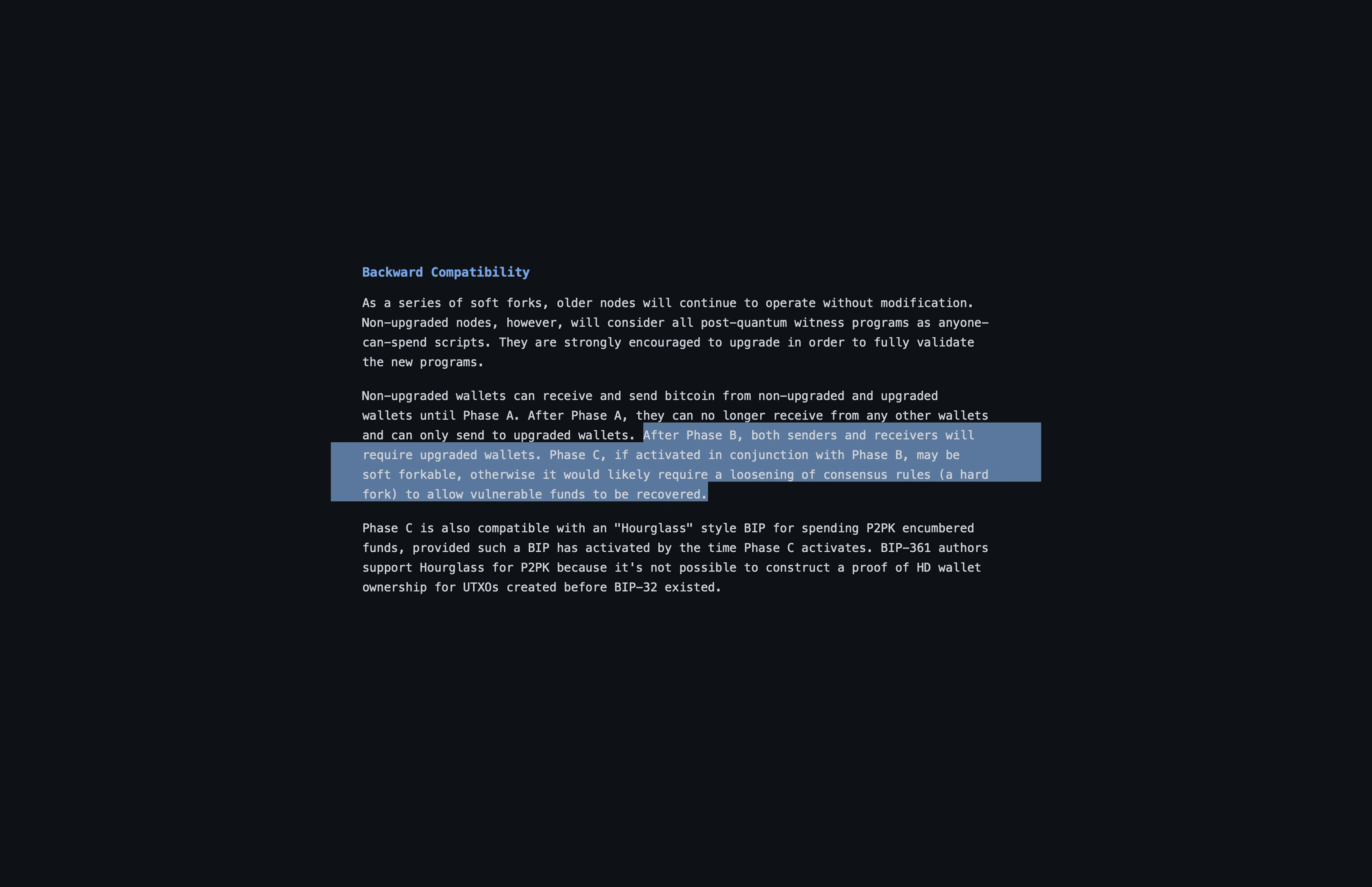
The proposal's own backward compatibility section acknowledges that Phase C may require a hard fork to implement. The classification remains contested.
The Immutability Concern
Bitcoin's foundational property has always been that no external authority can freeze or confiscate coins. Phase B would freeze coins, even if the stated purpose is protection. Critics argue that establishing this precedent is a greater long-term threat than quantum computers themselves. Once the network accepts preemptive coin freezing as a legitimate governance action, the logic can be applied to future situations for different stated reasons.
The Canary Address Alternative
Alternative approaches have been proposed. A market-driven canary address model would establish known-vulnerable addresses with small Bitcoin balances. When canary coins move without the owner's action, the network receives an early warning signal and can activate protective measures reactively.
The Case for a Pre-Announced Sunset
Supporters counter that a reactive approach hands the advantage to the attacker. A sophisticated quantum actor would not target high-profile canary addresses first, it would begin with less visible, higher-value targets, draining them quietly over months. A pre-announced, time-bound sunset closes the attack surface permanently.
The coordination challenge: Coordinating decentralised networks is slow. Bitcoin's own history reflects this — major protocol changes have historically taken years to reach consensus. BIP-361's phased, deadline-driven structure is designed with that reality in mind.
Conclusion
BIP-361 is a planning document, not a crisis response. The quantum threat to Bitcoin's ECDSA-based cryptography is real, the timeline is compressing, and the proportion of exposed Bitcoin — 34% of the UTXO set — is large enough that the question cannot be deferred indefinitely.
Whether BIP-361 is the right mechanism, whether alternative approaches prove more compatible with Bitcoin's values, or whether the timeline shifts in ways that change the calculus, the underlying problem does not go away. The best position for any Bitcoin holder is to understand what the exposure is, take the steps that are available today, and follow the governance process as it develops.
BIP-361 was published as an informational draft on February 11, 2026, authored by Jameson Lopp, Christian Papathanasiou, Ian Smith, Joe Ross, Steve Vaile, and Pierre-Luc Dallaire-Demers. The full specification is available on the Bitcoin GitHub repository.
FAQ
What is BIP-361 and why was it created?
BIP-361, formally titled "Post-Quantum Migration and Legacy Signature Sunset," is a three-phase Bitcoin Improvement Proposal designed to migrate Bitcoin away from cryptography that quantum computers could eventually break. It aims to turn a potential future emergency caused by quantum attacks into a managed, structured process affecting all Bitcoin holders.
Why do quantum computers pose a threat to Bitcoin?
Bitcoin relies on elliptic curve cryptography, where security depends on no one being able to derive a private key from a public key. Classical computers cannot do this in any practical timeframe, but quantum computers running Shor's algorithm could. Academic roadmaps place cryptographically relevant quantum machines between 2027 and 2030, with advances potentially compressing that window by up to 20×.
What happens in Phases A and B of BIP-361?
In Phase A, over a 160,000-block (about three-year) window after activation, the network will stop accepting Bitcoin sent to old-style addresses, and coins moved to quantum-resistant addresses during this time are no longer at risk. Phase B begins two years after Phase A ends; at a pre-announced block height, nodes will reject any transaction spending from legacy ECDSA or Schnorr addresses, causing coins that remain in quantum-vulnerable addresses to become frozen until ownership can be proven via quantum-safe methods.
How are BIP-361 and BIP-360 related?
BIP-361 defines the rules and timeline for the quantum migration, while BIP-360 provides the technical infrastructure needed for quantum-resistant transactions. BIP-360, developed by BTQ Technologies, introduces new opcodes based on Dilithium (ML-DSA), a NIST-ratified post-quantum signature scheme, enabling the quantum-safe address type that BIP-361’s migration requires.
Disclaimer
The information provided in this article is for informational purposes only. It is not intended to be, nor should it be construed as, financial advice. We do not make any warranties regarding the completeness, reliability, or accuracy of this information. All investments involve risk, and past performance does not guarantee future results. We recommend consulting a financial advisor before making any investment decisions.
More like this


Written by

Andrew Kamsky
Andrew Kamsky is a Bitcoin analyst. He spent a decade in traditional finance across a Big Four firm and a listed fintech bank before going deep on Bitcoin full-time.