












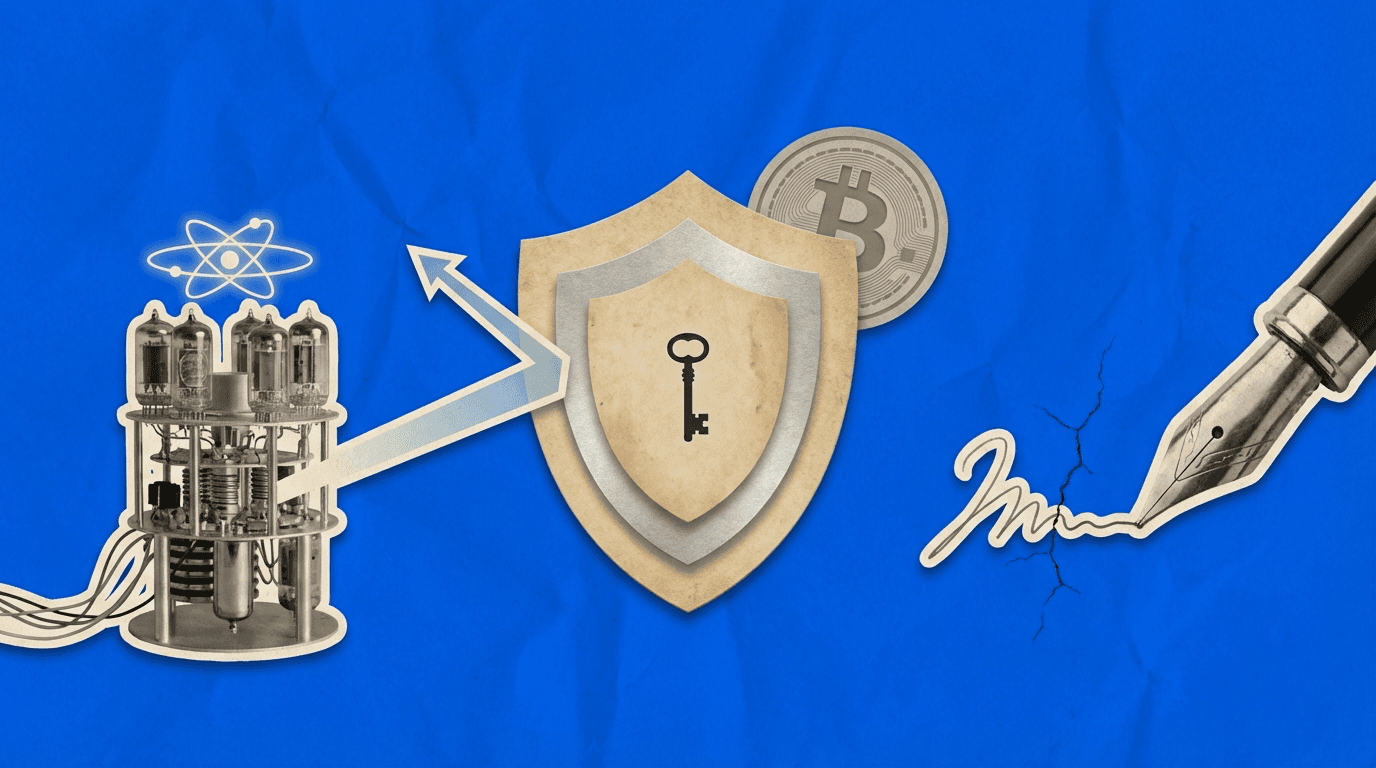
Quick summary
Quantum computers threaten exposed public keys, not SHA-256 protected Bitcoin addresses
Bitcoin becomes quantum-exposed the moment a wallet signs a transaction and reveals its public key on the blockchain
Unspent coins held in cold storage addresses that have never signed a transaction remain outside the quantum attack surface entirely
Holders reduce risk by keeping long-term holdings in wallets that have never signed a transaction and avoiding address reuse
Quantum computing technology introduces a specific cryptographic threat: the ability to reverse-engineer private keys from exposed public keys, an attack that classical computers cannot execute at meaningful scale.
Bitcoin is not immune to this development. But the risk is narrower than most headlines suggest, and it does not fall evenly across the network.
The exposure depends on one variable: whether a wallet has ever signed a transaction.
How Bitcoin's Security Works
Bitcoin wallets are protected by two separate cryptographic layers, and they serve different functions.
What is SHA-256 Hash
When a wallet is created, three things are generated in sequence — a private key, a public key, and an address. Think of them as a stack, each one derived from the one above it:
Private key: Sits at the top of the stack. It never leaves the wallet and is never visible to the outside world under any circumstances.
Public key: Derived from the private key and then processed through two hashing algorithms in sequence — first SHA-256, then RIPEMD-160. Together they convert the public key into a Bitcoin address. Both functions are one-way. The public key stays concealed behind that two-stage process.
Address: The output of that hashing process. It is what gets shared publicly to receive funds.
What is An ECDSA Signature
When a wallet is used to spend funds, a transaction is authorized and broadcast and the private key is used to generate a cryptographic signature. That signature proves ownership without revealing the private key itself. However, it does require the public key to be published alongside it on the blockchain for verification.
This is the moment the security model changes. Before spending, only the address was visible. After spending, the public key is permanently on the blockchain.
What Quantum Computing Targets
Quantum computers are not fast enough to break SHA-256. To date, no known algorithm, classical or quantum, can break SHA-256 outright. Grover's algorithm, a quantum approach, does introduce a theoretical speedup against hash functions, but Grover’s algorithm reduces effective security from 256 bits to approximately 128 bits, a level that remains computationally out of reach for any foreseeable attack.
Are Unspent Bitcoin Safe from Quantum Attacks?
In practical terms, a holder with Bitcoin in cold storage who has never made an outbound transaction remains protected by SHA-256 and related hashing mechanisms. The private key has never left the wallet, and the public key has never been revealed on-chain. No known algorithm — classical or quantum — can derive the private key under those conditions.
Early Bitcoin transactions, particularly those using Pay-to-Public-Key (P2PK), exposed public keys directly, without any hashing layer. Modern address formats (P2PKH and later) introduced an additional layer of protection by hashing the public key before it is ever revealed on the blockchain.
As a result, coins held in older P2PK outputs carry a different risk profile and are widely considered more exposed in a future quantum scenario.
What Does "Exposed" Mean: Is My Bitcoin at Risk?
In Bitcoin's security model, quantum exposure has a precise definition. It is the theoretical reverse-engineering of a public key that has already been revealed on the blockchain.
The dividing line is not how long coins have been held or how large the balance is. It is whether the wallet has ever signed a transaction.
Current network position: A large portion of Bitcoin in circulation has never been moved. Those coins have never revealed a public key. They sit outside the attack surface entirely.
That single event, a first spend, is what separates coins that quantum computing can theoretically target from coins that it cannot.
What Quantum Computers Can and Cannot Do
Quantum computers could break ECDSA efficiently using Shor's algorithm once sufficiently powerful machines exist. Quantum computers are not fast at breaking the type of lock Bitcoin uses to generate addresses (called SHA-256).
That distinction defines the entire risk:
Unspent bitcoin: Coins behind an untouched address remain protected by SHA-256 and are not directly targeted by quantum attacks.
Spent bitcoin: Coins moved through a signed transaction have revealed their public key, making quantum attacks theoretically possible.
The threat is real and precise but it does not affect the network uniformly. This means exposure is event-based, not time-based.
How Bitcoin Holders Can Reduce Quantum Risk Today
While the long-term timeline for breaking ECDSA remains uncertain, the practical response for individual holders is straightforward.
The key principle is simple: minimize public key exposure.
Preserve cold storage: Keep long-term holdings in wallets that have never signed a transaction.
Avoid address reuse: Do not repeatedly spend from the same address, as each transaction confirms and exposes the public key.
Use fresh wallets for spending: Before making a transaction from a hodl wallet, move funds from long-term storage to a new wallet, then spend from there.
This approach ensures that the primary “hodl” wallet remains outside the quantum attack surface at all times, while only smaller, actively used wallets become exposed temporarily.
What Responsible Holders Can Do Right Now
The practical response is simpler than most coverage suggests.
A holder with no immediate intention to sell is already in the strongest possible position. Current expert estimates place meaningful quantum capability at roughly five to ten years away — a substantial window to proactively reposition funds.
Conclusion
Quantum computing does not represent an existential threat to Bitcoin in its current form. It represents a precise and measurable one concentrated in wallets that have already revealed their public keys, in exchanges that cannot stop signing, and in holders who have accumulated exposure through years of address reuse.
The majority of Bitcoin in circulation has never signed a transaction. It has never revealed the key required to attack it. For that portion of the network, the quantum threat does not exist in any practical sense today.
The story here is not one of collapse. More so a shift in what responsible custody requires and a window of five to ten years in which the network, its developers, and its holders have every opportunity to respond.
Bitcoin has faced existential narratives before. It has responded with protocol improvements, behavioral change, and infrastructure development every time. Quantum computing will be no different.
FAQ
When is Bitcoin most exposed to quantum attacks?
Bitcoin is most exposed once a wallet has signed a transaction, because the public key must then be published on the blockchain, making it theoretically possible for a quantum computer to reverse-engineer the private key.
Are unspent bitcoins in cold storage safe from quantum attacks?
Yes. If a wallet has never made an outbound transaction, its public key has never been revealed on-chain and remains protected behind SHA-256 and related hashing mechanisms, with no known classical or quantum algorithm able to derive the private key.
What is the difference between unspent and spent bitcoin in terms of quantum risk?
Unspent bitcoin behind an untouched address is protected by SHA-256 and is not directly targeted by quantum attacks, while spent bitcoin has revealed its public key through a signed transaction, making quantum attacks theoretically possible.
How can Bitcoin holders reduce their quantum risk today?
Holders can minimize public key exposure by keeping long-term holdings in wallets that have never signed a transaction, avoiding address reuse, and using fresh wallets for spending by first moving funds from long-term storage to a new wallet before transacting.
Disclaimer
The information provided in this article is for informational purposes only. It is not intended to be, nor should it be construed as, financial advice. We do not make any warranties regarding the completeness, reliability, or accuracy of this information. All investments involve risk, and past performance does not guarantee future results. We recommend consulting a financial advisor before making any investment decisions.
More like this
Written by

Andrew Kamsky
Andrew Kamsky is a Bitcoin analyst. He spent a decade in traditional finance across a Big Four firm and a listed fintech bank before going deep on Bitcoin full-time.