









Quick summary
Hyperliquid pursues US regulatory legitimacy via CFTC engagement, despite lobbying pushback from CME and ICE
Exchange dominates perp DEX market with 36.4% share; HYPE nears all-time high price
BlackRock and others expand in-kind Bitcoin ETF conversions, lowering IBIT minimum to $1 million
Bitcoin and Hyperliquid both move deeper into regulated US infrastructure through different institutional rails
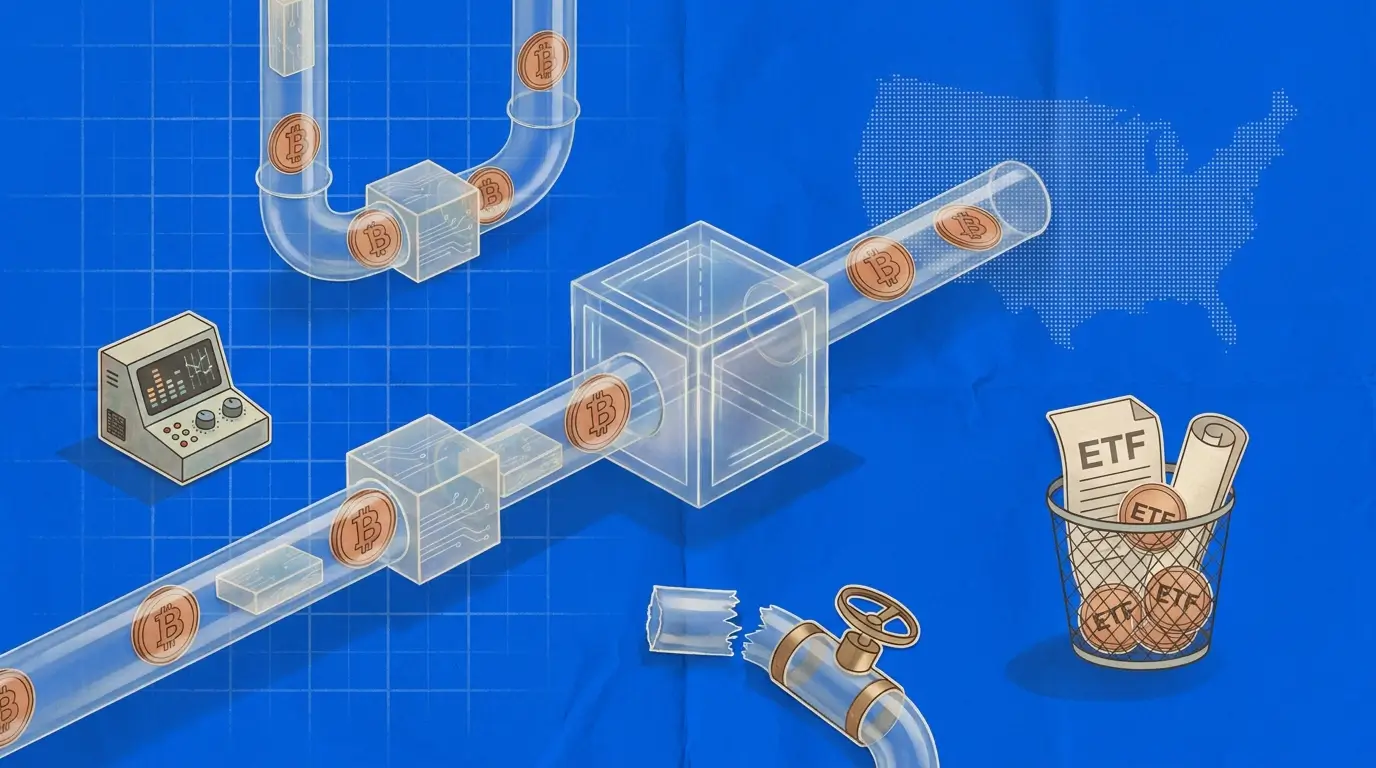
Bitcoin and Hyperliquid are converging on the same destination, regulated US market access, arriving through opposite doors.
Bitcoin trades at $79,023, 37.4% below its all-time high. Two structural stories are taking shape: the largest on-chain derivatives exchange is edging toward US regulatory legitimacy, while Wall Street is making it steadily easier for large Bitcoin holders to move coins directly into bank-issued ETFs.
Hyperliquid Nears US Compliance: A CFTC Path Years in the Making
Hyperliquid has spent the past week gaining regulatory attention that decentralized exchanges rarely receive without a subpoena attached. President Trump said publicly that the CFTC chair is working to bring Hyperliquid into the United States "in a fully compliant and legal fashion," a comment that landed alongside a broader Treasury-driven rally and has continued shaping how the exchange is discussed in Washington since.
The groundwork predates the headline: Hyperliquid's policy arm, funded with 1 million HYPE from the Hyper Foundation, has been submitting SEC comment letters for months, well before any presidential comment made the effort visible.
Not everyone in traditional finance wants this to happen: CME Group and ICE have lobbied against Hyperliquid, arguing the protocol carries market manipulation and sanctions evasion risk. Hyperliquid's counter is that full on-chain transparency makes bad actors easier to trace than on opaque legacy venues, not harder.
The market share behind the HYPE story is real, once measured against the full category: Hyperliquid processed $12.427 billion of the $34.15 billion in total 24-hour perp DEX volume across all 256 protocols DefiLlama tracks for derivatives, a 36.4% share, well ahead of the next-largest venue, Lighter, at $3.392 billion.
No rule exists yet: the CFTC has proposed nothing formal, and no US Hyperliquid entity has been created. The regulatory path is a direction of travel, rather than a finished process, and pricing the process as done risks mistaking anticipation for confirmation.
The token move is smaller than circulating figures suggest, though still the strongest read this session: HYPE trades at $81.70, within 1.9% of its August 23 all-time high, up 40.6% over seven days per the current warehouse snapshot.
Bitcoin ETFs: Wall Street Keeps Lowering the Cost of Moving Coins Onshore
While Hyperliquid works to bring an on-chain exchange onshore, a parallel process is pulling Bitcoin itself deeper into regulated financial infrastructure. In-kind conversion, swapping actual Bitcoin for ETF shares without a cash leg, is no longer a mechanism reserved for a handful of the largest trading desks.
The access threshold has been falling for weeks: BlackRock cut the in-kind creation and redemption minimum on IBIT from $25 million to $1 million in early August, a 96% reduction that opened the mechanism to a wider tier of institutional participants.
Adoption is now showing up at competitors, not just BlackRock: at Morgan Stanley, in-kind conversions account for roughly 5% to 7% of overall holdings in its $560 million MSBT fund, according to the bank's global head of ETFs, Ally Wallace, reported by Bloomberg within the past day.
The scale has grown well past its original size: BlackRock's Mitchnick says IBIT has facilitated more than $5 billion in in-kind conversions to date, up from roughly $3 billion when Bloomberg first reported on the trend last October.
The mechanism has a bottleneck: Wallace described a lengthy education process for institutions unfamiliar with the transaction type, and 21Shares reports its completed in-kind transactions averaging around $5 million, smaller and slower than the headline minimums suggest.
This does not touch retail accounts: in-kind conversion runs through authorized participants, typically banks and trading firms. It has no bearing on an ordinary brokerage account holder's ability to redeem ETF shares for Bitcoin directly.
The Lesson
Regulatory legitimacy and financial-product plumbing look like unrelated stories until they are placed side by side. Hyperliquid is trying to bring an on-chain venue into a compliant US structure. Wall Street is trying to make moving Bitcoin into a compliant US structure as frictionless as a bank transfer.
Bitcoin and Hyperliquid are converging on the same destination, regulated US market access, through opposite doors. The useful habit is tracking which door closes the gap first, rather than assuming either one already has.
Coinjuice Lens
Both developments extend a thread this desk has tracked through ETF demand and institutional treasury coverage this month: the recurring question is not whether Bitcoin-adjacent infrastructure keeps drawing regulated capital, but which rails end up carrying it. Neither the Hyperliquid regulatory conversation nor the in-kind conversion trend has run on Coinjuice before, so no forced link sits here. Both are new threads worth returning to as they develop.
News Behind Today’s Read
BTC price breaks out of six-week range to top $71,000. $3 billion in shorts wiped out (CoinDesk, Aug 20, 2026) — source for the CFTC's exploration of a compliant Hyperliquid path, raised by Trump alongside the same Treasury buyback rally.
BlackRock Cuts IBIT In-Kind Minimum From $25M to $1M (FinanceFeeds, Aug 10, 2026) — source for the 96% reduction in IBIT's in-kind conversion threshold.
BlackRock Helps Pull More Bitcoin Wealth Deeper Into Wall Street (Bloomberg via WealthManagement, Aug 26, 2026) — source for the Morgan Stanley 5–7% in-kind figure and the $5 billion cumulative IBIT conversion total. Note: this piece itself dates the original BlackRock cut to July, which conflicts with the August 10 on-air disclosure date reported elsewhere; the article's own body is the source of that inconsistency, not this draft.
Hyperliquid TVL, Fees, Revenue & Volume (DefiLlama) — source for HYPE price, ATH distance, and corrected 7-day performance, checked directly against the warehouse.
Perp DEX Volume Rankings (DefiLlama) — source for the corrected $34.15B category total and 36.4% Hyperliquid share.
This article was developed with the support of artificial intelligence tools as part of CoinJuice's editorial process and reviewed by our editorial team before publication.
Readers looking to navigate this stage of institutional integration can start with the Coinjuice ebook, Bitcoin Trading Without Leverage, or go deeper with a Coinjuice subscription, currently 30% off the annual plan, where we start and complete trades and you will learn to snipe them independently.
Market Snapshot
Asset | Price | Distance from ATH | 7d Change |
BTC | $79,023 | 37.4% below ATH ($126,156) | +22.9% (CoinGecko) |
ETH | $2,463 | 50.2% below ATH ($4,946) | +30.2% (CoinGecko) |
DeFi TVL | $87.9B | — | — |
FAQ
What regulatory progress is Hyperliquid making in the United States?
President Trump stated that the CFTC chair is working to bring Hyperliquid into the United States in a fully compliant and legal fashion, but the CFTC has not proposed any formal rule and no US Hyperliquid entity has been created yet.
How significant is Hyperliquid’s current market share among perpetual DEXs?
Hyperliquid processed $12.427 billion of the $34.15 billion in total 24-hour perp DEX volume across 256 protocols tracked by DefiLlama, giving it a 36.4% share and placing it well ahead of the next-largest venue, Lighter, at $3.392 billion.
What change did BlackRock make to IBIT’s in-kind conversion minimum, and why is it important?
BlackRock reduced the in-kind creation and redemption minimum for IBIT from $25 million to $1 million in early August, a 96% cut that opened this mechanism to a wider tier of institutional participants.
Can retail investors use in-kind conversion to redeem Bitcoin ETF shares for Bitcoin directly?
No. In-kind conversion runs through authorized participants, typically banks and trading firms, and has no bearing on an ordinary brokerage account holder’s ability to redeem ETF shares for Bitcoin directly.
Disclaimer
The information provided in this article is for informational purposes only. It is not intended to be, nor should it be construed as, financial advice. We do not make any warranties regarding the completeness, reliability, or accuracy of this information. All investments involve risk, and past performance does not guarantee future results. We recommend consulting a financial advisor before making any investment decisions.
More like this



Written by

Andrew Kamsky
Andrew Kamsky is a Bitcoin analyst. He spent a decade in traditional finance across a Big Four firm and a listed fintech bank before going deep on Bitcoin full-time.