









Quick summary
Bitcoin price is range bound near $64,150 while options remain unusually expensive
Tudor Investment rotated from IBIT call options into spot ETF shares, reducing optionality exposure
XRP shows leveraged bullish positioning around the key $1 level despite very negative sentiment
Strategy and Metaplanet defend large Bitcoin paper losses using fixed-supply and M2 expansion arguments
The bull case is being priced in options and argued in essays, but not yet confirmed by price.
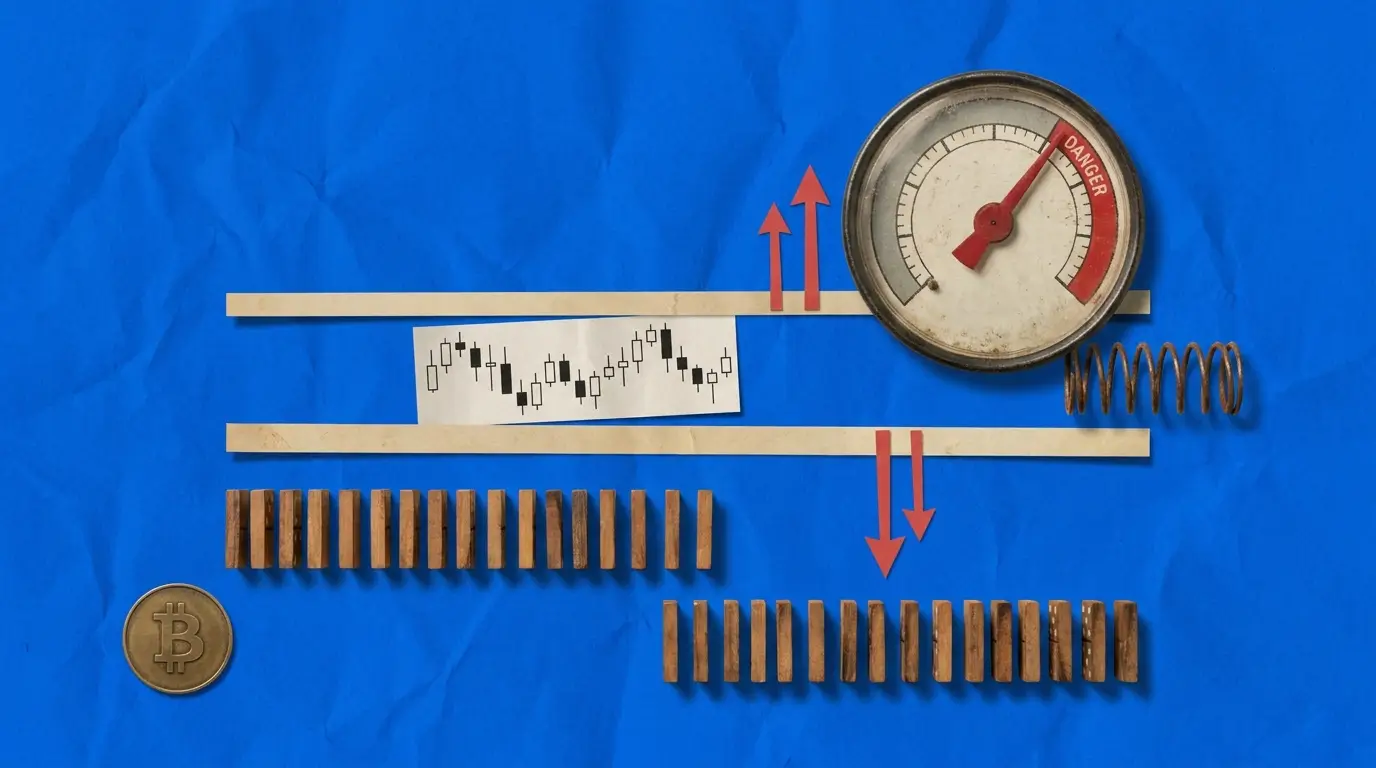
Bitcoin trades near $64,150, roughly 49.1% below its recorded all-time high of $126,080, still inside the $62,229 to $65,348 band that has contained the last twenty sessions. The options market, which prices what has not happened yet rather than what has, is saying something specific, and it is not cheap to disagree with.
The Options Market Is Charging a Premium for a Range That Refuses to Break
An option is insurance against a large price move, and its cost normally tracks how much price has actually been moving. Uneventful markets make the cover cheap. Bitcoin has been about as quiet as it has been since October 2025, and the cover has stayed expensive anyway. Sellers are charging as though a break is coming, and buyers are paying it.
Both figures are annualised rates, not forecasts of a move: volatility is quoted the way an interest rate is, so 36.35% does not mean anyone expects a 36% move. It also says nothing about direction. Up and down are priced the same, which is why puts and calls both get dearer when the number rises.
Scaled to a month, the gap becomes concrete: the 36.35% expected reading works out to roughly a 10% swing in either direction over 30 days, or a band of about $57,500 to $70,800 from current levels. The 21.80% Bitcoin has actually delivered works out to roughly 6%. Traders are charging for a market that moves half again as much as this one has.
The one-week window is stretched further still: Glassnode data puts short-dated expected movement near 29% against actual movement near 16%, which is roughly 4% of weekly range being priced against the 2% that has been arriving. That gap sits close to its widest in a year.
The pricing is not irrational, because calm ends suddenly: a long stretch of narrow trading drags the actual figure down without dragging the expected figure with it. Slower periods in Bitcoin have historically broken abruptly rather than faded gently, and sellers keep charging for that.
The cost falls entirely on the buyer: a purchase of protection needs price to travel further than the roughly 10% already priced in before it returns anything, while the seller keeps the premium for as long as the range holds. The $65,500 strike that expired on August 15 sat about 2% above spot, well inside what the option cost to own.
One institution moved the other way in the same quarter, and the headline version of that move understates it. Tudor Investment added 109,446 spot IBIT shares, lifting its holding 18.9% to 688,529 shares, per Yahoo Finance. In the same filing it cut its IBIT call position from roughly 998,000 underlying share equivalents to about 148,000. The shares bought are outnumbered close to eight to one by the call exposure dropped, and the calls abandoned were larger than the entire share position retained. Tudor bought spot exposure and walked away from optionality, which reads less as a directional and more as a call than as a decision to stop paying for expensive cover.
Two limits on that reading. Form 13F reports options in underlying-security terms rather than contract counts, so call equivalents and ordinary shares are not directly additive and the combined figure is a rough proxy rather than an exposure number. The filing also describes June 30 and excludes short positions, so it establishes a preference rather than a forecast.
The same divergence between positioning and price is running in XRP, and with more leverage attached.
Open interest built into weakness: XRP futures open interest rose to $2.78 billion, up 2% over 24 hours, with volume climbing 55% to roughly $1.17 billion, per CoinDesk.
The skew is concentrated, rather than universal: Binance's largest accounts show a 3.6 to one long-to-short ratio, matched at OKX, while the CoinGlass aggregate ratio sits near 0.93. Two venues are carrying the bullish bet; the wider market is close to balanced.
Sentiment points the opposite way: Santiment data shows commentary across X, Reddit and Telegram at its most negative in three months, even as roughly 50,000 active addresses were recorded in a 24-hour stretch, the highest in over two months.
The line that defines the risk: XRP sits at $1.00, a level held since November 2024. A sustained break below it liquidates leveraged longs that run out of collateral, which converts a price move into forced selling.
A pattern claim readers should carefully consider: the same CoinDesk newsletter describes a confirmed golden cross both as an event on ether's daily chart and as an event on the ether-to-bitcoin ratio. Those are different claims with different implications, and only the second would indicate relative leadership. Warehouse data shows ETH/BTC at 0.02954 with ether 61.7% below its own recorded high, which does not yet corroborate leadership on either reading.
Bitcoin's Two Largest Corporate Holders Answered a Paper Loss With a Supply Argument
Coinjuice's August 14 edition put a number on the pressure sitting inside the two largest corporate positions, a combined $12.46 billion unrealized loss as of that date. The current reading is $11.74 billion: $10.13 billion at Strategy, whose 842,139 BTC are valued at $53.95 billion against a $64.09 billion cost basis, and $1.61 billion at Metaplanet, whose 40,177 BTC are valued at $2.57 billion against a $4.18 billion cost basis, per DefiLlama's DAT tracker.
That $720 million improvement is worth understanding, because Bitcoin rose only about 1.3% over the same four sessions. A price move of barely one percent moved the combined paper loss roughly six percent. Concentrated single-asset balance sheets translate small price changes into large accounting swings in both directions, which is the same mechanism that produced the losses in the first place. Both companies have now answered publicly, and neither answer references price.
Metaplanet framed it as a denominator problem: CEO Simon Gerovich pointed to global M2 money supply reaching a record above $100 trillion, arguing the case is structural rather than cyclical, per CoinDesk. The fixed 21 million supply schedule is the constant he sets against an expanding one.
The argument contains its own counterexample, and he states it: Bitcoin decoupled from that liquidity expansion over the past year, roughly halving while M2 grew. Gerovich reads that decoupling as consistent with previous bear-market cycles rather than as a refutation.
Strategy raised the abstraction: executive chairman Michael Saylor published an essay framing money as stored economic energy and Bitcoin as its most efficient digital form, on the grounds that its supply cannot be expanded arbitrarily.
A third party supplied the transmission channel: Fidelity's Jurrien Timmer expects Bitcoin to close the gap with M2 expansion if gold builds momentum first, citing a liquidity regression model that places gold fair value near $5,000.
CoinDesk's reporting cites Strategy at 840,447 BTC worth $53 billion and Metaplanet at 43,000 BTC worth $2.7 billion.
July consumer and wholesale inflation both declined and July retail sales fell 0.75% month over month to $660.05 billion, the largest drop since May 2025, per MT Newswires. CME FedWatch now prices a 67% probability that the Federal Reserve leaves rates unchanged in September, up from 56% a week earlier, with the target lower limit at 3.50%. Goldman Sachs described a September rate increase as very unlikely following the retail sales print, per CoinDesk, and the dollar sits at its weakest since June. July FOMC minutes land Wednesday.
An expanding money supply is a condition, not a catalyst. M2 rose throughout the drawdown that produced the paper losses in the first place.
The Lesson
Bitcoin's fixed supply is an argument with no expiry date. An option has one printed on it. That gap is the whole difference between a claim that is probably true and a claim worth paying for now, and mistaking the first for the second is how conviction turns into money handed to whoever sold the other side.
The distance between the movement traders expect and the movement actually arriving is the market pricing its own guess at when the flat stretch ends. Sitting close to its widest in a year, that distance says cover is being sold at a markup rather than a discount. The 21 million cap will still be true in five years, and will not have earned anything by itself in the meantime. An option bought at a one-year-high price has only until its expiry date, and the premium is spent whether or not the break arrives.
Readers looking to trade range-bound conditions like this can start with the Coinjuice ebook, Bitcoin Trading Without Leverage, or go deeper with a Coinjuice yearly subscription, currently 30% off, where we start and complete trades and you will learn to snipe them independently and get the book for free with your subscription.
Coinjuice Lens
Tudor made the same choice, in a different form. It let go of the right to buy roughly 850,000 shares' worth of Bitcoin ETF at a set price later, and bought 109,446 shares outright instead. The first kind of position dies on a fixed date whether or not anything happens. The second one lasts until the owner decides to sell. Whether Tudor did that because it expects the move to take longer than an option allows, or simply because those contracts had become expensive to keep renewing, the filing does not say. It also describes June 30, not the present. What it does show is a preference for the position that waits without cost, which is the same preference Why the Most Profitable Crypto Traders Eventually Abandon Leverage documented among traders who arrived at it the expensive way.
What Investors Are Asking
Why are Bitcoin options expensive when price is barely moving?
Options are insurance against a large move, and they are priced on the movement traders expect rather than the movement already delivered. Both figures below are annualised rates, quoted the way an interest rate is, so neither is a forecast of a move that size, and neither says anything about direction.
Bitcoin has actually delivered 21.80% on that measure over 30 days, the calmest since October 2025, while the BVIV index shows the market pricing at 36.35%. Scaled to a month, that is roughly a 6% swing arriving against a 10% swing being charged for. Calm periods tend to end abruptly rather than fade, so sellers keep charging for that risk even when nothing is happening. Protection therefore costs more than the quiet chart suggests, and price has to travel further than the 10% already priced in before a buyer sees anything back.
Does record global M2 mean Bitcoin has to rise?
Not on any defined timeline. Global M2 reaching a record above $100 trillion describes the supply of money, not the demand for any particular alternative to it. Bitcoin roughly halved over the past year while M2 expanded, which the argument's own proponents acknowledge as a decoupling consistent with prior bear phases. A fixed supply schedule is a condition that holds indefinitely rather than an event with a date attached, which makes it a reason to own an asset rather than a reason to expect a move this quarter.
News Behind Today's Read
"Bitcoin's summer calm is making options look unusually expensive" (CoinDesk, Aug 17, 2026) — source for the BVIV/realized volatility spread.
"Bitcoin's biggest holders, Strategy and Metaplanet, are betting on math, not price" (CoinDesk, Aug 17, 2026) — source for the Gerovich/Saylor/Timmer arguments.
"XRP traders bet on a rebound as price slips to $1 and bearish chatter surges" (CoinDesk, Aug 17, 2026) — source for the $2.78B open interest, the 3:1 long/short skew on Binance/OKX, and the sentiment read.
"U.S. Treasury Department proposes GENIUS Act stablecoin rule" (CoinDesk, Aug 17, 2026) — source for the stablecoin rule proposal.
"UBS, Tudor Investment Increase Bitcoin ETF Exposure in Q2" (Yahoo Finance, Aug 17, 2026) — source for Tudor's IBIT position shift.
Previous Affair Editions
What Happened in Crypto Today: Rulemaking Stalls Twice & Revenue Replaces Rank
Bitcoin Miners Add to Selling Pressure & Treasury Paper Losses Mount
Bitcoin Ignores Cooler Inflation & Goldman Buys In as Harmony Breaks
Market Snapshot
Asset | Price | Distance from ATH |
Bitcoin (BTC) | $64,150 | ▼49.1% |
Ethereum (ETH) | $1,895 | ▼61.7% |
Solana (SOL) | $75.77 | ▼74.2% |
DeFi TVL | $75.6B | — |
Disclaimer
The information provided in this article is for informational purposes only. It is not intended to be, nor should it be construed as, financial advice. This article was developed with the support of artificial intelligence tools as part of Coinjuice's editorial process and reviewed by our editorial team before publication. We do not make any warranties regarding the completeness, reliability, or accuracy of this information. All investments involve risk, and past performance does not guarantee future results. We recommend consulting a financial advisor before making any investment decisions
FAQ
Why are Bitcoin options expensive when the spot price is barely moving?
Options are priced on expected movement rather than delivered movement. The 30-day BVIV implied volatility index sits at 36.35% against 30-day realized volatility of 21.80%, the lowest realized reading since October 2025. Because volatility is mean-reverting, a long narrow range compresses realized volatility without convincing sellers the quiet will last, so protection costs more than the calm suggests.
What does the gap between implied and realized volatility mean for traders?
Glassnode data puts one-week at-the-money implied volatility near 29% against realized of roughly 16%, a spread close to a one-year high. A wide gap favours option sellers, who collect premium if the range holds, and penalises buyers, who need a large move before a position breaks even. The August 15 expiry of a roughly $1.07 million call position at a $65,500 strike is a live example of the buyer's side of that trade.
Why are Strategy and Metaplanet pointing at M2 instead of price?
Both companies carry large unrealized losses, $10.13 billion at Strategy on 842,139 BTC and $1.61 billion at Metaplanet on 40,177 BTC per DefiLlama's DAT tracker. Their public response frames Bitcoin's fixed 21 million supply schedule against global M2 money supply reaching a record above $100 trillion. The argument is structural rather than cyclical, and its proponents acknowledge Bitcoin decoupled from M2 expansion over the past year.
Why are XRP traders positioned bullishly while sentiment is negative?
XRP futures open interest rose to $2.78 billion with the largest accounts on Binance and OKX showing roughly 3.6 long positions per short, while Santiment data shows social commentary at its most negative in three months. The CoinGlass aggregate ratio near 0.93 indicates the bullish skew is concentrated on two venues rather than market-wide. XRP sits at $1.00, a level held since November 2024, and a sustained break below it would force liquidation of leveraged longs.
Disclaimer
The information provided in this article is for informational purposes only. It is not intended to be, nor should it be construed as, financial advice. We do not make any warranties regarding the completeness, reliability, or accuracy of this information. All investments involve risk, and past performance does not guarantee future results. We recommend consulting a financial advisor before making any investment decisions.
More like this


Written by

Andrew Kamsky
Andrew Kamsky is a Bitcoin analyst. He spent a decade in traditional finance across a Big Four firm and a listed fintech bank before going deep on Bitcoin full-time.