





Quick summary
Litecoin grew through ETFs, treasury firms, DeLorean partnership and upcoming institutional Canton integration
Schwartz says price lags due to heavy shorting and liquidity dilution despite strong on-chain utility
MWEB optional privacy usage expanded sharply but hardware wallet incentives slow broader adoption
Focus remains on LitVM Layer 2, more partnerships, and promoting Litecoin as non-bank payment rail
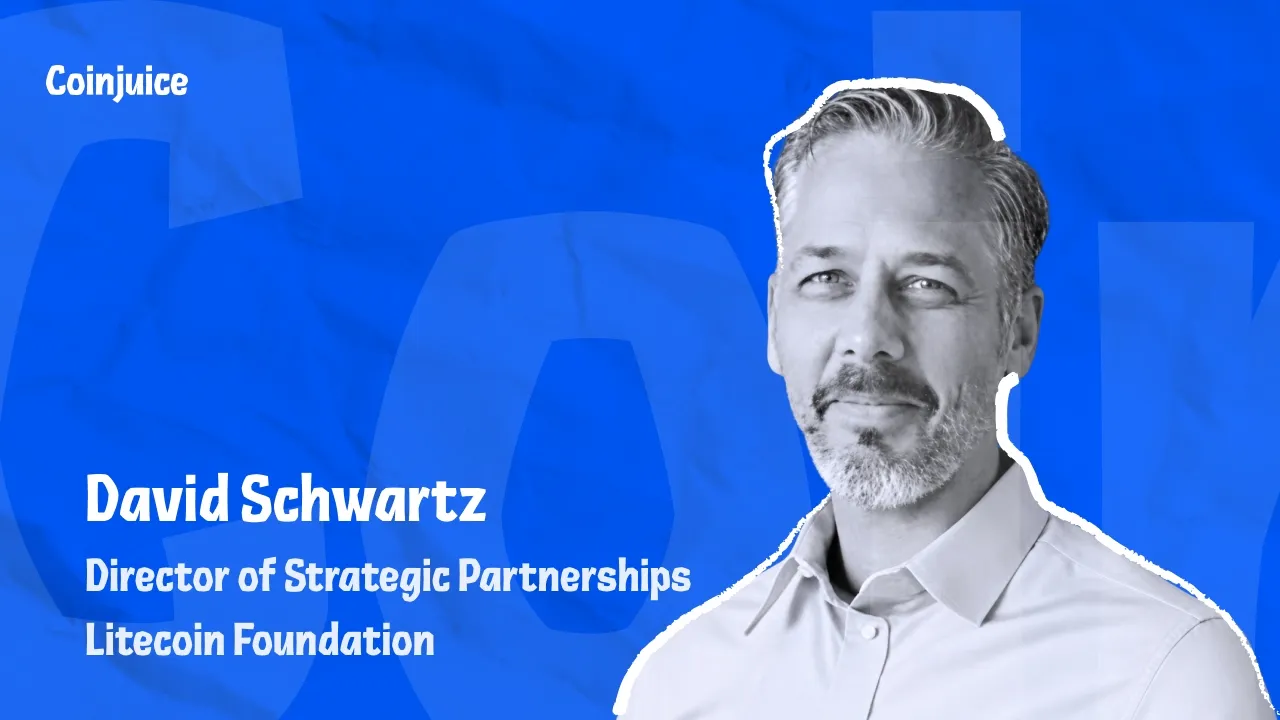
David Schwartz, Director of Strategic Partnerships at the Litecoin Foundation, spoke with Coinjuice in October 2026, nearly two years after his previous interview with Andrew Kamsky in November 2024. In the time since, Litecoin has gained an ETF, dedicated treasury companies, a carmaker partnership, a planned institutional integration and a Layer 2 in testing.
Schwartz described a network that has grown without the marketing push behind many newer tokens. Litecoin, he said, “kind of did the opposite of what everybody else is doing. There’s no real fanfare, there’s no real marketing push... but there’s all the utility behind it, and there’s all the recognition and the respect.”
What Changed for Litecoin Between 2024 and 2026
Asked what had happened since November 2024, Schwartz began with the Litecoin account on X. Schwartz explained: “Well, November 24, we could probably start off with the [Litecoin] handle going kind of crazy on social media on X. They caused a big stir, brought a lot of attention back to it because of the whole memecoin craze.” Schwartz added the account “just made fun of the whole memecoin craze instead because of the market conditions.”
The Foundation also took its conference abroad. Schwartz said there had been “two more [Litecoin] summits... Vegas, and then this year we did Amsterdam. It was the 1st time outside of the US.”

On privacy, Schwartz described steady promotion of MWEB: “we’ve been pushing the idea of optionally private [Litecoin] addresses through [MWEB] quite a bit, so that’s grown.”
Schwartz then turned to two publicly listed Litecoin treasury companies: Lite Strategy in the United States and Luxxfolio Holdings in Canada. “We’ve had some digital asset treasury companies come out,” he said, referring to companies that “now hold quite a significant amount of Litecoin.”
Luxxfolio has also expanded into mining. “They’re actually mining Litecoin now, too,” Schwartz said. Its fleet operates through LuxxPool, an in-house mining software stack that remains in development as a public product. Both Lite Strategy and Luxxfolio have announced investments in LitVM, the planned zero-knowledge Layer 2 for Litecoin.
The final item on his list was a carmaker. Schwartz explained: “we just struck a deal with... DeLorean, the car from... Back to the Future... fame and... they’re having a new electric vehicle coming out next year... where you could actually pay for it in [Litecoin] if you wanted to, and... they’re figuring how to add [Litecoin] to their treasury.”
Why the Litecoin Price Has Not Followed Its Usage
Schwartz gave two structural reasons for the weak price. The first was positioning: “there’s always been sort of heavy shorting on [Litecoin], for whatever reason.” The second was dilution. Schwartz said: “That dilution of liquidity into so many different things really takes away from I’d say the more established cryptocurrencies that have been around for a long time.”
Schwartz framed longevity as a disadvantage in an attention market: “it’s harder to stay relevant for a long duration, like 15 years, like [Litecoin] has versus a coin that has a bunch of backing behind it.” Newer participants, in his view, arrive with different goals: “They’re in it for the trades. They’re in it for the memes. They’re in it for things that have nothing to do. Literally, with what [Litecoin] stands for right now.”
Schwartz also compared Litecoin with four larger assets, Bitcoin Cash, Monero, Zcash and Dogecoin: “Those 4 all have a higher market [cap] than [Litecoin] does.” On activity, he argued the order reverses: “if you were to take their actual utility versus [Litecoin], [Litecoin’s] is far and above, all of them combined.”
From there Schwartz described the strategy he believes sets Litecoin apart: “[Litecoin] kind of did the opposite of what everybody else is doing. There’s no real fanfare, there’s no real marketing push... but there’s all the utility behind it, and there’s all the recognition and the respect and whatever else. And ultimately, that will win out versus money being pushed towards marketing.”
Schwartz’s case is simple: usage, not marketing, will decide what Litecoin is worth.
Schwartz reached for an investing parallel to make the point: “It’s the reason why Warren Buffett invested so much into infrastructure and logistics and everyday staples, things that were boring to everybody, you don’t think about it on a daily basis, but you need it. You use it.” And on timing, he was direct: “This is a marathon. This is a long term game that we’re in, right?”
Is Litecoin Still Digital Silver?
The digital silver label carried Schwartz’s first interview, and he treated it with more caution in 2026. Schwartz said: “digital silver is still mostly probably more of a narrative, right? But as time goes by, that narrative does take shape and it is slowly taking shape.”
Schwartz's reasoning rests on fixed supply against fiat currency: “all fiats die at some point.” Schwartz continued: “That’s where Bitcoin comes in, as for [Litecoin] comes in. They’re hard capped.” He closed the point with a qualification which applied to Bitcoin as much as Litecoin: “it will fit the commodity narrative, but right now it’s probably still more narrative than reality, and that goes for Bitcoin too.”
Readers new to digital silver framing can find the full background in the Coinjuice guide What Is Litecoin? A Complete Guide to Digital Silver.
The Litecoin Halving and Dogecoin Merge Mining
Schwartz placed the next halving in 2027: “I think it’s May. I think it’s May of [2027]. It’s really close.” At the halving the block reward falls to “3.125, which is where Bitcoin currently is, in its cycle.” On price behaviour, he described a repeating pattern: “there tends to be a price surge prior to the [halving], and then there’s a sell off.”

On merge mining, Schwartz confirmed miners often take their profit in Dogecoin: “the economics are that it’s more profitable to... get your payout [in] Dogecoin at this point.” He did not treat the arrangement as a weakness. Schwartz said the Dogecoin link gives Litecoin a long-term mining incentive Bitcoin lacks: “[Litecoin] has not as much of a problem with that because of the fact that it’s [merge-mined] with [Dogecoin].”
Schwartz expects the balance between the two coins to rotate: “It’s sort of like they’re taking turns being the most profitable, right?” Schwartz added: “I don’t think it’s permanent the way it is right now. I think it’s just sort of like a cyclical thing.” He pointed to Dogecoin’s own history as evidence: “prior to Elon Musk mentioning anything about Dogecoin, There was like 3 zeros in front of that too.”
Schwartz was candid about the length of the stagnation: “if you invested in early 2017 or mid 2017, say September even of 2017, you’re basically at the same price as it is right now.”
Asked whether Litecoin would benefit from a figure like Elon Musk, he declined the idea: “if that’s what it takes for [Litecoin] to be relevant, I don’t know if that’s really the best thing anyway, because then you’re going back to a central figure.” He applied the same view to Bitcoin’s most visible advocate: “I don’t think large masses of people hanging their every like emotional decision on how they invest in something on what one individual is doing is healthy.”
The Litecoin ETF and the First Treasury Companies
In 2024 Schwartz described a Litecoin ETF as a matter of time. He confirmed Canary’s fund launched: “it was in 2025, I believe. Maybe even October [2025].” On performance, Schwartz said: “It’s done fine. There’s been periods of quietness with that too, but lately here it’s been picking up. And I think it’s been good. It's been a net positive for [Litecoin] in general.”
For Schwartz, the larger effect was access. The ETF, he said, “helped kick off outside of... [Grayscale], the idea that institutions or, or others... that are accredited investors, could actually invest in something like [Litecoin].” Schwartz added Litecoin also sits “in a few basket ETFs here and there having to do with either indexes or whatever else.”
On treasury companies, Schwartz counted two: “If you were to talk exclusive... Litecoin as their treasury, then that would be two that I know of.” He named Lite Strategy in the United States and Luxxfolio Holdings in Canada, and said DeLorean would make a third.

Both companies, he explained, want to do more than passively hold Litecoin: “They don’t want to just be a company that just, you know, buys Litecoin, sits on it, right?” Instead, they are trying “to help fund infrastructure and other companies, start-ups that have something to do with Litecoin, too.” That includes investments in LitVM announced by both Lite Strategy and Luxxfolio.
DeLorean and the Canton Network: Two Routes to Adoption
The DeLorean partnership centres on the company’s first new electric model. Schwartz said DeLorean is “actually coming out with a new vehicle... the [Alpha5] next year... a fully electric vehicle.” He described the deal as a beginning: “it’s the start of a deeper collaboration. and partnership.” The motivation, in his account, is personal as well as commercial: “The guys that run DeLorean Labs are fans of [Litecoin].”

The Canton Network deal targets institutions rather than consumers. Schwartz explained: “There’s only one digital asset that’s basically offered on the Canton Network right now, and that’s Bitcoin. So, [Litecoin is] going to be the second.” He gave a target date: “we’re looking to have that live by the start of next year.”
The mechanism is a one-to-one wrapped asset. Schwartz said: “when you take your, like, one for one, put it into [cLTC], and then put it onto the Canton Network. Those large players, they’re not buying 5 or 6... [Litecoin] to go put on there... They’re buying, you know, 1000s of it and then that’s getting locked up.” On why Canton chose Litecoin, he pointed to its record: “there’s a recognition of [Litecoin] for its durability. It’s never been down, it’s history.”
An earlier route into other ecosystems fared worse. On the wrapped Litecoin product discussed in 2024, Schwartz said: “I don’t think the [wrapped Litecoin] did very well.” Schwartz separated the product from the idea: “The premise of being able to [wrap Litecoin] and put it into other ecosystems is still alive and does well.”
MWEB Adoption: Wallet Support Sets the Pace
Schwartz drew a clear line between Litecoin and privacy coins: “[Litecoin’s] not necessarily a privacy coin. It’s a, it’s a cryptocurrency that has an optional... layer of privacy. For the sake of fungibility.” The purpose, he said, is to keep every coin interchangeable: “So the more [Litecoin] that go through those [MWEB] addresses, and are being exchanged... the more fungible [Litecoin] becomes.”
Schwartz described the privacy MWEB offers in everyday terms: “We want a level of privacy. We’re not looking to be nefarious. We’re not trying to do anything illegal. We just don’t want everybody to see how much we have and how much we’re sending to somebody else or receiving.”
On usage, Schwartz gave the clearest figure of the interview: “if you were to take 2024, like I said, it was probably around, I don’t know, twenty or 30,000 LTC coins that were... in [MWEB] addresses and now it’s about a half a million.” He set the next milestone himself: “once you hit about 770,000, you’re at one percent of the total supply [Litecoin].” Since the strength of MWEB privacy depends on how many people use it, the growth carries direct weight for users, a point Schwartz acknowledged: “the more people that use it, the more untraceable it becomes.”
Coinjuice’s own earlier analysis of MWEB adoption covers the anonymity set problem in detail in Litecoin’s MWEB: Four Years Later, Has Optional Privacy Worked?
Schwartz identified hardware wallets as the main bottleneck, and his explanation was commercial rather than technical:
No swap revenue: “there’s no financial incentive for them to add [MWEB] addresses because they don’t make anything off of it.”
Extra steps for users: “currently you cannot swap... tether into... [an MWEB] address, you would have to go to a regular [Litecoin] address first and then you would have to send it to an [MWEB] address.”
Smaller wallets lead: “Cake Wallet is loved a lot by [Litecoiners] because they added [MWEB] addresses to it. Stack wallet did the same thing.”
Scale gap: “how many people are honestly using [Nexus] wallet? Probably a few tens of thousands, right?... versus, you know, like a [Ledger] or a [Trezor] who probably has 1,000,000s of wallets out there.”
MiCA, Korea and the Case for Optional Privacy
Asked whether optional privacy places Litecoin at a regulatory disadvantage, Schwartz disagreed: “No, actually, I think it’s at an advantage versus those others, because one of the other things we didn’t talk about that happened since the last time we spoke was that LTC became [MiCA]-approved... in the EU.”
He described how EU banks choose coins for their trading apps: “What they realized is there’s only a handful that they can actually [add]. And [Litecoin] usually ends up being one of them.” Schwartz named Santander among the banks running such checks, and said Litecoin sits “on a very, very short list of maybe three, 4, or possibly 5 at the very most, that gets added to their trading apps.”
The optional design, in his account, is what makes the difference for compliance teams: “they don’t have to accept [Litecoin] coming from an [MWEB] address... They can just say, look, we’ll accept [Litecoin] and send [Litecoin] but it has to come from a transparent address.”
South Korea remains the exception.
Schwartz described the 2022 delistings as “kind of like this knee jerk reaction without actually investigating what [MWEB] addresses actually were,” adding: “because they heard, like, [Litecoin] and privacy, they just delisted it.” On talks to return, he gave a blunt account: “like one or 2 of them would be like, sure, we’ll relist it, but we’ll need $10,000,000 worth of [Litecoin] or whatever.” The Foundation’s answer, according to Schwartz: “we’re not paying for that. We don’t play those games.”
The wider regulatory picture for privacy assets is covered in the Coinjuice explainer Privacy Coins Explained: How Private Transactions Stay Untraceable on Public Ledgers.
Litecoin Developers, LitVM and the Quantum Question
Schwartz described a small core team focused on security. He said developers “run... very periodic checks of the code. They’ll run it through, you know, different... programs to see if there’s any potential... vulnerabilities or potential exploits.” He added: “there was a time period where we did, I think, 4 or 5 patches within a very short period of time, probably a few months... just here in the last, you know, 8 to 10 months.”
On team size, Schwartz was unapologetic: “there’s not a need to have 600 developers.” Schwartz's reasoning ties back to Litecoin’s purpose: “the key idea is that [Litecoin] is used for spending and storing and transferring, right? And as long as you keep it that simple, don’t mess with the base code.” Asked about disagreement among developers, Schwartz answered: “Not at all... They’re all basically the same mindset on everything from privacy to how the base [code] should be handled.”
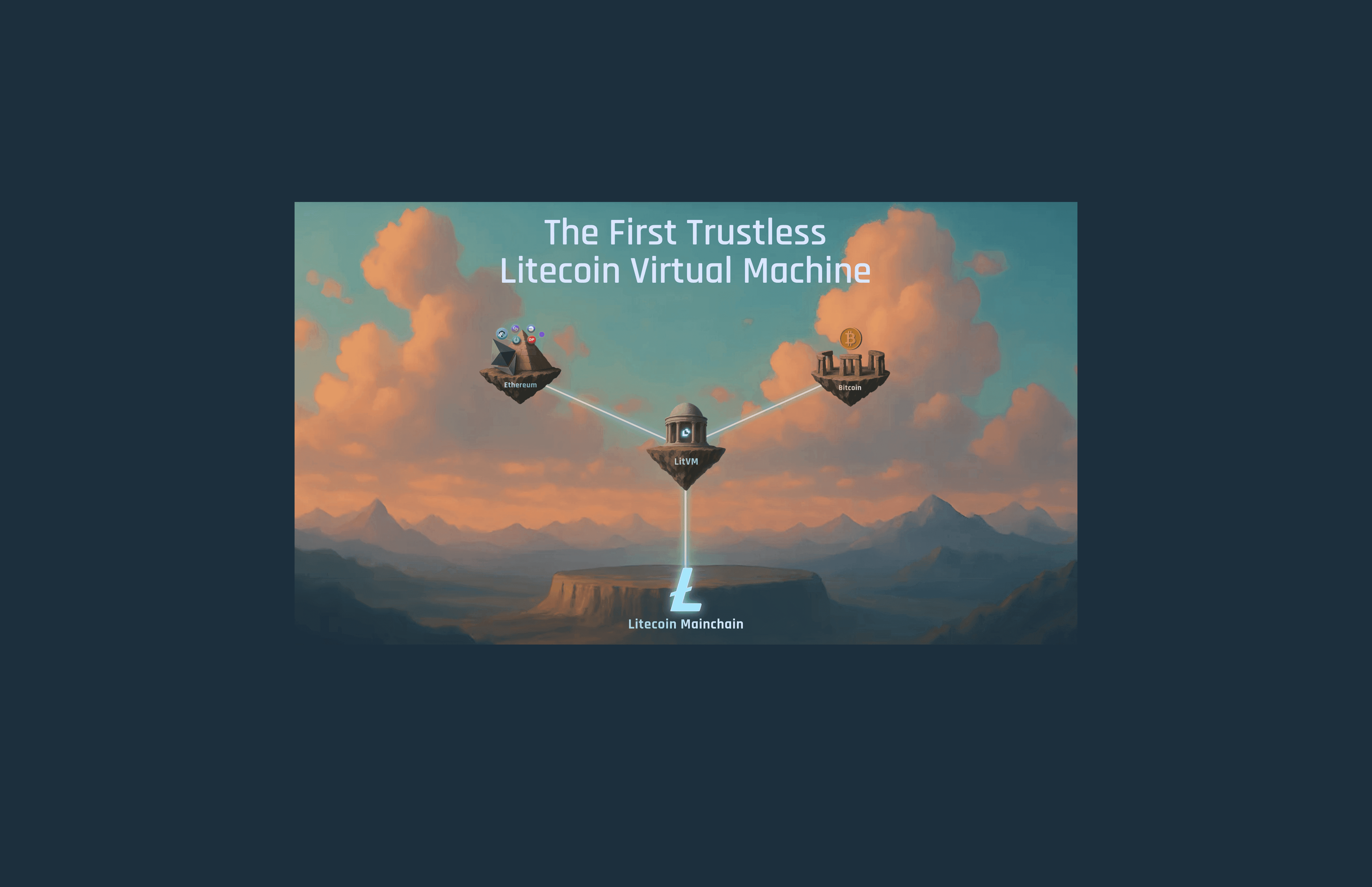
New development, in Schwartz’s view, will arrive on the Layer 2. He said: “[LitVM] is, yeah, that’s going to be the layer [2] that goes live in Q one of 2027.” He described the scope as “everything from smart contracts to creation of tokens... stablecoins,” and reported strong early demand: “like 100s of projects were trying to be green lighted into the test net,” adding “it’s done almost 4,000,000 transactions on [testnet].”
On quantum computing, Schwartz rejected confident claims in either direction: “what is really quantum safe at this point, right?” Schwartz said Litecoin’s hashing algorithm sits in the same position as Bitcoin’s: “I would say that [Scrypt] or [Litecoin] would be just as ready to make a change or adaptation as Bitcoin or anything else.” And he warned against forecasts: “if anybody were to try and tell you that they’re experts in it, can predict what’s going to happen, I think they’re lying to you.”
Stablecoins and a Payment Rail Outside the Banking System
Schwartz accepted stablecoins as competition for payments: “I think it is a competitor, but I think you have people that understand the difference between using [Litecoin] versus a stablecoin because there are things that can happen on a stablecoin that don’t happen on [Litecoin]. Like [USDC] can be frozen, right?”
On capacity, he said Litecoin “has already shown that it can handle, you know, more than 1,000,000 transactions in a 24 hour period.” But Schwartz located Litecoin’s advantage elsewhere: “LTC shines in the fact that it’s more a financial rail that’s outside of the traditional financial system. Because stablecoins end up tying back to the traditional financial system.” His description of the alternative was pointed: “a stable coin that’s basically pretending to be a dollar.”
Litecoin Summits and What to Watch Next
Schwartz described the Litecoin Summit as a deliberately small, two-day event of “anywhere from, you know, 3 to 500” people. He compared the atmosphere with the early days of the industry: “very much like early Bitcoin conferences prior to all the commercial, prior to all the commercialization, right? So it’s very intimate. You can talk to any of the speakers. I mean, Charlie’s milling around there.” The size is a choice: “it’s not like we’re trying to bring in 30,000 people that have no clue what [Litecoin] is.”
For the next twelve months, Schwartz set out three priorities. On partnerships: “I’m going to try and lock down more... partnerships like the Canton one, like the DeLorean partnership.” On technology: “watch the development of [LitVM] as a layer two.” And on privacy: “probably trying to push more awareness for the [MWEB] addresses in general and just having people continue to use it for what it was meant for.”
Readers tracking Litecoin through its halving cycle can find the base-building framework Coinjuice applies to assets like LTC in the free ebook included with every Coinjuice Pro annual subscription.
Executives and founders interested in a Coinjuice interview can reach out at hello@coinjuice.com.
Disclaimer: The information provided in this article is for informational purposes only. It is not intended to be, nor should it be construed as, financial advice. We do not make any warranties regarding the completeness, reliability, or accuracy of this information. All investments involve risk, and past performance does not guarantee future results. We recommend consulting a financial advisor before making any investment decisions.
FAQ
What major developments occurred for Litecoin between 2024 and 2026?
Litecoin saw its X (Twitter) account gain renewed attention during the memecoin craze, held two more Litecoin Summits including its first outside the US in Amsterdam, promoted optional privacy through MWEB, gained two publicly listed treasury companies (Lite Strategy in the US and Luxxfolio Holdings in Canada), saw Luxxfolio expand into mining via LuxxPool, progressed LitVM as a planned zero-knowledge Layer 2, and struck a partnership with DeLorean to allow Litecoin payments for its upcoming electric vehicle and potential treasury integration.
Why does David Schwartz believe Litecoin’s price has lagged behind its usage?
He points to persistent heavy shorting of Litecoin and dilution of liquidity across many newer cryptocurrencies, which he says draws attention and capital away from established assets. He also notes that in an attention-driven market, a 15-year-old coin like Litecoin struggles to stay as “relevant” as newer, heavily marketed tokens, even though he argues Litecoin’s actual utility is far greater than several higher-cap assets combined.
How does MWEB change Litecoin’s privacy and what is its current level of adoption?
MWEB adds an optional layer of privacy to Litecoin for the sake of fungibility, allowing users to keep amounts sent, received, and held from being publicly visible while not making Litecoin a full privacy coin. Coins can be moved into MWEB addresses, and the more that do so, the more fungible and untraceable Litecoin becomes. Schwartz notes that coins in MWEB addresses grew from roughly 20–30,000 LTC in 2024 to about 500,000 LTC, with 770,000 LTC marking around 1% of total supply.
What is LitVM and how is it expected to expand Litecoin’s capabilities?
LitVM is a planned Layer 2 for Litecoin scheduled to go live in Q1 2027. It is designed to support smart contracts, token creation, and stablecoins. Schwartz reports strong early interest, with hundreds of projects seeking access to the testnet and nearly 4,000,000 testnet transactions already processed.
Disclaimer
The information provided in this article is for informational purposes only. It is not intended to be, nor should it be construed as, financial advice. We do not make any warranties regarding the completeness, reliability, or accuracy of this information. All investments involve risk, and past performance does not guarantee future results. We recommend consulting a financial advisor before making any investment decisions.
More like this

Written by

Andrew Kamsky
Andrew Kamsky is a Bitcoin analyst. He spent a decade in traditional finance across a Big Four firm and a listed fintech bank before going deep on Bitcoin full-time.