







Quick summary
ORO lets users describe financial goals in simple language, then builds on-chain transactions
The platform is fully non-custodial, with users signing every step and limited supported tokens
Security includes a Shield Engine, vetted protocols, audits, and guardrails against AI hallucinations
ORO earns via transaction fees, planned subscriptions, and aims to support AI agents through x402
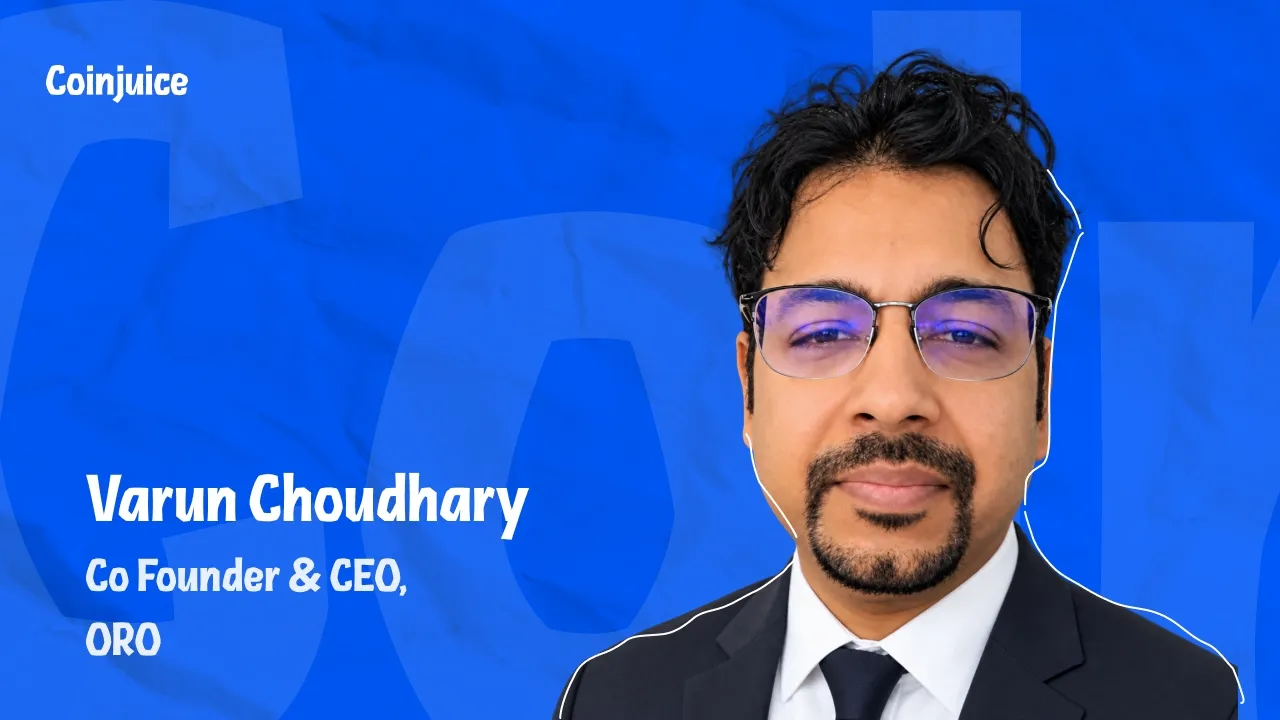
Varun Choudhary is the co-founder and CEO of ORO, a platform where an ORO user describes a financial goal and AI builds the on-chain transactions for review and signature. Choudhary, based in Amsterdam, spent about a decade building AI systems across Europe and Asia before starting ORO in November 2024.
Choudhary's starting point is a gap between what DeFi can do and how hard it is to use. Choudhary explained, "What we saw was that DeFi has great infrastructure, but the user experience is still too complex." ORO turns a simple human-language prompt and request into steps the user reviews and signs.
No custody, no autonomous trading: Choudhary says ORO does not hold user funds, make automatic payments, or run limit orders.
A deliberate boundary: Choudhary presents ORO’s refusal to hold funds, trade autonomously, or run limit orders as part of the platform’s non-custodial design.
Readers will come away knowing how a human-language request becomes a vault deposit or a tokenized stock purchase, where the risks sit, how ORO makes money, and where Bitcoin and AI agents fit into the model.
Why Varun Choudhary Built ORO
Choudhary explained that "before ORO, I spent around 10 years across Europe and Asia, building AI systems, mostly in high-stakes sectors like healthcare and education, where technology has to be useful, reliable, and understandable for real people."
Choudhary connected the timing to how people now use AI day to day: "So we built ORO to make on-chain finance easier to understand and use, especially since now AI is becoming like a more natural interface for the entire internet."
When the work began, Choudhary said, "So around November 2024 was when we started, yes." The motivation was personal.
Choudhary described losses he and others have taken while moving funds through DeFi by hand: "we have lost our personal money also, because sometimes you don't know which bridge to trust or how exactly to execute." Choudhary added, "you just didn't consider the slippage correctly or anything. You just lose your money. And a lot of people have gone through that."
ORO: DeFi Access for First Time Users
Choudhary's target user is the person who has never touched DeFi. Choudhary explained, "ORO is built for real people," and described the promise in direct terms: "your entire learning curve is zero. You don't need to learn anything. You just come to ORO, speak your natural language, just tell your intent what you want to do."
He also framed ORO as a route into assets once reserved for wealthier markets. Choudhary said "someone sitting in an emerging market, like Indonesia, Vietnam, or India, they can also just take an exposure to US tokenized assets," and added, "But the interface needs to be very clean and understandable so that they know what they are doing and they are able to execute it."
Coinjuice has examined the wider case for these assets in what tokenization actually solves.
How ORO Turns a Request Into an On-Chain Transaction
The first hurdle ORO removes is the account itself. Choudhary said, "you don't need to make an account on ORO because ORO is completely non-custodial."
He described where most newcomers give up: "When you ask them to create a MetaMask wallet and then MetaMask gives you a 12 phrase seed phrase that you have to note it down or you lose all your money. Most of the people turn away from that point." ORO's answer is a social login: "you can just simply log in using your Gmail as an Apple account. That will create a wallet. It is, again, completely non-custodial, so we never have access to any part of your keys or anything."
Asked what a basic task looks like, Choudhary walked through a $1,000 deposit from start to finish. The conversation opens with a goal "you can come and say, hey, I have got $1000 into my bank account. Where can I get the best yield out of it? Now ORO will analyze, and it can ask you a few questions that, okay, you said that I have a horizon of 6 months. I do not want a lot of risk."
The AI then lays out each step: "1st step, it will give you a transaction box where you can move your funds like the $1000 from a bank account to on chain. It will convert it to USDC. Now, suppose the vault is an Ethereum vault. So in the next step, it is gonna convert your USDC to Ethereum, and then in the next step, it will deposit your Ethereum into that particular vault."
The final decision stays with the person. Choudhary said, "you as the user have the final authority, you click on the wallet when the signature comes in. When you click it, then only the fund moves. And funds move directly from your wallet to that contract. It never comes to us."
ORO: Staking Support and a Limited Token List
The same pattern applies to staking. Asked whether ORO only explains how to stake Ethereum, Choudhary said, "it will not just tell you how to do it, but it will arrange everything for you. You just have to click, confirm and sign, and it will go and stake it." On language, he added, "We support more than 80 languages as of today."
ORO also limits what can be moved. Choudhary said the token list is short by design: "It is like USDT, USDC, BTC, SOL, ETH, a handful of 6 to 7 tokens." He explained the reasoning: "So even if someone does something by mistake, it is not like the money is gone."
Why ORO Will Not Trade on Its Own
Asked if ORO could pay a supplier automatically or every two weeks, Choudhary linked the refusal to custody: "if you do that, that means ORO is having a financial, you know, uh, authority over your account that we can move your funding every two weeks. So that means we are taking custody of your fund."
Choudhary added: "Even I'm not that comfortable, you know, even giving AI a complete authority on moving funds."
Limit orders face the same constraint: "No, because again, that means having custody, like you can do it on a centralized exchange, like on Binance. You can set up a limit order for buy order yourself because they can do it because they have the custody of your funds."
Custody would also introduce a different regulatory framework. Choudhary said: "Then you have to take care of many other things also, you know, like the compliance says, jurisdiction, you need to have proper license in place to have custody."
ORO can still organise a trading strategy, but each transaction remains manual: "You can tell ORO, you just have to sign it."
Choudhary described the product as: "It is an AI companion for you." ORO's AI plans every step, but the wallet holder signs every transaction.
Risk, Hallucination and the Shield Engine
Asked what risks a user takes on, Choudhary first pointed to ORO's checks before any transaction runs: "we have like a Shield Engine in place, which is like the 6th layer of security, which we simulate every transaction before we do it."
The protocol list is the second safeguard. Choudhary said ORO avoids chasing extreme returns: "it is not going to happen that I come and say that, hey, I have $100 to maximize the yield and I go and find a random protocol which is giving the 500% APY today. But tomorrow that protocol is gone." He set a clear bar for new integrations: "We do not integrate any new protocol which has been out there only for 6 months."
He did not claim the system is risk-free. Choudhary said, "But yes, being a user in technology, I can never give you a 100% guarantee that yes, this is hard-proof or nothing can happen to this one." He added that ORO's own contracts "has been audited by Halborn." Halborn has published a security assessment of ORO's CosmWasm contracts.
AI hallucination is the risk specific to ORO's design, and Choudhary addressed it directly: "AI can hallucinate a lot, because if you go to ask a normal AI, it is never going to come and say that, hey, I don't know this." He described ORO's response: "So in our case, we have got proper systems from guardrails in place so that the AI doesn't hallucinate because we understand that what we are dealing with is like a very critical component of finance and interactions."
How ORO Makes Money
Asked how ORO generates revenue, Choudhary said, "So we take a transaction fee on top of every transaction which you are doing, and we will be introducing a different subscription tiers going down the line." Choudhary described the tiers as volume allowances: "each tier gives you an allowance for a particular amount of volume which you can move through every month. And beyond that, it is pay as you go."
Transaction fees: A fee is charged on every transaction executed through ORO.
Subscription tiers: Planned tiers will each include a monthly volume allowance, with pay-as-you-go pricing above it.
Gas abstraction: "So we want to bring in a gas abstraction in place where you as a user, you only pay into a single credit. That's it." He added, "So ORO is just like a normal fintech app for you."
Users, Competitors and What Sets ORO Apart
On usage, Choudhary said, "as of today, we have more than 100K daily active users, and recently, the total number of connected wallets across all the campaigns and everything that has crossed to five million." Coinjuice has not independently verified either figure.
Asked about competitors, Choudhary said some rivals take custody: "some of them are out there, which are custodial AI bots as well." He pointed to integration as the difference: "as of today, we have got more than 90 different types of transactions which are built within our interface. So you do not need to go out of our interface."
He welcomed more entrants rather than fearing them: "people are getting more comfortable using AI, which is a good thing because then they will be comfortable using ORO as well."
AI Agents, x402 and Why AI Needs Crypto Rails
Asked whether AI could keep growing at its current pace without crypto, Choudhary pointed to what agents cannot do with a bank: "And AI agent cannot go and say, open a traditional bank account, have money, and pay using those things, but you can still empower an AI agent today to open a crypto wallet."
He added, "And it runs 24/7. There is no closing time or settlement time." Philipp Eryushev of Xyper made a similar observation in his Coinjuice interview on AI agents earning crypto.
Asked whether agents could one day outnumber human clients, he said, "It can happen, definitely, it can happen, and that is why in our roadmap, we also have x402 payment infrastructure integration." Coinjuice covered the standard in its breakdown of x402 AI agent payments.
Choudhary described how an agent would use ORO without the chat window: "an agent can talk to ORO directly without opening the interface and all. It can directly talk to our API and they can pay for the fees and everything with x402."
ORO: From DeFi to Travel Booking
Asked whether ORO could eventually book a flight, a taxi and a hotel, Choudhary said, "Yeah, definitely. I think that will be possible."
Choudhary framed ORO as a connector rather than a provider: "I'm not saying that we are gonna launch our own flight booking services, but I am definitely sure that within a year's time there will be a lot of good reliable players who will be doing this and yes, we will integrate them."
Conclusion
Asked to name ORO's main innovation, Choudhary returned to usability: "I think the biggest innovation which also [ORO] has solved is in abstracting the complete interface for the user." He described what users want in simple terms: "they want the safe, reliable interface to use their money, grow their money. That's it."
ORO grew out of losses Choudhary and many others took while bridging funds by hand, and its design reflects those losses. DeFi protocols can still fail, and Choudhary said so himself. What ORO changes is who plans the route, not who controls the money. Understanding what gets signed remains part of ownership.
ORO's AI plans every step, but the user signs every transaction.
Readers who want to support Coinjuice directly can sign up for Coinjuice Pro, which currently includes the ebook at no extra cost.
Executives and founders interested in a Coinjuice interview can reach out at hello@coinjuice.com.
Disclaimer
The information provided in this article is for informational purposes only. It is not intended to be, nor should it be construed as, financial advice. Statements attributed to Varun Choudhary reflect his own views and interpretations and are not independently verified facts unless otherwise noted. All investments involve risk, and past performance does not guarantee future results. We recommend consulting a financial advisor before making any investment decisions.
FAQ
What is ORO?
ORO is a non-custodial AI platform where users describe a goal in plain language and the AI builds the on-chain transactions for the user to sign.
Can ORO trade automatically?
No. Choudhary said ORO does not run automated payments, trading strategies or limit orders, because doing so would mean taking custody of user funds.
How does ORO make money?
ORO charges transaction fees, with subscription tiers and a single-credit gas system planned.
Which protocols does ORO work with?
Choudhary named Ondo, Aave, Morpho, Kamino, Raydium, Uniswap and Lido as current partners.
Disclaimer
The information provided in this article is for informational purposes only. It is not intended to be, nor should it be construed as, financial advice. We do not make any warranties regarding the completeness, reliability, or accuracy of this information. All investments involve risk, and past performance does not guarantee future results. We recommend consulting a financial advisor before making any investment decisions.
More like this
Written by

Andrew Kamsky
Andrew Kamsky is a Bitcoin analyst. He spent a decade in traditional finance across a Big Four firm and a listed fintech bank before going deep on Bitcoin full-time.