









Quick summary
Bitcoin trades around $77,500 near its 20 day average, with underlying macro fragility
US Treasury Secretary Bessent urges Bank of Japan to hike rates, pressuring yen higher
Past BOJ hikes triggered yen surges and carry unwinds where bitcoin and ethereum dropped
TIME OpenAI cover signals possible sentiment extreme in AI, echoing prior market peaks
Political pressure on Japan's yen and a sentiment extreme in AI stocks both point to fragility.
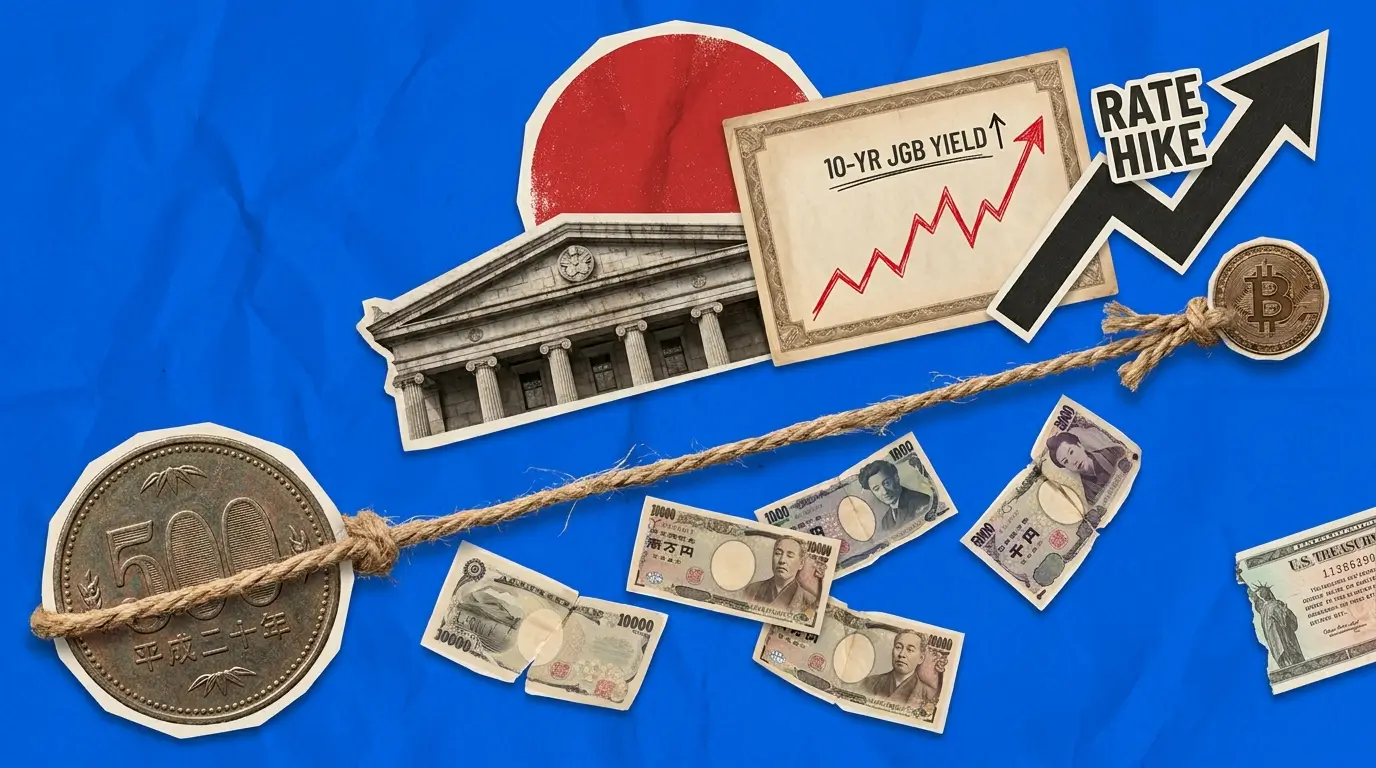
Bitcoin is consolidating near $77,500, up against its 20-day average. One level down, a sitting Treasury official is actively trying to steer the yen higher, and a magazine cover has an entire generation of AI investors avoiding a hard look at their own trade. Political pressure on Japan's yen and a sentiment extreme in AI stocks both point to fragility beneath bitcoin's price action.
Yen Pressure Builds: Bitcoin's Rules Stay Out of Reach
Bloomberg reported, citing Japan's NHK, that Treasury Secretary Scott Bessent told Bank of Japan Governor Kazuo Ueda and Finance Minister Satsuki Katayama that Japan's next move should be an interest rate increase, delivered on the sidelines of a G20 meeting in North Carolina. Separately, Bessent told CNBC he expected Japan to act to strengthen the yen and that markets were already pricing in a hike at the BOJ's September 17-18 meeting.
Bessent pressed for a hike: Treasury Secretary Scott Bessent told Bank of Japan Governor Kazuo Ueda and Finance Minister Satsuki Katayama that Japan's next move should be an interest rate increase, per NHK, cited by Bloomberg.
Japan's bond market reacted: Japan's 10-year yield rose to its highest level since 1996 on the same day, with US Treasury yields also broadly higher, per CNBC.
The August 2024 precedent is documented: a Bank of Japan rate move that year drove a yen surge and a carry-trade unwind, during which bitcoin and ethereum lost up to 20%, per the Bank for International Settlements' Bulletin 90.
Cover Story Warning: A Sentiment Extreme in AI Stocks Flares
TIME's September 7 cover features OpenAI's founders under the headline "Trust Us." CoinDesk reports the cover checks the three conditions Paul Macrae Montgomery set for his magazine cover indicator: a mainstream publication rather than a trade title, a widely understood theme, and a substantial price run-up already behind it.

The historical record has real hits: TIME named Jeff Bezos Person of the Year in December 1999, months before the dot-com crash; a "Home $weet Home" cover in June 2005 preceded the subprime mortgage collapse; and Elon Musk's December 2021 Person of the Year arrived shortly before Tesla shares fell through 2022.
The record also has real misses: CoinDesk notes Apple has appeared on magazine covers multiple times without it ever marking a top for its share price. The article also points out that OpenAI itself is not publicly traded, and that Montgomery's rule was designed to apply to a sector-wide theme rather than one company, which limits how directly it applies here.
CoinDesk also notes bitcoin bottomed out alongside tech stocks in late 2022 with ChatGPT's debut, and both have been on a tear since.
The Lesson
A rate decision three weeks out and a magazine cover are both inputs, not outcomes. The useful habit is separating the mechanism from the mood: a yen-funded unwind forces selling regardless of what anyone believes about bitcoin, and a sentiment extreme in one crowded trade doesn't confirm anything about a different one. Political pressure on Japan's yen and a sentiment extreme in AI stocks both point to possible fragility.
Readers looking to build a framework for treating macro fragility as one input, not a signal on its own, can start with the Coinjuice ebook, Bitcoin Trading Without Leverage, or go deeper with a Coinjuice subscription, currently 30% off the annual plan, where we start and complete trades and you will learn to snipe them independently.
Coinjuice Lens: Market Structure
This closes two loops running through the desk's recent coverage. Yesterday’s edition covered Strategy's fresh 4,603 BTC purchase without yet knowing how its STRC preferred defense was performing; today's figures answer that it still isn't fully resolved. Separately, Saturday’s edition flagged conflicting weekly ETF inflow figures; a newly reported $3.5 billion August total from Bloomberg via PANews adds a third, higher estimate to a month that already had two disagreeing sources, and none of the three is treated here as final.
News Behind Today's Read
Bessent Tells Japan Officials Rate Hikes Needed, NHK Reports (Bloomberg) — source for the Treasury Secretary's meetings with Japan's finance minister and BOJ governor, and the call for rate hikes.
OpenAI's 'Trust Us' TIME Cover Raises an Old Warning for AI Bulls (CoinDesk, Omkar Godbole) — source for the TIME cover, the magazine cover indicator's three conditions, and its historical hits and misses.
Strategy Inc., Form 8-K (period ended August 30, 2026) (SEC EDGAR) — primary source for the $635.2 million cumulative STRC repurchase, reconciled from the program's original $1.0 billion authorization against $364.8 million remaining capacity.
US Bitcoin, Ethereum Spot ETFs Post Strongest Monthly Inflows (PANews, citing Bloomberg) — source for the reported $3.5 billion August ETF inflow figure, flagged as unverified against the warehouse.
This article was developed with the support of artificial intelligence tools as part of Coinjuice's editorial process and reviewed by our editorial team before publication.
Get the framework
Check out the ebook → | See subscription pricing →
Market Snapshot
Asset | Price | Distance from ATH |
BTC | $77,520 | 38.6% below ATH ($126,156) |
ETH | $2,414 | 51.2% below ATH ($4,946) |
DeFi TVL (base) | $85.3B | Flat, +0.03% w/w |
FAQ
How is political pressure on Japan's yen linked to potential fragility in bitcoin?
A push for higher Japanese interest rates could strengthen the yen and trigger a yen-funded carry-trade unwind. A similar Bank of Japan rate move in August 2024 drove a yen surge and forced selling, during which bitcoin and ethereum lost up to 20%, highlighting how such macro moves can create fragility beneath bitcoin’s price action.
What did Treasury Secretary Scott Bessent recommend to Japanese officials?
Scott Bessent told Bank of Japan Governor Kazuo Ueda and Finance Minister Satsuki Katayama that Japan’s next move should be an interest rate increase and said he expected Japan to act to strengthen the yen, with markets already pricing in a hike at the BOJ’s September 17–18 meeting.
Why is TIME’s OpenAI ‘Trust Us’ cover seen as a warning signal for AI stocks?
The cover meets Paul Macrae Montgomery’s magazine cover indicator conditions: it appears in a mainstream outlet, covers a widely understood theme, and follows a substantial price run-up. Past examples like Jeff Bezos in 1999, “Home $weet Home” in 2005, and Elon Musk in 2021 preceded major market declines, suggesting a sentiment extreme in AI-related trades.
What main lesson is drawn about using macro and sentiment signals in bitcoin trading?
A rate decision and a magazine cover are treated as inputs rather than outcomes. The key habit is separating mechanism from mood: a yen-funded unwind can force bitcoin selling regardless of beliefs, and a sentiment extreme in one crowded trade, such as AI stocks, does not by itself confirm anything about a different trade like bitcoin.
Disclaimer
The information provided in this article is for informational purposes only. It is not intended to be, nor should it be construed as, financial advice. We do not make any warranties regarding the completeness, reliability, or accuracy of this information. All investments involve risk, and past performance does not guarantee future results. We recommend consulting a financial advisor before making any investment decisions.
More like this



Written by

Andrew Kamsky
Andrew Kamsky is a Bitcoin analyst. He spent a decade in traditional finance across a Big Four firm and a listed fintech bank before going deep on Bitcoin full-time.