









Quick summary
Bitcoin fell to $81,568 after hotter September CPI, triggering ETF outflows and liquidations
September CPI hit 3.7 percent, sharply raising but then easing October Fed hike odds
Spot Bitcoin ETFs saw about $261 million outflows as leveraged positions were unwound
Strive bought 2,822 BTC and Sberbank gained crypto approval, widening non ETF access
Bitcoin traded at $81,568 at 04:59 UTC on October 15, 2026, 35% below its all-time high of $126,156, after a hotter U.S. inflation print on October 14. Underneath, ETF money left within hours of the inflation data while Strive and Sberbank added buying routes independent of fund flows, a split worth tracking because the two forces operate on different timescales.
Bitcoin began October stronger than usual but faded in the second week, and by the time of Coinjuice’s CryptoQuant QuickTake it had slipped to about $80,867, roughly 3.2% below its October 1 open of $83,576, against a 2013 to 2025 average gain of 6.7% by the same point. The closest historical analog is 2022, when BTC peaked around October 5 and stayed range-bound before finishing the month 5.9% above its open.
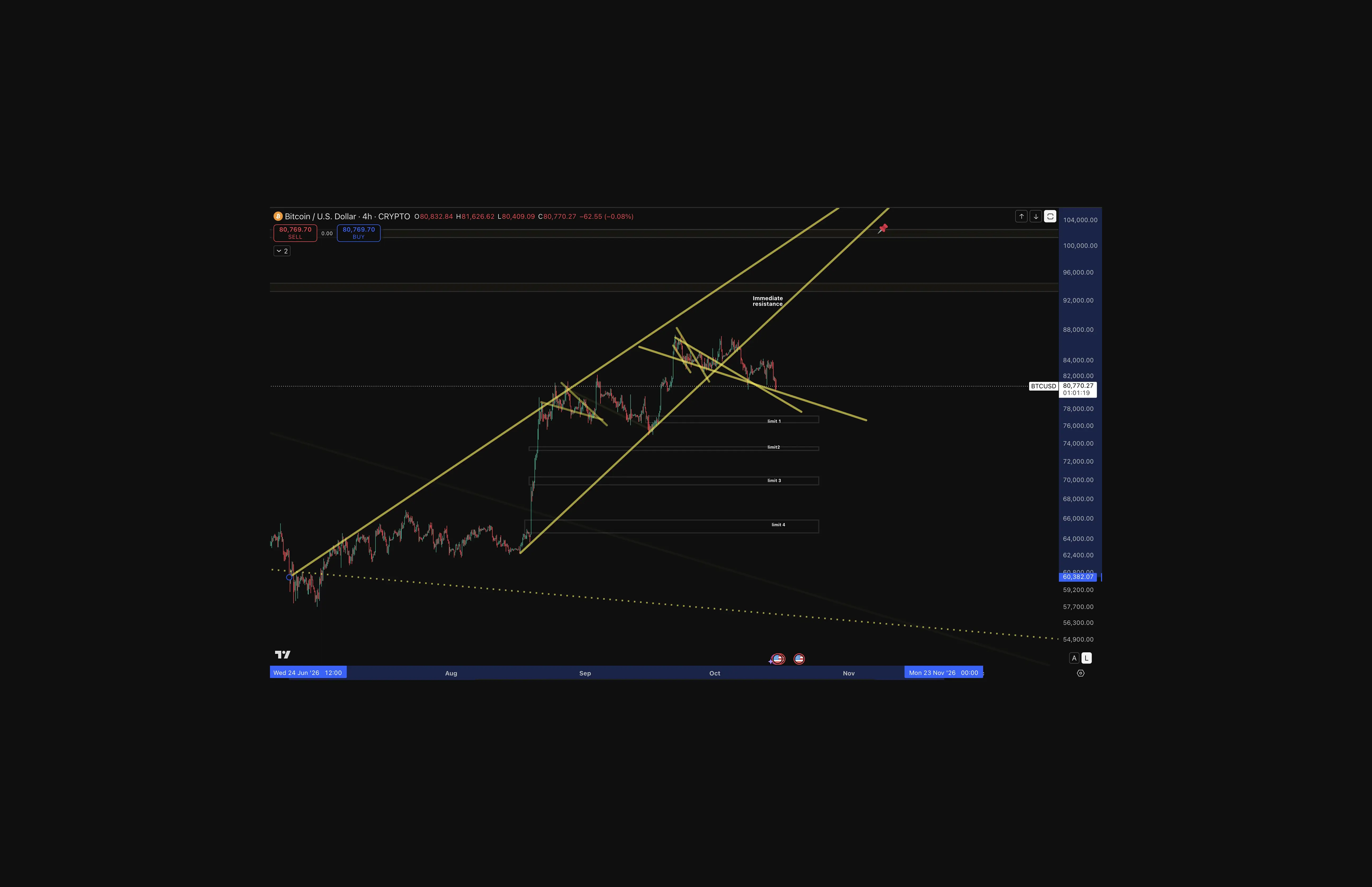
On the 4-hour chart, BTC broke below a three-month ascending wedge on October 7 and is now testing trendline support near $80.4K, where a confirmed close below would shift attention to $77K, $73.5K, $70K and $64K.

Hot CPI: A 3.7% Print Arrived as ETF Outflows Returned
Inflation data reached Bitcoin through rate expectations, then through fund flows and leveraged positions:
The print: September CPI rose 3.7% from a year earlier, up from 3.4% in August and above economists' expectations. Core CPI climbed to 2.6% from 2.4%, per CoinDesk.
The repricing: CME FedWatch odds of an October rate hike jumped to almost 47% from roughly 22%, per CoinDesk, then eased to about 27% on the CME tool. Polymarket briefly priced nearly 50% before easing to about 30%, per CoinDesk.
The fund reaction: U.S. spot Bitcoin ETFs recorded $150.5M of outflows on October 14, reversing the $175.7M inflow of October 13, per CoinDesk citing Giottus CEO Vikram Subburaj. DefiLlama's data, which includes IBIT, shows a larger outflow of $261.4M across the 12 tracked spot Bitcoin funds, led by FBTC (-$152.7M) and IBIT (-$110.9M). CoinDesk's figure matches DefiLlama's total excluding IBIT.
Bitcoin ETF Flows
ETF | 24h flow (Oct 14) | 7D flow (Oct 8 to 14) |
IBIT | -$110.90M | -$93.50M |
FBTC | -$152.70M | -$250.30M |
ARKB | $0.00M | -$20.30M |
GBTC | $0.00M | -$8.20M |
Four-fund total | -$263.60M | -$372.30M |
Note: Figures run through October 14, 2026, are DefiLlama-tracked and may be revised. The table shows four of the 12 spot Bitcoin funds DefiLlama tracks; the 12-fund total for October 14 is -$261.4M. Source: DefiLlama.
The leverage: About $483M of Bitcoin and Ether futures were liquidated over 24 hours, with Ether at $286M and Bitcoin at $197M, per CoinGlass data in CoinDesk. Ether fell about 6.4% against about 3.2% for Bitcoin, although its futures market is roughly $30B against $52B for Bitcoin.
Widening Access: Strive and Sberbank Build Routes Beyond ETFs
A filing and a regulatory register added demand channels running outside fund flows:
Strive's purchase: Strive's 8-K, filed October 14, reports 2,822 BTC bought between October 12 and 13 at an average of about $83,266 including fees and expenses.
The funding backdrop: The same filing reports 273,493,909 warrants exercised for 13,674,703 Class A shares, with expected gross proceeds of $369.2M, and no traditional PIPE warrants remaining as of October 13. The filing does not state how the Bitcoin purchase was funded.
Sberbank's register entry: The Bank of Russia added Sberbank to its register of crypto exchange operators on October 12, six days after listing it as a digital depository, per Decrypt citing Interfax. First products are planned for December 1 in SberBank Online, SberInvestments and SberBusiness, starting with Bitcoin, Ether and USDT. The date depends on central bank decisions and secondary rules.
The limits: Retail buyers face a 300,000 ruble annual cap per intermediary and a knowledge test, and domestic crypto payments remain illegal, per Decrypt. From July 2027, trades must go through registered intermediaries, per CoinDesk. Sberbank reported 110.6M retail clients at the end of Q2.
Interpretation: Strive's purchase and Sberbank's registration both sit outside the ETF channel, but neither is a guaranteed flow: the purchase is a past event with funding not stated, and the Sberbank launch is dated yet conditional. Macro fear drives short-term selling while corporate and bank access keeps widening.
Coinjuice Lens: Corporate Treasuries
Treasury companies buy Bitcoin with capital raised in markets, so purchase pace depends on investor appetite for the instruments funding it, as well as on price. Strive's warrant exercise is one such route. Preferred shares are another, examined in Coinjuice's research on whether Bitcoin digital credit can create a permanent price cap. Banks such as Sberbank add a retail route governed by caps and tests rather than by fund flows. Macro fear drives short-term selling while corporate and bank access keeps widening.
Want to trade ETF-driven swings without a liquidation price? Start with the Coinjuice ebook, Bitcoin Trading Without Leverage, using code TRADE15OFF for 15% off, or WELCOME50 for 50% off. To go deeper, join the Coinjuice subscription, where we start and complete trades in our private group and you learn to do the same on your own.
News Behind Today's Read
Bitcoin wilts as Fed rate uncertainty weighs. Kospi plunges 8% (CoinDesk). Source for the CPI figures, the rate-hike odds on CME FedWatch and Polymarket, and the $150.5M ETF outflow on October 14.
Nearly $1 billion in crypto bets liquidated as bitcoin, ether and XRP slide (CoinDesk). Source for the $483M Bitcoin and Ether liquidation total and the Ether and Bitcoin split. The headline says nearly $1 billion, while the article body gives $483M for Bitcoin and Ether futures.
Strive, Inc. Form 8-K (October 14, 2026) (U.S. Securities and Exchange Commission). Source for the 2,822 BTC purchase, the average price and the warrant exercise with expected gross proceeds of $369.2M.
Russia's largest bank Sberbank secures approval to trade crypto (CoinDesk). Source for the December 1 plan, the July 2027 intermediary rule and the central bank's control of the final coin list.
Russia's Biggest Bank Sberbank Wins Approval to Trade Bitcoin (Decrypt). Source for the October 12 register date, the retail cap and knowledge test, and Sberbank's 110.6M retail clients.
Continue the read: Oct. 14 · Oct. 13 · Oct. 12
Market Snapshot
Asset | Price | Distance from ATH / reference |
BTC | $81,568 | 35.34% below ATH ($126,156) |
ETH | $2,383 | 51.82% below ATH ($4,946) |
ETH/BTC | 0.02922 | Spot ratio, DefiLlama |
DeFi TVL | $88.9B | Base TVL, DefiLlama |
Data timing and sources: BTC, ETH, ETH/BTC and DeFi TVL are DefiLlama figures as of 04:59 UTC on October 15, 2026, and have moved since. DeFi TVL is base TVL only and does not reconcile with category-row sums. ETF flows are DefiLlama-tracked through October 14 and may be revised. CPI, rate-hike odds, the $150.5M ETF figure and liquidation totals come from CoinDesk and are not independently verified. Strive figures come from its SEC filing. Sberbank details come from CoinDesk and Decrypt.
This article was developed with the support of artificial intelligence tools as part of Coinjuice's editorial process and reviewed by our editorial team before publication.
Disclaimer
The information provided in this article is for informational purposes only. It is not intended to be, nor should it be construed as, financial advice. We do not make any warranties regarding the completeness, reliability, or accuracy of this information. All investments involve risk, and past performance does not guarantee future results. We recommend consulting a financial advisor before making any investment decisions.
FAQ
How did the hotter U.S. CPI print affect Bitcoin and ETF flows?
September CPI rose 3.7% year-on-year, above expectations and up from 3.4% in August, which pushed up rate-hike odds and coincided with U.S. spot Bitcoin ETF outflows of $150.5M on October 14, reversing a $175.7M inflow on October 13. DefiLlama data, including IBIT, shows a larger October 14 outflow of $261.4M across 12 spot Bitcoin funds.
What were the key technical and performance levels for Bitcoin in October 2026?
Bitcoin traded at $81,568 at 04:59 UTC on October 15, 2026, about 35% below its $126,156 all-time high. It had slipped to about $80,867, roughly 3.2% below its October 1 open of $83,576, compared with a 2013–2025 average gain of 6.7% by the same point. On the 4-hour chart it broke below a three-month ascending wedge on October 7 and was testing trendline support near $80.4K, with lower levels at $77K, $73.5K, $70K and $64K in view if that broke.
What Bitcoin-related actions did Strive take, and how were they funded?
Strive reported buying 2,822 BTC between October 12 and 13 at an average of about $83,266 including fees and expenses. In the same 8-K filing, it reported 273,493,909 warrants exercised for 13,674,703 Class A shares with expected gross proceeds of $369.2M, and no traditional PIPE warrants remaining as of October 13. The filing does not state how the Bitcoin purchase was funded.
What crypto access is Sberbank planning to offer, and what limits apply to retail users?
The Bank of Russia added Sberbank to its register of crypto exchange operators on October 12, with first products planned for December 1 in SberBank Online, SberInvestments and SberBusiness, starting with Bitcoin, Ether and USDT, subject to central bank decisions and secondary rules. Retail buyers face a 300,000 ruble annual cap per intermediary and a knowledge test, domestic crypto payments remain illegal, and from July 2027 trades must go through registered intermediaries.
Disclaimer
The information provided in this article is for informational purposes only. It is not intended to be, nor should it be construed as, financial advice. We do not make any warranties regarding the completeness, reliability, or accuracy of this information. All investments involve risk, and past performance does not guarantee future results. We recommend consulting a financial advisor before making any investment decisions.
More like this


Written by

Andrew Kamsky
Andrew Kamsky is a Bitcoin analyst. He spent a decade in traditional finance across a Big Four firm and a listed fintech bank before going deep on Bitcoin full-time.