






Quick summary
MSCI adopted broader non-operating company rules, with Strategy on a potential-deletion list
Removal from MSCI indexes may affect index fund holdings but is separate from Nasdaq listing
MSCI applies a 50 percent operating-asset screen plus five financial tests over two periods
Key dispute is whether Strategy’s large Bitcoin holdings qualify as operating assets under MSCI
MSCI’s decision could change which investment funds hold Strategy shares. It does not decide whether MSTR can trade on Nasdaq.
On October 15, 2026, MSCI adopted a broader rule for identifying non-operating companies. Strategy appears on the potential-deletion list, but the final list is due on November 11, 2026, ahead of implementation at the close of November 30, 2026. MSCI announcement
What is MSCI?
MSCI is a company providing indexes, investment data and analytics. Its indexes measure the performance of selected groups of securities. About MSCI
An index fund aims to follow a benchmark’s returns. Some funds own every constituent; others use a sample or derivatives. A constituent is a company or security included in an index. Consequently, changing an index’s membership can change the investments held by funds tracking it. SEC investor guide to index funds

MSCI, fund managers and stock exchanges perform different roles:
The index provider: Sets the benchmark’s rules, including eligibility and index construction. MSCI methodology
The fund manager: Manages the fund’s investments according to its stated objectives and strategy, which may include tracking an index. SEC explanation of index funds
The stock exchange: Provides a market for trading securities and applies its own listing requirements. Nasdaq listing rules and procedures
Removal from an MSCI index and delisting from Nasdaq are separate events. Nasdaq has its own procedures for listing deficiencies, hearings and delisting. Nasdaq Rule 5800 series. An MSCI removal means MSTR would no longer be included in the relevant MSCI index; it does not mean Nasdaq would stop MSTR trading.
For background on the company and its securities, see Coinjuice’s MSTR and digital-credit guide.
MSCI and Strategy: From Index Entry to Removal Risk
MicroStrategy, now Strategy, joined the MSCI World Index in May 2024 as one of the review’s three largest additions by full company market capitalization. MSCI’s May 2024 announcement confirms the addition but does not explain how MSCI assessed its operating-company status.
MSCI’s rules changed after Strategy joined the index:
October 10, 2025: MSCI proposed excluding companies whose digital assets represented at least 50% of total assets. While consulting on that proposal, it continued temporary restrictions on Metaplanet and Capital B and extended Metaplanet and Capital B to other existing index members on its preliminary affected list. MSCI’s announcement
New shares: Companies could still issue shares, but MSCI would not increase the share counts or inclusion factors used to calculate each company’s weight in MSCI indexes.
Size categories: Moves between small-, mid- and large-company index categories were postponed for the November 2025 review.
New entries: Companies on the affected list that were outside the indexes would not be considered for addition in November 2025.
January 6, 2026: MSCI decided not to introduce the proposed removal rule for digital-asset treasury companies in its February 2026 review. Existing digital-asset treasury companies could remain in MSCI indexes if said treasury companies met MSCI’s other rules. Instead, MSCI planned to seek feedback on a broader question: how to treat companies mainly holding investments, not just digital assets. The earlier restrictions on counting additional shares, admitting new companies and moving companies between size categories remained in place. MSCI’s January announcement
August 3, 2026: MSCI proposed financial tests to identify companies mainly holding investments rather than running other business activities. The proposal went beyond digital assets: MSCI’s example assessment, using May 2026 data, identified Strategy, Metaplanet and uranium holder Yellow Cake as potential removals. It was seeking feedback, not announcing final deletions. MSCI’s consultation document
October 15, 2026: MSCI approved new rules, effective at the close of November 30, 2026. The temporary restrictions would end, but companies would face the new financial tests instead. Ending the restrictions did not mean companies were safe from removal: those failing the removal requirements could lose their place in the indexes. MSCI said it would publish the final list on November 11, 2026, so Strategy’s removal was not yet confirmed. MSCI’s adoption announcement
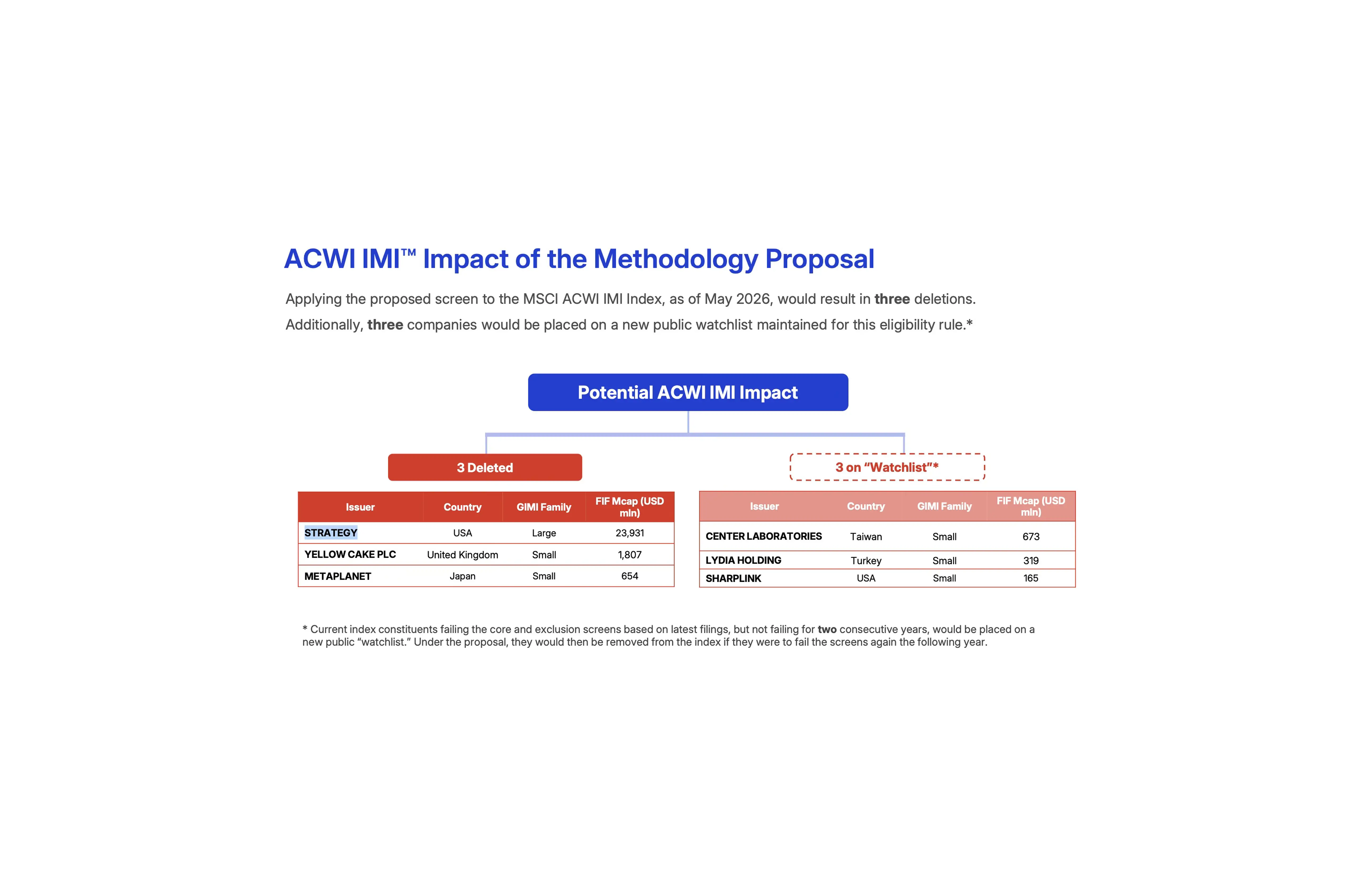
What “Deleted” meant in MSCI’s May 2026 example: MSCI placed Strategy in the “Deleted” group rather than on the watchlist. Under the proposal, the watchlist was for existing MSCI index members that failed the screens in the most recent company filing but had not failed the screens for two consecutive annual periods. MSCI consultation
MSCI's October list of potentially affected securities, which uses financial information as of September 30, 2026 and market values as of October 9, 2026, again marks Strategy A "Deleted" for the November review. The list is potential; MSCI's final list is due November 11, 2026. MSCI list of potentially affected securities
Why MSCI Separates Operating Companies From Investment Funds
MSCI says its indexes should represent companies running businesses rather than companies mainly holding investments. MSCI’s January announcement
The MSCI methodology uses financial tests to distinguish between the two. But a central question remains: which assets count as being used to run the business? MSCI methodology
In January, MSCI reported institutional investor concern about some digital-asset treasury companies having “characteristics similar to investment funds.” MSCI also acknowledged the difficulty of distinguishing investment activity from assets held for core operations, saying the distinction “requires further research and consultation with market participants.” MSCI January announcement
The companies included in each MSCI index can be viewed in MSCI’s member list. Select an index to see its members, and keep in mind the data is delayed. MSCI does not state an exact number of days on the constituent page. MSCI only says the information is “delayed data as per the ESMA Guidelines.” MSCI constituent list
How MSCI Decides Which Companies Can Stay in Its Indexes
The methodology has two stages.
First, check the assets: If MSCI counts at least half of a company’s assets as assets used to run its business, it passes this check. It still needs to meet the other index rules.
Then, apply five financial tests: Companies below that halfway mark face five further checks. Failing four or five can lead to exclusion.

Strategy argues that it should pass the initial 50% asset check without needing the five further tests shown above. In its August 31 response, the company says Bitcoin qualifies as an operating asset because it is used in its Bitcoin business segment and related gains and losses appear within operating expenses. Since Bitcoin represents more than half its assets, Strategy says it clears that first hurdle. This is the company’s argument, not MSCI’s confirmed assessment. Strategy’s response, page 5

MSCI’s five financial tests. “Constituents” means companies already in the index; “non-constituents” means companies outside the index. Existing members receive more forgiving thresholds on some tests. For an existing constituent, the passing conditions are:
Test | Passing condition |
Operating asset intensity | Operating assets are at least 10% of total assets. |
Expense intensity | Core business expenses are at least 5% of total assets. |
Cash flow | Funds from Operations is greater than zero. |
Fair-value intensity | The absolute non-operating fair-value movement is no more than 5% of total assets, or no more than 75% of the combined amount of net sales and the absolute total fair-value movement. |
Capital dependence | Financing cash flow is no more than 30% of total assets, or the filings review does not establish capital raising for asset accumulation. |
Source: MSCI methodology, Appendix I, pages 83–86. “Funds from Operations” is MSCI’s adopted label. The reviewed text does not supply an operational definition; operating cash flow or free cash flow should not be substituted.
When MSCI’s Tests Can Lead to Index Removal
Fair value is what an asset a company holds would sell for in the market today, so a company's reported gain or loss can change on paper as prices move, even if it has sold nothing
Two limits, one test: Only companies that have not cleared MSCI’s initial 50% operating-assets check reach this test. For a company already in the index, MSCI flags the test only if the absolute size of its non-operating fair-value movement exceeds both:
5% of total assets, and
75% × (net sales + the absolute value of total fair-value movements).
The two limits are separate and are not added together.
Hypothetical example: At the reporting date, a carmaker has $100 million in total assets, including $60 million in shares of fictional artificial-intelligence company Nova AI, which is unrelated to its car business. The carmaker bought the shares for $20 million and recorded a $40 million fair-value gain during the year. It also reports $10 million in sales and no other fair-value movements. Assume MSCI treats the Nova AI shares as non-operating assets.
The carmaker’s remaining $40 million of assets are used in its car business. Its operating assets therefore equal 40% of total assets, putting it through to the five-test screen.
The calculation: Compare the $40 million gain with two separate limits: $5 million (5% × $100 million in assets) and $37.5 million (75% × [$10 million in sales + $40 million in total fair-value movement]). The $40 million gain exceeds both limits. The company therefore fails this one test, not the whole eligibility screen. MSCI methodology, pages 84–85
MSCI generally reviews two annual filing periods: An existing index member is deleted only if that member fails both the core screen and the exclusion screen in both assessed periods. Failing in only one period is not enough. A company seeking admission can be blocked if that company fails both screens in either assessed period. MSCI may also consider more recent interim financial information.
How each test uses the two periods: The operating-asset, expense, cash-flow and fair-value tests are assessed separately for each filing period. Capital dependence is assessed across the two periods collectively. The methodology reviewed does not explain how MSCI combines those two periods for this test. MSCI methodology, October 2026, pages 85–86
Strategy's two latest annual reports cover FY2024 and FY2025. MSCI's list says it uses financial information as of September 30, 2026, and does not say which filings MSCI used for Strategy. The adopted methodology also allows MSCI to consider the latest interim filing
In simple terms: Holding a lot of Bitcoin does not, on its own, remove a company from MSCI's indexes. MSCI first has to count less than half of its assets as operating assets, and whether Bitcoin counts is the central dispute. If BTC doesn't, the company must then be flagged on at least four of the five financial tests, and fail the screens in both of the two assessed annual periods.
Why? The rule looks at how a company uses its assets and what its financial statements show, not just how much of one asset it owns.
Which means a large Bitcoin holding is only the first step. Removal also depends on how MSCI classifies the asset, what the company's financial statements show on the five tests, and whether the same result holds in both assessed periods.
Back to the hypothetical example: The carmaker's Nova AI shares have nothing to do with making cars. Strategy says its Bitcoin is different: it argues Bitcoin is used in its Bitcoin business, not just held. In its August 3, 2026 filing, Strategy reported selling 1,638 bitcoin for about $104.7 million. It said about $52.4 million of the proceeds funded dividends on its preferred stock, and about $52.3 million funded repurchases of its STRC preferred shares. [Strategy August 3, 2026 filing]
Whether selling Bitcoin to fund payouts makes BTC an operating asset is the question MSCI's tests are meant to answer, and the methodology reviewed does not say how.
How does MSCI decide which assets count as operating assets? The methodology defines them as assets "used in the conduct of normal business operations," but it does not say whether Bitcoin held by a company like Strategy qualifies.
Why Strategy Says Its Bitcoin Holdings Are Business Assets
Strategy combines a revenue-generating software business with a much larger Bitcoin treasury.
Strategy’s software business generated $477.2 million in revenue in 2025. As of June 30, 2026, digital assets were $49.67 billion against total assets of $52.56 billion, approximately 94.5%. The percentage describes the balance sheet; it is not a calculation of MSCI’s operating-asset ratio. FY2025 annual report, Q2 2026 quarterly report
MSCI’s screen, however, assesses the company’s overall assets and financial results. Strategy FY2025 annual report, MSCI methodology
Strategy Began Reporting Bitcoin as a Separate Business Segment
In its FY2025 annual report, Strategy reported one operating segment, its software business. Costs and expenses related to executing its Bitcoin strategy sat in a separate "Corporate & Other" category, which the report says "is not considered an operating segment." The same report lists Bitcoin's unrealized loss under operating expenses in its results of operations.
Beginning in Q2 2026, Strategy reports two segments: software and Bitcoin. Its Q2 2026 quarterly report describes the earlier approach as a "non-operating 'Corporate & Other' category" and says the change provides "greater visibility into the activities of our software business distinct from our bitcoin treasury operations."
Strategy's filings therefore present Bitcoin differently in different places. Neither the earlier presentation nor the later segment change independently settles MSCI's classification, and MSCI's list does not say which Strategy filings it used.
Strategy’s Main Challenge to MSCI’s Tests
Strategy’s letter challenges three parts of MSCI’s proposal:
Initial operating-assets screen: Strategy argues Bitcoin qualifies as an operating asset because Strategy uses Bitcoin in a Bitcoin operating segment.
Expense test: Strategy argues Bitcoin losses are included within operating expenses.
Fair-value test: Strategy argues Bitcoin fair-value changes are reported within operating expenses, rather than as movements on non-operating assets.
On that basis, Strategy says it “has in fact not triggered four of five” proposed flags. The letter lists the proposed cash-flow test but does not specifically rebut it. These are Strategy’s arguments, not MSCI determinations. Strategy’s response, page 5
Strategy wrote its letter on August 31, before MSCI adopted the final rules on October 15. Strategy therefore responded to the proposal and not the final methodology. The letter uses a 50% sales-based fair-value threshold and the adopted threshold for existing members is 75%. The letter also refers to “operating expenses,” while the final methodology uses “Core Business Expenses.”

Strategy was not the only Bitcoin treasury company to challenge the proposal. Strive says it would also be excluded and Strive's letter is an interested party’s submission, not independent confirmation of its inclusion on MSCI’s potential-deletion list. Strive’s consultation comments.
Yellow Cake Shows the Rule Extends Beyond Bitcoin
Yellow Cake holds physical uranium and says it may raise capital to buy more when its shares trade above net asset value. Yellow Cake also appears on MSCI’s potential-deletion list. The affected companies therefore include a uranium holder as well as Bitcoin treasury companies. Yellow Cake’s strategy, MSCI’s affected-securities list
Coinjuice’s companies holding Bitcoin overview provides broader context, but its business groupings should not be confused with MSCI eligibility determinations.
What Remains Unknown Before MSCI’s Final List
MSCI has not yet confirmed which securities will be removed. Its final list is due on November 11, 2026. MSCI adoption announcement
The published figures describe different things:
Strategy’s market value: MSCI’s workbook reports approximately $40.3 billion in float-adjusted market capitalization, using market values dated October 9, 2026. This is not an estimate of how much funds would sell. MSCI workbook
Strategy’s estimate of tracking-fund holdings: Strategy says funds tracking MSCI GIMI indexes hold 3.1% of its basic shares outstanding. Its footnote puts the holding at roughly 13 million shares. This is Strategy’s own undated estimate; the page does not provide a fund-by-fund breakdown. Strategy’s MSCI response page
The calculation for Strategy: The MSCI documents reviewed for this article do not include a worked calculation showing Strategy’s results under each test. MSCI methodology
Neither market capitalization nor the company’s holdings estimate establishes how many shares would be sold or how MSTR’s price would respond.
Conclusion: What Is Settled, and What Is Not
Some things are settled. MSCI has adopted a rule for identifying non-operating companies, and it takes effect at the close of November 30, 2026. Removal from an MSCI index is not delisting from Nasdaq. And a company already in the index is removed only if it fails MSCI's screens in both assessed annual periods.
Several questions remain open. The methodology defines operating assets as those "used in the conduct of normal business operations," but the pages reviewed do not say whether Bitcoin held by a company like Strategy qualifies. Those pages also leave "Funds from Operations" and "Core Business Expenses" undefined, and say nothing about how the two periods combine for the capital-dependence test. Strategy argues its Bitcoin is an operating asset. In the documents reviewed, MSCI has not said how MSCI assessed Strategy's argument.
That is why the question hangs in the balance. The rules are published. How they apply to a company whose main asset is Bitcoin is not.
FAQ
Would MSCI removal stop MSTR trading on Nasdaq?
No. Removal from an MSCI index is different from removal from a stock exchange. Nasdaq applies its own listing rules and delisting procedures. An MSCI decision does not itself stop investors from buying or selling MSTR on Nasdaq.
Are STRC, STRD and STRF also being removed?
MSCI’s affected-securities workbook identifies Strategy A. The documents reviewed do not announce the removal of STRC, STRD or STRF, and they do not support saying that every Strategy security has been blacklisted.
Would MSCI removal stop Strategy joining the S&P 500?
No. S&P Dow Jones Indices makes its own decisions under separate eligibility rules. For the S&P 500, those rules include positive GAAP net income from continuing operations in the latest quarter and across the latest four quarters combined, as well as size, liquidity and public-float requirements. Meeting the criteria does not guarantee selection.
Why is Strategy’s Bitcoin classification important for MSCI index eligibility?
MSCI distinguishes operating companies from those mainly holding investments based on how assets are used. Strategy argues its Bitcoin holdings are operating assets used in a Bitcoin business segment and included in operating expenses, and since Bitcoin is more than half its assets, this would allow it to pass the initial 50% operating-asset check. Whether MSCI accepts Bitcoin as an operating asset is a central unresolved question for Strategy’s index status.
Disclaimer
The information provided in this article is for informational purposes only. It is not intended to be, nor should it be construed as, financial advice. We do not make any warranties regarding the completeness, reliability, or accuracy of this information. All investments involve risk, and past performance does not guarantee future results. We recommend consulting a financial advisor before making any investment decisions.
More like this


Written by

Andrew Kamsky
Andrew Kamsky is a Bitcoin analyst. He spent a decade in traditional finance across a Big Four firm and a listed fintech bank before going deep on Bitcoin full-time.