











빠른 요약
Taproot is a Bitcoin upgrade introducing Pay-to-Taproot (P2TR), combining Schnorr signatures and Tapscript
It improves privacy, efficiency, and flexibility by simplifying outputs and concealing unused spending conditions
Schnorr signatures enable more compact multisignature coordination, reduced data usage, and cleaner advanced contract constructions
Taproot adoption remains gradual and has sparked debate over data usage, fee dynamics, and decentralization trade-offs
Taproot is a Bitcoin protocol upgrade activated on November 14, 2021. It introduced a new way to lock and spend coins known as Pay-to-Taproot (P2TR). Taproot combines three coordinated improvements, Schnorr signatures (BIP340), Taproot outputs (BIP341), and Tapscript (BIP342). Together, they aim to improve privacy, reduce transaction data in certain cases, and enable more advanced spending conditions without always revealing them on-chain.
At its core, Taproot refines how Bitcoin transactions are structured while keeping the system decentralized and verifiable. Understanding what Taproot actually does matters now more than ever, as proposals like BIP-110 seek to restrict some of the very capabilities it introduced.
What Taproot Changes
Taproot introduces structural improvements to how Bitcoin outputs are created and spent.
Taproot (P2TR): A new output type that allows coins to be spent either through a simple signature or through a more complex script path when needed.
Key path spend: The default, streamlined spending method that looks like a normal single-signature transaction on-chain.
Script path spend: A conditional spend that reveals only the specific script branch being used, rather than every possible condition attached to the coin.
Tapscript: An updated scripting framework designed to work natively with Schnorr signatures and allow future extensibility.
Together, these changes allow Bitcoin transactions to appear simpler on-chain while still supporting advanced conditions when necessary.
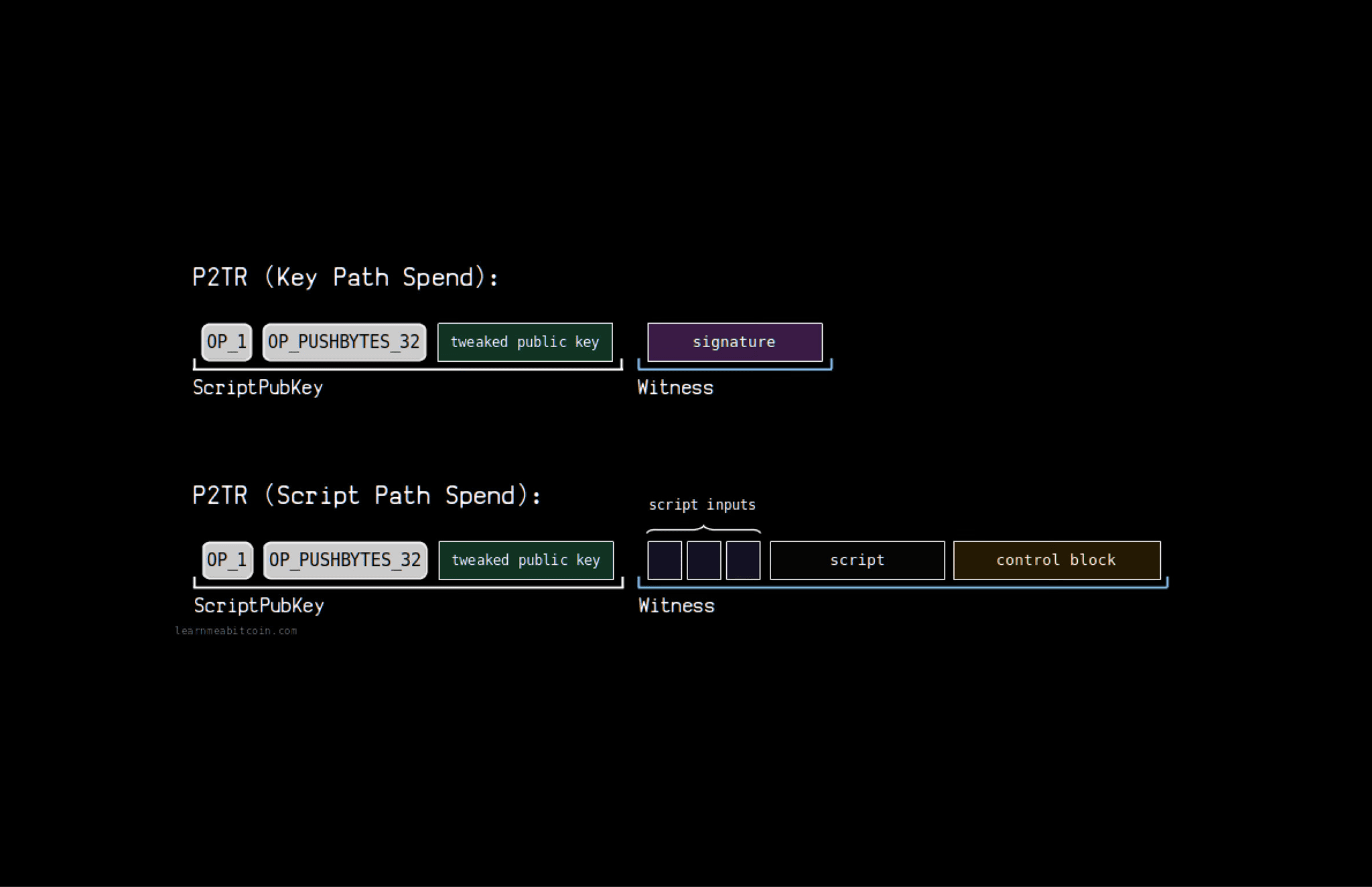
P2TR (Pay To Taproot) is a locking script that locks an output to a public key and multiple optional custom locking scripts* | Source: learnmeabitcoin
Schnorr Signatures in Plain Language
A major part of Taproot is the move to Schnorr signatures, which replace the older ECDSA signature scheme for Taproot transactions.
Schnorr signatures: A digital signature method that enables more compact and mathematically flexible constructions.
Key aggregation: Multiple participants can cooperate so that a multisignature wallet can appear similar to a normal single-signature spend, depending on how it is constructed.
Efficiency gains: Certain multisig setups can use less signature data, potentially reducing fees and validation work.
In simple terms, Schnorr allows multiple keys to coordinate in cleaner ways, which can improve privacy and efficiency under common usage patterns.
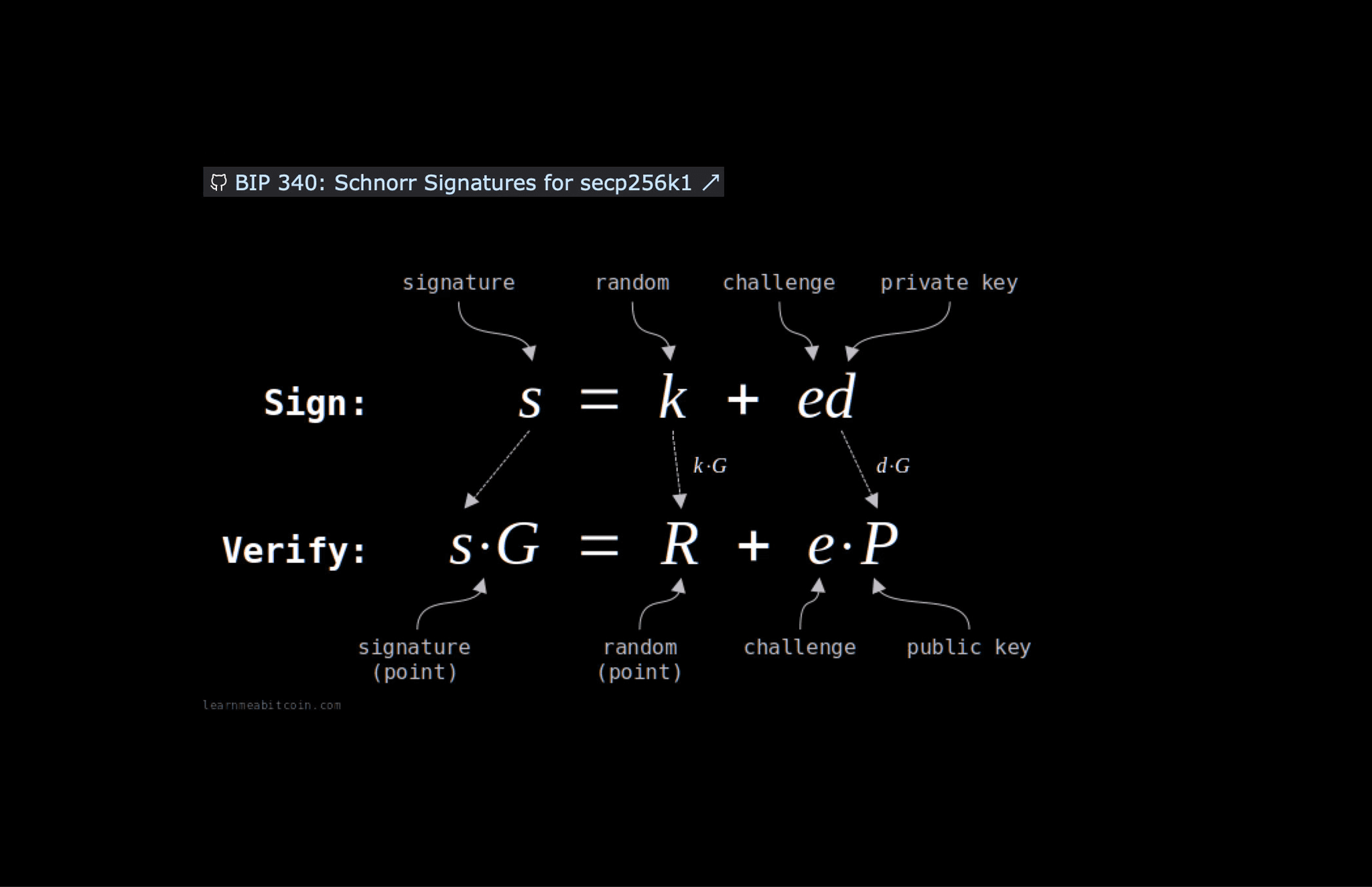
Schnorr signatures are a better than ECDSA for creating and verifying digital signatures | Source: learnmeabitcoin
Script Trees and Selective Disclosure
Taproot also changes how spending conditions are stored using a concept similar to a Merkle tree.
Script tree structure: Many possible spending rules can be committed to in advance, but only the branch actually used must be revealed.
Privacy benefit: Unused conditions remain hidden, meaning observers cannot automatically see backup or recovery paths.
Size benefit: Complex contracts avoid publishing every conditional branch when only one applies.
Before Taproot, sending Bitcoin with complex conditions was like mailing a transparent envelope, everyone could see all the rules written inside. Taproot lets you seal that envelope. If everything goes smoothly, it looks like a normal letter. Only if a specific condition is triggered does that branch need to be shown.
This selective disclosure improves efficiency without removing Bitcoin’s global transparency.
Why People Say Taproot Helps Bitcoin
Taproot is often described as foundational because it improves existing behavior while opening future design space.
Privacy: Certain complex transactions can appear indistinguishable from simple ones, improving user privacy in common scenarios.
Efficiency: Some constructions require less on-chain data than older equivalents, which may reduce fees in those cases.
Flexibility: More advanced spending policies become possible without forcing full contract logic to be visible. In practice, this means coins can carry layered conditions such as backup keys, time delays, or recovery paths, while ordinary cooperative use remains simple and minimally exposed on-chain.
Future building: Developers gain cleaner primitives for designing protocols and second-layer systems. This includes improvements to multisignature coordination, payment channels, and other layered constructions built on top of Bitcoin’s base layer.
These benefits depend on implementation and adoption, but the structural improvements are real.
Adoption and What Taproot Looks Like in Wallets
Since its activation in November 2021, Taproot adoption has expanded steadily, though integration across the ecosystem remains gradual.
Taproot addresses: Many modern wallets now support addresses beginning with “bc1p,” which indicate Pay-to-Taproot (P2TR) outputs.
Wallet support: Leading hardware and software wallets have implemented Taproot signing, though some advanced features are still being refined.
Exchange rollout: Exchanges and custody providers typically integrate protocol upgrades cautiously due to security audits, operational testing, and infrastructure adjustments.
Adoption pace: Bitcoin prioritizes stability, upgrades are adopted progressively rather than all at once.
Practical reality: Taproot’s privacy and efficiency benefits only materialize when users intentionally send and receive funds using Taproot-compatible addresses.
Network visibility: Even as support grows, a portion of transactions still use legacy formats, meaning Taproot’s full potential is realized incrementally.
Like many Bitcoin upgrades before it, activation occurred at the protocol level in a single moment, but real-world ecosystem integration unfolds over years rather than months.
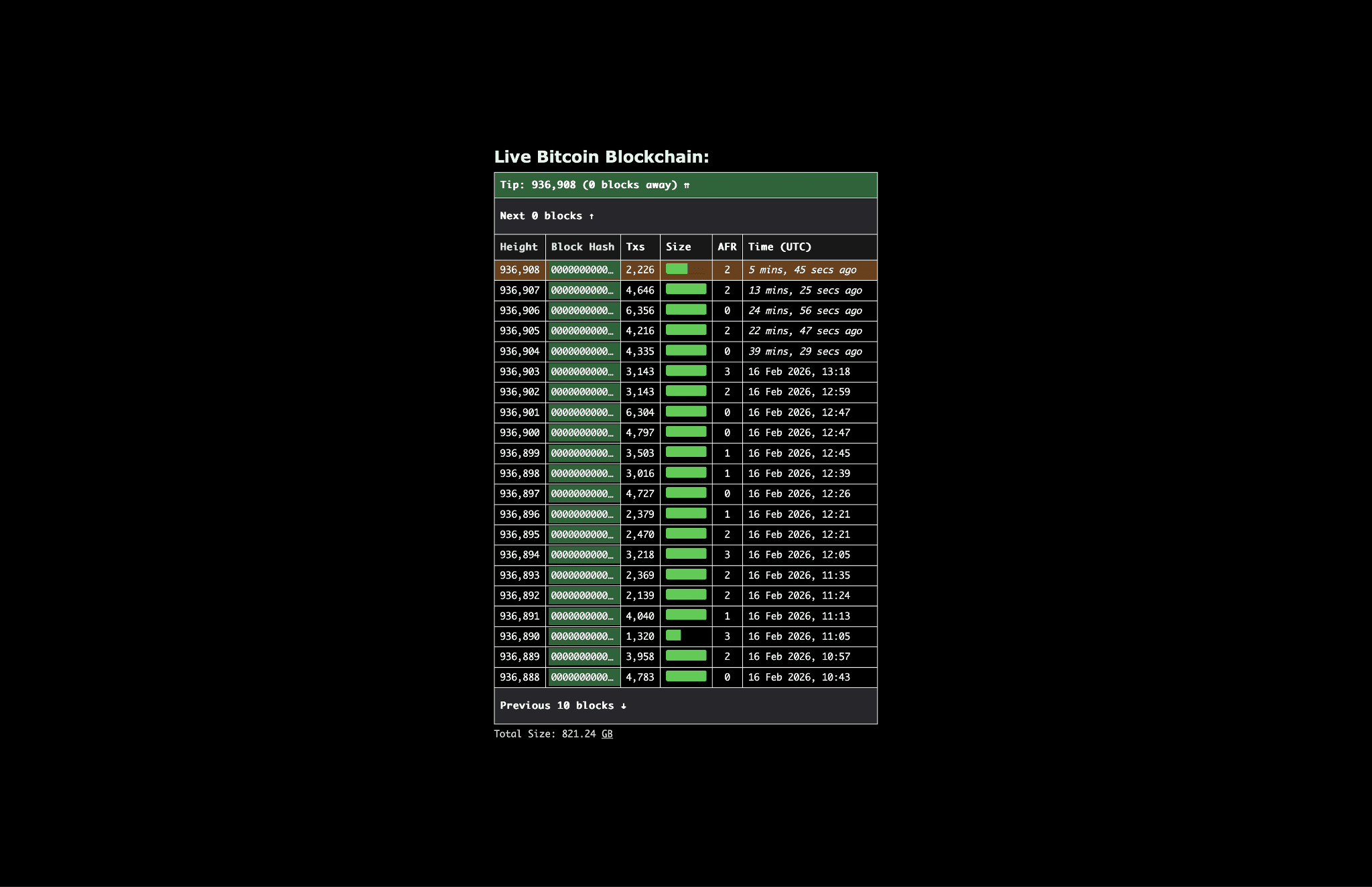
Live Bitcoin blockchain total size: 821 GB February 16, 2026 | Source: learnmeabitcoin
Taproot and the Data-on-Chain Debate
Taproot’s expanded scripting flexibility has coincided with new forms of on-chain usage that were not widely anticipated at activation.
While the upgrade was designed to improve privacy and contract efficiency, its structure also allows data to be included in certain transaction components.
Technical reality: Taproot’s script-path witness section can include arbitrary data, provided it fits within consensus and weight limits.
Inscriptions and artifacts: Some protocols use this mechanism to attach digital content or metadata directly to transactions, creating what are often described as on-chain artifacts.
Blockspace economics: These transactions compete in the same fee market as monetary transfers, meaning inclusion is determined by fee rate rather than transaction purpose.
Resource considerations: Although witness data does not increase the UTXO set directly, it contributes to total blockchain size and must be stored and validated by full nodes.
Fee pressure: Periods of high data-related demand can increase transaction fees, affecting users who rely on base-layer confirmation.
Philosophical divide: Supporters argue that fee-paying demand represents open participation in Bitcoin’s neutral blockspace market. Critics emphasize long-term node cost and decentralization as higher-order priorities.
Design separation: Taproot’s original objectives, improving privacy, enabling cleaner multisig patterns, and supporting flexible spending logic, are independent from how market participants ultimately choose to use blockspace.
The discussion therefore extends beyond Taproot itself. It touches on larger questions about Bitcoin’s role: whether the base layer should remain narrowly optimized for monetary settlement, or whether it can accommodate broader forms of data as long as consensus rules are respected and fees are paid.
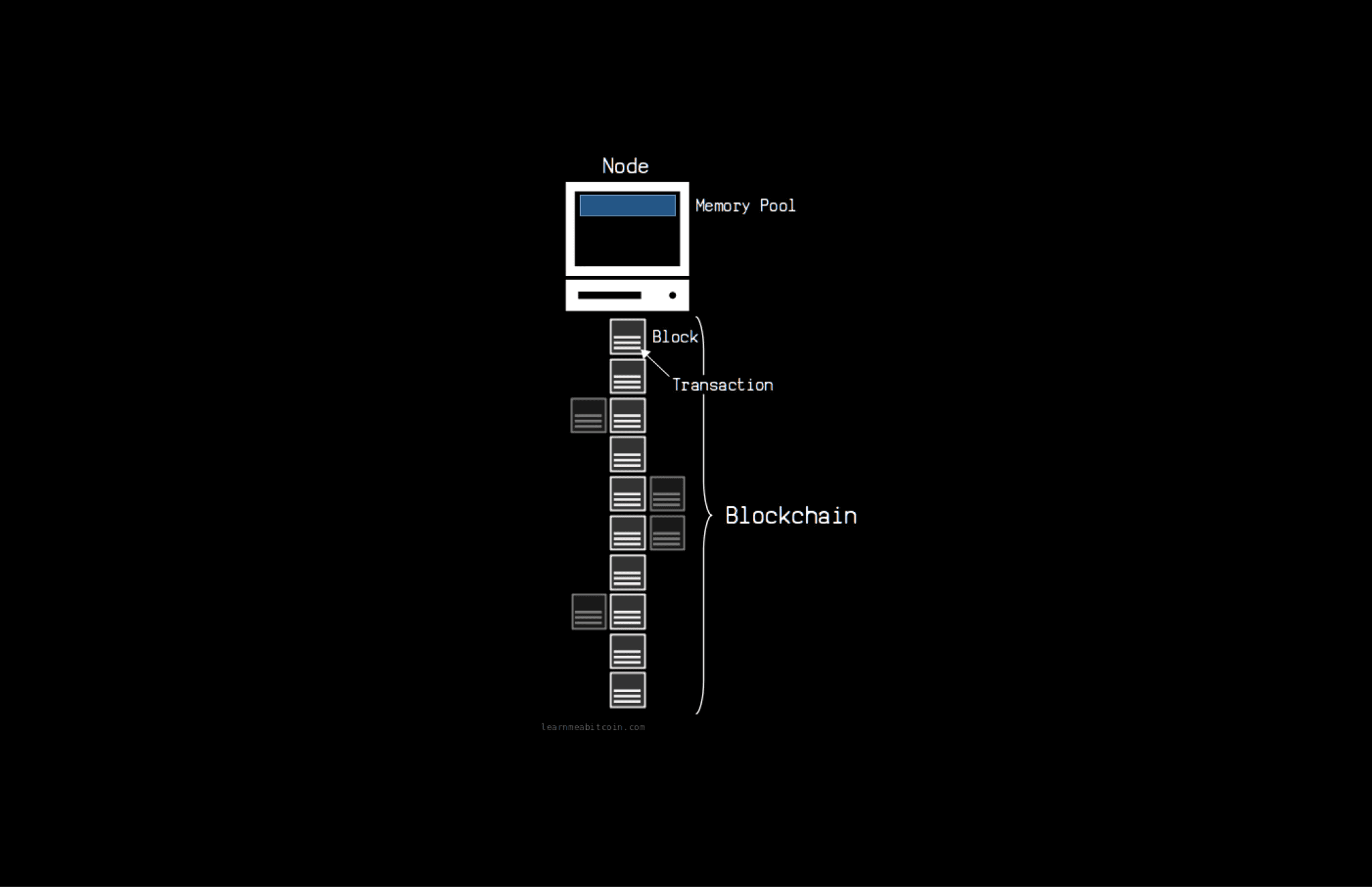
A node is a computer running the Bitcoin program | Source: Learnmeabitcoin
Some community proposals like BIP-110 have suggested tightening certain scripting behaviors in response to the above concerns, illustrating how governance discussions continue to evolve alongside technical upgrades.
History of Utility: Risks Versus Benefits
Taproot follows Bitcoin’s long-standing approach of careful, incremental upgrades. Rather than redefining the system, it extends capabilities in ways that can be adopted gradually. As with previous changes such as SegWit, the long-term effects are shaped less by the code itself and more by how the ecosystem chooses to apply it.
Benefits:
Multisig coordination: Custody providers and collaborative setups can streamline complex key arrangements while maintaining internal security rules.
Contract modularity: Developers can build layered policies, such as staged withdrawals or collaborative settlements, without embedding all logic directly into each transaction.
Reduced fingerprinting: Cooperative transactions can resemble simpler payments, making classification by external observers more difficult.
Risks:
Emergent behavior: Expanded capabilities can lead to secondary use cases that were not originally anticipated.
Fee volatility: Additional transaction demand can intensify fee fluctuations during periods of high network activity.
Infrastructure pressure: Over long horizons, rising storage or validation demands could increase hardware requirements for node operators.
Governance dimension: Protocol upgrades introduce new possibilities, and the community must continually assess boundaries and long-term effects.
Conclusion
Taproot is best understood as a toolbox upgrade. It adds P2TR, Schnorr signatures, and Tapscript so Bitcoin can support more private and efficient transactions when used thoughtfully, while also enabling advanced spending conditions. The ongoing discussion is not about whether Taproot functions correctly, but about how Bitcoin balances innovation, blockspace demand, and decentralization over time.
자주 묻는 질문
What is Taproot and what did it introduce to Bitcoin?
Taproot is a Bitcoin protocol upgrade activated on November 14, 2021. It introduced Pay-to-Taproot (P2TR), combining Schnorr signatures (BIP340), Taproot outputs (BIP341), and Tapscript (BIP342) to refine how transactions are structured, improve privacy, reduce transaction data in some cases, and support more advanced spending conditions.
How do key path and script path spends differ in Taproot?
Key path spends are the default, streamlined way to spend Taproot outputs and look like normal single-signature transactions on-chain. Script path spends are conditional spends that reveal only the specific script branch actually used, rather than all possible conditions attached to the coin.
What benefits do Schnorr signatures provide in Taproot transactions?
Schnorr signatures enable more compact and mathematically flexible constructions, allow key aggregation so multisignature wallets can appear similar to single-signature spends, and can reduce signature data in certain multisig setups, potentially lowering fees and validation work while improving privacy and efficiency under common usage patterns.
How has Taproot influenced the data-on-chain debate in Bitcoin?
Taproot’s expanded scripting flexibility allows arbitrary data in the script-path witness section within consensus and weight limits, enabling inscriptions and on-chain artifacts that compete for blockspace via fees. This raises considerations about blockchain size, node resource requirements, fee pressure, and a philosophical divide over whether Bitcoin’s base layer should focus narrowly on monetary settlement or also accommodate broader data uses.
면책 조항
이 글에 제공된 정보는 정보 제공을 위한 것입니다. 이는 금융 자문으로 간주되어서는 안 되며, 금융 자문을 의미하지 않습니다. 우리는 이 정보의 완전성, 신뢰성, 정확성에 대해 어떠한 보증도 하지 않습니다. 모든 투자는 위험을 수반하며 과거의 실적이 미래의 결과를 보장하지 않습니다. 투자 결정을 내리기 전에 금융 자문가와 상담할 것을 권장합니다.