










빠른 요약
Home Bitcoin mining remains viable in 2026 for miners who have matched electricity cost to the right model
Two models exist: high-power ASIC setups running in pools, and low-power Bitaxe devices pointed at solo mining
Solo mining carries long odds but documented block wins worth $200,000+ at under $5 per month in running costs
Pool mining profitability requires electricity below $0.06/kWh, current-generation hardware, and an 18-month minimum ROI horizon
Most home Bitcoin miners in 2026 are asking the same question: is there still a point? The answer is yes but only for miners who have matched their electricity cost to the right model.
The April 2024 halving cut block rewards from 6.25 BTC to 3.125 BTC, network hashrate keeps climbing, and electricity costs have pushed casual mining into loss territory across most regions. As industrial miners pivot toward hybrid AI data center models, two distinct profitability models have emerged for the individual at home. Both work. Both have documented wins. Both require a completely different evaluation framework.
Two Bitcoin Mining Models, Two Different Payoffs
Before buying any hardware, the decision that determines everything else: which of these two models fits the setup and the electricity rate.
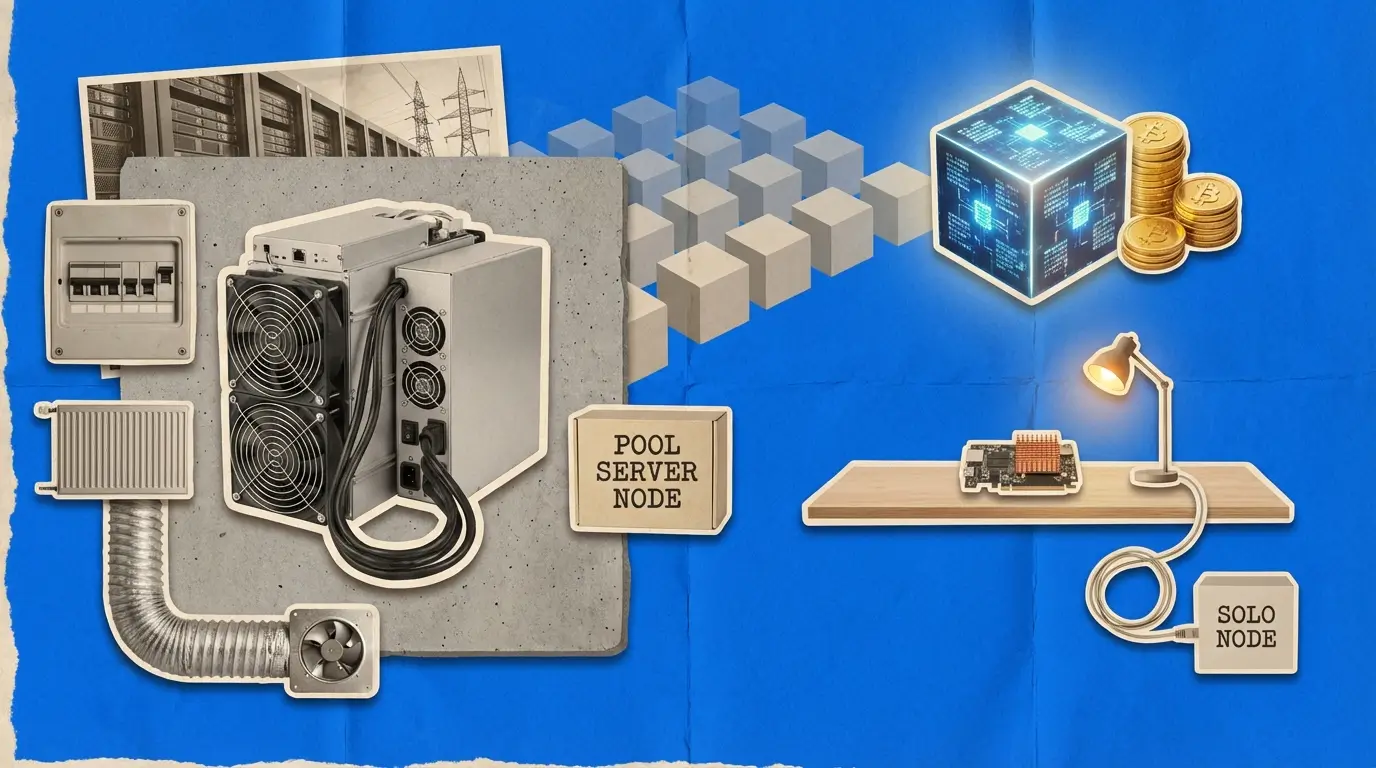
The first model: traditional ASIC setups running in pools. Hardware at this level draws 3,000+ watts continuously, generates significant heat and fan noise, and requires dedicated space. A garage, basement, or separate structure with ventilation and a 240V dedicated circuit. Setup involves electrical infrastructure work, ongoing hardware monitoring, and active management of temperature and power load. Profitability lives or dies on electricity cost, hardware generation, and Bitcoin's price moving in the right direction at the right time.
The second model: solo mining on low-power devices. The Bitaxe, an open-source hardware drawing 5–15 watts, silent enough for a desk has become the flagship. Daily earnings sit near zero. The payoff is a real shot at one complete block reward: 3.125 BTC plus transaction fees. At current Bitcoin prices that represents a life-changing single payout from hardware costing under $200.
Solo Mining: Documented Block Wins by Home Miners
Critics dismiss solo mining on probability alone. The math confirms the odds are longshot to win the Bitcoin coinbase reward, but documented wins have accumulated steadily enough to make the model worth understanding.
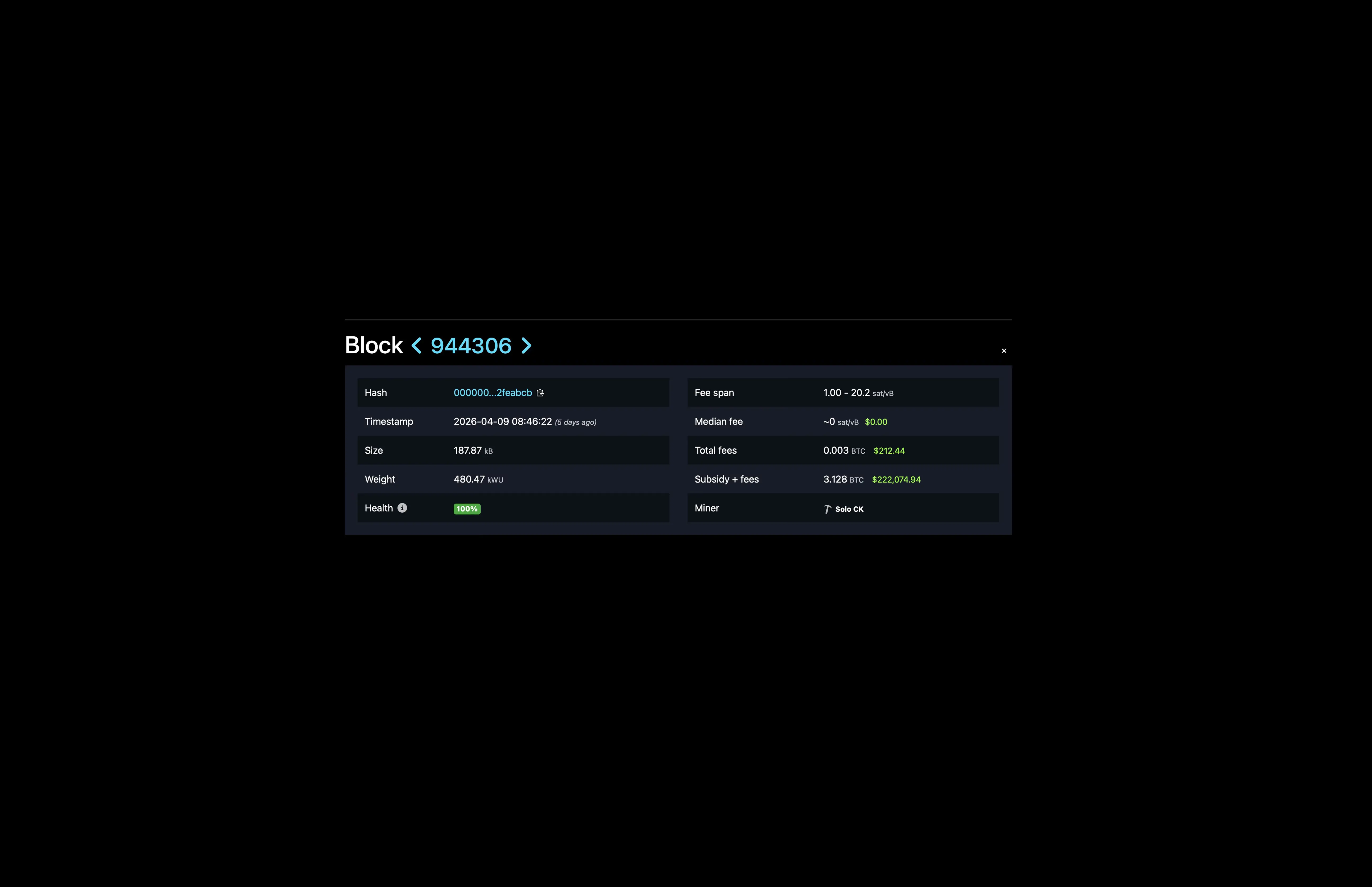
April 2026 two solo wins in seven days: On April 9, 2026, a solo miner running just 70 TH/s found a Bitcoin block through CKPool and collected 3.125 BTC approximately $225,000. CKPool developer Dr-ck confirmed the miner held a one in 100,000 daily probability of finding a block, statistically equivalent to once every 300 years. Seven days earlier, a separate solo miner collected $210,000 under identical conditions. Back-to-back wins inside a single week. The 313th and 314th solo blocks have been found via CKPool since the service launched
July 2024 Bitaxe Supra, block 853,742: A single Bitaxe Supra running 500 GH/s found a Bitcoin block through Solo CKPool, earning 3.15 BTC worth approximately $200,000. A device drawing less power than a desk lamp, costing under $200, beat every industrial miner on the network to that block
March 2025 six-unit Bitaxe cluster, block 887,212: A home miner running six Bitaxe units with a combined 3.3 TH/s found a block through Solo CKPool worth approximately $250,000. CKPool's Con Kolivas confirmed the daily odds were below 1 in a million — statistically a 3,500-year wait.
The Probability Model Behind Every Bitcoin Solo Miner Win
CK Solo Pool publishes real-time luck statistics. Miners running for months without finds show "unlucky" status; early block finders show "lucky." Both extremes appear regularly in the data, confirming the probability model produces real outliers.
Calculating odds before allocating hashrate is healthy practice.
Solo Chance lets miners enter their hashrate and see daily probability and expected time to block across all mineable SHA-256 coins — Bitcoin, Bitcoin Cash, and others side by side. Poolbay lists every mineable coin with live market cap and 24-hour trading volume, filtering out coins with no exchange liquidity before any hashrate gets committed. Together: know the odds, know the exit.
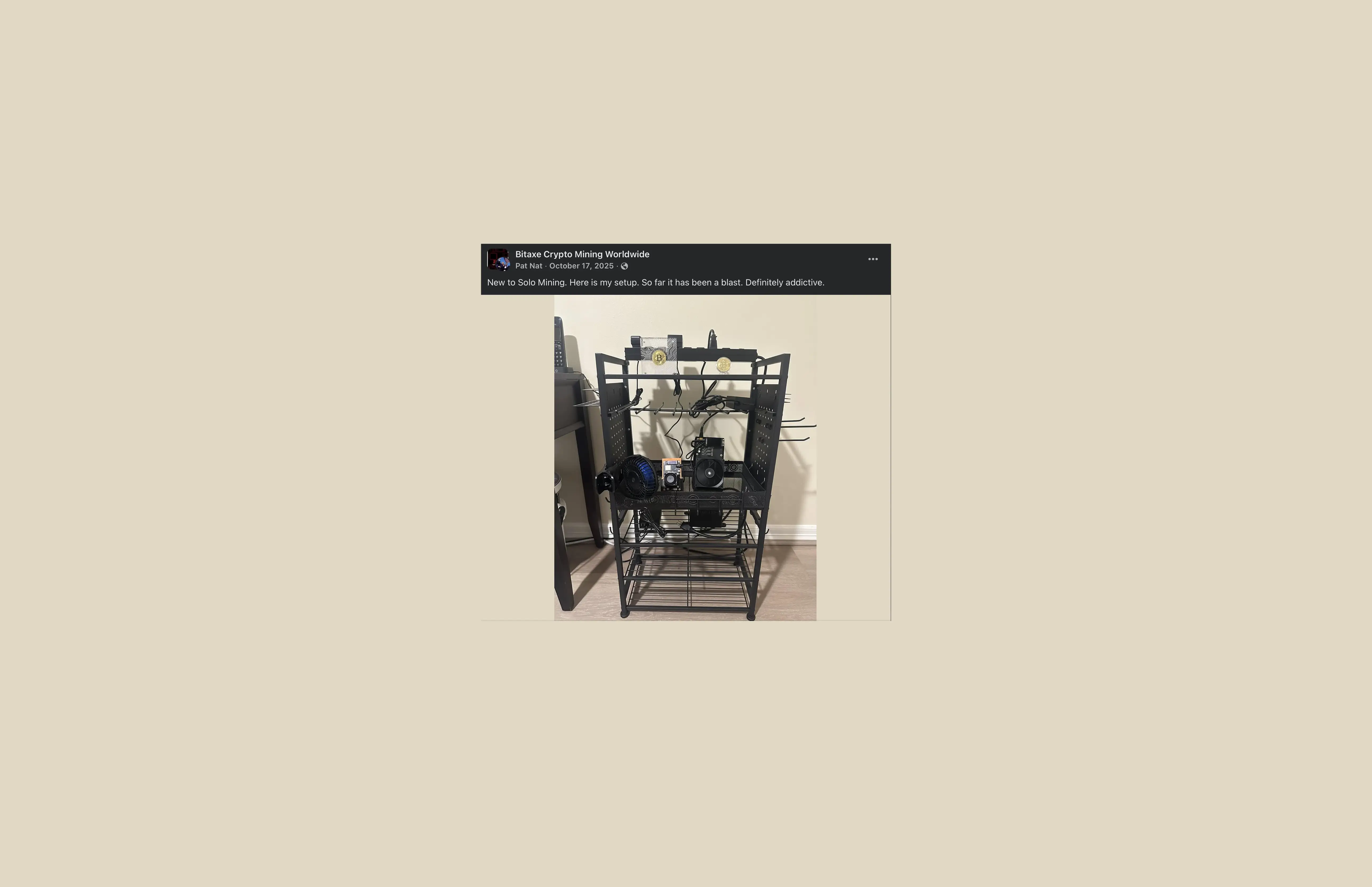
A Bitaxe at 500 GH/s contributes 0.0000001% of current network hashrate.
Solo mining in 2026 is a deliberate low-cost position, not a profitability strategy:
Odds: A single Bitaxe at 500 GH/s carries an expected time to block measured in thousands of years — scaling to ten units compresses that expectation into the multi-century range, still long, but the cost of staying in the game remains negligible
Prize: A block reward at current Bitcoin prices pays approximately $225,000 in a single payout
Cost: Electricity runs under $5 per month per unit — the position stays open indefinitely for near-zero ongoing cost
Pool Mining Profitability: The Actual Numbers
Profitability in pool mining runs on two inputs: electricity cost and hardware efficiency.
Cheap power paired with inefficient hardware still runs at a loss. Efficient hardware on expensive power bleeds fast also. Both variables have to land in the right range simultaneously, one without the other does not produce profit.
Bitcoin Mining Electricity Cost: A Deciding Variable
Electricity rates vary significantly by region and even by provider within the same country. This means checking your local rate against these thresholds before buying hardware is the first calculation that matters. Some figures to work with include:
Profitable floor: $0.05 per kWh or below generates workable margins on current-generation hardware
Breakeven band: $0.07–$0.08 per kWh is where most home setups stop making money
Viable regions in 2026: Texas, Washington, parts of Canada, and select Central Asian regions sit inside the profitable band. Western Europe at $0.25+ per kWh is outside it for nearly every home configuration
Current Hardware Benchmark for Bitcoin Home Pool Mining:
Antminer S21 XP air-cooled home standard: 270 TH/s at 13.5 J/TH. The most efficient air-cooled Bitcoin miner commercially available in 2026 for home-compatible pool mining
Whatsminer M60S alternative manufacturer: 186 TH/s at 18.5 J/TH with an integrated PSU — one less component to buy, cable, and troubleshoot
Antminer S23 Hyd industrial ceiling: 580 TH/s at 9.5 J/TH, liquid-cooled, data-center grade. Not home-deployable included to show the efficiency gap home air-cooled hardware is competing against at network level.
ROI reality in 2026
Timeline: 18 months to 3 years under favorable conditions with electricity below $0.06/kWh, current-generation hardware and Bitcoin price holding
Depreciation pressure: New ASIC generations arrive fast enough that resale values on current hardware drop meaningfully within 12–18 months of purchase — a cost most home miner calculators underweight.
Bitcoin Energy Strategy: Three Ways to Lower the Mining Cost Floor
Energy costs are not always fixed. Three strategies home miners use to lower the effective rate without moving to a cheaper region:
Time-of-use tariffs: off-peak scheduling through programmable controllers or firmware can reduce effective electricity costs by 30–50% in regions where utility providers charge less during low-demand hours
Solar integration: miners with existing photovoltaic installations can run Bitaxe units or a single ASIC on surplus daytime generation with no added grid draw, battery storage extends that window into nighttime hours
Heat reuse: ASICs convert virtually all electrical draw into heat. Ducting that output into living spaces offsets residential heating costs in cold climates, improving total mining economics without touching the electricity rate
Pools Worth Using
For pool mining, Foundry USA and F2Pool hold the largest global hashrate shares with proven payout reliability. ViaBTC and Braiins Pool offer solid mid-tier alternatives. Braiins Pool has adopted Stratum V2, returning transaction selection control from the pool to the individual miner.
For solo mining, CK Solo Pool takes a 2% service fee with the remaining 98% paid directly to the miner's wallet. It publishes transparent luck statistics and has a verified track record of small miner block finds going back to 2014.
Conclusion
Home Bitcoin mining in 2026 is profitable under specific, measurable conditions: electricity below $0.06/kWh, current-generation hardware below 15 J/TH, and the patience to run an 18-month minimum ROI horizon on pool mining.
Solo mining on a Bitaxe operates on a different logic entirely near-zero ongoing cost, a real shot at a full block reward, and direct participation in Bitcoin network decentralization.
Both models reward the same thing: miners who understood the math before the hardware arrived.
For Bitcoin market cycle analysis, mining profitability research, and investment frameworks, visit Coinjuice.com.
자주 묻는 질문
What are the two main home Bitcoin mining models in 2026 and how do they differ?
The first model is traditional ASIC pool mining, using 3,000+ watt hardware that needs dedicated space, ventilation, a 240V circuit, and active management of heat and power. Profitability depends on cheap electricity, current-generation hardware, and favorable Bitcoin price movement. The second model is solo mining on low-power devices like the Bitaxe, which draw 5–15 watts, are quiet and inexpensive, earn near-zero daily income, but offer a real chance at a full 3.125 BTC block reward plus fees.
Under what conditions can home pool mining still be profitable in 2026?
Home pool mining can be profitable when electricity costs are below about $0.06 per kWh, current-generation hardware efficiency is below 15 J/TH, and the miner is prepared for an ROI timeline of 18 months to 3 years. Profitability requires both low electricity rates and efficient hardware at the same time.
Why do some home miners choose solo mining with Bitaxe devices despite the low odds?
Solo mining with Bitaxe is a low-cost position rather than a steady profitability strategy. A single Bitaxe at 500 GH/s has an expected time to find a block measured in thousands of years, but electricity costs are under $5 per month per unit, so the miner can stay in the game indefinitely. The potential prize is about $225,000 for a single block reward at current prices, from hardware costing under $200.
What strategies can home miners use to lower their effective electricity costs?
Home miners can use time-of-use tariffs by running miners during off-peak hours with programmable controllers or firmware, potentially cutting effective rates by 30–50% where such tariffs exist. They can integrate solar by using surplus photovoltaic generation, optionally extended with batteries, and they can reuse ASIC heat by ducting it into living spaces in cold climates to offset residential heating costs.
면책 조항
이 글에 제공된 정보는 정보 제공을 위한 것입니다. 이는 금융 자문으로 간주되어서는 안 되며, 금융 자문을 의미하지 않습니다. 우리는 이 정보의 완전성, 신뢰성, 정확성에 대해 어떠한 보증도 하지 않습니다. 모든 투자는 위험을 수반하며 과거의 실적이 미래의 결과를 보장하지 않습니다. 투자 결정을 내리기 전에 금융 자문가와 상담할 것을 권장합니다.